
Red Light Therapy
October 17, 2026
Red light therapy for muscle recovery: soreness, strength and real performance
On this page
The day after a hard workout can make recovery feel very simple. Your thighs hurt on the stairs, your usual weights feel heavier, and you would like something that helps you feel ready again. Red light therapy is appealing because it promises help without another exercise session, another supplement or a cold bath.
The research is more interesting than a simple yes or no. Some controlled studies of light applied directly over working muscles have reported better recovery of force or changes in blood markers. Other trials have found no useful difference, particularly when the question changes from a local treatment to a whole-body device. Even within one experiment, soreness, jumping ability and a muscle enzyme can tell different stories.
As of October 17, 2026, photobiomodulation is a plausible but inconsistently supported recovery adjunct. The evidence does not establish that an arbitrary home panel speeds muscle repair or makes an athlete ready to train again. The most useful way to read a claim is to ask what recovered, in whom, after which exercise, with which device.
This article focuses on recovery after exercise. Improving performance before fatigue occurs is a related question, but a faster first sprint does not automatically demonstrate better recovery tomorrow. Likewise, feeling less sore is worthwhile if it matters to you, but it is not a test of whether a strained muscle has healed.
What researchers mean by red light therapy
In this literature, the more precise term is photobiomodulation, often shortened to PBM or PBMT. Investigators use red or near-infrared light from LEDs, low-level lasers, or a cluster combining several light sources. The intended action is a biological response to light rather than tissue destruction or a large heating effect.
That description matters because the commercial category is much broader. A red room, an infrared sauna, a high-power therapeutic laser and a handheld research probe can all be described casually as light treatment. They do not deliver the same exposure. Some studies also combine light with a static magnetic field. A benefit from that combination cannot be assigned confidently to light alone.
A particularly revealing randomized study compared three commercial light devices in 40 untrained men. The investigators measured voluntary force, soreness and creatine kinase after eccentric exercise. Its design directly addressed whether devices with different power and delivery characteristics should be assumed interchangeable. It is a useful warning against treating a shared wavelength or a shared total energy number as a complete description of treatment. Original device-comparison trial
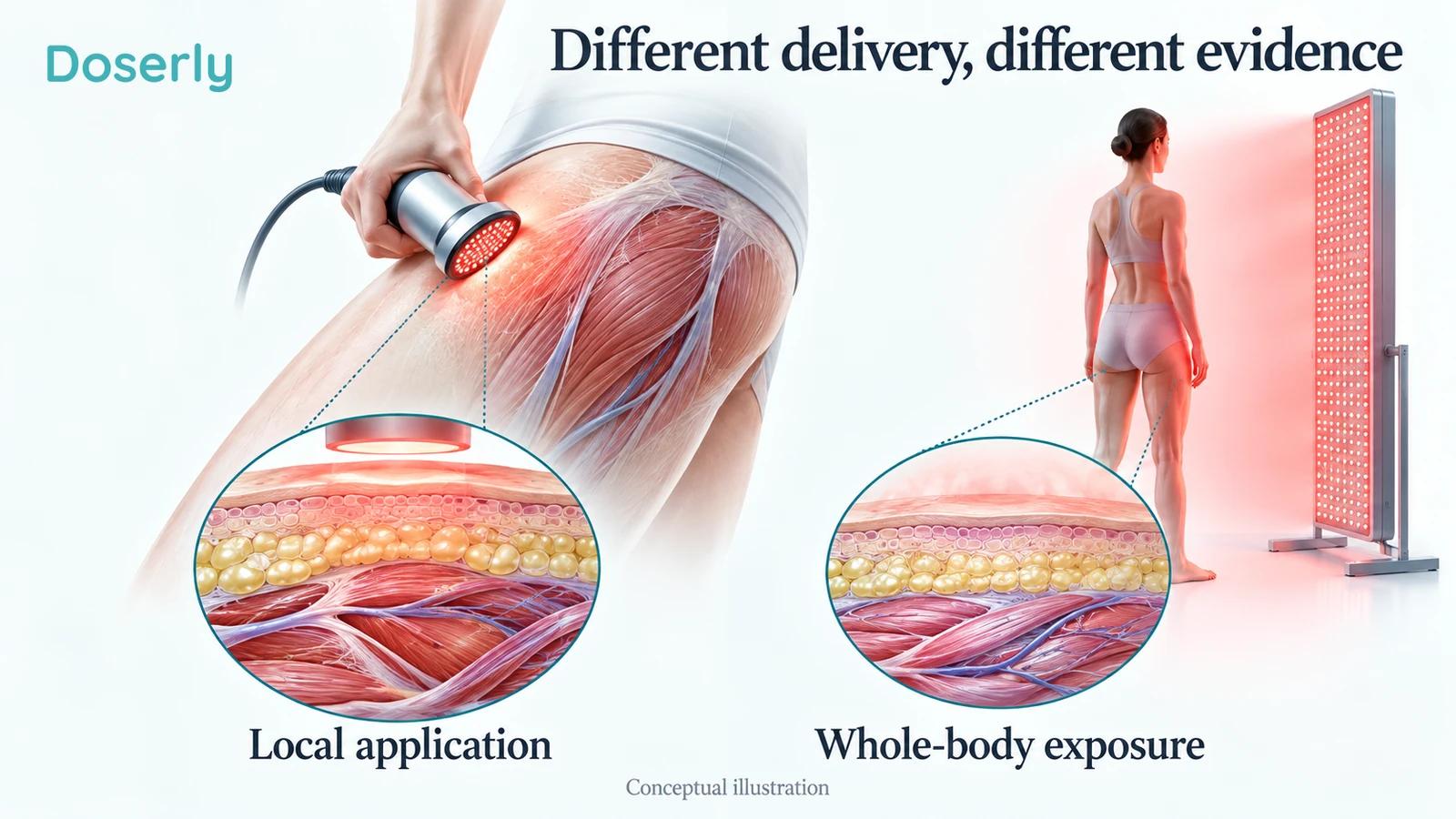
For a reader, the practical consequence is straightforward: when someone says a device is backed by research, ask whether the research used that device in that way. A citation about a probe held against the quadriceps provides limited guidance about standing several feet from a panel. Neither a larger illuminated area nor a brighter glow establishes a better muscle treatment.
Soreness, damage markers and strength answer different questions
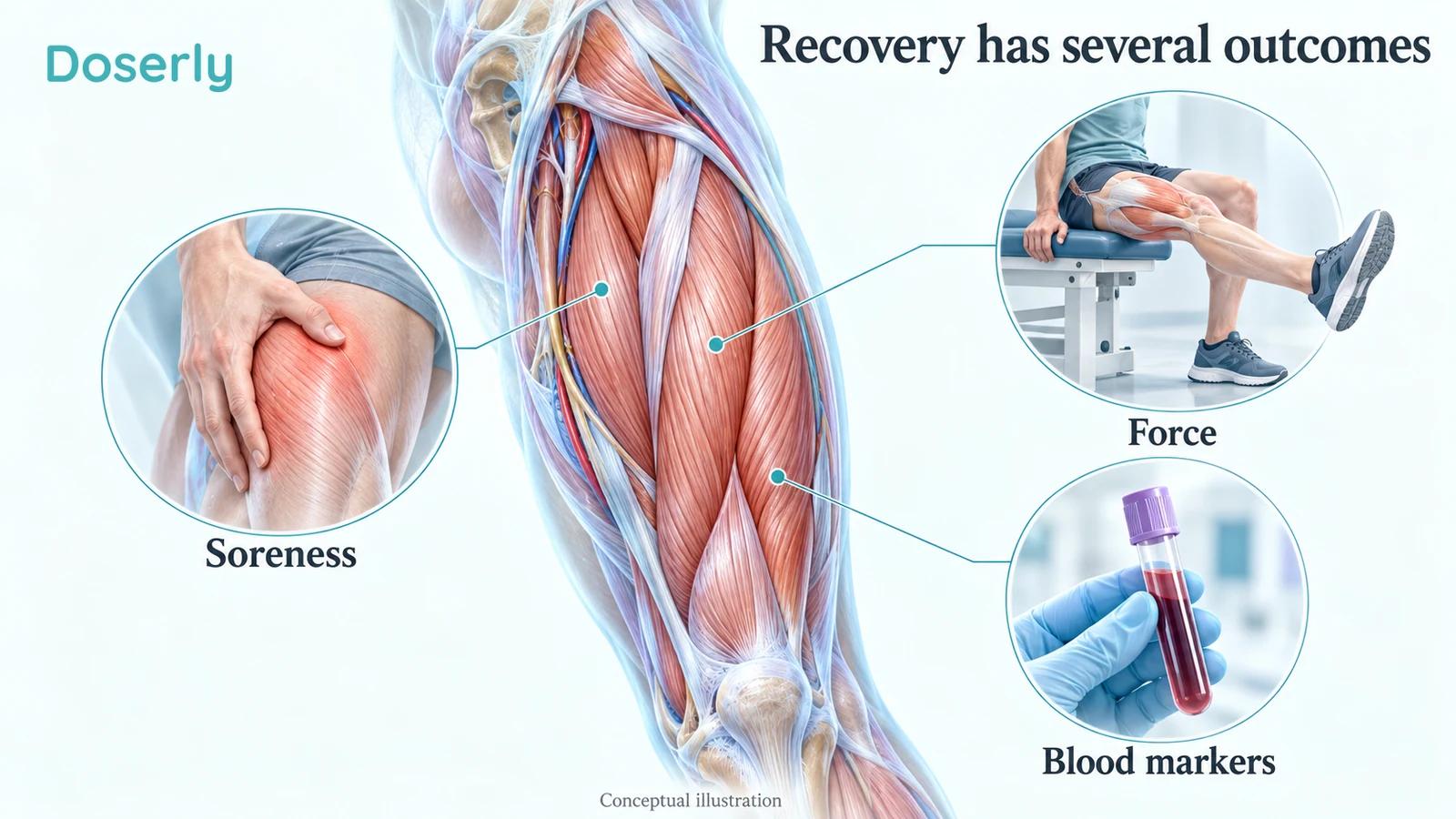
Delayed-onset muscle soreness describes the aching and tenderness that can follow unfamiliar or demanding activity. A soreness rating is a real outcome, but it records a person's experience. It does not measure how much force the muscle can produce, and it does not provide a microscopic picture of the tissue.
Creatine kinase, usually abbreviated CK, is an enzyme researchers often measure in blood after strenuous exercise. The measurement can help describe the response to a damaging exercise bout. It is not a direct count of torn fibers. It also should not be confused with creatine, the dietary supplement; the similar names can make the two sound like interchangeable recovery measures.
Force and performance tests ask a different question: what can the person do? A maximal voluntary contraction measures force or torque under standardized conditions. A jump test captures an integrated movement that also depends on coordination and technique. A repeated-sprint test adds pacing and fatigue resistance. None is a complete replacement for the others.
This separation is visible in a plyometric-exercise trial published in its journal issue in 2022, after an earlier online publication. Red or near-infrared LED treatment produced selected differences in CK and squat-jump outcomes, but the groups did not differ in soreness or countermovement jump after the first bout. When participants repeated the exercise two weeks later without treatment, there was no treatment effect. That is a mixed outcome pattern, not evidence that every part of recovery improved. Plyometric exercise and repeated-bout trial
Imagine two athletes with the same soreness score. One can perform their normal controlled movement comfortably; the other has marked weakness and altered technique. Their next training decisions need not be the same. A light treatment that changes the score would not erase that difference. This is why useful recovery tracking starts with the activity you need to return to, rather than with whichever marker makes a product look strongest.
Why local muscle studies attracted attention
Early recovery studies often used deliberately demanding laboratory exercise, followed by closely timed measurements. That approach makes a small experiment manageable: investigators know which muscle was challenged, when the challenge occurred and where the light was applied. It is less like a normal training week, where sleep, nutrition, travel and the previous session all vary.
One randomized placebo-controlled study assigned 40 volunteers to PBM, cryotherapy, their combinations or placebo. After the fatigue protocol, the light-containing groups showed better recovery of maximal voluntary contraction than placebo or cryotherapy alone, with differences in CK as well. This supports studying local light as a recovery intervention. It does not establish a universal advantage over every form of cooling, or tell us how a home panel compares with the study treatment. PBM and cryotherapy recovery trial
A different placebo-controlled crossover study recruited 12 high-level male rugby players. A multiwavelength cluster was applied at specified sites before a sprint field test. Average sprint time, fatigue index, lactate changes and perceived fatigue favored the active treatment. The investigators included a device-manufacturer affiliation. The findings are encouraging for that narrow setting, while the small sample and immediate field-test outcomes leave longer recovery and independent replication unresolved. Rugby field-test trial
These trials help explain why athletes and clinicians remain interested. They are human experiments with comparison conditions, not simply photographs of a glowing muscle or laboratory cells exposed to light. The difficulty is deciding how far the positive findings travel. A treatment can show a signal in a tightly controlled experiment without making a reliable difference across sports, sexes, ages and devices.
For recreational athletes, the everyday question is often less dramatic than the marketing: will this make tomorrow's planned session easier to complete without changing technique or accumulating fatigue? Many studies do not directly answer that question. They examine one exercise bout and a short series of tests, rather than weeks of successfully completed training.
Newer findings keep the picture mixed
A 2024 crossover study of 18 rugby athletes tested light before exercise, during the interval and after exercise, alongside a no-light condition. The researchers did not find differences in CK, lactate or the functional test outcomes between groups and times. There were selected exercise-test improvements associated with particular timing conditions. The authors' recovery and performance findings should therefore be read separately; the study did not demonstrate a general improvement in muscle-damage markers. Timing study in rugby athletes
The 2025 journal publication of a trial in 15 female futsal athletes adds an important counterexample. It compared placebo with three LED energy conditions in a randomized crossover design. None improved the measured endurance, power, strength or perceived-exertion outcomes. Although this was primarily an acute performance experiment, it challenges the assumption that a suitable-looking light exposure reliably improves muscular function in trained athletes. Female futsal dose-response trial
In May 2026, a small CrossFit crossover trial compared four post-workout recovery strategies in 12 athletes. Its primary outcome, countermovement-jump height at one hour, did not differ significantly between interventions. PBM combined with a static magnetic field produced favorable secondary findings at later time points, including jump height compared with passive recovery. The study disclosed manufacturer research support for an author. The fair reading is a null primary comparison with interesting secondary signals, requiring confirmation rather than a blanket claim of superior recovery. 2026 CrossFit trial
A June 2026 trial studied 45 physically active men receiving placebo, red LED PBM, osteopathic manipulation or their combination before an exercise-induced muscle-damage protocol. The combined group showed a different CK recovery pattern. Crucially, the authors described strength recovery as a nonsignificant, exploratory trend. That wording rules out presenting the study as proof that light restored strength, and the combination design complicates attributing any signal to PBM alone. 2026 PBM and manipulation trial
The newer evidence is not uniformly negative or uniformly positive. It is a collection of specific comparisons. Preserving that detail is more useful than counting how many papers contain an encouraging conclusion.
Why a whole-body bed is a separate research question
Whole-body light treatment is convenient. It seems reasonable that exposing more muscle should produce more recovery. But convenience and biological effectiveness are separate questions. A local probe and a bed distribute light differently, and the amount arriving at a target muscle is not determined by the device's advertised total power alone.
A randomized crossover study in 12 trained men tested whole-body light-bed treatment before and after a high-intensity session involving resistance exercise and repeated sprints. It found no statistically significant benefit for the measured CK response or salivary interleukin-6 response. The result does not prove every whole-body treatment is ineffective, but it directly contradicts assuming that positive local-device findings automatically transfer to a light bed. Whole-body light-bed trial
The consumer implication is not to search for a bigger device until a positive result appears. It is to ask for evidence that matches the proposed use. Coverage, distance, contact, wavelengths, treatment duration and the muscle being studied all belong in that comparison. A specification sheet is helpful for identifying differences, but cannot by itself predict the clinical consequence of those differences.
What would make a recovery result useful to you?
Consider a runner who wants to complete an easy session two days after a race. A laboratory change in knee-extension torque may be relevant, but it does not tell the whole story about that run. The runner also needs tolerable symptoms, normal movement and a sensible plan for the overall training load. A study that only reports a blood sample cannot establish those things.
Now consider a strength athlete with two closely spaced competition sessions. A small, reliable difference in a specific force measure could matter more to them than it would to someone training casually three times a week. The same result can therefore have different practical value without either person misunderstanding the science. The important connection is between the measured outcome and the decision the person actually faces.
There is no single percentage improvement that makes every recovery product worthwhile. Baseline discomfort, the reliability of the measurement, the time required and the cost all affect the decision. An expensive intervention with a barely perceptible benefit may be a poor fit even if a study identifies a statistically significant average difference. Conversely, symptom relief that matters to someone should be acknowledged without relabeling it tissue repair.
Ask about the size and consistency of a benefit rather than only whether a paper reported a small p value. Were most participants helped, or was the average influenced by a few large responses? Was the test repeated under similar conditions? Did the benefit remain at the next relevant training session? When an abstract does not provide those answers, it is appropriate to leave them unresolved.
The choice of comparison matters too. Improvement compared with doing nothing does not show superiority to another credible recovery routine. An unblinded comparison can also incorporate expectations about a new treatment. A sham-controlled result is more informative about the specific intervention, provided participants could not readily tell which condition they received. These are practical reasons to look for replication rather than treating one memorable experiment as a final answer.
Before exercise or afterward?
Recovery marketing often assumes treatment belongs after a workout. Many positive PBM experiments instead treated muscles before exercise, attempting to alter the response to the upcoming load. Those are different strategies. Prevention of a decline in force is not necessarily the same process as restoring force after the decline has occurred.
A 2020 randomized, triple-blinded trial assigned 60 untrained men to several timing conditions for PBM combined with a static magnetic field, placebo or a no-treatment control. The primary measure was peak torque, with CK and soreness as secondary outcomes. Several pre-exercise timing conditions favored active treatment, but each group was small and the combined intervention was specific. Manufacturer research support was disclosed. Its timing findings should not be converted into a schedule for an unrelated home device. Pre-exercise timing trial
If a clinic suggests an approach, the useful question is how its timing relates to the study it cites. Was treatment given before the exercise, immediately afterward or repeatedly during recovery? Was the light aimed at the muscles actually used? Was there a benefit at the time that matters for your next session? These questions are more informative than asking whether morning or evening is universally best.
There is also a practical tradeoff. An elaborate recovery routine can become another demand on a crowded training day. If it delays eating, sleep or a necessary rehabilitation appointment, its opportunity cost matters even when the device itself causes no obvious problem. Recovery should make a sustainable routine easier, not turn every workout into a sequence of compulsory gadgets.
The mitochondrial explanation needs human testing
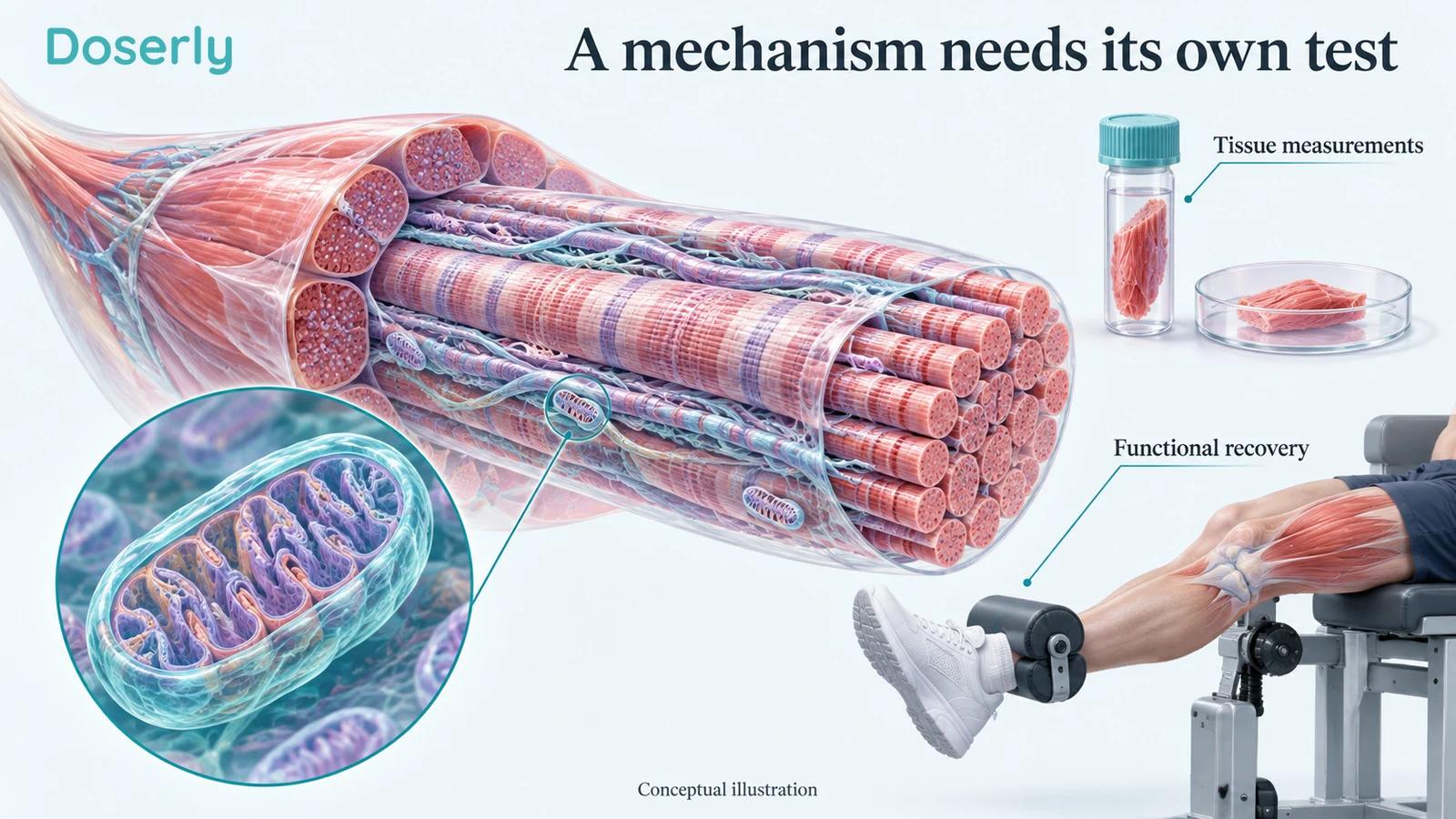
A common explanation is that light improves mitochondrial function, allowing muscle cells to produce energy and recover more effectively. It is a reasonable research hypothesis, but it should not be described as a proven response in every human muscle exposed to red light.
An August 2026 human investigation compared PBM with sham treatment in opposite legs of 12 healthy adults. Under that protocol, mitochondrial respiration measured in sampled skin and muscle did not increase. Skin temperature rose substantially, an important exposure detail. This was a single-session mechanistic experiment, not a recovery trial, and its thermal response limits extrapolation to nonthermal protocols. Nevertheless, it challenges the casual promise that one light session necessarily boosts mitochondrial energy production. Original 2026 mitochondrial investigation
A biological explanation is most helpful when it generates a testable prediction. If a proposed pathway improves recovery, we still want to see an appropriate comparison in people and an outcome that matters. A change in an antioxidant marker would not by itself show that someone can complete more useful training. Conversely, a reproducible functional benefit would deserve attention even if the exact mechanism remained unsettled.
Does reducing the response to exercise undermine adaptation?
Athletes reasonably ask whether dampening soreness or a biochemical response might interfere with training adaptations. The short recovery studies cannot resolve every version of that question. Looking better at 48 hours and becoming stronger after months of training are different outcomes.
The repeated-bout experiment discussed earlier did not find evidence that the tested LED treatment impaired the protective response to the later exercise bout. That narrow observation is reassuring within its design. It does not establish that all wavelengths, doses and repeated treatment schedules preserve every long-term adaptation. Nor does it show that a lower CK value is a goal athletes should pursue after every workout.
It helps to distinguish a competition week from a training block. During closely spaced events, restoring usable performance quickly may be the priority. During progressive training, the objective includes developing capacity over time. A recovery intervention should be judged against the purpose of that phase, rather than assumed valuable because it makes a short-term marker smaller.
For someone considering a recurring expense, ask whether the evidence concerns a single bout or repeated training. Ask whether strength, training completion or sport performance was followed long enough to matter. If only a short biochemical window was studied, the answer about long-term adaptation remains open.
What sensible personal tracking looks like
You do not need to turn yourself into a laboratory experiment to notice whether a recovery routine is useful. Start by defining the problem in ordinary language. Perhaps stairs are unusually uncomfortable after a familiar session, or your next planned session repeatedly needs to be shortened. A clear goal is easier to evaluate than a general desire to optimize recovery.
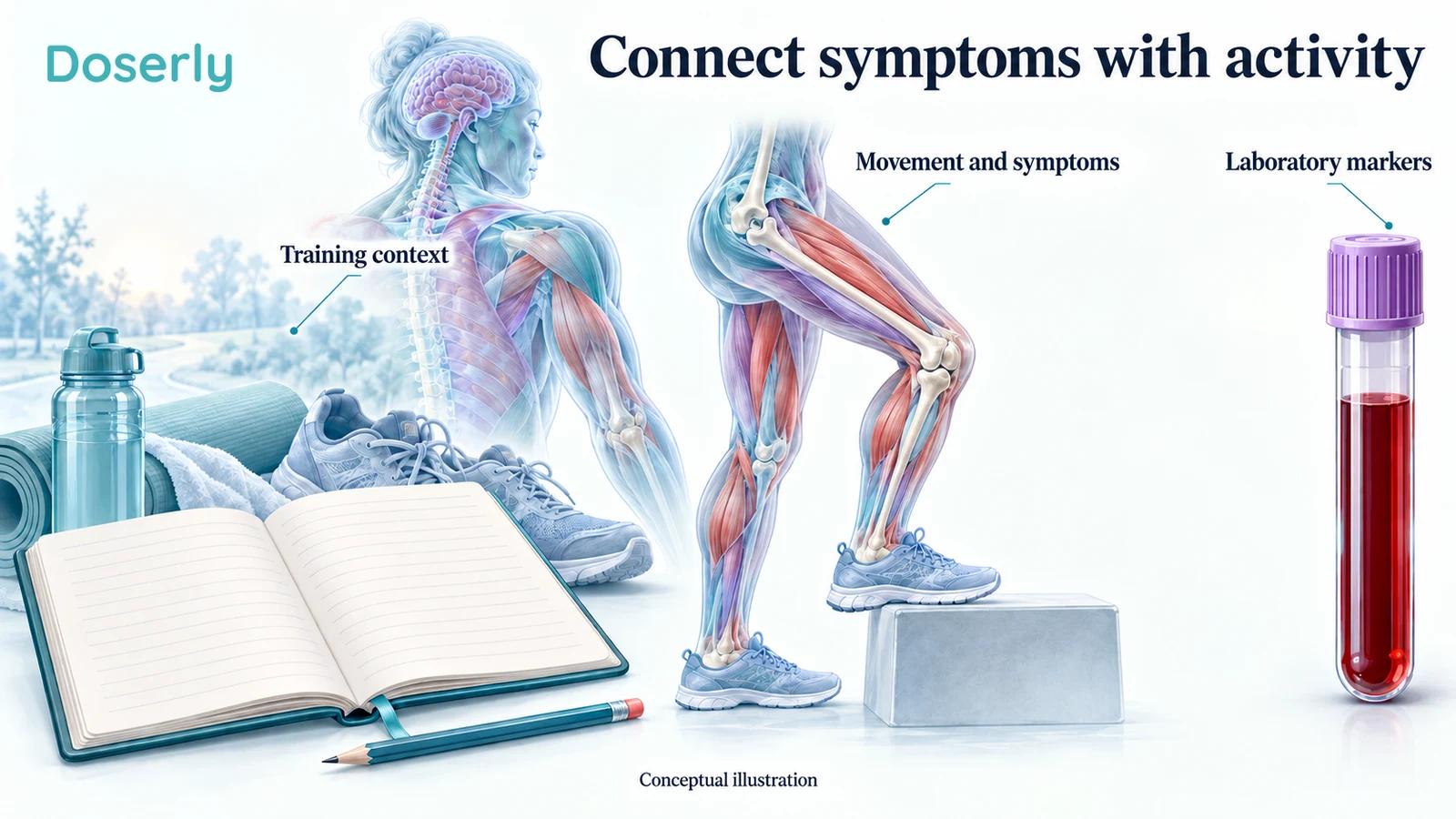
Choose a few repeatable observations: the exercise session completed, next-day soreness during the same movement, perceived readiness and whether the next scheduled workout was performed as planned. Keep the context beside the result. A much lighter workout, an unusually good night's sleep or a change in training frequency can explain improvement independently of light.
Avoid making a maximal test part of every recovery check. Repeated hard testing adds its own fatigue and can make the measurement alter the thing you are trying to observe. For an injured athlete, the relevant functional assessments belong within a clinician's rehabilitation plan.
If you are also considering supplements, the Doserly creatine guide can help you separate that evidence from light-device claims. Creatine use, training changes and a new recovery device introduced together make it difficult to know what contributed to any improvement. The plant-based protein guide is useful background when the more immediate question is whether your eating pattern supports your training.
A simple diary will not remove expectation effects or establish causation. It can still answer a practical question: is this routine producing a noticeable, repeatable benefit that justifies its time and cost? Decide what would count as useful before investing heavily, and allow an honest answer of no clear difference.
When the problem needs assessment instead of another recovery session
Ordinary post-exercise soreness and an injury are not interchangeable. A sudden sharp pain during activity, substantial swelling, persistent loss of strength or symptoms that are worsening deserve assessment rather than being treated as evidence that you need more light. Severe muscle pain with dark urine or profound weakness requires urgent medical attention. A device cannot determine the cause of those symptoms. CDC guidance on rhabdomyolysis symptoms
For normal training recovery, protect the basics that make the rest interpretable: a manageable training load, enough time between demanding sessions, food that supports that load and consistent sleep. Discuss recurrent problems with a qualified clinician or coach, especially when your performance is deteriorating despite reducing training stress. Persistent fatigue is a reason to investigate the whole situation.
If you do use a device, follow its instructions and the clinician's advice for that specific equipment. Do not infer eye safety from the fact that the light looks red, and do not interpret uncomfortable heat as evidence that a deeper treatment is working. Research on low-level nonthermal PBM cannot be used to justify progressively hotter or more intense exposure.
The encouraging part of this field is that meaningful human trials exist. The unresolved part is how consistently their findings translate into everyday recovery with accessible devices. A useful decision leaves room for both facts: PBM may help in some settings, but less soreness, a lower enzyme value and restored performance remain three different claims.