
Peptides
October 16, 2026
Reading retatrutide phase 3 headlines without confusing press releases and papers
On this page
Retatrutide is being studied because it activates three hormone receptors involved in metabolism: GIP, GLP-1 and glucagon. The practical question is whether that design can produce substantial, tolerable improvements in weight and related health problems. By October 2026, answering that question means sorting through several different phase 3 trials, not watching a single study accumulate bigger percentages.
The results are encouraging, but the headline needs its context. A percentage from an obesity trial without diabetes cannot be exchanged for one from a diabetes trial. A sponsor announcement and a journal paper may describe the same participants. Two weight-loss estimates can both be correct because they answer different statistical questions.
There is also a timely correction to older summaries: TRIUMPH-1 now has a peer-reviewed NEJM publication, and TRIUMPH-2 has a Lancet publication, both published online September 29, 2026. Describing all retatrutide phase 3 evidence as press-release-only is out of date. Describing every phase 3 headline as a published trial is equally inaccurate. This article separates the specific sources checked on October 15, 2026. TRIUMPH-1 publication, TRIUMPH-2 publication, publication announcement.
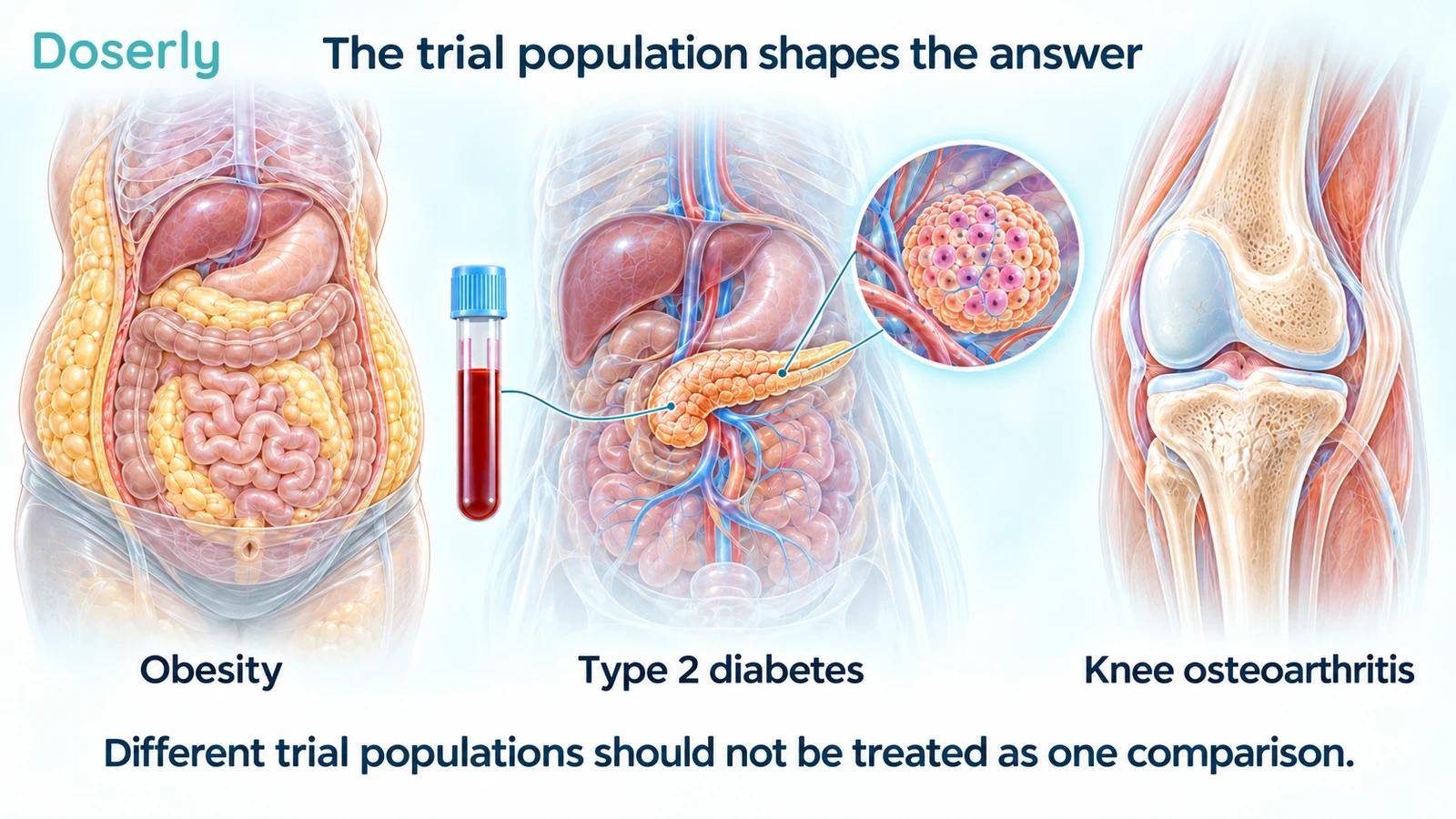
The same investigational medicine is being studied in different populations. These anatomical scenes explain eligibility differences; they do not depict individual trial participants or comparative treatment effects.
First identify which trial the headline describes
A trial name is more useful than the phrase “the new retatrutide study.” TRIUMPH-1 studied obesity or overweight without diabetes. TRIUMPH-2 studied obesity or overweight with type 2 diabetes. TRIUMPH-4 enrolled people with knee osteoarthritis and obesity or overweight, without diabetes. The diabetes program also includes TRANSCEND studies. Those names identify different clinical questions, participants and follow-up periods.
The original obesity phase 2 paper is another separate dataset: 338 adults followed for 48 weeks. Its often-quoted weight-loss finding helped establish the rationale for larger trials. It does not become phase 3 evidence when a later news story repeats it beside new results. Original phase 2 trial.
A useful reading habit is to write one sentence before interpreting a result: “This trial studied these people, against this comparator, for this long.” If a news item does not supply those details, follow its link to the underlying report. A high percentage without that sentence can create a false impression of a universal expected response.
The existing Doserly retatrutide guide explains the receptor design and broader development program. Here, the focus is how to read individual claims as results and publications continue to arrive.
A sponsor announcement can be informative without being a journal paper
A sponsor release is a primary account of what the company is announcing. It can contain real trial results, statistical definitions and important safety information. Calling it a press release should not imply that its numbers are fabricated. It means the document has a different purpose and level of methodological detail from a full research report.
For example, Lilly's December 2025 TRIUMPH-4 release describes a 445-participant, 68-week randomized comparison and explicitly says detailed results will be presented and published later. That is a positive trial announcement, not a journal article hidden behind a corporate web address. TRIUMPH-4 announcement.
Conversely, a company can announce findings that are already published. The September 2026 TRIUMPH-2 release states that the findings were simultaneously published in The Lancet. The journal record confirms a phase 3 randomized trial. The release remains a sponsor document; the linked publication supplies another view of the same experiment.
This distinction prevents double counting. A topline announcement, conference presentation, paper and follow-up company story may be four documents about one trial. They are not four independent replications. Independent replication would involve another set of participants and another experiment.
Why one trial can produce two weight-loss percentages
An estimand is the precise treatment question a statistical analysis is designed to answer. The word sounds technical, but the underlying issue is familiar: what should the estimate mean when some people stop treatment, miss doses or start another intervention?
An efficacy estimand asks about an effect under specified conditions of treatment continuation and restrictions on other therapies. A treatment-regimen estimand aims to address the assigned treatment strategy with a different approach to events such as stopping treatment. The exact definitions belong to each trial; they should not be replaced by a casual “best case versus real life” label.
TRIUMPH-2 makes the difference visible. Its journal abstract reports an average 80-week body-weight change of −18.8% with 12 mg and −5.1% with placebo using the treatment-regimen estimand. Lilly's release highlights −20.8% and −4.0%, respectively, using the efficacy estimand. These are different analyses, not evidence that the paper disproved the press release. Journal abstract, sponsor's estimand definition.
Neither estimate guarantees what an individual would experience. Both depend on trial design, data and assumptions. The helpful response to competing percentages is to locate the estimand, population and time point before deciding that one source is wrong.
Also distinguish a percentage from a percentage-point difference. In a hypothetical study, losing 20% of body weight compared with 5% on placebo would be a 15-percentage-point difference. It would not mean that treatment caused a 20% placebo-adjusted reduction. That arithmetic example is illustrative, not another retatrutide result.
Read the biggest obesity headline with its full label
In its May 2026 TRIUMPH-1 announcement, Lilly reported an average 28.3% weight reduction at 80 weeks with 12 mg, compared with 2.2% with placebo, under the efficacy estimand. The treatment-regimen estimates were 25.0% and 3.9%. The population did not have diabetes. TRIUMPH-1 announcement.
The September 29 NEJM paper now provides the peer-reviewed report of this 2,339-participant trial. Its abstract reports the treatment-regimen estimates, including 25.0% with 12 mg versus 3.9% with placebo. Thus the May headline remains an accurately attributed sponsor estimate, while describing TRIUMPH-1 itself as unpublished is now wrong. The journal also describes knee osteoarthritis and sleep-apnea subgroups within TRIUMPH-1; these should not be confused with the separate TRIUMPH-4 trial. TRIUMPH-1 publication.
A mean also compresses a distribution. It does not tell a reader that everyone lost approximately the same amount. Responder thresholds, treatment discontinuation and variation around the mean help explain how many people had smaller or larger changes. Those details matter when a headline sounds like a promise.
The dose in a study identifies a randomized treatment group. It is not a recommended dose for a reader or a protocol for an online product.
Longer follow-up does not automatically mean weight stayed off after stopping
The same TRIUMPH-1 announcement describes a 104-week extension for participants with a baseline BMI of at least 35. Participants continued treatment, and the extension included movement toward a maximum tolerated dose. Its most prominent efficacy estimate was 30.3% weight reduction in the group originally assigned 12 mg. Extension description.
That is evidence about a particular extension population and treatment strategy. It cannot answer how much weight would remain lost after stopping retatrutide. A study testing withdrawal would need to observe people after discontinuation, ideally with a design that permits a useful comparison.
The extension also should not silently replace the original trial population. Eligibility and continued participation shape who contributes to longer follow-up. When a headline changes from “80 weeks” to “two years,” check whether the same group, treatment plan and analysis are being described.
This is especially important for a person thinking about long-term care. Questions about continued benefit, tolerability, access and what happens after stopping are related, but one longer time point does not settle all four.
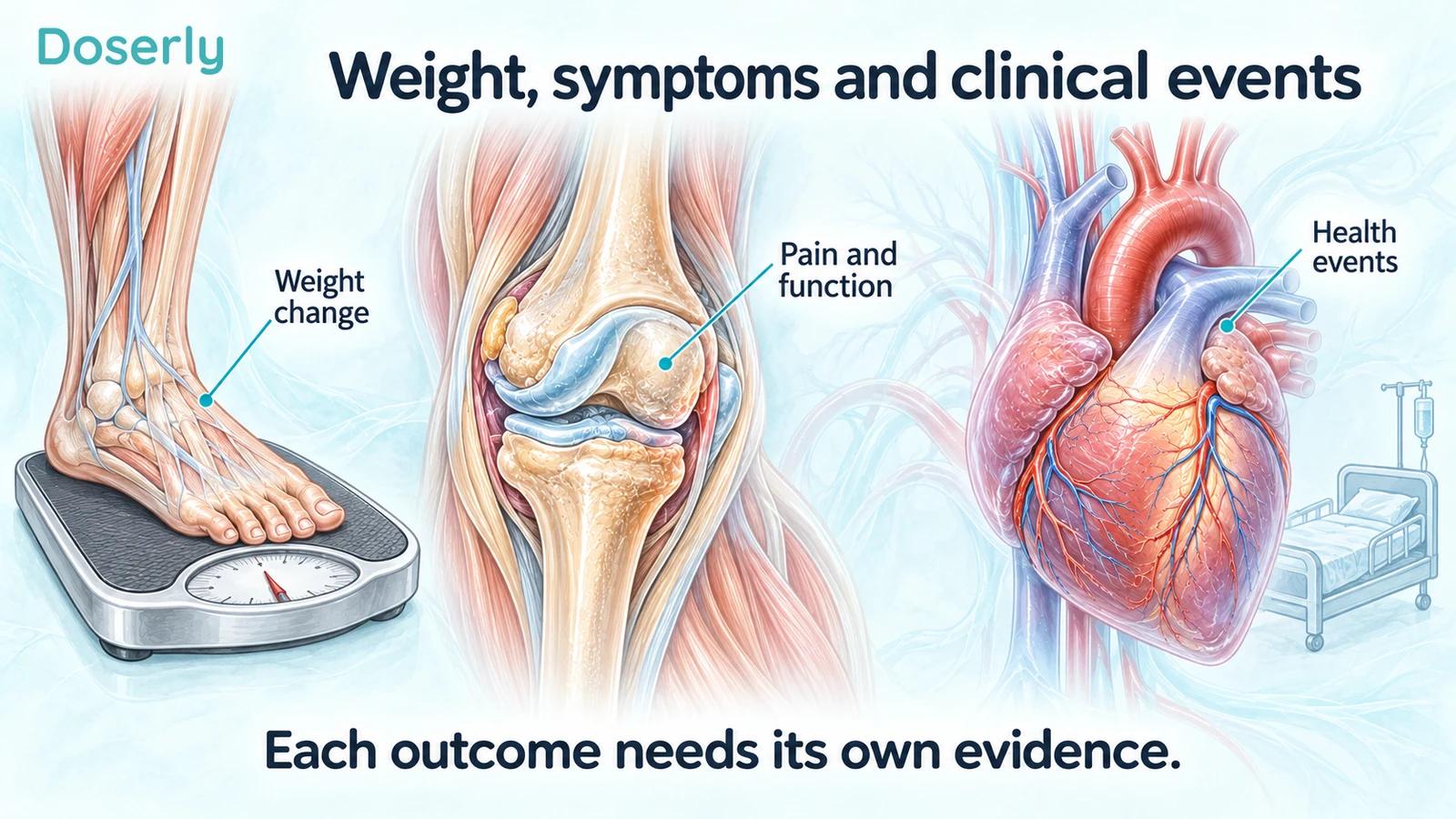
Weight, pain and health events are different outcomes. This conceptual atlas plate does not claim that a change in one proves a benefit in the others.
A knee-pain result is not proof of cartilage repair
TRIUMPH-4 investigated both body weight and knee osteoarthritis symptoms. Its release reports changes in the WOMAC questionnaire, a patient-reported measure of pain and function. Those outcomes matter: less pain can change what daily activity feels possible.
But a symptom score is not a direct image or tissue measurement of regenerated cartilage. Nor does improvement alone identify how much arose through reduced mechanical load, another biological effect, or their combination. The study question and measurements determine what can be concluded.
Likewise, a decline in blood pressure or an inflammatory marker is not the same outcome as fewer heart attacks, hospital admissions or deaths. Those are events that must be counted and analyzed in appropriately designed studies. A release listing several favorable risk markers does not turn a weight-loss trial into a completed cardiovascular outcomes trial. TRIUMPH-4 endpoints, additional phase 3 reporting.
This is where the wording of a claim matters. “Improved a pain questionnaire” preserves the measured outcome. “Repaired damaged joints” adds a biological conclusion the questionnaire cannot establish.
Safety belongs beside efficacy, with the same attention to definitions
The largest weight-loss percentage is rarely the whole decision. Look for the common adverse events, serious events, reasons people stopped treatment and the number of participants exposed. “Generally mild or moderate” and “rarely caused discontinuation” are distinct statements; neither means nobody was substantially affected.
TRIUMPH-4 illustrates why denominators and categories matter. Its sponsor reported discontinuation because of adverse events in 18.2% of the 12 mg group versus 4.0% on placebo. That measure should not be confused with overall study withdrawal or with discontinuation caused by one particular symptom. Safety reporting.
A large trial improves the ability to characterize common effects. It still has a defined duration and selected eligibility criteria. Rare events, longer exposure and groups excluded from enrollment may remain uncertain. A safety table is therefore evidence about the trial experience, not a certificate that every future use will be harmless.
For a reader comparing options with a clinician, relevant questions include whether their health conditions resemble those studied, whether established therapies have suitable outcome evidence, and which adverse effects would matter most in their daily life.
A positive phase 3 result is not regulatory approval
As of the source check for this article, retatrutide remains investigational. Lilly's September 2026 announcement describes a planned US biologics application in the first quarter of 2027. A planned submission is not a submitted application, an approval decision or a guaranteed availability date. Development announcement.
The FDA separately states that retatrutide is not a component of an approved drug and cannot be used in compounding under federal law. It also warns about unapproved products sold for human use with research-only labels. An online vial is not made equivalent to a trial medicine by sharing its name. FDA statement.
A headline is therefore useful for understanding the direction of research, not for building a self-treatment schedule. Trial results were produced with a defined product, protocol and follow-up. Those conditions are part of the evidence.
A practical way to read the next announcement
Before sharing a new percentage, capture six details: the trial name, population, comparator, duration, measured outcome and estimand. Then identify whether the source is a registration, company announcement, conference report or journal publication.
Read the safety paragraph before forming an overall impression. Check whether a later article describes new participants or simply a new analysis of an existing trial. If a claim extends from weight to organ protection, or from continued treatment to life after stopping, look for the additional study that would justify that step.
Retatrutide's phase 3 program has generated meaningful clinical evidence. Reading it carefully does not require ignoring the promising results. It requires keeping each result attached to the people, methods and question that produced it.
Sources
- NEJM, September 2026: TRIUMPH-1 phase 3 trial.
- TRIUMPH-2, The Lancet: peer-reviewed phase 3 trial.
- Lilly, September 2026: TRIUMPH-2 detailed results and publication.
- Lilly, May 2026: TRIUMPH-1 topline results and extension.
- Lilly, December 2025: TRIUMPH-4 topline results.
- Lilly, June 2026: additional phase 3 presentations.
- NEJM, 2023: original obesity phase 2 trial.
- FDA: concerns with unapproved GLP-1 drugs.