
HRT
October 16, 2026
Premature ovarian insufficiency needs a different conversation from midlife menopause
On this page
The ovaries do more than release eggs. They also produce hormones that influence menstrual cycles, vaginal tissues and bone. When ovarian activity becomes insufficient before age 40, the consequences can reach well beyond an unexpected change in periods.
Premature ovarian insufficiency (POI) describes this loss of ovarian function at a young age. It can involve intermittent activity rather than a complete, permanent end to every ovarian function. That distinction matters for both fertility hopes and contraception. It also helps explain why care should not simply copy an HRT discussion intended for someone decades older. International POI guideline.
A diagnosis can bring several questions at once: why did this happen, can I still become pregnant, do I need hormones if I have few symptoms, and what will protect my long-term health? Each deserves its own answer. The aim is to build a care plan that addresses the present while accounting for years of potentially reduced hormone exposure.
What makes POI different?
Typical midlife menopause occurs after the final menstrual period, recognized retrospectively after a sufficient period without menstruation when another cause is not responsible. POI occurs before 40 and has a different range of causes and possible patterns. Early menopause, generally referring to ages 40–44, is also clinically important, but it is not the same age-defined diagnosis.
POI may follow medical treatment, including surgery or some cancer treatments, or occur without an immediately apparent cause. Genetic and autoimmune conditions can be involved. In other people, investigation does not identify a clear explanation. Not finding a cause does not mean the symptoms are imaginary or that the person caused the condition.
You also do not need to have dramatic hot flashes to deserve assessment. Persistent irregular or absent periods in a younger person require a diagnostic conversation, especially when accompanied by symptoms of reduced estrogen. Our POI guide gives broader background on the condition and its care.
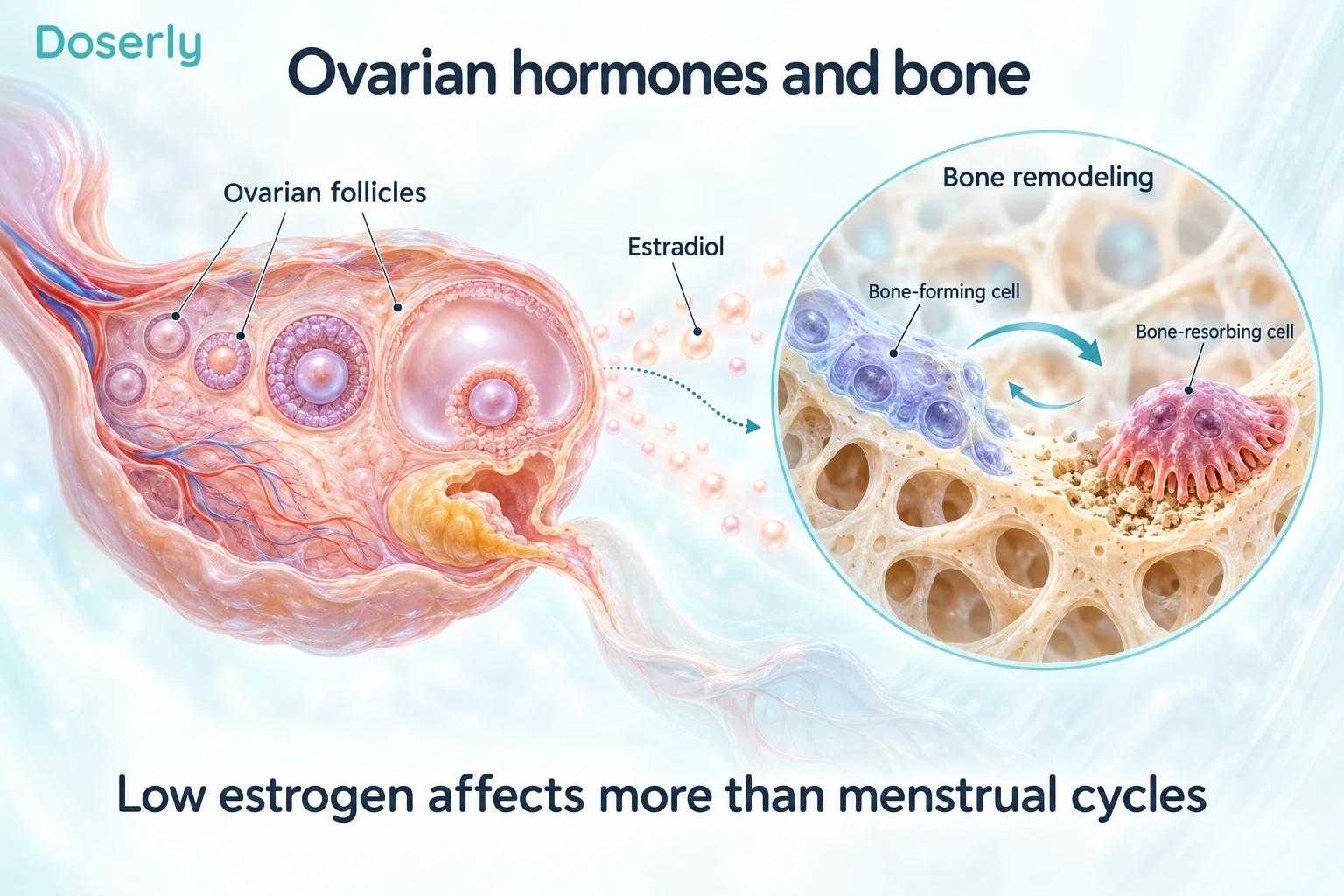
Conceptual physiology: bone-forming and bone-resorbing cells participate in remodeling. This is not a measured treatment response.
Diagnosis is more than a low estrogen result
The updated international guideline recommends considering POI with disordered cycles for at least four months and a follicle-stimulating hormone, or FSH, concentration above 25 IU/L. FSH is a pituitary signal that stimulates ovarian follicles; it often rises when ovarian hormone feedback falls. Repeat testing after four to six weeks is advised when uncertainty remains. Testing does not need to occur on a particular cycle day for this purpose. International guideline.
That recommendation differs from NICE’s approach of two elevated FSH measurements four to six weeks apart for suspected POI. A clinician may follow their jurisdiction’s pathway. The difference should be explained rather than presenting one isolated result as universally sufficient. NICE recommendations.
Pregnancy and other explanations for absent periods must be considered. Hormonal contraception can obscure the pattern and alter laboratory results. Do not discontinue prescribed contraception simply to obtain an apparently cleaner panel; ask how testing can be arranged while managing pregnancy risk.
Anti-Müllerian hormone, or AMH, is not recommended as the primary diagnostic test for POI. A result describing ovarian reserve cannot by itself answer every question about ovarian function, symptoms or future pregnancy.
Investigating the cause has practical value
Once the diagnosis is established, investigation can identify issues relevant to other aspects of health and sometimes to relatives. The international guideline recommends chromosomal analysis and FMR1 premutation testing in non-treatment-related POI, with discussion of genetic implications. It also addresses thyroid assessment and testing for adrenal autoimmunity in appropriate cases. International guideline.
The purpose is not to collect as many abnormal numbers as possible. A result should change counseling, monitoring or treatment. Genetic information may affect family planning and relatives; an autoimmune finding may warrant specialist assessment.
Ask what each test is intended to clarify and how the result will be communicated. It is reasonable to need more than one appointment to absorb this information. A clear follow-up plan is especially useful if the initial diagnosis was delivered during an unrelated fertility or menstrual investigation.
Why hormone replacement may matter without severe symptoms
For a younger person with POI, hormone treatment often replaces exposure that would ordinarily be present at that age. This differs from starting systemic hormones for the first time long after natural menopause.
Professional guidance recommends hormone therapy, when appropriate and without contraindications, until around the usual age of natural menopause, followed by reassessment. The goals include treating symptoms and addressing the consequences of prolonged estrogen deficiency. ACOG also emphasizes that direct comparisons of regimens and long-term outcomes in POI remain limited. ACOG committee opinion.
Thus, absence of hot flashes does not automatically mean there is no reason to discuss treatment. Equally, age alone does not make every hormone regimen suitable. A history of hormone-sensitive cancer, unexplained bleeding or other relevant medical conditions can substantially change the plan.
If the uterus is present, systemic estrogen generally needs appropriate progestogen protection for the uterine lining. The clinician should explain the purpose of each part of treatment, what bleeding to expect and which changes require assessment.
What the bone studies actually show
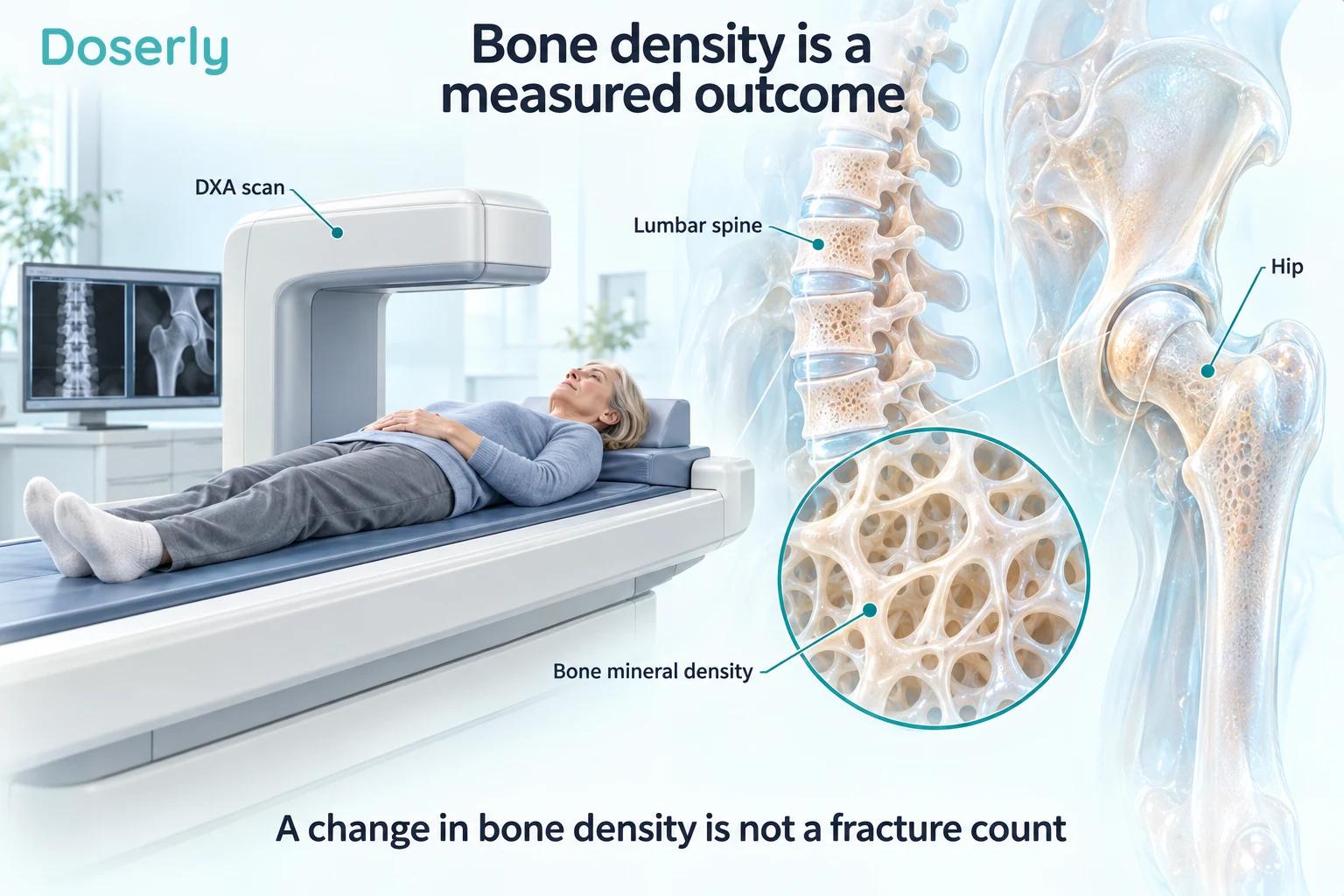
Bone is living tissue that continually remodels. Reduced estrogen can shift that balance toward loss. Researchers often use bone mineral density (BMD), measured by a DXA scan, to assess treatment effects. BMD is informative, but it is not identical to fractures prevented.
A two-year study by Cartwright and colleagues enrolled 59 women with spontaneous ovarian insufficiency, aged 18–44. Thirty chose treatment and were randomized to HRT or a combined oral contraceptive; 29 declined treatment and were followed separately. Only 36 of the original 59 completed the trial.
HRT produced a greater increase in lumbar-spine BMD than the contraceptive pill studied: a between-group difference of 0.050 g/cm², with a 95% confidence interval of 0.007–0.092. Bone density fell in the untreated observational group. The small sample, substantial dropout and nonrandomized untreated comparison limit certainty. Cartwright trial.
This supports discussing the formulation and purpose of treatment. It does not establish that every HRT product is superior to every contraceptive, or quantify the number of fractures a particular young person will avoid.
A second trial clarifies what was randomized
A three-year NIH study included 145 young women with POI and 70 contemporaneous women with normal ovarian function. All participants with POI received estradiol and progestin; they were randomized to additional testosterone or placebo.
Femoral-neck BMD in the estrogen/progestin-treated patients increased toward that of the comparison group. Adding testosterone did not show a significant additional bone-density benefit. The randomization therefore tested testosterone added to replacement therapy, not estrogen versus no estrogen. Popat and colleagues.
That detail matters when a headline calls the study a randomized demonstration of hormone replacement. Its results support the treatment approach, but the non-POI comparison group was not randomized to ovarian insufficiency or to replacement. The study also did not establish a need to add testosterone routinely for bone protection.
Taken together, these studies provide relevant evidence in younger people. They are more directly applicable than assuming that every finding from older postmenopausal populations answers the POI question.
Fertility is reduced, but ovarian activity can recur
In a referral-center study of 358 people with idiopathic ovarian insufficiency, 86 showed features of resumed ovarian function. Twenty-one spontaneous pregnancies occurred in 15 participants. The study combined retrospective and prospective observation. Bidet and colleagues.
These findings explain why “insufficiency” is often more accurate than “failure.” They do not predict whether a specific person will ovulate or become pregnant. Resumed activity can be intermittent, and a return of bleeding does not necessarily mean sustained fertility.
If pregnancy is desired, request reproductive specialist advice early. Discuss established options, time-sensitive decisions and the evidence behind any proposed intervention. Hormone replacement is not an established treatment that restores the follicle pool, and an experimental ovarian procedure should not be presented as a proven way to reverse POI.
If pregnancy is not desired, contraception remains a separate issue. HRT does not reliably suppress ovulation. The occasional possibility of ovarian activity is enough to make pregnancy prevention relevant even when spontaneous conception is uncommon.
Long-term care should include more than a prescription
The international guideline recommends a baseline DXA assessment where available. Follow-up depends on the initial result, risk factors and whether adequate replacement is being used. Low bone density warrants a more active review than a normal scan in someone taking treatment consistently. International guideline.
Bone care also includes appropriate activity, nutrition and attention to factors such as smoking. A supplement cannot substitute for assessment of a major hormone deficiency. Conversely, hormones do not eliminate the need to address other contributors to poor bone health.
Blood pressure, metabolic risk factors, vaginal symptoms, sexual comfort and psychological wellbeing belong in follow-up too. Concern about future health should lead to a practical monitoring plan, not a prediction that serious disease is inevitable.
Tell the clinician if cost, skin irritation, bleeding or a complicated schedule makes treatment difficult to sustain. Adjusting a workable plan is often more useful than repeatedly prescribing one that is not being used.
Revisit the plan as life circumstances change
A POI diagnosis can remain the same while the purpose of the next appointment changes. Someone initially focused on understanding a missed-period investigation may later want pregnancy advice. A person using contraception may decide that pregnancy is now desired. Another may need help maintaining replacement treatment while changing jobs, insurance, or healthcare teams.
Those transitions are a reason to review the plan rather than assuming that a prescription made at diagnosis will answer every later question. Keep the diagnostic evidence, investigation results, treatment history, and current pregnancy intentions available together. This helps a new clinician distinguish established POI from an isolated historical hormone result.
When the usual menopause age approaches, the discussion changes again. Continuing treatment then requires reassessing symptoms, medical history, benefits, risks, and preferences in the new age context. The earlier reason for replacement remains relevant, but it does not create an automatic lifelong prescription or an automatic stopping date. ACOG committee opinion.
A useful handover states why each medicine is being used and which monitoring is due. It also records unresolved fertility or genetic questions, so those issues do not disappear when a person moves between services.
Make room for the emotional and reproductive questions
A diagnosis before 40 can disrupt expectations about fertility, identity and relationships. Someone may feel grief even if they were not planning pregnancy immediately. Another person may mainly want relief from symptoms or clarity about long-term health. There is no single expected reaction.
Ask for counseling or specialist psychological support if needed, and choose how much to share with partners or relatives. Genetic counseling and emotional support serve different purposes; needing one does not mean the other is unnecessary.
Before the next appointment, it can help to separate three priorities: confirming and understanding the diagnosis, choosing a sustainable hormone and monitoring plan, and addressing pregnancy intentions. Bring menstrual history, relevant family history, medicines and any prior test results. Record what remains unanswered.
POI care works best when those questions stay connected without being collapsed into one laboratory value. Our premature ovarian insufficiency guide can help you prepare for the longer conversation.
Sources
- International evidence-based POI guideline, 2024.
- Cartwright bone-density trial, 2016.
- Popat replacement and testosterone trial, 2014.
- Bidet ovarian activity cohort, 2011.
- ACOG hormone therapy opinion, 2017.
- NICE menopause recommendations.