
Supplements
October 16, 2026
Potassium supplements and salt substitutes need a medication check
On this page
Potassium helps nerves carry signals and muscles contract, including the heart. It is also part of the reason nutrition advice often emphasizes beans, vegetables, fruit and other minimally processed foods. But adding potassium through a supplement or a replacement for table salt raises a more specific question: can your kidneys remove the extra potassium safely with the medicines you take?
That question matters even when the product is sold beside ordinary seasonings. A potassium-containing salt substitute can help reduce sodium for some people, while being unsuitable for someone else in the same household. A normal blood-pressure reading does not answer the potassium-safety question.
Here we’ll separate the evidence for dietary patterns, salt substitution and concentrated supplementation. We’ll also explain what a medication review should cover before you change your routine. Our potassium guide provides broader background on the mineral and its uses.
Why blood potassium is different from potassium in your diet
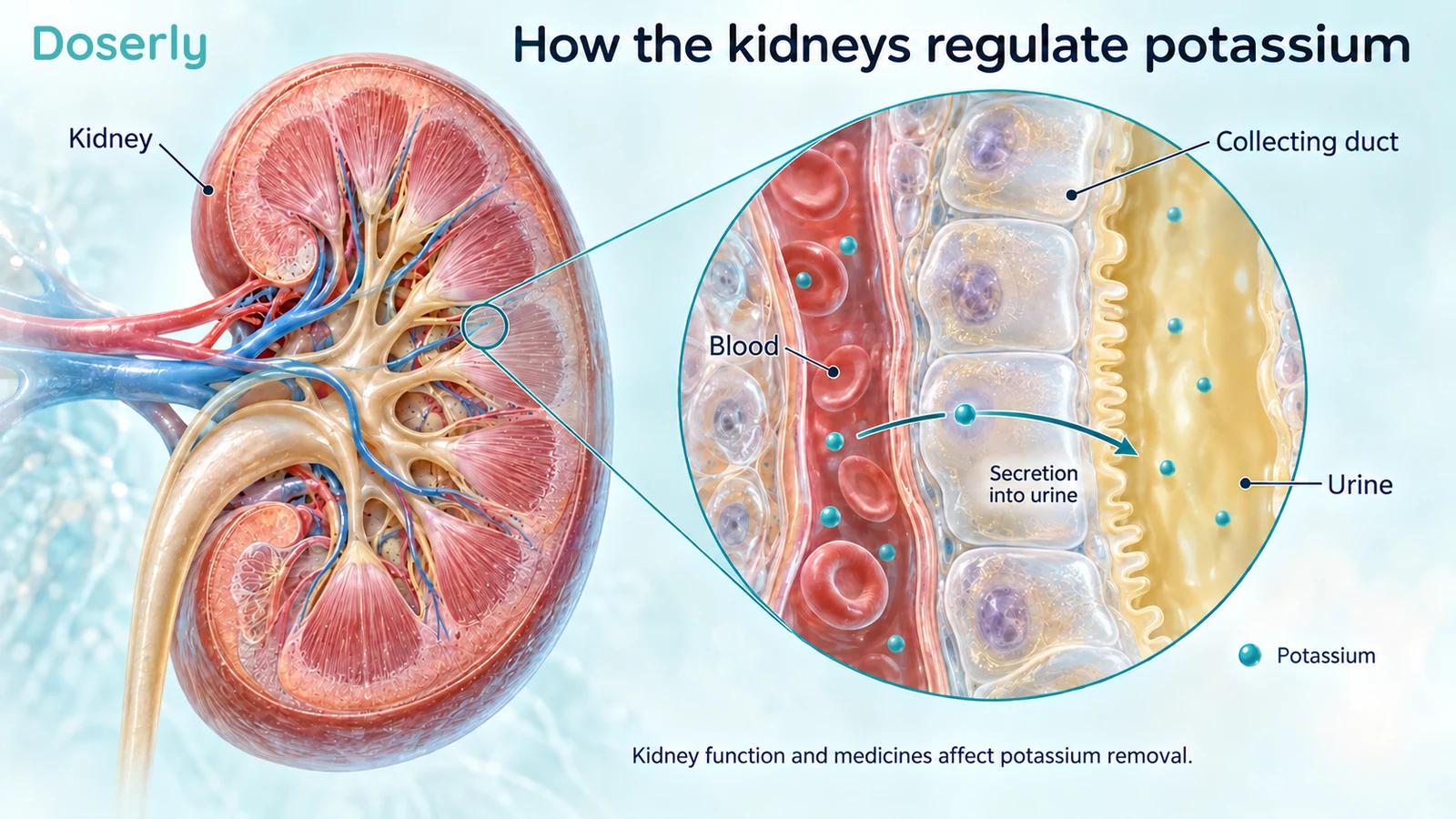
Most potassium is inside cells. The smaller amount circulating outside them is tightly controlled because the balance across cell membranes helps produce electrical signals. Your kidneys adjust how much potassium leaves in urine; kidney function, hormones and medicines influence that adjustment. This is why a nutrient essential for normal function can become dangerous when its blood concentration rises too far. NIH potassium fact sheet.
Hyperkalemia means an abnormally high blood potassium concentration. It is not another name for having eaten a potassium-rich meal. A person can have a diet that seems modest in potassium and still develop hyperkalemia if removal is impaired. Conversely, healthy kidneys usually adapt to variation in dietary intake.
The usual intake targets are nutrition-planning values, not instructions to take enough capsules to fill a calculated shortfall. NIH explicitly notes that its adequate-intake values do not apply to people whose potassium excretion is impaired by disease or medicines. A food diary and a blood test answer different questions: one describes exposure; the other helps assess circulating concentration.
What happened when people with kidney disease received extra potassium?
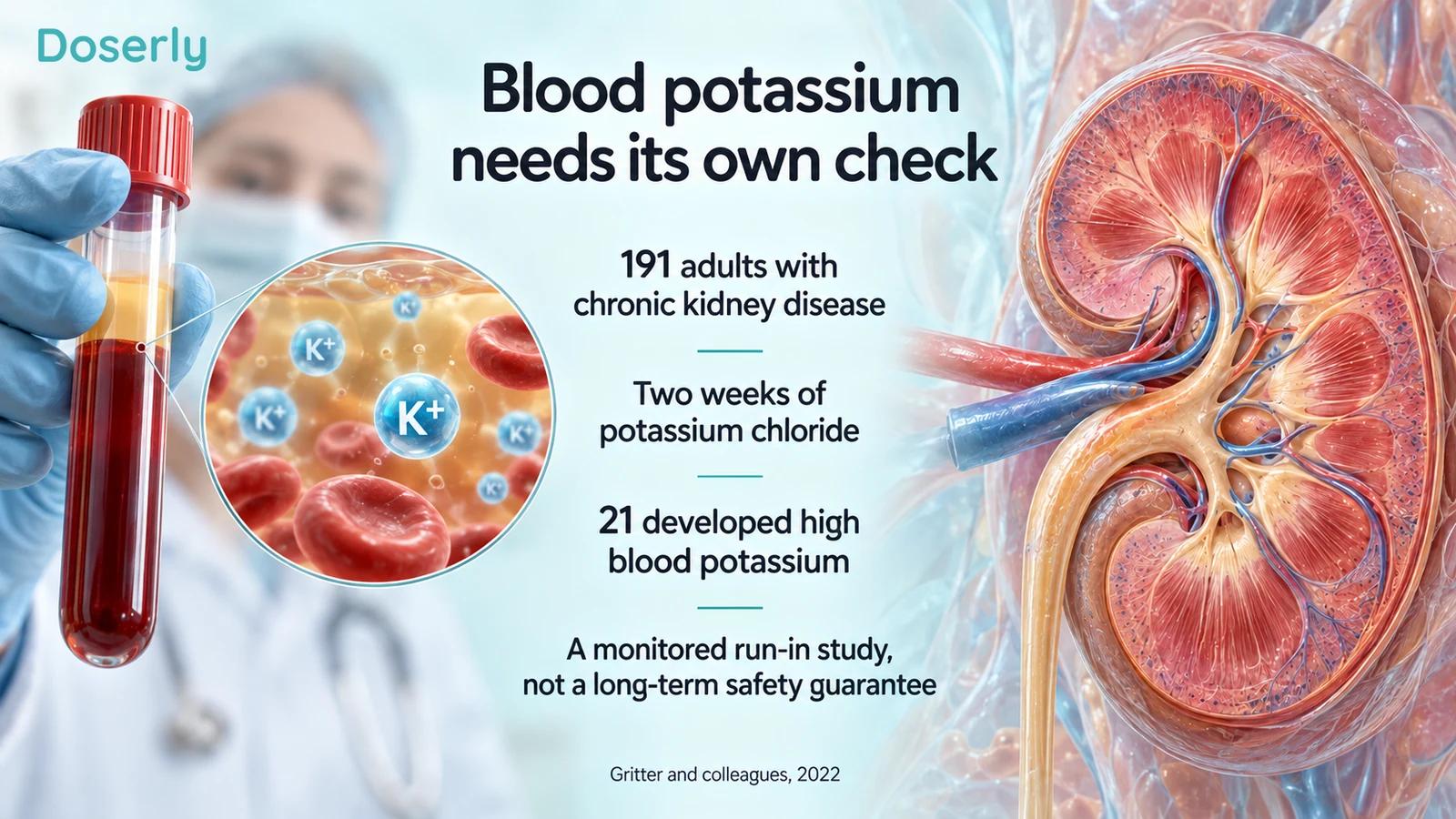
A 2022 study examined the two-week run-in before a longer trial. All 191 participants received potassium chloride providing 40 mmol of potassium daily, about 1,560 mg. Their average estimated glomerular filtration rate, or eGFR, was 31 mL/min/1.73 m², indicating substantially reduced filtration. Most took medicines acting on the renin–angiotensin system.
Average blood potassium rose from 4.3 to 4.7 mmol/L. Twenty-one participants, 11%, developed hyperkalemia; older age and higher starting potassium were associated with that outcome. Office blood pressure, eGFR and urine albumin did not significantly improve. Gritter and colleagues, 2022.
This was a monitored run-in, not the randomized long-term comparison. It cannot establish whether the intervention prevents heart attacks or kidney failure, nor estimate risk in someone with healthy kidneys. It does show why adding a nutritional amount is not automatically safe in chronic kidney disease. The study amount describes the experiment; it is not a suggested self-treatment dose.
Why the large salt-substitution trial still matters
The Salt Substitute and Stroke Study, reported in 2021, involved 20,995 people across 600 rural Chinese villages. Participants had a history of stroke or were at least 60 with high blood pressure. Villages received ordinary salt or a mixture containing 75% sodium chloride and 25% potassium chloride by mass.
Over an average 4.74 years, stroke rates were 29.14 versus 33.65 per 1,000 person-years, favoring the substitute. The rate ratio was 0.86, with a 95% confidence interval of 0.77–0.96. Major cardiovascular events and deaths were also less frequent. Serious events attributed to hyperkalemia did not differ significantly. Salt-substitution trial.
Those findings concern a change that reduced sodium and increased potassium together, rather than adding a potassium pill to an unchanged diet. The serious-event safety endpoint differs from systematically measuring every rise in blood potassium. It cannot replace an individual assessment.
Person-years combine participants and observation time. The stroke-rate difference is about 4.5 events per 1,000 person-years, not a statement that 4.5% of every group avoided a stroke.
What does current guidance recommend?
The World Health Organization’s 2025 guideline conditionally suggests replacing regular table salt with a potassium-containing lower-sodium substitute for adults who choose to use table salt. It places that suggestion within the broader goal of reducing sodium intake.
The recommendation excludes people with kidney impairment or other circumstances compromising potassium excretion. It also does not cover children or pregnant women. Those exclusions matter: a public-health recommendation has a defined audience. Being outside that audience calls for individualized advice. WHO guideline.
“Lower sodium” describes composition, not an assurance that everyone can use the product freely. Check who eats meals prepared with a shared substitute. The person buying it may not be the person with a relevant prescription or kidney condition. Reducing how much salt goes into a meal and changing the mineral composition of that salt are related but distinct decisions.
Which medicines change the conversation?
Some blood-pressure and heart-failure medicines reduce potassium excretion. Examples include angiotensin-converting enzyme inhibitors, called ACE inhibitors, and angiotensin receptor blockers, or ARBs. Potassium-sparing diuretics also deserve attention. Spironolactone is one example; unlike some other diuretics, it can raise potassium.
Current spironolactone prescribing information specifically identifies potassium supplements and potassium-containing salt substitutes as factors increasing hyperkalemia risk. It identifies interactions with other potassium-raising medicines, including ACE inhibitors and ARBs, and calls for potassium monitoring after starting or adjusting treatment and regularly afterward. Spironolactone prescribing information.
This does not mean stopping a beneficial prescription to accommodate a supplement. Have a pharmacist or prescriber review the proposed product alongside the full medicine list. Include nonprescription pain medicines, prescribed potassium and occasional products. The review should address the combination, not simply whether each bottle is legal to buy.
Some other diuretics increase potassium losses, which is one reason replacement is sometimes prescribed. The word “diuretic” alone cannot determine whether someone needs more potassium or should avoid extra exposure. NIH medication interactions.
Read the amount, not just the product name
A supplement label should state elemental potassium, meaning the potassium itself, rather than the total weight of the salt containing it. Potassium chloride and potassium citrate are different compounds. The weight of the whole compound is not interchangeable with its potassium content.
Serving sizes matter. A teaspoon of salt substitute, a scoop of electrolyte powder and a capsule can provide very different amounts. NIH describes a wide range of potassium concentrations among salt substitutes. Hydration products can add another source even when potassium is not prominent on the front label. NIH sources of potassium.
For a practical label review, write down what one serving contains, how much you use and how often. If a powder’s serving is two scoops but you use one, record that distinction. If a seasoning goes into a shared pot, acknowledge that your exact share is unknown. A useful record does not require an invented precise total.
Bring photographs of the actual labels. “An electrolyte product” provides much less information than the ingredient list and serving amount. Check whether a reformulated product has changed since the last review, too: keeping the same brand name does not necessarily mean the same mineral exposure.
Does this mean avoiding potassium-rich foods?
No general rule follows that everyone with kidney disease should remove fruit and vegetables. Dietary advice depends on laboratory results, disease stage, medicines and the overall eating pattern. The National Institute of Diabetes and Digestive and Kidney Diseases recommends individualized work with a health professional or renal dietitian; potassium needs can change as kidney function changes. NIDDK nutrition guidance.
There is also a distinction between evidence for an eating pattern and evidence for one nutrient. The original DASH trial assigned 459 adults to different diets for eight weeks after a run-in. The combination diet emphasized fruit, vegetables and low-fat dairy while reducing saturated and total fat. Sodium intake and body weight were maintained. Blood pressure fell more than with the control diet. DASH primary trial.
That experiment supports the pattern studied. It did not isolate potassium as the sole active ingredient. Replacing that pattern with a capsule removes the other changes in the intervention. For someone with CKD, adapting a healthy eating pattern with a dietitian is more informative than copying an unrestricted meal plan or eliminating whole food groups without assessment.
The review can also identify what you would eat instead. Removing a nutritious food and replacing it with a highly processed alternative may solve neither the dietary goal nor the sodium problem. A personalized plan should remain workable and nourishing, rather than becoming a list of isolated nutrient prohibitions.
Symptoms cannot reliably tell you whether potassium is safe
High potassium can cause few or no symptoms until it is serious. Symptoms can include weakness, nausea, palpitations or other heart-related problems. Feeling well or exercising normally does not establish that a new product is safe. Blood testing identifies the concentration. National Kidney Foundation explanation.
Severe weakness, fainting, chest discomfort or a new abnormal heartbeat warrants urgent medical attention. Do not try to correct suspected high or low potassium by taking more supplements, drinking extra water or changing prescriptions yourself. Similar nonspecific symptoms can have different causes.
If a clinician reports an abnormal result, ask what follow-up is needed and how soon. A supplement log establishes exposure but cannot determine urgency or replace clinical interpretation. Do not assume that the absence of a telephone call means a result has been reviewed; make sure you know how results will be communicated.
A review is easier when the timeline is clear. Record the date of the blood draw, the date a medicine changed and the date you began the new seasoning or supplement. A result from before the change does not describe what happened afterward. Also note who suggested the product: a prescribed replacement for a documented deficiency has a different starting purpose from a self-selected electrolyte mix. Bring both to the same review so that the clinician can reconcile the total plan rather than assess each addition in isolation.
A useful conversation before changing the salt shaker
Start with your reason for the change. Is the goal reducing sodium, addressing diagnosed low potassium or managing cramps? These are different problems; evidence for one does not settle the others.
Then make the review concrete:
- Identify every source. Include salt substitute, electrolyte drinks, capsules, prescribed potassium and approximate frequency.
- Review kidney measurements and medicines. Ask whether recent results and prescriptions affect potassium removal.
- Agree on monitoring if a change is appropriate. Ask which test, when it should occur and who reviews it.
- Clarify the household plan. Shared meals need advice that fits the people eating them.
A dated record in Doserly can help describe when a product began, how often you used it and whether a prescription changed around the same time. Its purpose is accurate communication, not calculating a safe blood concentration from intake.
Potassium remains essential. The practical decision is how to obtain it in a way that fits your health and treatment. For the broader food, supplement and interaction context, see our complete potassium guide.
Sources
- Gritter et al., 2022: potassium chloride in CKD.
- Neal et al., 2021: salt substitution.
- Appel et al., 1997: DASH.
- NIH: potassium.
- WHO, 2025: lower-sodium salt substitutes.
- Spironolactone label, March 2026.
- NIDDK: CKD nutrition.
- National Kidney Foundation: hyperkalemia.