
Supplements
October 16, 2026
Postbiotics: what inactivated microbes can do for digestive health
On this page
A microorganism does not necessarily have to remain alive to affect the body. Its cell structures and the substances produced during fermentation can still interact with the digestive tract after it has been inactivated. That is the idea behind postbiotics, an increasingly visible category of gut-health products.
For someone dealing with diarrhea or irritable bowel syndrome, the useful question is whether a particular preparation improves symptoms. Several human trials suggest that certain inactivated bacterial preparations can help. The results also show why the word “postbiotic” is not enough to choose a product: different preparations, manufacturing methods and patient populations produce different answers.
Our postbiotics guide covers the wider category, including products marketed around short-chain fatty acids. Here we will separate those terms and examine what people actually received in controlled digestive-health trials.
What counts as a postbiotic?
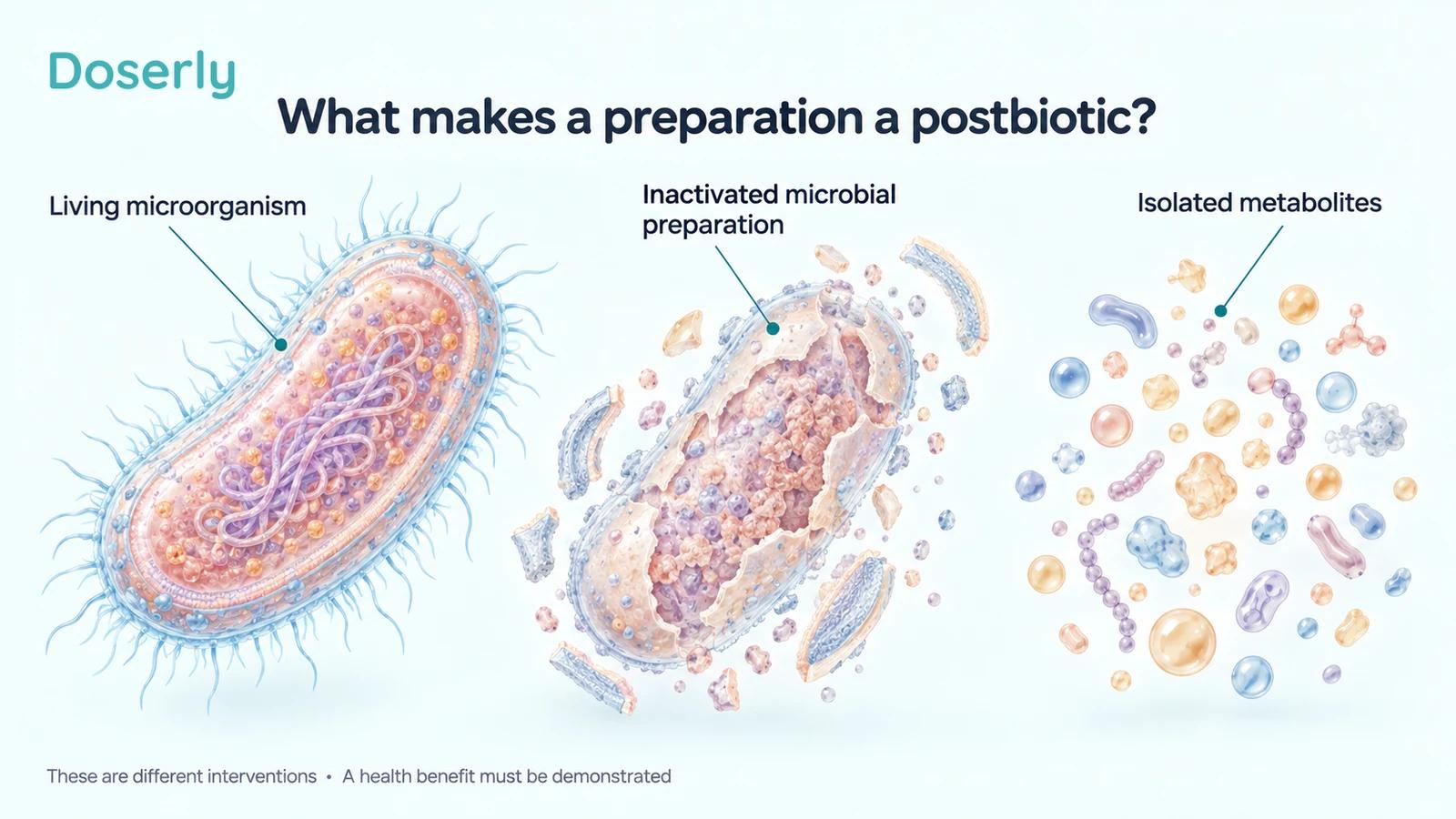
The 2021 International Scientific Association of Probiotics and Prebiotics consensus defines postbiotics around preparations of inactivated microorganisms or their components that provide a health benefit. The preparation can also contain metabolites, the substances microorganisms produce. However, an isolated, substantially purified metabolite does not meet that definition on its own. ISAPP consensus
This gives us three useful distinctions. A probiotic contains living microorganisms with evidence of benefit. A qualifying postbiotic contains inactivated microbial material with evidence of benefit. A purified compound such as butyrate may have biological effects and its own research, but it is a different intervention from a heat-treated bacterial preparation.
Nor does every fermented food automatically become a postbiotic if it is heated. The starting microorganisms, processing method, final composition and demonstrated benefit matter. A fermented food can be worth eating for other reasons without borrowing a clinical claim from an unrelated supplement.
These distinctions are practical. If a capsule of purified butyrate is promoted using a trial of heat-treated Bifidobacterium, the trial has not tested that capsule. If a label simply says “fermentation extract,” you may still need more information to identify what is in it.
How could an inactivated preparation have an effect?
Living microbes can reproduce and make new substances in a suitable environment. Inactivated microbes cannot do that. But inactivation does not remove every structure from the cell or every substance already present in the preparation. Proposed postbiotic mechanisms include interactions with intestinal and immune cells and effects involving the surrounding microbial community. Which mechanisms matter depends on the preparation. ISAPP consensus
Heat treatment is therefore part of the intervention, not an incidental detail. It can alter what remains in the final product. A result for one heat-treated strain does not establish that simply heating any probiotic will reproduce the same effect.
The distinction also changes the label. For a living product, researchers may report colony-forming units, which count organisms capable of growing under the assay conditions. An inactivated preparation may instead be described by cell equivalents or mass. Comparing those numbers as though they were the same measurement would be misleading. A larger number is not a category-wide measure of potency. NIH probiotic terminology
From a reader's perspective, the biological explanation makes the research plausible. It cannot tell you how much urgency or abdominal discomfort will improve. Those outcomes need to be measured in people, and the digestive trials offer several informative examples.
What did the chronic-diarrhea crossover trial find?
A 2024 trial examined Probio-Eco, a fermented and heat-treated preparation made using three named strains: Lacticaseibacillus paracasei Zhang, Lactiplantibacillus plantarum P-8 and Bifidobacterium animalis subsp. lactis V9. Its production involved a soy-and-milk-containing fermentation mixture, heat treatment and drying. This was a whole preparation, not a trial of purified butyrate. Guo and colleagues
Seventy-two young adults were randomized and 69 completed the study. Each participant received the preparation and placebo in separate 21-day periods, with a 14-day washout between them. The randomized order helped compare experiences during the two treatments. Stool form, bowel-movement frequency and urgency improved during the active intervention. The study also examined anxiety and collected stool for microbial and metabolite analyses. Primary trial
This is encouraging for the specific preparation and group studied. It remains a short study, with only three weeks of exposure in each treatment period. Three participants withdrew after antibiotic use. Investigators observed carryover: improvement persisted into the placebo period in the group that received the postbiotic first. They therefore restricted the between-group symptom comparison to the first 21-day period. That makes the positive result a short first-period comparison, rather than an uncomplicated estimate across both crossover periods. Trial methods and results
For someone with chronic diarrhea, the strongest practical message is that symptoms were measured directly. It is not necessary to rely entirely on a laboratory theory. However, the study does not establish durable benefit after stopping, benefits in older adults with different illnesses, or an appropriate substitute for investigating the cause of ongoing diarrhea.
Does more butyrate in stool explain the improvement?
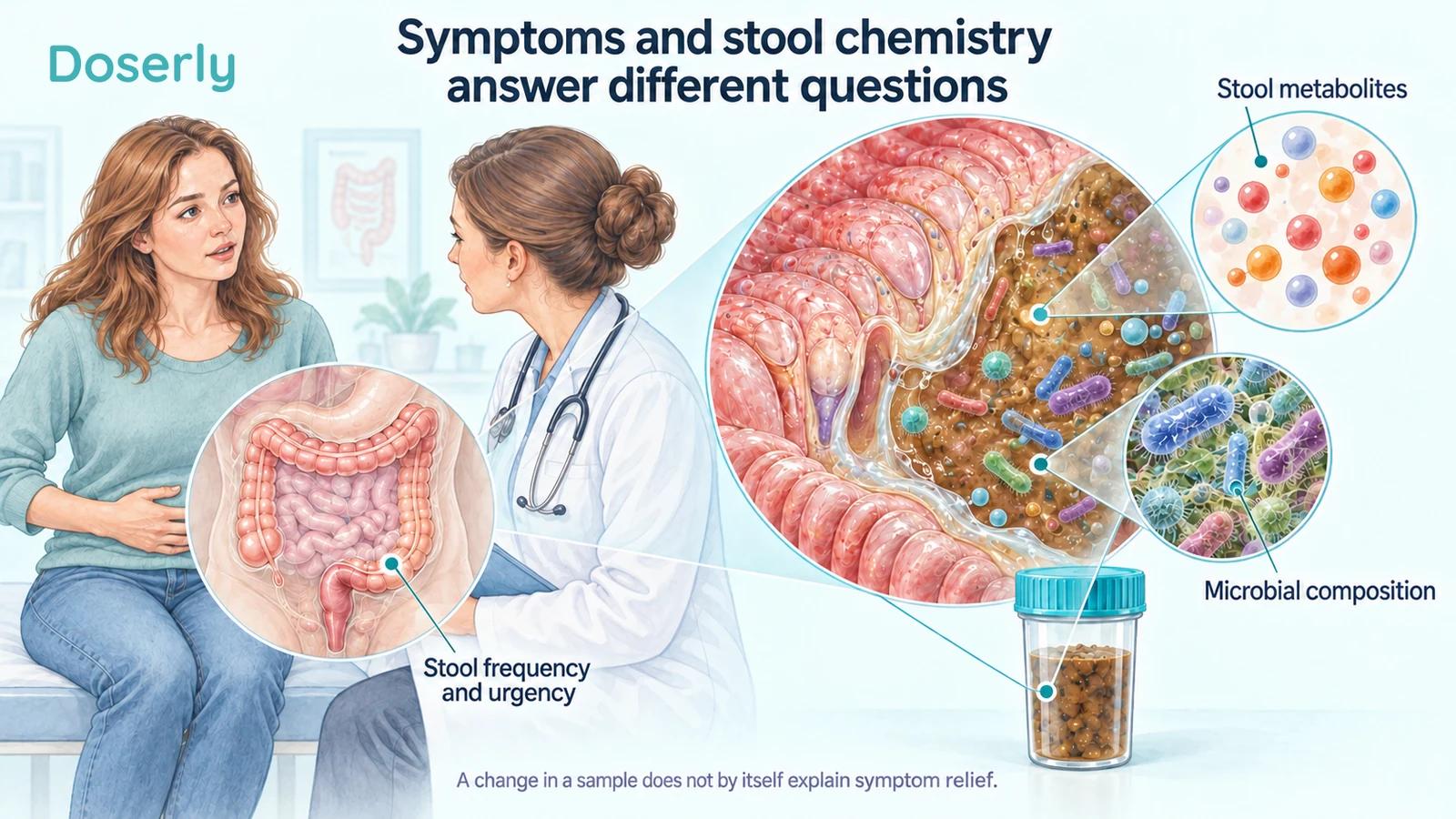
The same study reported an increase in fecal butyric acid and changes in several microbes and other metabolites. Those observations help researchers develop explanations for what happened. They do not establish that one measured substance caused the symptom improvement. Guo and colleagues
A stool sample is a snapshot of material leaving the intestine. It is not a direct measurement of every interaction between microbes and intestinal tissue. When many microbial species and metabolites are examined, several may change together. The study needs additional work to separate a causal mechanism from a companion change.
This is why it would be a mistake to retell the trial as “butyrate cured diarrhea,” then recommend a different butyrate product. Participants received the whole fermented preparation. Its microbial material, fermentation products and food matrix were delivered together.
A useful explanation can acknowledge both levels: people reported better bowel symptoms, and researchers observed biological changes that might help explain them. The clinical finding does not require pretending that the mechanism has already been fully solved.
What about people with diagnosed IBS-D?
Diarrhea-predominant irritable bowel syndrome, or IBS-D, involves recurrent abdominal pain along with changes in bowel habits. It is a defined clinical condition, not simply another name for any loose stool. A 2024 randomized trial in India enrolled 200 adults with IBS-D and compared live Bifidobacterium longum CECT 7347, its heat-treated counterpart HT-ES1, and placebo for 84 days. Srivastava and colleagues
The main outcome was change in the IBS Symptom Severity Scale, a questionnaire that combines several dimensions of symptom burden. Mean scores fell by approximately 178 points in the heat-treated group and 60 points with placebo. The live preparation also improved scores. Secondary outcomes included stool consistency, abdominal pain and quality of life. Primary report
That is direct evidence that a nonliving preparation can produce a clinically relevant symptom result. It does not mean that all inactivated products are equivalent, or that heat treatment necessarily makes a strain better than its living form. The trial's findings concern the particular preparations and population studied.
The study was funded by ADM, which participated in design and manuscript preparation, and some authors were employees. Of the 200 randomized participants, 194 completed the full study. Independent replication would strengthen confidence, particularly before assuming a similar effect in other settings. Funding and participant flow
Why a healthy-adult pilot gives a different perspective
A separate 2024 study tested HT-ES1 in 60 generally healthy adults with mild-to-moderate digestive symptoms. Participants received the product or placebo for eight weeks; 53 completed the study and formed the per-protocol analysis. The investigators reported minimal changes in gastrointestinal symptoms. Naghibi and colleagues
The paper also described changes in cholesterol and the abundance of some intestinal bacteria. Those findings can justify further investigation, but they do not turn a limited symptom result into proof of better digestive comfort. The study was a small pilot, with industry involvement and multiple measurements.
This comparison is useful because it holds the preparation more nearly constant while changing the population and study context. People with a diagnosed disorder and higher initial symptom burden are not interchangeable with generally healthy people reporting milder symptoms. They may have different room for improvement and different reasons for those symptoms.
For someone buying a product for occasional bloating, the IBS-D trial should therefore not be the only study considered. The closer population may produce a less dramatic result. That is a reason to make expectations more specific, rather than to conclude that either paper must be wrong.
Is there a larger trial of another inactivated strain?
Yes. A 2020 multicenter trial randomized 443 people with IBS to heat-inactivated Bifidobacterium bifidum MIMBb75 or placebo for eight weeks. Its main response required both improvement in abdominal pain and adequate overall IBS relief during at least four of the eight weeks. The response was reached by 74 of 221 participants receiving the preparation, approximately 34%, versus 43 of 222 receiving placebo, approximately 19%. Andresen and colleagues
The relative risk of response was 1.7, with a 95% confidence interval of 1.3–2.4. This describes the chance of meeting the trial's combined response definition. It does not mean symptoms improved by 70% in every participant. Most participants in both groups did not meet that endpoint.
The result adds another product-specific example to the field. It is not confirmation that MIMBb75, HT-ES1 and the three-strain fermented preparation are interchangeable. Nor is it a head-to-head comparison establishing which is best. These trials asked different questions in different groups using different endpoints.
Does nonliving mean risk-free?
An inactivated preparation does not have the same capacity to reproduce as a living microorganism. That is a meaningful property, but safety still depends on the finished product, its composition, contaminants, allergens and the person taking it. The consensus framework includes safety assessment; it does not grant every inactivated preparation an automatic safety claim. ISAPP consensus
The Probio-Eco example makes this concrete: the preparation used soy and milk ingredients. A reader focused exclusively on the bacterial names could overlook other relevant components. The appropriate product comparison includes the whole ingredient list, not only the headline microbial ingredient.
Short trials also leave questions about longer use and less common adverse events. A preparation studied in adults with IBS should not automatically be offered to infants, hospitalized patients or people with substantially different health conditions. Ask the treating clinician whether the evidence and safety assessment fit the intended user.
What to check before choosing a product
The most useful question is: “Which study tested this preparation for the problem I want to improve?” The answer should identify the starting strain, how it was inactivated, the finished formulation and the patient group. If the answer points only to a general discussion of the microbiome, the clinical connection is still missing.
Then identify the outcome. Better stool consistency, less pain and lower urgency are different from a change in a stool metabolite or a laboratory inflammatory marker. Decide which matters to your day-to-day life and what would count as a worthwhile improvement.
For an agreed trial of use, record the exact product, start date, bowel symptoms and any concurrent treatment changes. Keep the observations manageable: urgency, frequency and pain can be more useful than trying to track every possible sensation. A personal record supports a clinical conversation but cannot separate all treatment effects from natural variation.
Postbiotics are a scientifically useful category when the term helps identify a well-characterized preparation with demonstrated benefit. They become confusing when the label is used to connect unrelated products and outcomes. The Doserly postbiotics guide can help you compare the forms; the trials above show why the final decision should stay tied to a specific preparation and a specific health question.
Sources
- ISAPP consensus statement, 2021: definition, processing and safety framework.
- Guo et al., 2024: chronic-diarrhea crossover trial.
- Srivastava et al., 2024: live and heat-treated B. longum in IBS-D.
- Naghibi et al., 2024: healthy-adult HT-ES1 pilot.
- Andresen et al., 2020: heat-inactivated MIMBb75 in IBS.
- NIH Office of Dietary Supplements: microbial supplement terminology.