
Supplements
October 16, 2026
Curcumin for knee pain: why the formulation matters
On this page
Curcumin is one of the compounds in turmeric, the yellow spice used in cooking. Concentrated turmeric and curcumin preparations have been studied for painful conditions, including knee osteoarthritis. Some trials report symptom improvements, making the research relevant to people who find walking, climbing stairs or getting out of a chair uncomfortable.
The practical question is more specific than whether turmeric is “anti-inflammatory.” Which preparation was tested, what improved, and what risks came with that exposure? A product designed to increase absorption may behave differently from ordinary turmeric powder. More curcumin reaching the circulation does not automatically mean greater benefit.
Physionic’s article on supplements expresses enthusiasm for curcumin research. That is a reasonable starting point for examining the studies, but it does not remove the need to inspect the formulation and outcome. Here we focus on knee-pain research, without attributing claims from videos or conversations that were not reviewed. Original author article.
What is happening in an osteoarthritic knee?
Osteoarthritis affects more than the smooth cartilage covering the ends of bones. The joint lining, surrounding tissues and bone can also change. Pain, stiffness and difficulty moving may interfere with ordinary activities, and people vary considerably in the severity of their symptoms. NIAMS osteoarthritis overview.
This explains why researchers measure several outcomes. A person’s pain score asks about symptoms. A function questionnaire asks how difficult activities are. Imaging examines features of the joint itself. These measurements can move differently.
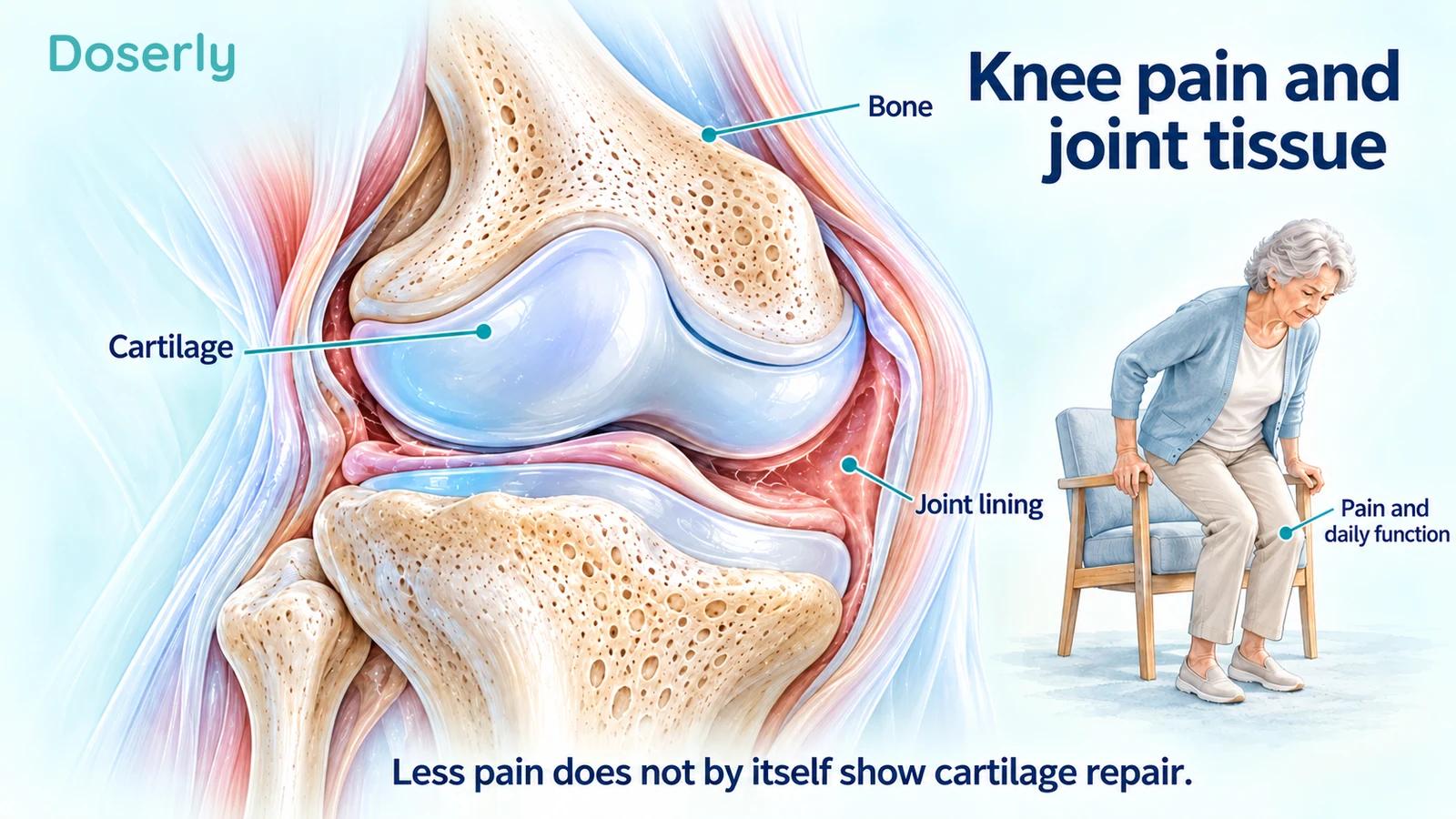
For someone considering a supplement, symptom relief is a legitimate goal. Being able to walk more comfortably can matter even without an imaging change. The mistake would be to describe that relief as cartilage regrowth or proof that the disease has been reversed.
What the 2026 enhanced-curcumin trial found
A 2026 trial randomized 50 adults aged 40–75 with radiographically confirmed knee osteoarthritis to CurcuBoost plus standard care or standard care alone. Treatment lasted eight weeks; all participants completed it. The intervention used 500 mg daily of that specific enhanced formulation. Primary report.
Pain, function and quality-of-life measures favored the added supplement. Using the investigators’ responder criteria, 20 of 25 participants in the supplement group responded, compared with 12 of 25 receiving standard care alone: 80% versus 48%.
The study was open label. Participants knew whether they were receiving the additional product, and there was no matching placebo. That matters particularly when the outcomes depend on reported symptoms. The result is encouraging, but expectations and differences associated with receiving an extra treatment can influence the comparison.
It was also an adjunct trial. It tested adding the preparation to care, not replacing that care. No treatment-related serious adverse events were reported, but 50 people followed for eight weeks cannot establish long-term safety or exclude uncommon harms.
What do those responder numbers mean?
The difference between 80% and 48% is 32 percentage points. In this small study, more people met the chosen response definition in the group receiving the supplement. That is a description of the trial result, not the probability that a new patient will benefit.
A responder definition combines thresholds chosen for the study. It does not mean that every person in the group became pain-free or regained normal joint structure. Nor does it tell us how much improvement persisted after treatment ended.
For an individual decision, it helps to translate the research question into an activity that matters to you. For example, you might want to climb a flight of stairs with less discomfort or return to a regular walk. That is more concrete than deciding in advance that a particular percentage reduction in a questionnaire must be sufficient.
It is also useful to ask what else changed during treatment. A research report can describe average differences, but your clinician still needs to consider your exercise plan, medicines and the nature of your knee problem.
A placebo-controlled trial separates pain from imaging
A 2020 study enrolled 70 people with symptomatic knee osteoarthritis and evidence of joint fluid and lining inflammation. It compared a Curcuma longa extract with placebo for 12 weeks. Two primary outcomes were knee pain and the volume of effusion-synovitis measured on MRI. Wang and colleagues.
Pain improved by an estimated 9.1 millimeters more on a visual analogue scale with the extract. The 95% confidence interval ranged from 0.4 to 17.8 millimeters in favor of treatment, showing uncertainty about the size of benefit.
The MRI outcome did not show a clear improvement. A cartilage-composition measurement also did not establish benefit. So the findings support a symptom signal for the tested preparation, while leaving structural claims unsupported.
This is a particularly useful distinction for readers. An intervention can help a person feel better without proving that it changed the underlying joint anatomy. We do not need to dismiss the pain result to preserve that boundary.
Why “curcumin” does not identify one interchangeable product
Turmeric powder, concentrated extracts and enhanced-delivery preparations are different exposures. Products may contain different amounts of curcuminoids and use different approaches intended to increase availability in the body. NCCIH notes substantial variation among preparations and continuing uncertainty about benefits across health conditions. NCCIH turmeric information.
A label’s large front-of-pack number may refer to an extract’s total weight, an equivalent amount of raw plant material or a stated quantity of curcuminoids. Those descriptions should not be treated as identical.
The research comparison is therefore product-specific. Ask whether the cited trial used the same formulation, the same daily exposure and the same clinical condition. If the manufacturer cites a study of a different extract, that is background evidence, not a direct test of the bottle in your hand.
Our turmeric and curcumin guide explains the broader differences between preparations. Keeping those differences visible helps avoid confusing a well-studied ingredient category with proof for every product sold under its name.
For example, imagine that two labels both say “500 mg,” but one refers to a turmeric preparation and the other to a differently standardized extract. The matching numbers alone do not establish matching curcumin content or absorption. A useful comparison needs the ingredient specification and serving information, followed by the actual trial formulation. If those details are missing, the honest result of the comparison is uncertainty. Increasing the number of capsules to imitate a study would not resolve it; the product itself remains different. This is a reason to ask for documentation before treating a marketing citation as a practical dosing guide.
What does enhanced absorption actually establish?
Bioavailability describes how much of a substance becomes available in the body after administration. Researchers often examine blood concentrations over time. That information helps explain exposure, but it does not directly measure less pain or better physical function.
A frequently cited 1998 experiment tested curcumin with piperine, a black-pepper constituent, in healthy volunteers as well as in an animal component. The human results showed substantially greater measured curcumin exposure when piperine was included. The experiment did not test relief of knee osteoarthritis. Pharmacokinetic study.
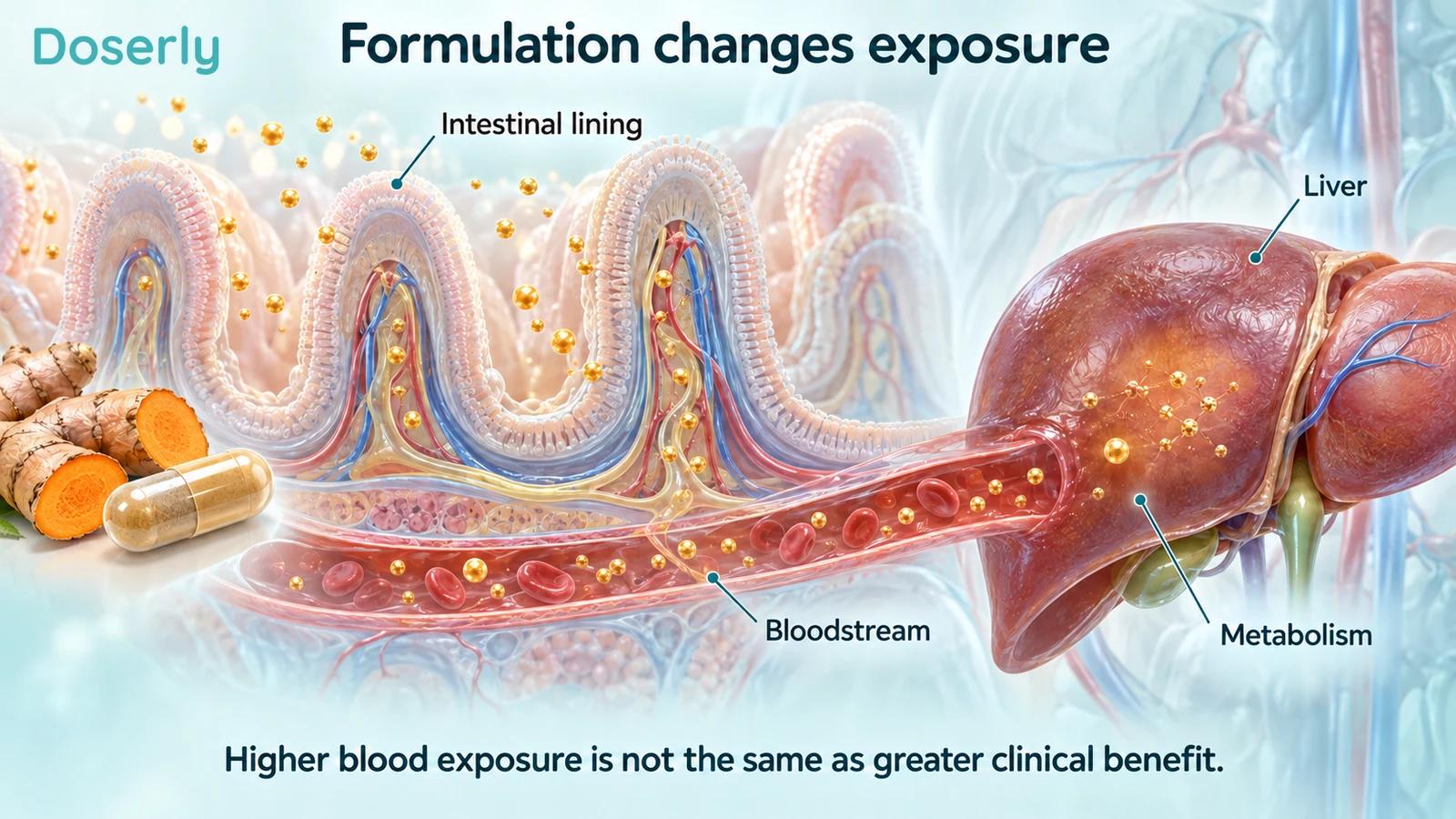
A large relative increase from a low starting exposure can sound impressive. It still leaves open the clinical questions: what exposure is needed, whether further increases help, and how the risk changes. An absorption study cannot answer those questions by itself.
More exposure also makes safety relevant
Concentrated supplements should not inherit the safety assumptions people associate with using a spice in food. Australia’s Therapeutic Goods Administration warns of a rare risk of liver injury with medicinal turmeric or curcumin products. It notes that risk may be higher with enhanced-absorption products or higher doses, while evidence remains limited. TGA safety alert.
The regulator distinguishes this concern from typical dietary use. That does not make every supplement dangerous; it means the product’s purpose and exposure matter when discussing risk.
If a product is marketed primarily on its ability to deliver much more of an active compound, it is reasonable to ask for safety information on that same formulation. Reassurance based only on the long history of turmeric in cooking answers a different question.
This is also a reason to bring the entire label to a medication review. An enhanced product may contain additional ingredients, and those ingredients are part of the exposure rather than incidental details.
What the liver-injury case series can tell us
The US Drug-Induced Liver Injury Network reported 10 adjudicated cases associated with turmeric products. Five people were hospitalized, and one died of acute liver failure. Turmeric was confirmed in all seven products available for analysis; three also contained piperine. DILIN report.
These were selected cases of injury, not a trial following all supplement users. Five hospitalizations among ten cases does not mean half of people taking turmeric will be hospitalized. The study cannot estimate the overall incidence because it lacks a denominator of exposed people.
Likewise, finding piperine in some products does not prove it caused the injury. The report provides a serious safety signal and details for further investigation, rather than a precise risk estimate for every formulation.
This distinction prevents both overreassurance and alarmism. Rare but potentially severe injury deserves attention even when the probability for an individual cannot be calculated from the available series.
Symptoms that should change the plan
The TGA advises stopping the product and seeking medical advice if symptoms suggesting liver injury occur, including yellowing of the skin or eyes, dark urine, unusual fatigue, nausea, poor appetite or abdominal pain. As a precaution, the TGA advises people with current or previous liver problems to avoid medicinal turmeric or curcumin supplements; questions about that advice should be discussed with their clinician. TGA advice.
Keep the bottle or a photograph of its ingredients and record when use began. If symptoms develop, that information helps the clinician reconstruct the exposure. It is more useful than describing the product only as “natural” or “joint support.”
For ordinary follow-up, also record whether knee pain and function actually improved. Continuing indefinitely because a product is well tolerated is a different decision from continuing because it provides a worthwhile benefit.
Do not use the absence of stomach upset as proof that all important risks have been excluded. Adverse effects differ in how they appear, and a short successful trial does not settle long-term safety.
How to compare options without losing the clinical goal
Start with the diagnosis and the activity you want to improve. Then review the exact preparation, the evidence for that preparation and how it fits with your current care. Ask what would lead to stopping it: no useful benefit, an adverse effect, a new medicine or a change in health.
A product-specific study can support a discussion about symptom relief. It cannot justify dropping other parts of care merely because the ingredient is described as anti-inflammatory. The 2026 trial explicitly studied an addition to standard care, while the 2020 trial left imaging outcomes unchanged.
A sensible follow-up conversation can therefore hold two ideas together: less pain may be worthwhile, and less pain does not prove joint repair. Keeping that distinction clear allows the potential benefit to be discussed honestly without expanding it into claims the studies did not test.
Sources
- 3 Supplements that Work (2023)
- Bioavailability-Enhanced Curcumin (CurcuBoost®) as Adjunct Therapy Improves Symptoms in Knee Osteoarthritis (2026)
- Effectiveness of Curcuma longa Extract for the Treatment of Symptoms and Effusion-Synovitis of Knee Osteoarthritis (2020)
- Influence of piperine on the pharmacokinetics of curcumin in animals and human volunteers (1998)
- Liver Injury Associated with Turmeric—A Growing Problem: Ten Cases from the Drug-Induced Liver Injury Network (2023)
- Medicines containing turmeric or curcumin—risk of liver injury (2023)
- Turmeric: Usefulness and Safety
- Osteoarthritis (2023)