
Peptides
October 16, 2026
Petrelintide's long-acting design: beyond convenience
On this page
A medicine that can be given once a week is easier to imagine fitting into daily life than one tied to several meals. That is part of the interest in petrelintide, a long-acting amylin analogue being developed for weight management.
But “long-acting” describes what happens to drug exposure, not simply how often someone uses a pen. A medicine that remains in the body for days can accumulate during repeated treatment, take time to settle after a dose change and remain measurable after the last administration. Those properties can be useful, but they also shape how clinical trials must be designed.
Petrelintide's human phase 1 publication gives a more informative picture than the shorthand “weekly amylin.” Its terminal half-life was approximately ten days, and its absorption after a subcutaneous injection was slow. These findings support continued investigation of weekly treatment; they do not provide a personal dosing schedule. Phase 1 primary report
The problem the molecule was designed to solve
Natural amylin is a pancreatic hormone released alongside insulin. Reproducing its useful biological effects in a practical medicine requires solving several problems at once: receptor activity, sufficient exposure and a preparation that remains suitable for administration.
Pramlintide, an earlier amylin analogue, demonstrates that amylin-based treatment is not a new idea. Its historical US prescribing information describes a roughly 48-minute half-life and administration before major meals in its approved insulin-adjunct setting. That is a different clinical role from a weekly obesity medicine. FDA pramlintide label
Petrelintide's development involved chemical changes intended to improve stability and prolong exposure while retaining relevant receptor activity. The medicinal chemistry publication describes modifications to the peptide and a fatty-acid attachment associated with its long-acting design. It also evaluates behavior in laboratory systems and animals. Development paper
Those experiments explain why the candidate was worth taking into people. Human measurements are still necessary because a long half-life in an animal does not establish the corresponding value in humans.
The petrelintide guide covers the molecule's broader clinical development. Here, the focus is what its exposure profile means and what it leaves unresolved.
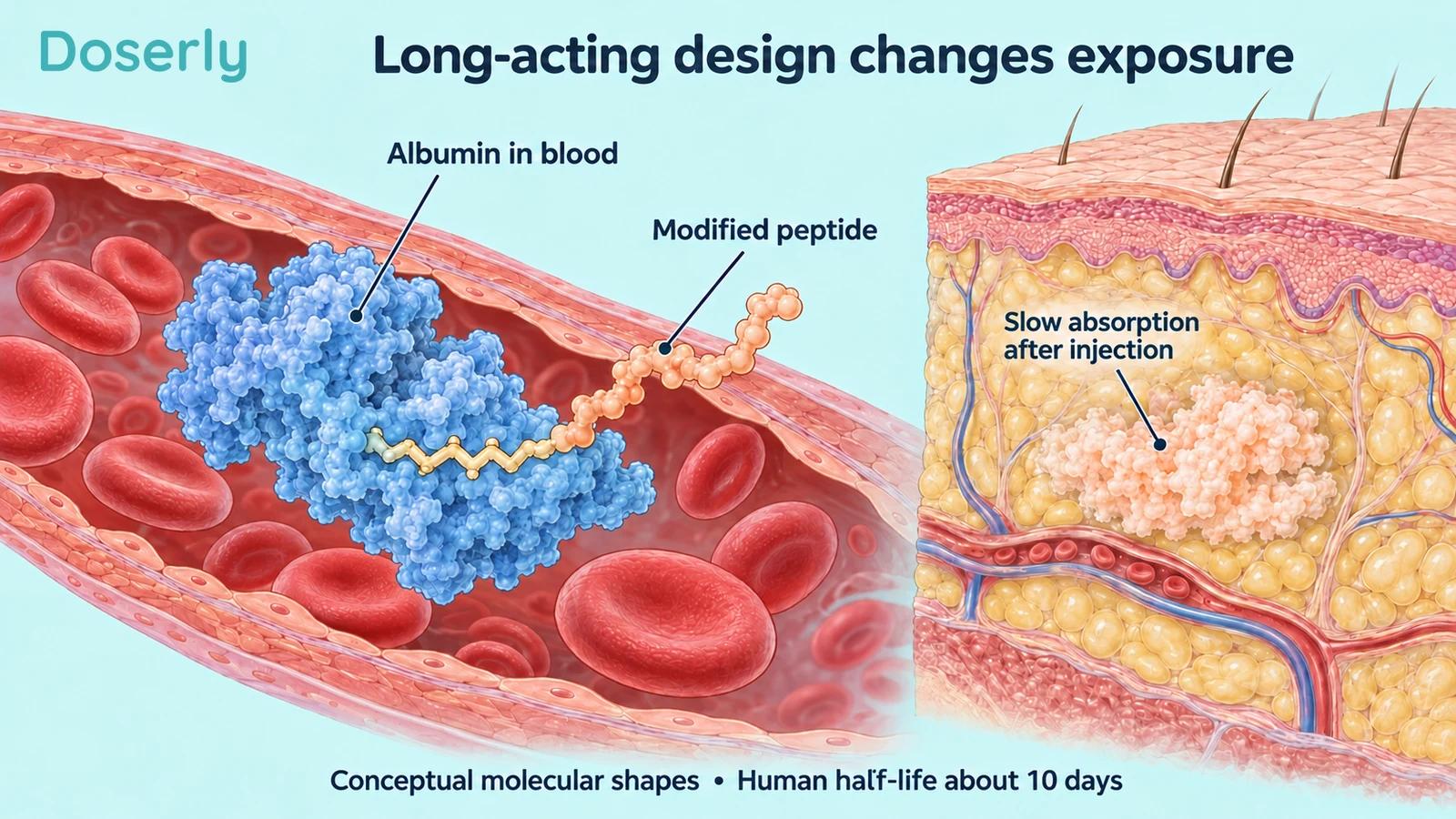
Albumin binding is part of the design story
Albumin is an abundant protein in blood. Drug developers can use chemical modifications that encourage association with albumin as one strategy for extending a peptide's circulation.
The phase 1 authors describe petrelintide's fatty-acid attachment and albumin binding in explaining its prolonged exposure. However, some underlying binding information is described as unpublished. The measured human pharmacokinetic profile is therefore firmer evidence than a claim that every contribution to the long half-life has been directly quantified in people.
This distinction is easy to lose in an illustration. A peptide shown beside an albumin molecule is a conceptual explanation, not a picture of the drug's exact shape or proof that it remains permanently attached. Nor does it mean albumin is an ingredient in a vial.
A development mechanism and a clinical measurement complement each other. The mechanism explains the intended strategy; the blood-sampling study shows what exposure actually looked like in the tested volunteers. Phase 1 primary report
What a ten-day half-life means
A terminal half-life describes the approximate time over which the measured concentration falls by half during the terminal phase of the concentration curve. It is not the time at which all drug disappears.
Petrelintide's phase 1 studies reported terminal half-lives of 213–257 hours following subcutaneous administration, roughly nine to eleven days. An intravenous comparison also showed prolonged elimination, with a reported half-life of 239 hours. Phase 1 primary report
The intravenous observation matters because it bypasses absorption from the injection site. It helps researchers investigate whether a prolonged concentration profile reflects slow entry into the circulation, slow elimination or a combination of processes.
A half-life is also not a direct timer for appetite effects. Concentration, receptor activity, adaptation and clinical response are related but different measurements. A person cannot infer the exact day a medicine “stops working” from the terminal half-life alone.
The same caution applies to safety. A long half-life does not prove that adverse effects will last for ten days, and a short symptom episode does not prove that the drug has left the body. Symptoms and blood concentrations need their own observations.
Absorption after injection was gradual
In the single-dose part of the program, petrelintide concentrations generally rose over the first 12–24 hours and then showed a broad plateau. Median times to maximum concentration varied across the tested dose groups, ranging from 28 to 108 hours.
That is a different pattern from a medicine that reaches its peak almost immediately. Slow absorption can help create sustained exposure, but it also means that the relationship between administration time and observed effects may not be simple.
The study included a low-dose intravenous comparison that allowed estimation of subcutaneous bioavailability. At the tested 0.35 mg dose, the estimate was 77.4%. Bioavailability describes how much of an administered dose reaches systemic circulation relative to the comparison route; it is not a percentage of clinical effectiveness.
That estimate belongs to the tested conditions. It does not establish the same value for every possible concentration, formulation, injection circumstance or patient. It also cannot be used to convert between routes outside a study.
For readers, the useful point is that the investigators measured more than a single headline half-life. They examined entry into the circulation, peak timing, total exposure and elimination, which together provide a basis for choosing regimens to test. Phase 1 primary report
Repeated dosing changes the picture
When another dose is given before the previous dose has been eliminated, exposure can build over time. Eventually, a repeated regimen may reach a relatively stable pattern in which the amount entering and leaving the body balances across dosing intervals.
The phase 1 report describes steady state after the fifth weekly dose. That does not mean concentrations became perfectly flat, or that all participants had identical exposure. It means the repeated-dose pattern had approached a stable range under the studied conditions.
This explains why the first week cannot stand in for the entire treatment course. Tolerability early in treatment may differ from tolerability after repeated dosing or escalation. Researchers need observations across those stages.
It also explains why trial schedules matter. A cohort may spend several weeks moving toward a target dose and only a shorter period at that target. In the 16-week phase 1 portion, the three active cohorts spent different lengths of time at their final doses: approximately 12, eight and six weeks. Comparing their final weight changes as a simple dose ranking would ignore that difference.
Long exposure therefore creates a need for careful interpretation, not an automatic argument that the largest tested dose is the most useful. Phase 1 primary report
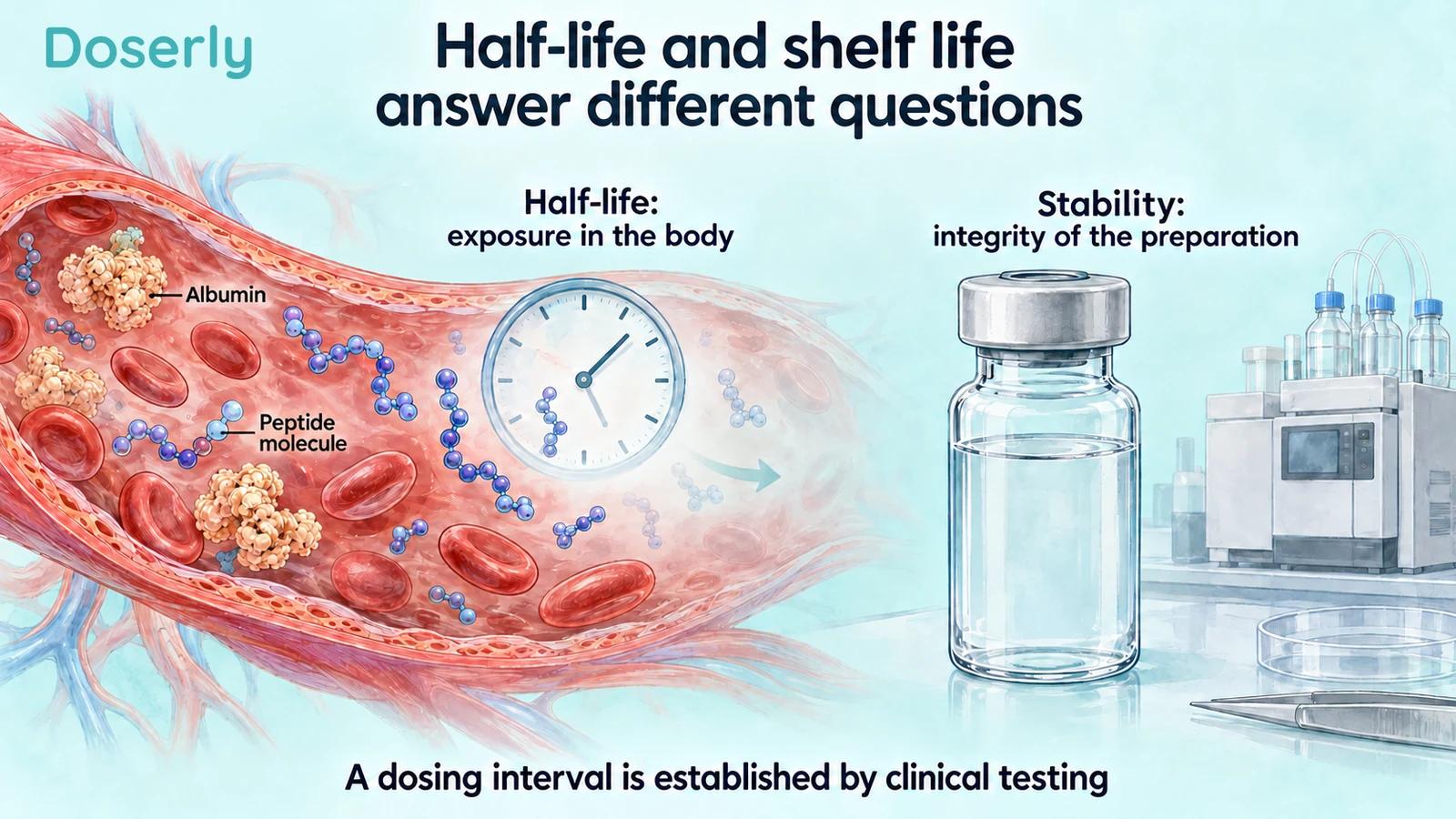
Half-life is not formulation stability
A peptide can remain in circulation for a long time and still require careful formulation. Conversely, a stable solution can contain a molecule that the body clears quickly.
The medicinal chemistry work on petrelintide included efforts to improve stability near neutral pH. These experiments address the behavior of the preparation under defined laboratory conditions. They are separate from the human blood-sampling measurements used to estimate half-life. Development paper
A neutral-pH formulation can be relevant to future product development and possible combinations. It does not establish a final commercial shelf life, storage temperature, compatibility with another product or permission to mix medicines.
Those practical instructions require testing of the exact finished preparation and, if approved, its product information. A research paper's formulation result is not a substitute for them.
Convenience must be measured in actual use
Weekly administration may reduce the number of treatment occasions. Whether it improves someone's experience depends on more than frequency.
The final device, preparation steps, storage requirements, injection experience, symptom burden and follow-up needs all contribute to practical use. A weekly treatment that is difficult to tolerate may be less convenient for a particular person than the calendar suggests.
Published phase 2 evidence now provides a larger view of petrelintide's clinical effects than the early pharmacokinetic studies. ZUPREME-1 demonstrated weight reduction compared with placebo and reported gastrointestinal adverse events. It did not establish a universal preference for weekly treatment over every alternative. ZUPREME-1 primary report
Preference and persistence also deserve separate attention. Someone can prefer a dosing schedule yet stop because of adverse effects, cost or access. A trial can show good completion under structured support without proving the same persistence in routine care.
These are reasons to ask for patient-centered outcomes, not reasons to dismiss the value of a less frequent schedule.
Long exposure affects interruptions and follow-up
If a medicine remains in the body for days, stopping administration does not instantly remove exposure. That makes follow-up after the final dose scientifically important.
The phase 1 investigators continued pharmacokinetic sampling for weeks after the last administration, with sampling extending up to nine weeks in relevant parts of the program. Such follow-up helps characterize the concentration tail rather than assuming the study ends when dosing ends. Phase 1 primary report
This does not establish a universal washout period. The appropriate interval for a future trial, a medication change or a clinical decision depends on the question, the dose history and the relevant product evidence.
For the same reason, a long half-life cannot be converted into a do-it-yourself missed-dose rule. The safe response to an interruption must come from the studied regimen or approved instructions for the actual medicine, not from dividing or multiplying the half-life.
Combination development adds another exposure question
Petrelintide is also being studied as a potential partner for another investigational medicine. The registered phase 2 combination study with enicepatide includes combination groups, individual components and placebo. Combination trial registration
Two long-acting agents may have different absorption and accumulation patterns. Their effects and adverse events need to be studied together under the proposed regimen. Knowing each molecule's half-life separately does not establish the best combination schedule.
Co-administration also differs from co-formulation. Giving two medicines in the same treatment plan does not show that they can share a preparation or device. Exposure, compatibility and clinical benefit remain distinct development questions.
What the long-acting result establishes
The human data support a clear conclusion: petrelintide was successfully engineered into a candidate with prolonged exposure, and its measured profile justified testing weekly regimens.
That achievement is meaningful. It expands what an amylin-based medicine might be able to offer beyond older meal-related treatment approaches. But the practical value ultimately depends on sustained benefit, tolerability, usable product design and evidence in the people who would receive it.
The most useful way to read “long-acting” is therefore as a description of the drug's behavior over time. Convenience is one potential consequence. Accumulation, gradual changes in exposure and the need for adequate follow-up are consequences too.
Sources
- Human phase 1 pharmacokinetic and clinical report.
- Petrelintide medicinal chemistry and formulation paper.
- Historical FDA pramlintide label.
- ZUPREME-1 phase 2 publication.
- Petrelintide–enicepatide trial registration.