
Peptides
October 16, 2026
Petrelintide and amylin: what is actually new?
On this page
Amylin is one of the hormones your pancreas releases after you eat. It helps connect the arrival of food with the body's response to that meal, including signals involved in feeling full. Scientists have been interested in using that biology to treat metabolic disease for years. Petrelintide is a newer attempt to turn it into a practical, long-acting medicine for weight management.
The new part isn't the discovery that amylin matters. It is the design of a modified molecule that can remain in the body much longer and stay stable under conditions useful for drug development. Human trials are testing whether those pharmaceutical features translate into worthwhile weight loss with acceptable side effects. Those are related questions, but they need different kinds of evidence.
If you're following obesity research, petrelintide matters because it targets a pathway different from the one used by semaglutide. It may eventually offer another option or a component of a combination. At this article's October 15, 2026 research check, it remains investigational. Our petrelintide guide provides broader background.
What does the body's own amylin do?
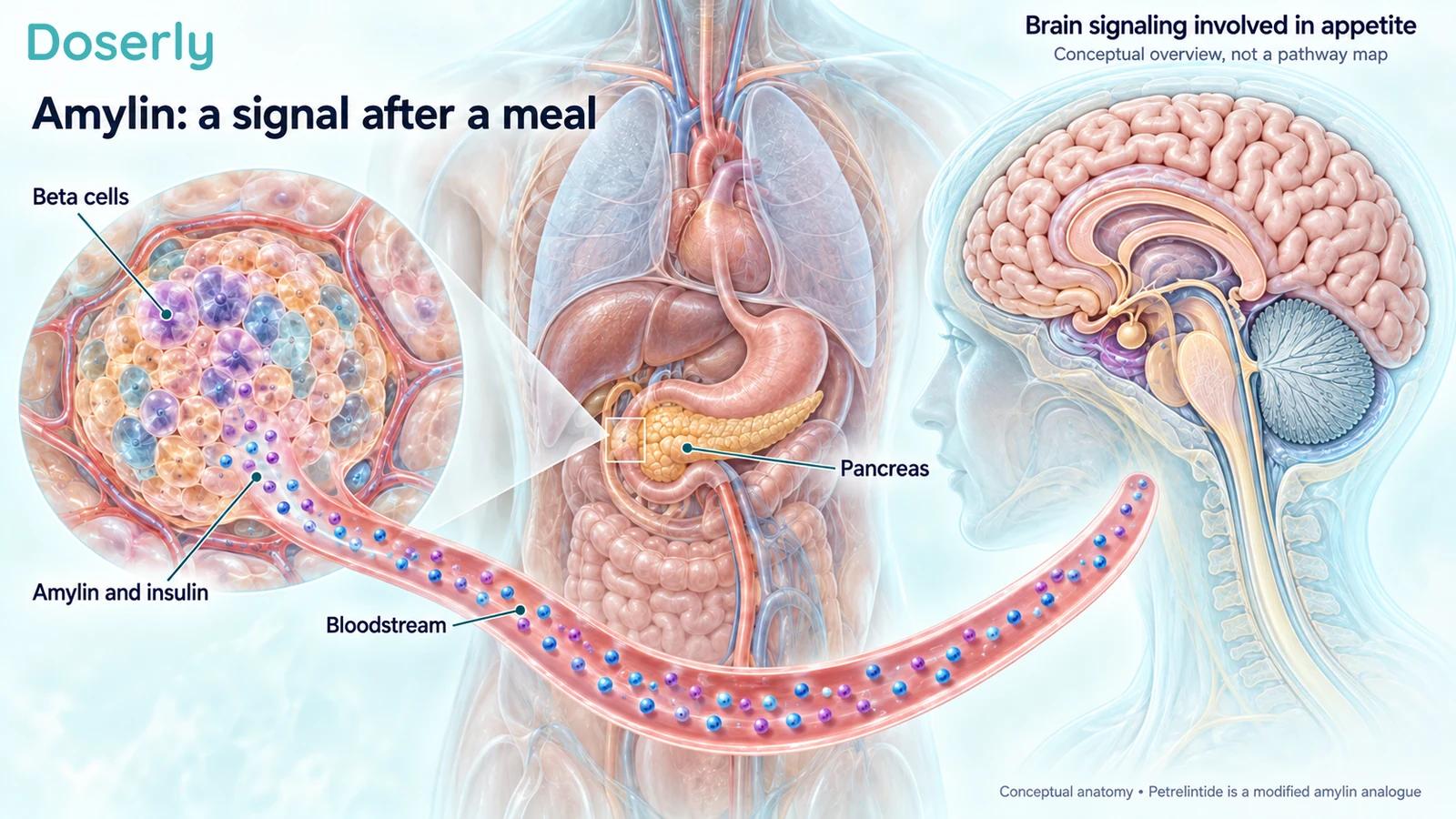
The pancreas contains clusters of hormone-producing cells called islets. Within those clusters, beta cells make insulin and amylin. Both are released in response to food, but their jobs aren't identical. Insulin is central to controlling blood glucose; amylin contributes to the handling of nutrients after a meal and to appetite regulation.
The official pramlintide label describes effects on stomach emptying, suppression of the meal-related rise in glucagon, and centrally mediated regulation of food intake. Glucagon is another pancreatic hormone that can stimulate the liver to release glucose. “Centrally mediated” means nervous-system signalling contributes to the effect. These mechanisms help explain interest in both diabetes and weight management. FDA pramlintide label
It helps to distinguish satiation, which helps bring a meal to an end, from satiety, which describes reduced hunger between meals. Everyday descriptions such as feeling full can cover either. An appetite medicine might affect eating without reproducing every response to natural amylin. Researchers still need to measure what people experience and what changes during treatment.
Why not simply use natural amylin?
A hormone can be biologically useful and difficult to develop into a medicine. Researchers need a preparation that stays usable during manufacture and storage, reaches its intended targets, and produces an exposure pattern suitable for treatment.
Natural human amylin presents a formulation challenge: molecules can associate into fibrils, organized strands that are undesirable in an injectable product. A modification that reduces this tendency is valuable, but it must preserve the molecule's ability to activate its target. Improving one property while losing another would defeat the purpose.
Petrelintide's medicinal-chemistry development addressed physical and chemical stability. Physical stability concerns how molecules associate; chemical stability concerns changes to the molecule itself. Researchers modified susceptible parts of the peptide, reduced fibrillation, and replaced a vulnerable disulfide linkage with a more stable lactam linkage. A linkage is a chemical connection within the molecule. The resulting candidate retained laboratory receptor activity and could be formulated near neutral pH. Development paper
The significance is practical: investigators were trying to make an amylin-based drug that could be manufactured and studied in useful formulations. This isn't evidence that the molecule repairs a damaged pancreas or restores natural hormone production.
Pramlintide shows that the biological idea is older
Pramlintide, marketed as Symlin, is an earlier synthetic amylin analogue. An analogue is a molecule designed to resemble another molecule while changing selected properties. The historical FDA label describes pramlintide as an adjunct for certain people with diabetes who use mealtime insulin.
Pramlintide is short acting: the label reports a half-life of approximately 48 minutes in healthy individuals. It is administered around meals, and its use with insulin requires attention to severe hypoglycemia, or dangerously low blood glucose. These features belong to the studied pramlintide product and treatment setting. They cannot be copied directly into instructions for another amylin analogue. Symlin clinical pharmacology and safety
This history changes how we interpret claims that petrelintide introduces completely new biology. The pathway already has a clinical precedent. What needs evaluation is whether this newer molecule offers a different balance of exposure, efficacy, tolerability and practical use.
It also explains why comparisons based solely on milligrams are misleading. Different analogues have different molecular properties, receptor activity and persistence. A number of milligrams for one drug isn't directly comparable with a number of micrograms for another.
What makes petrelintide long acting?
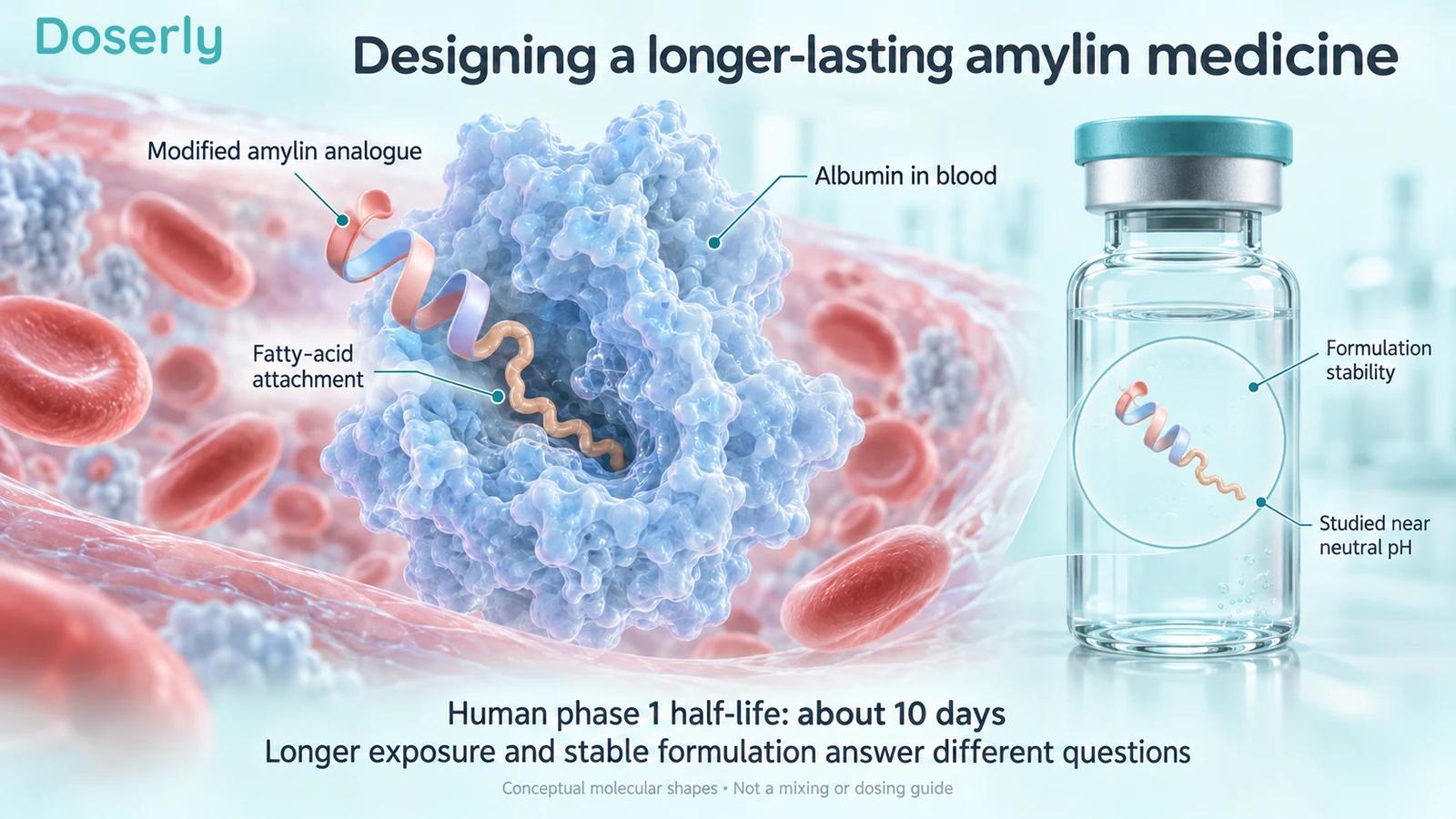
Petrelintide has a fatty-acid attachment that supports association with albumin, a protein in blood. This is part of its strategy for prolonging exposure. The human phase 1 report describes slow absorption and an elimination half-life of about ten days. Half-life is the time over which drug concentration falls by roughly half during the measured elimination phase. Phase 1 trials
That finding supports investigating weekly administration. It doesn't mean a dose has exactly ten days of clinical benefit or that all drug disappears on the tenth day. Concentration declines gradually, and repeated administrations can overlap in time.
A long half-life has consequences beyond convenience. Researchers need to understand accumulation during repeated treatment, what happens after escalation, and how long follow-up should continue after treatment stops. A medicine that persists cannot be evaluated only in the hours immediately after administration.
These are development considerations, not a self-treatment schedule. Trial administration involves a defined product, eligibility criteria, monitoring and planned responses to intolerance. A research vial sold outside that system doesn't inherit the evidence simply because its label uses the same compound name.
Why does formulation near neutral pH matter?
The pH of a solution describes how acidic or alkaline it is. A peptide that requires one narrow chemical environment may be difficult to combine in the same solution with a peptide that requires another. Developing stability near neutral pH can widen the formulation possibilities.
That doesn't mean petrelintide can be mixed with any injectable medicine. Compatibility requires testing the actual ingredients, concentrations, container and storage conditions. Two drugs administered during the same treatment course are co-administered; two drugs prepared together in one formulation are co-formulated. Evidence for one doesn't automatically establish the other.
The distinction matters because readers may hear about a combination program and assume there is already a finished single-injection product. A company can first study two medicines given separately and investigate a common formulation later. Likewise, a chemically stable mixture can still fail to provide enough clinical benefit or cause unacceptable adverse effects.
Petrelintide's chemistry makes combination development plausible. Whether a particular combination is useful requires its own human trials. The September update describes a development program rather than an approved combination regimen. Zealand development update
Is petrelintide another GLP-1 drug?
No. Petrelintide is an amylin analogue, with activity at amylin receptors and the calcitonin receptor described in laboratory research. Amylin receptors involve the calcitonin receptor associated with receptor-modifying partner proteins. Semaglutide acts at the GLP-1 receptor, a different target. Similar effects on eating or weight don't make two molecules members of the same drug class. Development study
Receptor findings help explain why researchers might combine the approaches. They don't tell us how much each receptor contributes to weight loss in a person. Activating more receptor types also doesn't automatically make a medicine more effective or safer. Exposure, tissue responses, dose and adverse effects all matter.
For someone who couldn't tolerate a GLP-1 medicine, a different target is a reason to follow this research. It isn't proof that petrelintide would solve that person's problem. The relevant trial would directly study people with that treatment history and describe their outcomes.
What have the human trials established?
The early trials examined safety, tolerability and how the drug behaved in the body. They also found weight reductions, supporting larger studies. Their small cohorts were useful for development decisions but couldn't establish uncommon risks or long-term treatment outcomes. Phase 1 publication
A more substantial result is now available. ZUPREME-1 was published in September 2026, so describing all phase 2 evidence as unpublished company data is outdated. Researchers randomized 493 adults without type 2 diabetes; 485 received at least one dose. The main outcome was weight change at 28 weeks.
In the 5 mg maintenance-dose group, estimated mean weight reduction was 9.8%, compared with 1.7% for placebo, under the efficacy estimand, which estimates the effect in the specified scenario of continued treatment without rescue intervention. The difference was 8.1 percentage points. This is a study result, not a recommended dose or a prediction of an individual's response. Nausea was more common with petrelintide, despite low vomiting rates. ZUPREME-1 publication
Weight change demonstrates a clinical effect on that outcome. It doesn't by itself demonstrate fewer heart attacks, less kidney failure or longer life. Those outcomes require suitable follow-up and event measurements. A trial can be encouraging without answering every reason someone hopes to lose weight.
What changed for people with type 2 diabetes?
On October 7, 2026, Zealand reported ZUPREME-2 topline findings in 220 adults with overweight or obesity and type 2 diabetes. The announcement described up to 9.2% mean weight reduction at 28 weeks versus 2.0% with placebo, alongside improvements in HbA1c, a measure of longer-term blood glucose.
Participants were receiving metformin, with or without an SGLT2 inhibitor. This is a defined diabetes-treatment setting, not evidence covering every diabetes medicine combination. The results were sponsor-reported topline findings at this check; the complete report is needed to assess all dose groups, missing data and safety outcomes. ZUPREME-2 announcement
The update makes the evidence more relevant to diabetes care, but it doesn't convert petrelintide into a replacement for established treatment. It provides a new study to examine as the program develops.
What would make the new design valuable in practice?
For a future patient, a successful molecule would need to do more than remain stable in a laboratory. It would need to produce a useful benefit that people can sustain, with an acceptable burden of symptoms, administration and monitoring.
That includes questions about maintaining nutrition, everyday functioning, treatment persistence and outcomes after stopping. People differ in what they need: one person may prioritize blood glucose, another mobility, and another tolerability after difficulty with a previous treatment. An average weight result cannot answer all those questions.
Consider someone who loses weight but finds eating enough to maintain normal activities difficult. The scale alone wouldn't describe that person's treatment experience. Conversely, someone with a more modest weight change might value improved daily function. Future studies need to make these distinctions visible, rather than treating every kilogram as equivalent regardless of its circumstances.
Petrelintide's contribution is specific and meaningful: it carries established amylin biology into a longer-acting, formulation-conscious development program, with growing randomized human evidence. The next decisions depend on what larger trials show, rather than on the novelty of the molecule alone.
Sources
- Medicinal-chemistry development, 2025.
- Randomized phase 1 trials, 2026.
- ZUPREME-1 phase 2 publication, 2026.
- FDA Symlin label, historical 2019 version.
- ZUPREME-1 publication update.
- ZUPREME-2 topline announcement.