
Peptides
October 16, 2026
Pemvidutide trial dropouts: what tolerability adds to the weight-loss story
On this page
Pemvidutide is being studied for obesity and metabolic liver disease because it activates two hormone receptors involved in appetite and fuel handling: glucagon-like peptide-1, or GLP-1, and glucagon. For someone interested in treatment, the question goes beyond how much weight participants lost. Could people stay on the medicine long enough to benefit, and what happened when they couldn't?
The research offers a useful example. Two pemvidutide trials reported very different rates of stopping because of adverse events, even at the same weekly study dose. That difference deserves attention, but it cannot tell us that one patient group inherently tolerates the drug better. The studies enrolled different people and asked different clinical questions.
We'll look at the participants behind those percentages and how stopping changes the interpretation of a trial. Study doses identify research groups here; they aren't instructions for taking an investigational medicine. Our pemvidutide guide provides the broader biological background.
Three experiences that often get called “dropping out”
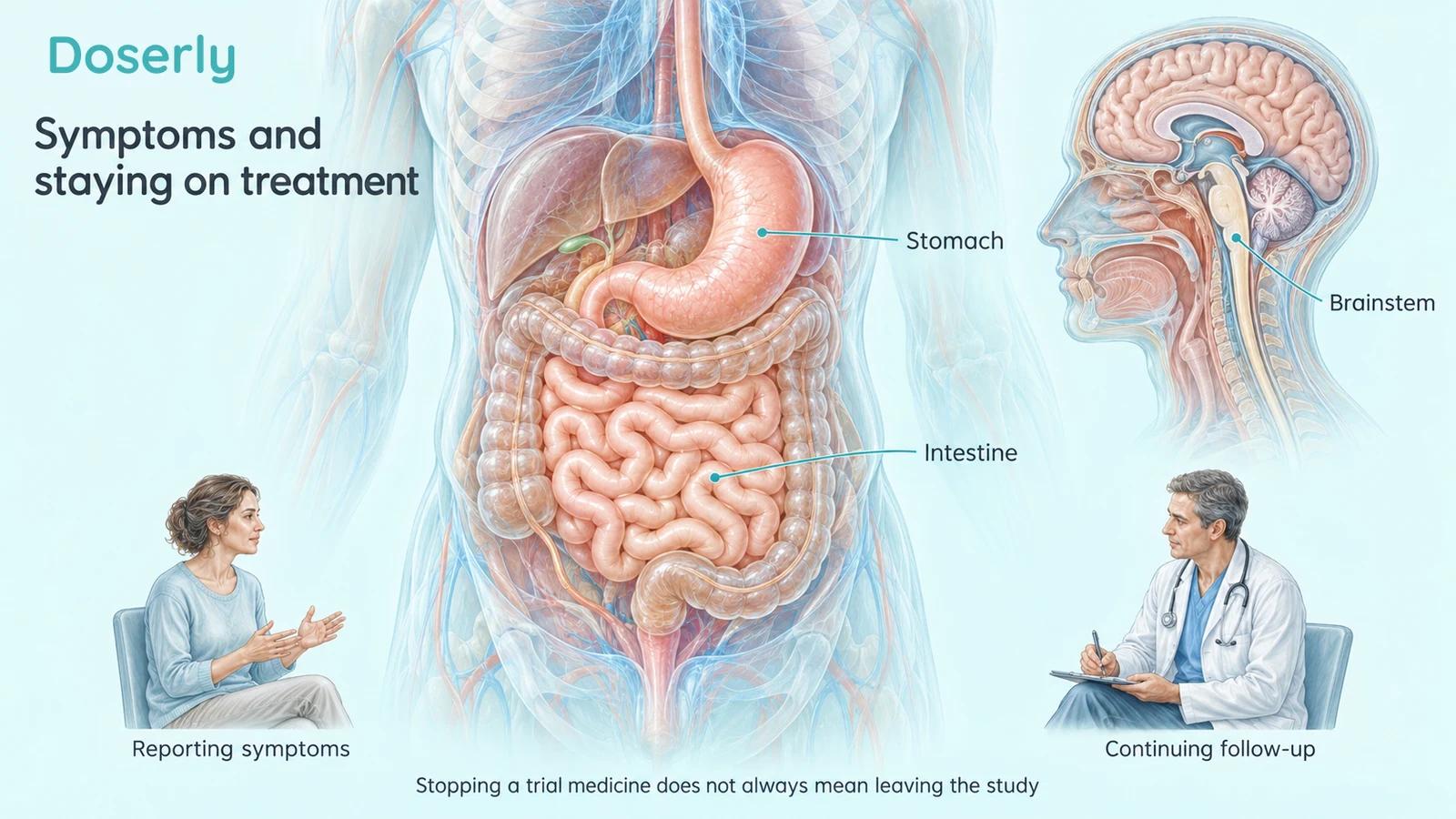
One participant might report nausea and continue treatment. Another might stop injections but still attend research visits. A third could leave the study entirely, making later measurements unavailable. These experiences have different implications for care and for the analysis.
An adverse event is an unwanted medical occurrence during a study. It doesn't automatically mean the study medicine caused it. Calling an event treatment-related reflects an assessment of its possible relationship to the medicine. An event leading to treatment discontinuation tells us treatment stopped in connection with it; that is another category.
The distinction matters when someone says “one in five dropped out.” Were they counting everyone who left, everyone who stopped the medicine, or only stops judged related to it? Was that one treatment group or the whole study? Without these details, the sentence may give a different impression from the report.
A research visit gathers information about both treatment experience and health measurements. Stopping a medicine changes exposure, but continued visits can still show what happens afterward. Regulatory guidance separates treatment discontinuation from missing observations. ICH E9(R1) guidance
What happened in the obesity study?
MOMENTUM enrolled 391 adults with obesity, or overweight and an associated condition, without diabetes. Participants received weekly pemvidutide or placebo for 48 weeks alongside diet and exercise advice. Its main purpose was to examine weight change. MOMENTUM conference abstract
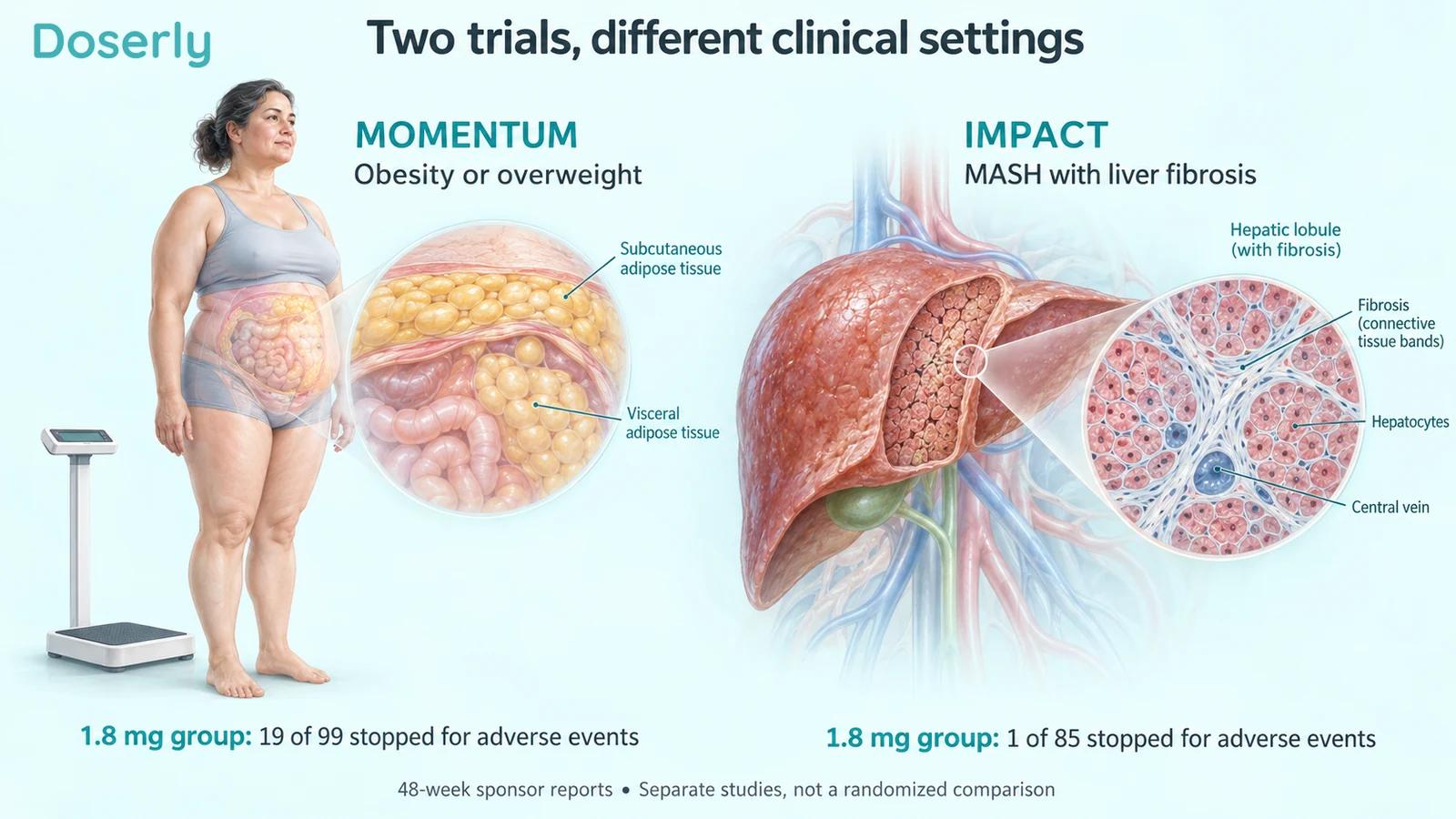
The sponsor reported adverse events leading to treatment discontinuation in 5 of 98 participants receiving 1.2 mg, 19 of 99 receiving 1.8 mg, 19 of 97 receiving 2.4 mg, and 6 of 97 receiving placebo. Those correspond to 5.1%, 19.2%, 19.6%, and 6.2%. This category was broader than events specifically judged drug-related.
At 1.8 mg, 59 of 99 participants reported nausea and 27 reported vomiting. Nineteen stopped because of an adverse event. Those counts describe different outcomes; they don't mean everyone with nausea stopped or that nausea caused every discontinuation. Original MOMENTUM disclosure
A symptom can therefore be common while permanent discontinuation is less common. That doesn't make the symptom trivial. Repeated nausea may affect meals, work, sleep or willingness to continue, even when it never meets the formal definition of a serious event.
Why the schedule belongs in the story
MOMENTUM used no titration for the lower two groups and a short titration period for the highest group. Titration means introducing treatment through planned dose changes rather than starting immediately at the eventual amount. The sponsor presentation states that dose reduction because of intolerability wasn't allowed. MOMENTUM presentation
This changes what the discontinuation rate describes. If someone couldn't tolerate the assigned schedule, the protocol didn't offer every adjustment that might be explored in another study. Persistence was measured under those particular rules.
It would go too far to conclude that a different schedule would have prevented the stops. That requires a direct comparison. The observation instead identifies a development question: can researchers preserve benefit while making treatment easier to sustain?
A decision to stop also isn't a failure of motivation. It may reflect an unwanted effect, a clinical recommendation or a change in circumstances. Reporting these reasons respects participants and makes the evidence more useful.
What happened in the liver-disease study?
IMPACT examined metabolic dysfunction-associated steatohepatitis, or MASH: liver fat accumulation with inflammation and cell injury. Participants had biopsy-confirmed disease and F2 or F3 fibrosis, meaning moderate or advanced scarring. This wasn't a trial of established cirrhosis.
The published 24-week report included 212 randomized participants and assessed tissue-based outcomes, including MASH resolution without worsening fibrosis. That clinical question differs from an obesity trial focused on weight loss. IMPACT publication
In the sponsor's 48-week presentation, adverse events led to treatment discontinuation in none of 41 participants receiving 1.2 mg, one of 85 receiving 1.8 mg, and three of 86 receiving placebo. Yet 35 of 85 people in the 1.8 mg group reported nausea. A low discontinuation count didn't mean an absence of gastrointestinal symptoms. IMPACT 48-week presentation
Why can't those rates explain their own difference?
Randomization makes treatment groups within a study more comparable. It doesn't randomize people between independently conducted trials. MOMENTUM participants weren't randomly assigned to “have obesity” versus “have MASH.”
The difference might involve eligibility, accompanying illnesses, other medicines, study procedures or additional features of trial conduct. Chance also matters, particularly when a group has only one discontinuation event. This comparison cannot isolate those explanations.
The defensible conclusion is therefore specific: tolerability varied across the observed research settings. Neither “pemvidutide is easy to tolerate” nor “one in five users will stop” adequately describes the whole program. Further trials need to establish the experience under the intended treatment schedule in the intended population.
The same issue arises when comparing pemvidutide with another medicine using unrelated trials. Such a comparison becomes more informative when populations, follow-up and symptom collection are similar. A randomized head-to-head study is better suited to deciding whether the medicines actually differ.
How stopping changes the meaning of an average
Consider a hypothetical participant who stops injections after several weeks but returns for the final assessment. Their later weight helps answer a practical question: what happened after assignment to this treatment strategy, including the possibility of stopping?
A second question asks what would have happened had the participant continued. Researchers cannot observe that alternative history. They must estimate it using assumptions and available information.
The precise treatment question is called an estimand. A treatment-policy approach generally includes outcomes regardless of specified changes such as discontinuation. A hypothetical approach estimates outcomes under a stated situation, such as continued treatment. These approaches answer different questions. The label doesn't, by itself, establish whether an analysis was well conducted. FDA statistical guidance
For a person considering treatment, both may be useful. One describes the potential effect of sustained exposure; the other addresses starting a strategy that some people will stop. Confusion arises when a headline quietly substitutes one for the other.
For example, an average based on a continued-treatment scenario shouldn't be presented as a promise to everyone who starts. Equally, a strategy-level estimate doesn't imply that all participants took every scheduled dose. Understanding the question behind the number is more informative than simply choosing whichever percentage looks larger.
What if the final measurement is missing?
Now change the example: the participant stops and doesn't return. Researchers no longer know their final weight. Earlier measurements, reasons for leaving and information from similar participants may help, but they aren't the missing observation itself.
Statistical methods can use those clues to estimate an outcome. The estimates still depend on assumptions. Someone who left because they felt unwell may differ from someone who continued comfortably. An analysis that assumes the same later pattern needs justification.
This isn't a reason to discard every study with missing data. It is a reason to ask how much is missing, why, and whether the conclusion holds under plausible alternative assumptions. A sensitivity analysis examines how the result changes when such assumptions change.
A transparent report follows participants from enrollment to final analysis. The number randomized, number treated, number still receiving treatment and number with an observed final measurement can all differ. Each denominator answers a different question.
These details also prevent a misleading calculation. You can't necessarily subtract treatment discontinuations from the number randomized and assume everyone remaining supplied the final measurement. Some people stop and remain in follow-up; others miss measurements while still classified as receiving treatment.
“Mild” doesn't mean irrelevant
Clinical reports distinguish an event's intensity from whether it meets criteria for seriousness. A recurring mild symptom may still disrupt a person's routine. A serious event is categorized by consequences such as hospitalization or a threat to life, rather than simply by a discomfort score.
That helps explain how a report can describe most gastrointestinal events as mild to moderate and still show meaningful discontinuation. Neither description cancels the other. Someone may reasonably find persistent mild nausea unacceptable even if they don't require urgent care.
Useful future reporting would describe when symptoms started, how long they lasted, whether they recurred and how they affected eating and daily activities. A single “any nausea” percentage doesn't provide that information.
Duration also matters for interpreting safety. A trial can provide reassuring information over its observed period while remaining too small or short to identify uncommon or delayed harms. Conversely, an adverse event occurring during treatment isn't automatically attributable to that treatment. Comparing both groups and examining individual events remains necessary.
The denominator can change the apparent story as well. An adverse-event table usually counts people who experienced an event at least once, while a participant-flow diagram records why people stopped treatment or left the study. Those records answer different questions. A reader should not subtract the number reporting nausea from the number randomized and call the remainder the people who tolerated treatment. Many people with nausea continued, and some people stopped for other reasons.
What belongs in a treatment conversation?
Begin with the problem being treated: obesity, liver disease or another condition. Then ask which study population best matches that goal. The benefit being sought and acceptable treatment burden may differ depending on the clinical situation.
Useful questions include how often participants stopped, what counted as a stop, and whether the efficacy estimate includes those experiences. If someone proposes changing the schedule, ask what evidence supports that change. A plausible adjustment isn't automatically a validated approach.
For trial participants, the research team needs to know about symptoms and missed treatment. A dated record of bowel changes, nausea, food intake and medication changes can make a conversation more accurate. It doesn't prove causation, but it helps describe what happened and when.
It can also help to state a functional goal alongside the numerical goal. Being able to eat adequately, work comfortably or follow daily routines is relevant even when a laboratory result or weight measurement improves. Treatment experience is part of assessing value, not an interruption of that assessment.
Pemvidutide's research warrants attention, and its differing tolerability results make the next studies especially informative. The useful account keeps benefit, symptoms, persistence and follow-up together. Our pemvidutide guide explains how these trials fit into the broader development program.
Sources
- MOMENTUM 48-week topline results — sponsor trial disclosure, 2023.
- 48-Week IMPACT Phase 2b Topline Data Presentation — sponsor trial disclosure, 2025.
- Safety and efficacy of weekly pemvidutide versus placebo for MASH (IMPACT): 24-week results — human rct, 2025.
- ICH E9(R1): Estimands and Sensitivity Analysis in Clinical Trials — regulatory guidance, 2021.
- MOMENTUM 48-week trial presentation — sponsor trial disclosure, 2023.
- 262-OR: Pemvidutide in overweight or obesity, MOMENTUM — conference abstract, 2024.