
Peptides
October 16, 2026
Pemvidutide for alcohol use disorder: what RECLAIM found
On this page
Alcohol use disorder is a medical condition that can make drinking difficult to control despite harmful consequences. Treatment goals can include stopping drinking, reducing heavy drinking and improving daily life. The possibility that medicines acting on GLP-1 pathways might help has generated interest, especially among people who have found existing approaches difficult.
Pemvidutide now has more than a theoretical rationale in this area. In July 2026, its developer reported positive results from RECLAIM, a randomized phase 2 trial in people with alcohol use disorder and overweight or obesity. The result is encouraging, but it remains a sponsor-reported early trial, not an established treatment recommendation or evidence that everyone will stop drinking.
This article explains what changed, what the outcomes mean and what would make the next round of evidence more convincing. The Doserly pemvidutide guide covers the wider drug-development program.
What RECLAIM was designed to test
RECLAIM randomized 100 adults to pemvidutide or placebo for 24 weeks. The registry describes moderate or more severe alcohol use disorder, BMI of at least 25, and substantial drinking before enrollment. Its primary outcome was the change in average heavy-drinking days per week, comparing baseline with weeks 21–24. A heavy-drinking day was defined as at least five drinks for men or four for women. RECLAIM registry
Participants were seeking to reduce or stop drinking, and both groups received a standardized behavioral intervention. The sponsor presentation describes 50 people in each assigned group. This means the comparison was treatment plus trial support versus placebo plus trial support—not a medicine versus no care at all. RECLAIM results presentation
That context matters for interpreting improvement in the placebo group. Contact with a treatment team, behavioral support, motivation to change and other trial features can influence drinking. Improvement without active drug is not evidence that the condition is imaginary. The randomized comparison is intended to estimate what the medicine added within that setting.
The study also selected for safety. The registry excluded people with clinically significant withdrawal symptoms, previous hospitalization for alcohol intoxication or withdrawal, and certain alcohol-related complications. Results from this selected population cannot establish that pemvidutide is suitable for managing acute withdrawal or for everyone with severe medical complications. RECLAIM registry
The main finding: a greater reduction in heavy-drinking days
The sponsor reported adjusted mean reductions of 4.20 heavy-drinking days per week with pemvidutide and 2.75 with placebo. The between-group difference was 1.45 fewer heavy-drinking days per week, with a reported p value of 0.0014. These are changes from baseline, not the number of heavy-drinking days remaining at the end. July 2026 topline report
That distinction prevents an easy misreading. A reduction of four days does not mean a person drank on four days, stopped drinking entirely, or had exactly the same response as the group average. The reported means summarize a statistical comparison across participants.
The result supports further study because the active group improved more on the outcome the trial was designed to test. It does not establish how durable the effect is after treatment ends, how it compares with approved alcohol-use-disorder medicines, or whether the benefit will be similar in people outside the eligibility criteria.
A larger follow-up trial should provide confidence intervals as well as p values, detailed participant flow and transparent handling of missing drinking records. Those details help readers assess the size and precision of the benefit rather than relying on the word “significant.”
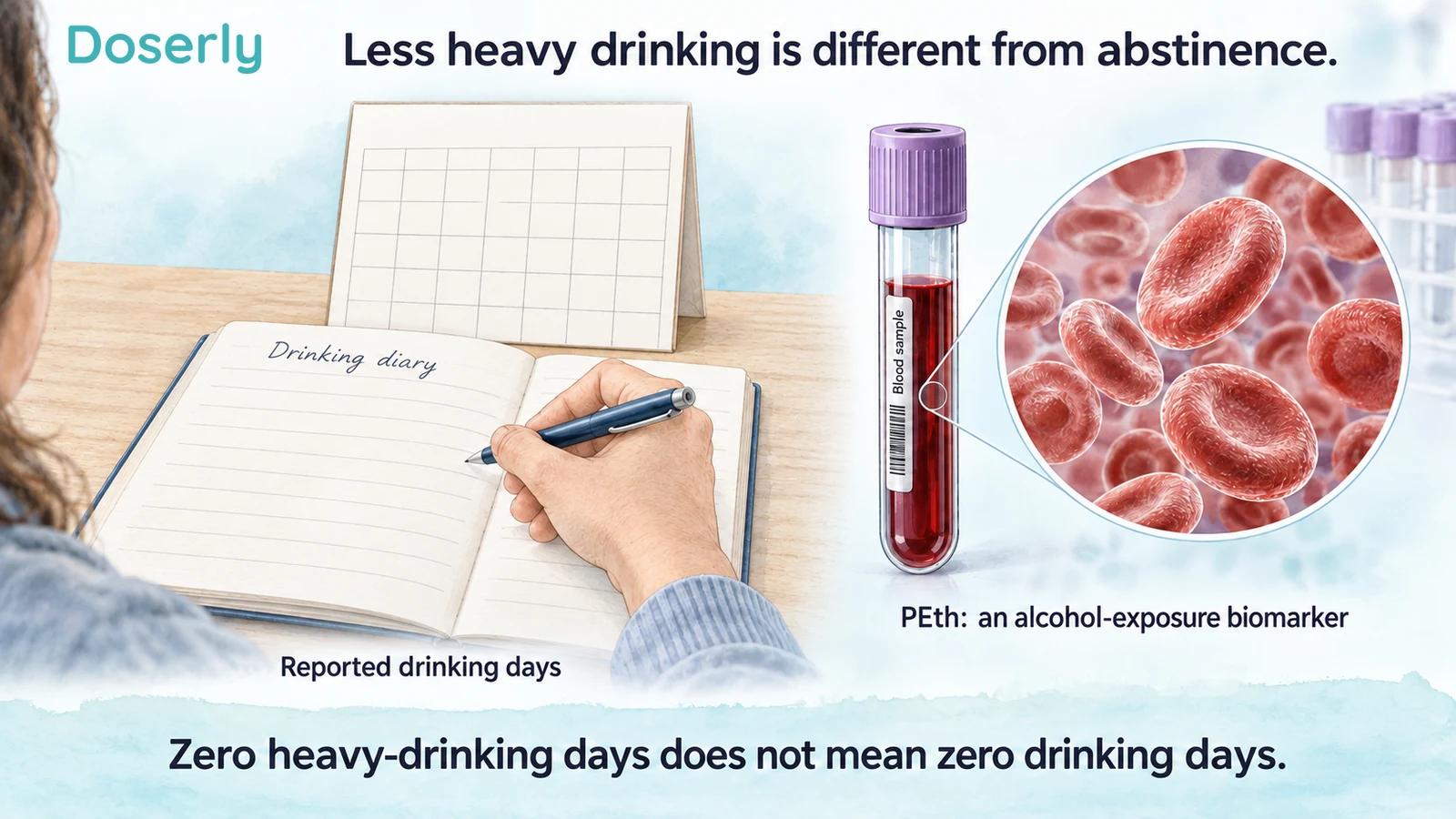
Zero heavy-drinking days does not mean abstinence
The sponsor reported that 42.2% of evaluated pemvidutide participants and 17.4% of evaluated placebo participants had no heavy-drinking days during weeks 21–24. The counts were 19 of 45 and 8 of 46, respectively. Those denominators are smaller than the 50 participants randomized to each group. July 2026 topline report
Someone can meet the “no heavy-drinking days” definition while still drinking below the study's daily threshold. Conversely, someone may have many abstinent days but still have a heavy-drinking episode. Both outcomes can be useful, but they describe different patterns.
For an invented example, imagine two people observed over four weeks. One has no alcohol on most days but one episode above the trial threshold. The other drinks on several days but never reaches that threshold. The second person can satisfy “zero heavy-drinking days,” while the first cannot. This example explains the classification; it is not advice about a safe amount to drink.
The separate outcome of change in percentage of abstinent days also needs careful wording. An increase in that percentage is not the same as the proportion of people who remained continuously abstinent. A headline that replaces either measurement with “quit drinking” would change the meaning of the result.
The denominator tells you who is being described
The presentation reports that 40 pemvidutide participants and 39 placebo participants completed treatment, while 45 and 46 completed the study. Some people therefore remained under observation after stopping the assigned treatment. RECLAIM results presentation
This is useful information, not a technical footnote. A treatment can look different when the question is “what happened while people kept taking it?” versus “what happened after people were assigned to try it?” Both can matter, but they should not be mixed without explanation.
For illustration, 19 of 45 is 42.2%, while 19 of 50 is 38%. The second calculation is simply the same numerator divided by the randomized group size. It is not a replacement trial estimate, because it assumes a particular way of treating missing observations. It shows why the missing-data method can affect a response percentage.
A full report should explain which participants contributed to each outcome, whether data after treatment discontinuation were collected, and how missing data were handled. It should also show sensitivity analyses when reasonable alternative assumptions could change the interpretation. None of this negates the positive primary result; it determines how confidently the finding can be applied.
Why PEth is useful alongside drinking reports
RECLAIM included phosphatidylethanol, usually shortened to PEth, as an objective marker of alcohol exposure. The sponsor reported a greater decrease with pemvidutide than placebo, alongside the self-reported drinking outcomes. The presentation identifies PEth as a marker of recent alcohol intake. RECLAIM results presentation
Using a biomarker alongside a drinking diary can strengthen the overall picture because the two measures obtain information differently. Agreement is reassuring. Disagreement would deserve investigation rather than an assumption that one measure always tells the whole story.
PEth is not a liver-biopsy result, a measure of recovery from alcohol-related harm or a complete account of a person's life. A lower group average cannot show that every participant was abstinent. The most useful interpretation is that it provides another view of alcohol exposure within the trial.
Tolerability belongs beside the benefit
In the 50-person pemvidutide group, nausea occurred in 44%, compared with 24% on placebo. Five active-treatment participants stopped treatment because of events judged drug-related. One serious event of low blood sodium was considered possibly related to treatment. These findings deserve attention alongside the drinking results. July 2026 topline report
A short trial cannot fully characterize uncommon adverse effects. It also cannot establish that an appetite-affecting medicine is appropriate for someone with poor nutrition, major medical illness or a different body-weight profile. Those are questions for further study and individualized medical assessment.
Tolerability can also affect interpretation of behavior. If people feel unwell, the full report needs enough information to help researchers evaluate how adverse effects, treatment continuation and drinking changes relate. That does not mean nausea explains the observed benefit. It means that a useful treatment must demonstrate a favorable overall experience, not just a favorable number for consumption.
Other GLP-1 research supports interest, not interchangeability
A 2025 randomized trial studied weekly injectable semaglutide in 48 adults with alcohol use disorder who were not seeking treatment. Over nine weeks, it reduced alcohol consumed during a laboratory task and improved some drinking and craving measures, but did not significantly change every consumption outcome. Original semaglutide trial
A separate 2026 trial studied oral semaglutide in 50 treatment-seeking adults over eight weeks. Its primary laboratory craving outcome was not significantly improved, while heavy-drinking days and several other measures favored semaglutide. Reporting both aspects avoids turning mixed outcomes into an unqualified success story. Original oral-semaglutide trial
These studies make further research into GLP-1-based approaches reasonable. They do not establish a uniform class effect, prove that pemvidutide is better, or identify the contribution of its glucagon component. Differences in molecule, formulation, participants, duration and primary outcome prevent a simple ranking from these small studies.
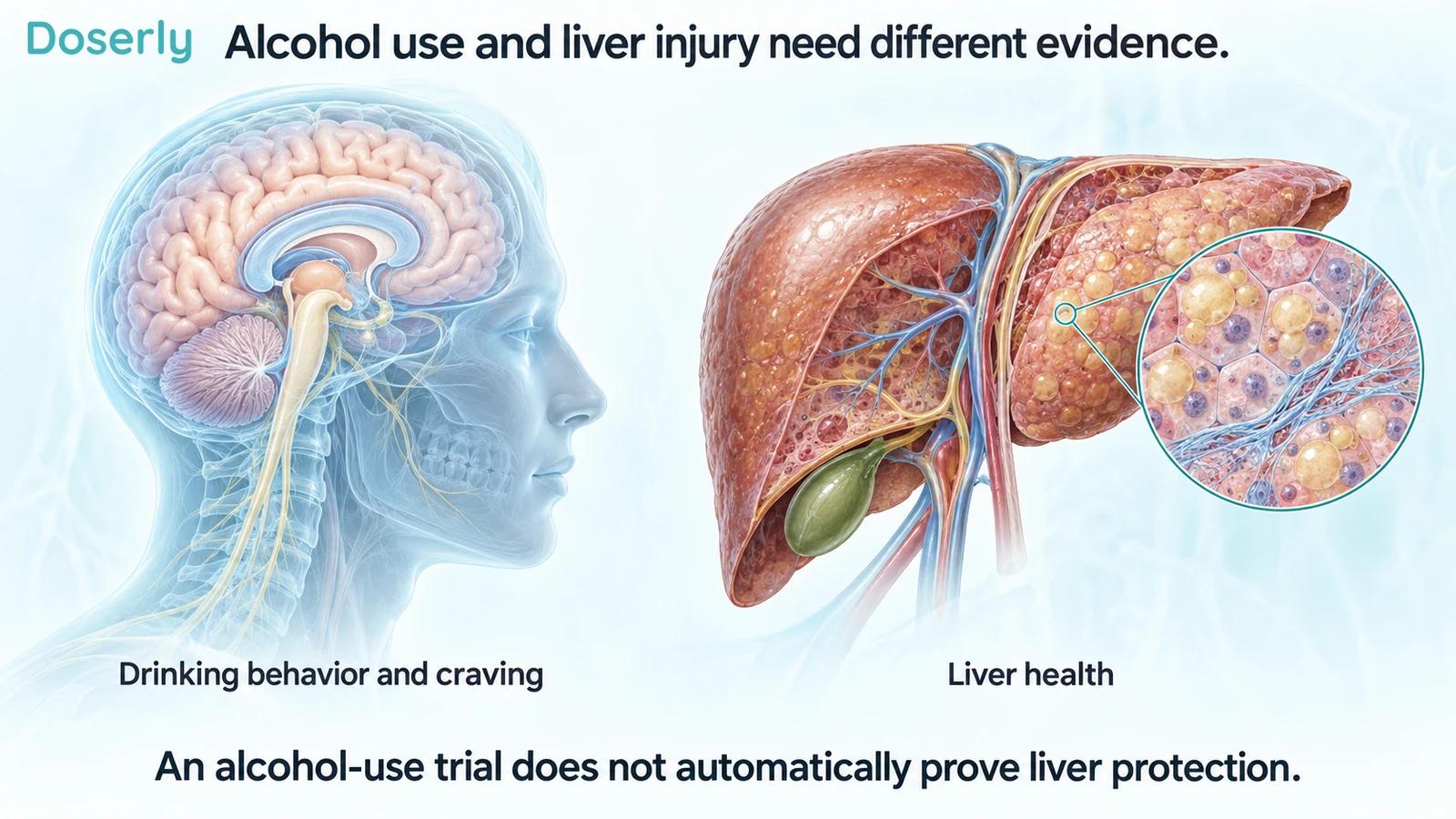
The same distinction applies to liver claims. A medicine could affect drinking behavior without demonstrating reversal of established fibrosis. Pemvidutide's trials in metabolic liver disease address a different population and should not be used as if they were outcomes from RECLAIM.
What convincing next-stage evidence would look like
The most useful next step would be a larger trial with a clearly specified main outcome, adequate follow-up and transparent results for all assigned participants. It should examine sustained drinking changes, adverse effects, treatment retention and outcomes people notice in daily life. Replication matters because one small trial can estimate benefit imprecisely even when its primary comparison is statistically persuasive.
The full RECLAIM report should also clarify the statistical testing plan for its multiple secondary outcomes. A positive result on several related measures is encouraging, but it is not the same as several independent trials. The measures come from many of the same participants and may move together.
Comparisons with established care would eventually help answer a practical question: where would this treatment fit for people who need help? That includes whether it adds benefit, who tolerates it, and how it works with behavioral support. A phase 2 placebo-controlled result starts that conversation; it does not finish it.
The trial registry also lists measures of alcohol-related consequences, including the Short Inventory of Problems and a PROMIS negative-consequences measure. These can help connect a change in drinking to problems people experience, although the topline release does not supply a complete account of those outcomes. A full publication should report them rather than letting favorable consumption measures stand in for every aspect of recovery. RECLAIM registry
That information would help answer whether fewer heavy-drinking days accompany fewer alcohol-related difficulties in work, relationships or health. It is a distinct question from whether the medicine changes weight or a laboratory biomarker.
Help does not have to wait for a new medicine
In the United States, approved alcohol-use-disorder medications include naltrexone, acamprosate and disulfiram. Behavioral treatment and support are also available, and an appropriate plan depends on health history, goals and preferences. People can seek care through primary care or addiction specialists rather than waiting for an investigational drug. NIAAA treatment guide
If someone drinks heavily and may be physically dependent, stopping abruptly can cause dangerous withdrawal. Medical advice is important before making that change; seizures, severe confusion or other severe withdrawal symptoms require urgent care. RECLAIM did not establish pemvidutide as a withdrawal treatment. NIAAA guidance on diagnosis and recovery
As of this October 2026 review, the RECLAIM evidence checked here is a registry plus sponsor-reported results, with a peer-reviewed full report not located. It is a meaningful development that warrants further study. It is also an invitation to ask precise questions about drinking patterns, safety and durable recovery—not a reason to postpone care that is available now.
Explore the research
- RECLAIM registry — eligibility and prespecified outcomes.
- July 2026 topline report — sponsor efficacy and safety results.
- Results presentation — trial support, participant disposition and biomarker context.
- 2025 injectable-semaglutide trial and 2026 oral-semaglutide trial — separate medicines/formulations and populations, not pemvidutide replication.
- NIAAA treatment guide and diagnosis and recovery guidance — available care and withdrawal considerations.