
Peptides
October 16, 2026
PEG-MGF stacks: how several untested links compound uncertainty
On this page
A peptide stack can sound convincing when each ingredient has a different job in the explanation. One is said to recruit repair cells, another to build tissue, and a third to extend the response. The story appears complete because the proposed roles fit together.
But a coherent story is not a tested combination. For PEG-MGF stacks, the unresolved questions begin before synergy: which molecule was studied, whether it reaches the intended tissue in people, whether its proposed effect is reproducible, and whether combining it with another substance changes benefit or harm.
Adding more mechanisms does not make those missing answers disappear. It creates a combination that needs evidence of its own. This article explains the gaps without providing a stack, cycle or administration schedule. The Doserly PEG-MGF guide provides broader background on the compound and its evidence.
First, identify what “MGF” means in the claim
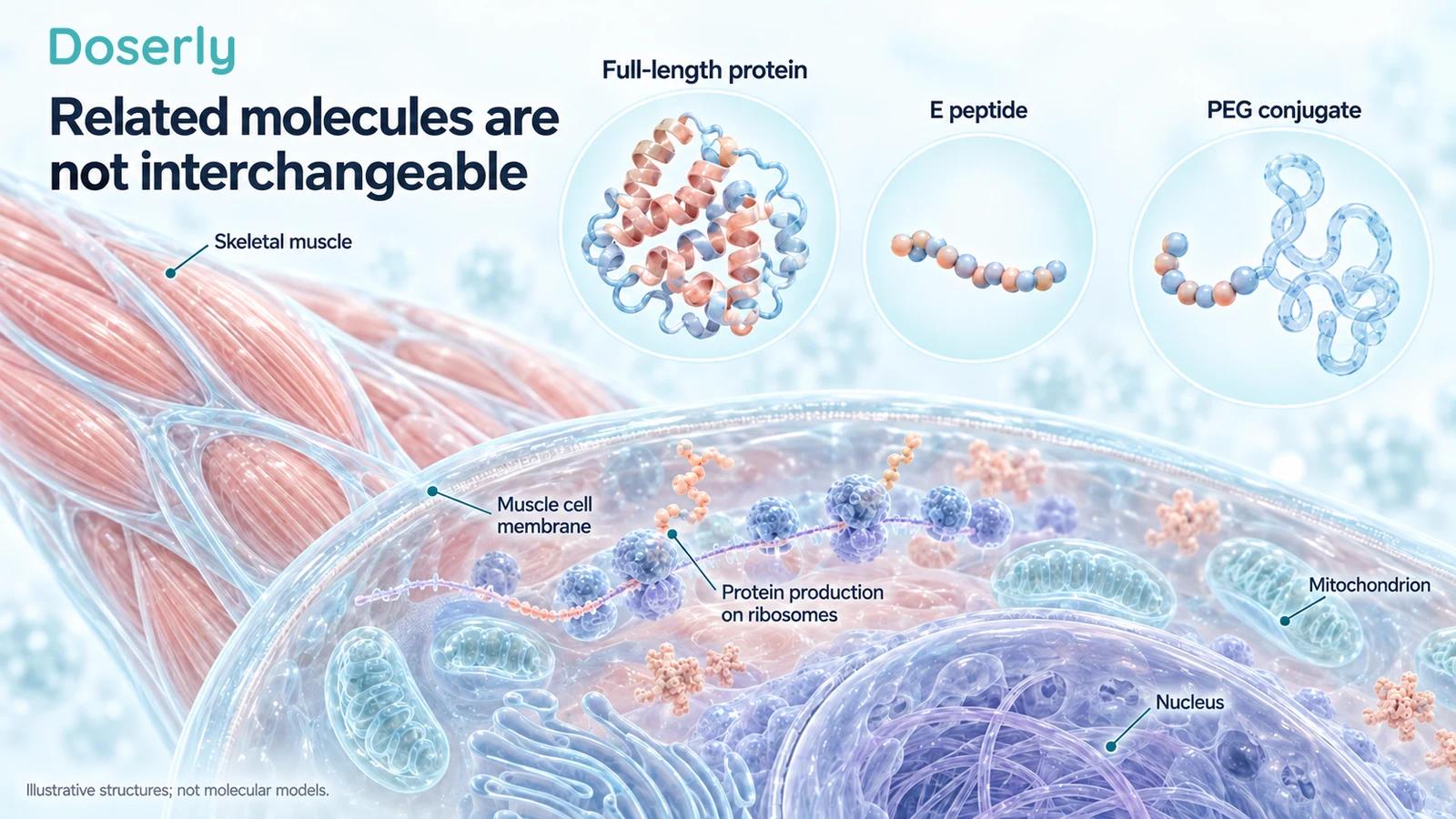
Scientific papers do not always use MGF to describe the same material. The name can appear in discussions of an IGF-1 splice variant, a corresponding full-length protein, or a short E-domain peptide. A PEG-conjugated preparation adds another identity question. Treating all of these as one substance makes the evidence seem more continuous than it is.
The distinction is visible in a receptor experiment by Janssen and colleagues. The researchers compared full-length MGF, human MGF and a stabilized MGF analogue, alongside other ligands. Full-length MGF activated the IGF-I receptor under the tested conditions; the shorter human MGF and stabilized analogue did not show that activation. The paper therefore cannot be summarized as “all MGF products activate IGF receptors.” Janssen and colleagues, 2016
Nor was this a human trial of a PEG-MGF stack. It was an in-vitro receptor study. The result helps explain why material identity matters; it does not validate a commercial combination or predict its clinical effect.
When a stack explanation cites this research, ask whether it preserves the names of the tested constructs. Replacing those names with a convenient product label is an unsupported step, even if the citation itself is genuine.
Exercise biology does not provide a dosing timetable
Some stack narratives begin with a natural sequence: exercise changes local signals, different processes occur during recovery, and externally administered peptides should supposedly be timed to reproduce them. The first part can be studied without establishing the rest.
Hameed and colleagues examined IGF-I splice-variant messenger RNA in muscle from young and older people after resistance exercise. This was human research, but the intervention was exercise and the measurements concerned endogenous expression. It was not a comparison of injected PEG-MGF schedules. Hameed and colleagues, 2003
That difference is easy to miss in a reference list. “Human study” sounds reassuring until the reader checks what the humans actually received. A biopsy study can reveal a biological response without testing any drug at all.
Expression timing also does not directly specify an external exposure target. Messenger RNA is a measurement of gene expression, not a prescription for a circulating concentration. A schedule inferred from it would require additional evidence about the administered product, tissue exposure and clinical outcomes.
The appropriate conclusion is that exercise biology can generate hypotheses. It cannot supply a validated sequence for combining untested preparations.
The timing story is not uniform across experiments
Another resistance-exercise study, by Psilander and colleagues, measured several myogenic regulatory factors and IGF-I messenger-RNA groupings over recovery. Some regulatory-factor transcripts rose transiently; the combined IGF-IEabc measurement decreased at certain early time points, while the IGF-IEbc measurement was unaffected. Psilander and colleagues, 2003
Those details do not need to become a memorization exercise. Their importance is that biological measurements depend on exactly what was measured and under which conditions. Different transcript groupings cannot automatically be substituted for one another.
A stack timetable that compresses this literature into “first this signal, then that signal” can erase differences in exercise protocol, sampling and assay targets. Even a reproducible endogenous pattern would still need an intervention study before it could support a treatment schedule.
Readers should therefore be cautious when precise timing is presented with no study of the precise intervention. Apparent precision can come from an attractive diagram rather than from clinical evidence.
A plausible role is not a demonstrated effect
The proposed job assigned to an ingredient must also be tested. If a stack depends on an MGF peptide reliably stimulating muscle precursor cells, evidence about that effect matters before any claim about adding another agent.
Fornaro and colleagues attempted to reproduce reported MGF-peptide effects in muscle-cell systems. They did not observe the expected proliferation or differentiation effects in their experiments, while relevant responses occurred with mature IGF-1 or full-length IGF-1Eb controls. Fornaro and colleagues, 2014
The finding does not establish that every related preparation is inactive under every condition. It does challenge the idea that the proposed E-peptide effect is a settled foundation on which a stack can simply be built.
This is an important distinction between a missing experiment and a conflicting experiment. A claim with no direct test remains uncertain. A claim facing unsuccessful replication also needs to account for the disagreement. Adding a second compound does not resolve either issue.
A balanced explanation should state what was tested and what failed to reproduce, rather than dismissing inconvenient studies or declaring that one experiment has answered every clinical question.
“Works together” can mean several different things
Combination claims often use synergy loosely. They may mean that two substances affect different pathways, that the combination performs better than no treatment, or that it performs better than either component alone. These are different propositions.
Suppose a hypothetical study finds that a combination improves a functional outcome compared with placebo. Without suitable component comparisons, it may remain unclear whether both ingredients contributed. One could account for the whole effect; the other might add no benefit.
Even a combination that outperforms either component is not automatically proof of synergy in a technical sense. That term requires a defined expectation for the combined effect and an analysis appropriate to the outcome. A diagram showing two converging arrows does not establish that relationship.
FDA's guidance on developing two or more new investigational drugs discusses demonstrating the contribution of individual components and evaluating the combination. Its scope is formal drug development, not endorsement of consumer peptide stacks, but the underlying research question is useful: what does each component add? FDA combination-development guidance
For a reader, the key is to request the comparison behind the claim. Evidence that A affects cells and B affects cells does not tell us what A plus B does in a person.

Uncertainty accumulates without a reliable percentage
It is tempting to describe a stack as having several independent chances of success and multiply guessed probabilities. That would create a number without a defensible basis. The uncertainties may be related, and their probabilities are usually not known.
A more useful approach is to list the unanswered links. Is the material correctly characterized? Does the proposed mechanism occur with that material? Is the relevant exposure achieved? Does that response improve a meaningful outcome? Does the combination preserve an acceptable safety profile?
A strong result at one link cannot automatically repair a weak result at another. Excellent chemical characterization does not establish clinical benefit. A cell response does not establish human exposure. A subjective improvement does not characterize the product.
This is what compounding uncertainty means here: the conclusion depends on several unsupported transitions. It does not mean that harm or failure can be assigned an invented numerical likelihood.
That approach also keeps criticism proportionate. The evidence can be inadequate for a confident claim without proving the opposite claim. “Not established” is a substantive finding when a product is being promoted as predictable.
Safety is a combination question too
When substances are combined, researchers need to consider how the combination changes exposure and biological effects. A lack of documented interactions is not the same as a study showing that interactions do not occur. The absence may simply reflect a lack of testing.
FDA's PEG-MGF entry states that it has not identified human exposure data for drug products containing PEG-MGF through any administration route. It also flags immunogenicity, peptide-related impurities and active-ingredient characterization concerns. These are unresolved safety questions for PEG-MGF itself, before another ingredient is added. FDA compounding safety information
The statement should not be inflated into a precise harm rate or a claim that every exposure causes injury. Equally, it should not be softened into reassurance because an online discussion contains few adverse-event reports.
A stack can also make attribution harder. If a person develops symptoms after several changes, the timing alone may not identify which change contributed. That is one reason a list of ingredients is not equivalent to a studied treatment regimen.
If someone is already using multiple products, an accurate list of names, dates and other medicines can help a clinician assess the situation. Recording exposure is useful clinical context, not a method for proving that continued use is safe.
Why a detailed anecdote still cannot isolate the effect
A person may describe a real improvement after starting a stack. The observation deserves an accurate account, but it does not reveal the counterfactual: what would have happened without the combination.
Recovery itself changes over time. Training load, nutrition, sleep, rehabilitation and expectations may change alongside product use. If several variables move together, a before-and-after account cannot reliably assign the result to one ingredient or to synergy.
More detail improves the account's usefulness but does not automatically change its design. A spreadsheet of symptoms remains an uncontrolled observation if it lacks an appropriate comparison. Conversely, a vague testimonial should not be treated as equivalent to a trial merely because it includes a scientific explanation.
Adverse experiences have a similar limitation. They can identify concerns worth investigating, but without clear exposure information and denominators they cannot establish how frequently a particular stack causes a particular problem.
The practical distinction is between documenting an experience and estimating a treatment effect. Both can matter, but they support different conclusions.
What would make the claim more credible?
Useful combination research would start with defined materials and a defensible reason to study them together. It would then assess exposure, relevant biological responses, meaningful outcomes and safety using designs appropriate to the question.
Where feasible and ethical, comparisons with the individual components help determine whether each contributes. The outcome should match the promise: a muscle-growth claim needs relevant tissue measurements, while a recovery claim needs recovery outcomes. Neither can be replaced by an appealing mechanism alone.
Study reports should also make uncertainty visible. How many participants were studied? How long were they followed? Were outcomes prespecified? What happened to people who discontinued? Did the result persist beyond an early measurement?
No single checklist guarantees a reliable conclusion, but these questions reveal whether the evidence actually concerns the combination being promoted. They are more informative than counting references or ranking stacks by the number of pathways mentioned.
For IGF-1 LR3 terminology that sometimes appears in these discussions, the Doserly IGF-1 LR3 guide provides separate background. Evidence about LR3 should not be transferred to PEG-MGF, or to their combination, without direct support.
A PEG-MGF stack remains an unvalidated combination when its argument depends on borrowed mechanisms, inferred timing and untested interactions. The most useful next step is better evidence about those links—not greater confidence in a more elaborate story.
Sources
- Janssen and colleagues: full-length MGF and receptor activation (2016).
- Hameed and colleagues: exercise and human IGF-I splice-variant expression (2003).
- Psilander and colleagues: resistance exercise and muscle messenger RNA (2003).
- Fornaro and colleagues: MGF-peptide replication experiments (2014).
- FDA: codevelopment of new investigational drugs in combination.
- FDA: bulk substances that may present significant safety risks.