
HRT
October 16, 2026
Patches Versus Pills: What Route Can Change About HRT Risk
On this page
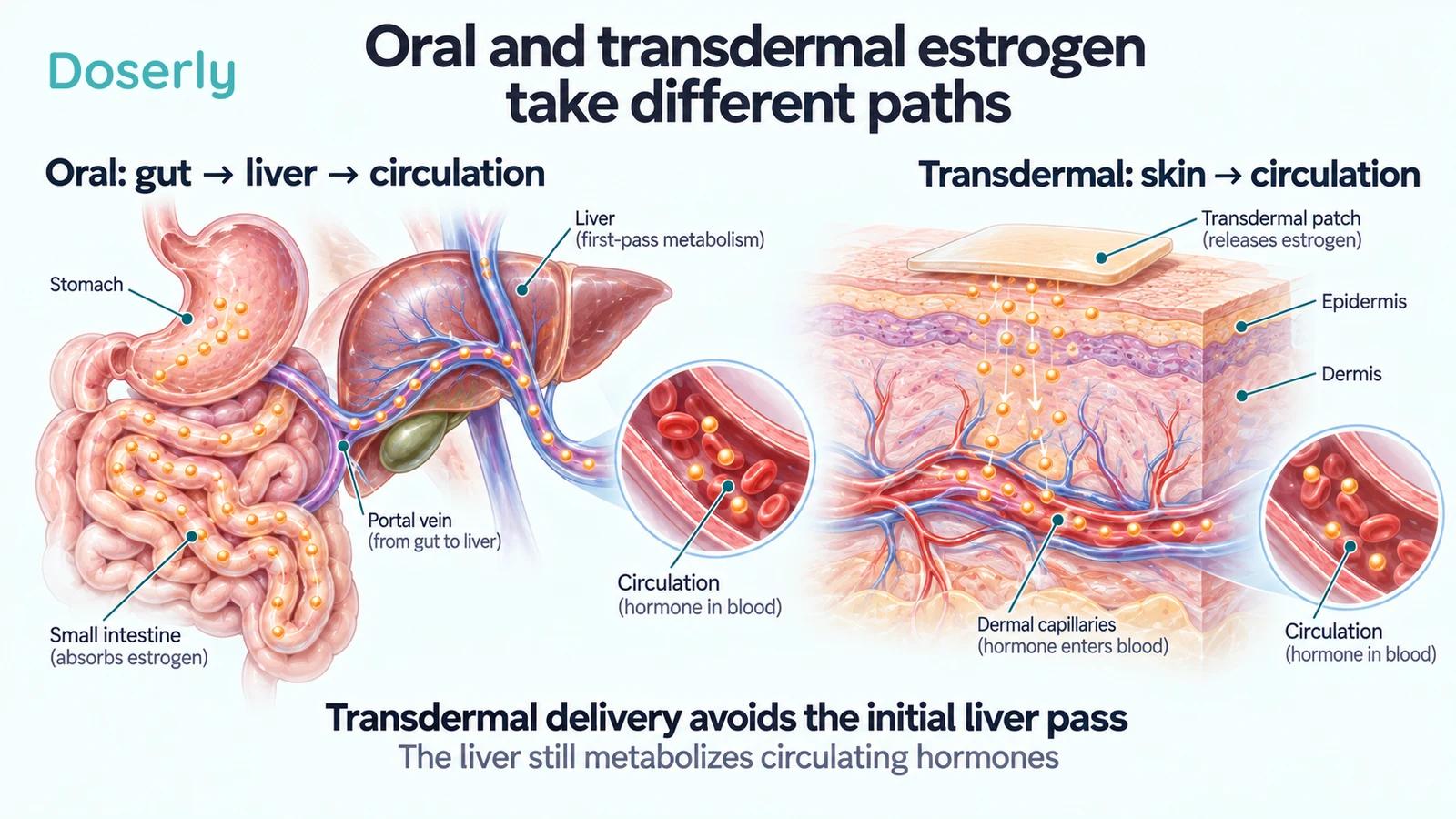
A prescription for an estrogen patch can look like a small change from an estrogen tablet. For the liver and blood-clotting system, the change can be meaningful. Estrogen swallowed through the digestive tract reaches the liver before entering the wider circulation. Estrogen absorbed through skin enters the circulation without that initial concentrated liver exposure.
That difference helps explain why clinicians often favor transdermal estrogen for people with increased risk of venous blood clots. It does not mean that a patch is local treatment, that the liver never encounters it, or that every cardiovascular outcome is identical across preparations. Route is one part of a prescription that also includes the molecule, dose, any progestogen, and the person taking it.
The useful question is specific: which risk might change when estrogen moves from a pill to a patch or gel, and how strong is the evidence? The clearest clinical discussion concerns venous thromboembolism. Stroke, heart attack, breast outcomes and endometrial protection each need their own evidence.
The first liver pass explains part of the difference
After an oral dose is absorbed from the gut, blood carries it through the portal circulation to the liver. This first pass influences the production of several liver-derived proteins, including proteins involved in clotting. Transdermal estradiol passes through skin into blood vessels, avoiding that initial portal delivery. Circulating hormone is still subsequently metabolized, including by the liver.
A small randomized crossover study illustrates the biological distinction. Twenty-one postmenopausal participants received oral conjugated equine estrogens, transdermal estradiol and placebo in separate treatment periods. Oral treatment more than doubled C-reactive protein, an inflammatory marker, while transdermal treatment did not have the same effect. The investigators interpreted this as a liver effect rather than a generalized rise in the measured inflammatory cytokines. Randomized route study, 2003
There are two limits to that example. It compared different estrogen molecules as well as different delivery routes, and a change in a blood marker is not a count of heart attacks. The study helps explain a mechanism; it cannot establish how many clinical events a patch prevents.
The strongest distinction concerns venous blood clots
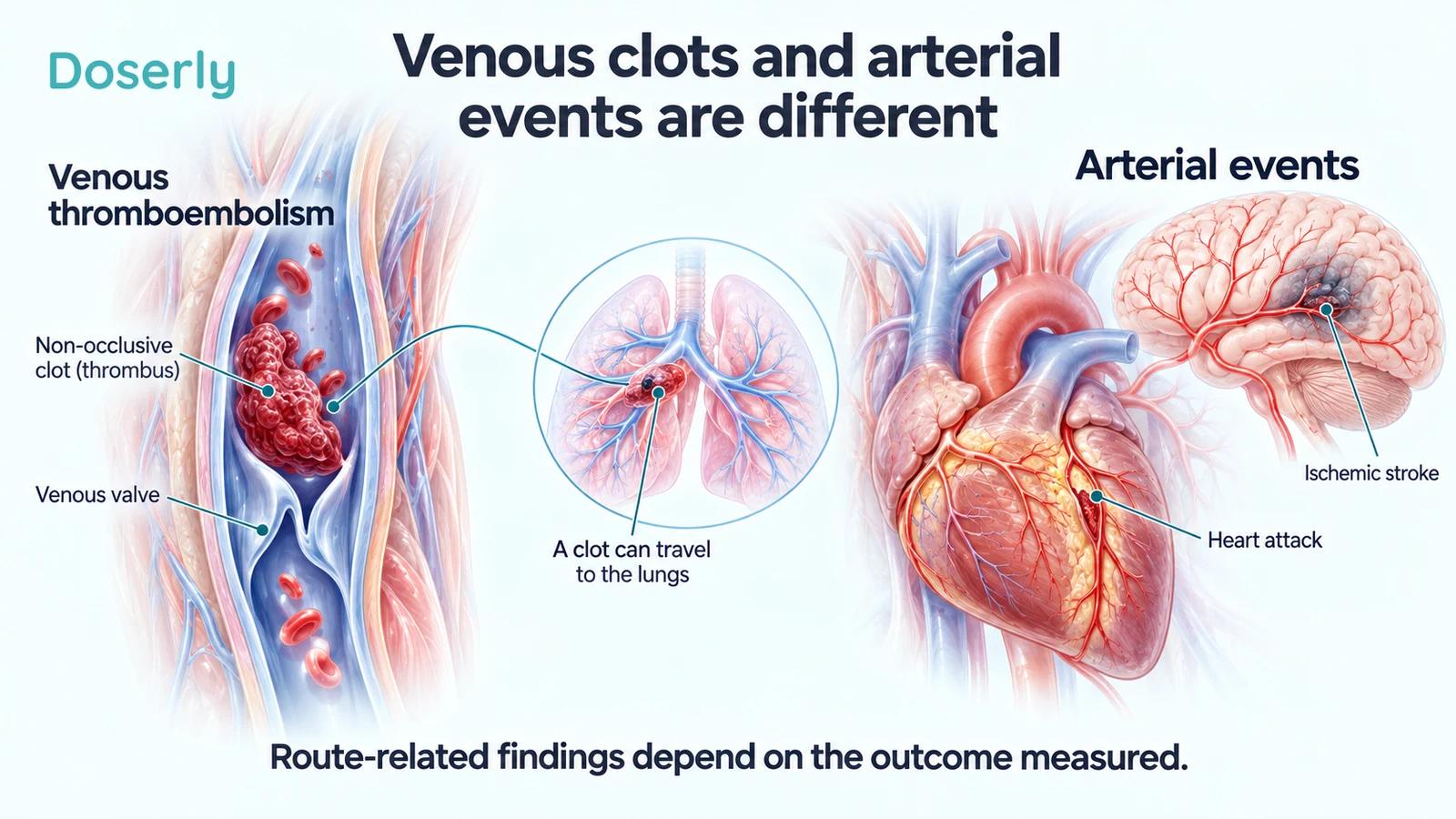
Venous thromboembolism, or VTE, includes a clot in a deep vein and a pulmonary embolism, in which clot material travels to the lungs. This is a different disease pathway from most heart attacks or ischemic strokes, which involve the arterial circulation. Calling all three “clot risk” can hide important differences in the evidence.
The ESTHER case-control study compared 271 women with a first idiopathic VTE with 610 controls. Relative to nonuse, the adjusted odds ratio was 4.2 for oral estrogen and 0.9 for transdermal estrogen. The confidence intervals were wide: 1.5–11.6 and 0.4–2.1, respectively. Transdermal use was not associated with an increase in that study; the result does not prove that its risk was exactly zero. ESTHER, 2007
A much larger UK analysis included 80,396 VTE cases and 391,494 matched controls. Oral HRT was associated with increased VTE odds, with an adjusted odds ratio of 1.58. Transdermal preparations were not associated with an increase, with an estimate of 0.93 and a confidence interval of 0.87–1.01. Different oral preparations also had different associations, so “oral HRT” was not a single interchangeable exposure. UK database study, 2019
These are observational studies. Clinicians may choose patches for patients whose underlying risks differ from those prescribed pills, and a prescription record cannot confirm every dose taken. Statistical adjustment helps but cannot remove every difference. Nevertheless, the consistency of the VTE findings, alongside the biological evidence, gives route a legitimate place in prescribing discussions.
The latest large study adds reassurance and a caveat
A Danish nationwide study published in September 2026 examined contemporary menopausal hormone therapy and three separate outcomes: VTE, ischemic stroke and myocardial infarction. It drew on national registries from 2003–2021 and included women aged 50–69 without specified prior conditions, including previous venous or arterial thrombosis. It was a nested case-control study, not a randomized comparison. Danish study, 2026
Oral therapy was associated with higher rates of all three outcomes. The reported hazard ratios were 1.6 for VTE, 1.3 for ischemic stroke and 1.2 for myocardial infarction. The estimated annual absolute increases were 0.09, 0.06 and 0.03 percentage points, respectively. For VTE, 0.09 percentage points is about nine additional events per 10,000 women over a year in the study's setting.
Those absolute estimates are more useful than a relative increase alone, but they are not a personal forecast. They depend on the study population, its baseline rates and its exposure definitions. A person with a previous clot was outside the population used for these estimates.
Most transdermal findings were reassuring, but one subgroup needs to remain visible: combined cyclic transdermal therapy was associated with myocardial infarction, with a hazard ratio of 2.1 and a wide confidence interval of 1.1–4.1. The authors emphasized sparse data for that subgroup. It should not be used to claim that all patches cause heart attacks, nor erased to claim that every transdermal regimen has been cleared of cardiovascular risk. Danish study, 2026
Stroke evidence also asks about dose
A UK study of stroke compared 15,710 cases with 59,958 controls. Low-dose estrogen patches were not associated with an increased stroke rate relative to nonuse: the rate ratio was 0.81, with a confidence interval of 0.62–1.05. Higher-dose patches were associated with an increase, with a rate ratio of 1.89. Oral therapy had a rate ratio of 1.28. Stroke and route study, 2010
The low-dose estimate should not be described as proof of stroke prevention. Its interval included no difference, and the study was observational. A favorable finding for one dose category cannot be extended to every patch strength, every age group or every treatment duration.
This is why a route discussion should include the actual prescription. “I use a patch” leaves out how much estradiol it delivers, whether the dose recently changed, and whether a progestogen is part of the regimen. Those details matter when comparing an individual treatment with the evidence.
What guidelines do with this evidence
NICE advises considering transdermal rather than oral HRT for people at increased VTE risk, including those with a body mass index over 30. Its recommendations distinguish the VTE findings for transdermal and oral treatment. ACOG's route guidance similarly discusses the possible thrombosis-sparing properties of transdermal estrogen and the importance of existing risk factors. NICE recommendations · ACOG route guidance
That advice supports a conversation about route. It is not permission to self-prescribe systemic estrogen after a blood clot. Product contraindications, the cause of a previous event and the person's current circumstances still need review. For example, the US label for transdermal Divigel retains contraindications involving thromboembolic disease even though skin delivery avoids the initial liver pass. Divigel prescribing information, 2026
Guidelines and labels answer related but different questions. A guideline may describe the preferred option among eligible patients with a risk factor. A label specifies conditions under which a particular product should not be used. A clinician must bring both to the actual prescription.
A patch does not remove the need for uterine protection
Systemic estrogen can stimulate the endometrium, the lining of the uterus, regardless of whether it arrived through the gut or skin. For someone with a uterus, changing from tablets to a patch does not by itself remove the need for an appropriate endometrial-protection strategy.
The Divigel label retains a boxed warning about endometrial cancer with unopposed estrogen in a person with a uterus. This is a different issue from VTE. A favorable route comparison for venous clots cannot establish that estrogen alone is suitable for that person's endometrium. Divigel prescribing information, 2026
Nor does a patch automatically resolve questions about breast cancer, unexplained bleeding or treatment duration. Those discussions involve the full regimen and clinical history. Keeping the outcomes separate prevents one encouraging piece of evidence from becoming an unsupported claim of overall safety.
The existing estradiol guide can help identify the formulation being discussed. Bring the exact name and strength to a review, particularly when a product is being changed.
Practical differences can determine whether treatment works
Route also affects daily life. A tablet requires a dosing routine. A patch requires reliable adhesion and a replacement schedule. A gel requires correct application and attention to the specific product's drying, washing and contact instructions. These are not interchangeable directions across brands.
For Divigel, the label includes precautions about transfer to another person and flammability because the gel contains alcohol. Those instructions do not apply in precisely the same way to a patch. “Transdermal” describes a route, not one universal method of use. Divigel prescribing information, 2026
If symptoms return after a switch, the explanation may involve delivered dose, application or adherence rather than a general failure of skin-based treatment. Reporting what actually happened is more useful than assuming that the nominal strengths of a tablet and patch are equivalent. A clinician can review whether the new regimen provides the intended exposure without inviting unsupervised dose conversion.
A route change also needs a clear record of what stopped and what started. Accidentally continuing both prescriptions is a different problem from choosing between them. Keep the prescriber's written instructions alongside the medication list, particularly when a pharmacy dispenses a different brand or when the progestogen is supplied separately.
Make the comparison specific enough to guide a decision
Before a review, record the estrogen product, route, strength, start date and any recent changes. Include the progestogen and its schedule if one is prescribed. Note problems such as a patch repeatedly lifting, missed doses, new bleeding or unwanted effects.
A useful discussion connects three things: the symptoms being treated, the person's relevant health history and the evidence for that particular regimen. Ask whether route materially changes the risk that matters most in your situation, and whether the proposed alternative changes the molecule or progestogen as well.
Doserly can support that conversation by keeping treatment changes and symptoms in one timeline. A log cannot diagnose a clot or calculate personal cardiovascular risk. It can make a medication review more accurate, especially when several changes occurred close together. The HRT monitoring guide offers a broader framework for follow-up.
Patches and gels have a credible advantage over oral estrogen in the evidence on venous clot risk. The responsible interpretation keeps the rest of the prescription in view: dose, progestogen, indication, contraindications and the outcome being discussed. That is enough to make route an important decision without turning it into a promise that one delivery method removes every risk.
Sources
- Randomized study of oral versus transdermal estrogen and C-reactive protein (2003)
- ESTHER study: hormone therapy and venous thromboembolism (2007)
- Use of hormone replacement therapy and risk of venous thromboembolism (2019)
- Transdermal and oral hormone replacement therapy and the risk of stroke (2010)
- Contemporary menopausal hormone therapy and thrombotic disease (2026)
- NICE: menopause identification and management recommendations
- ACOG: route of estrogen administration and venous thromboembolism
- FDA: Divigel prescribing information (2026)