
Supplements
October 16, 2026
Passionflower and anxiety: what changes between a procedure and daily life?
On this page
Passionflower, usually Passiflora incarnata in the studies discussed here, is a climbing plant with a history of use for calming and sleep. Researchers have tested oral preparations before surgery, during dental treatment, in people with generalized anxiety disorder and in people reporting stress or insomnia.
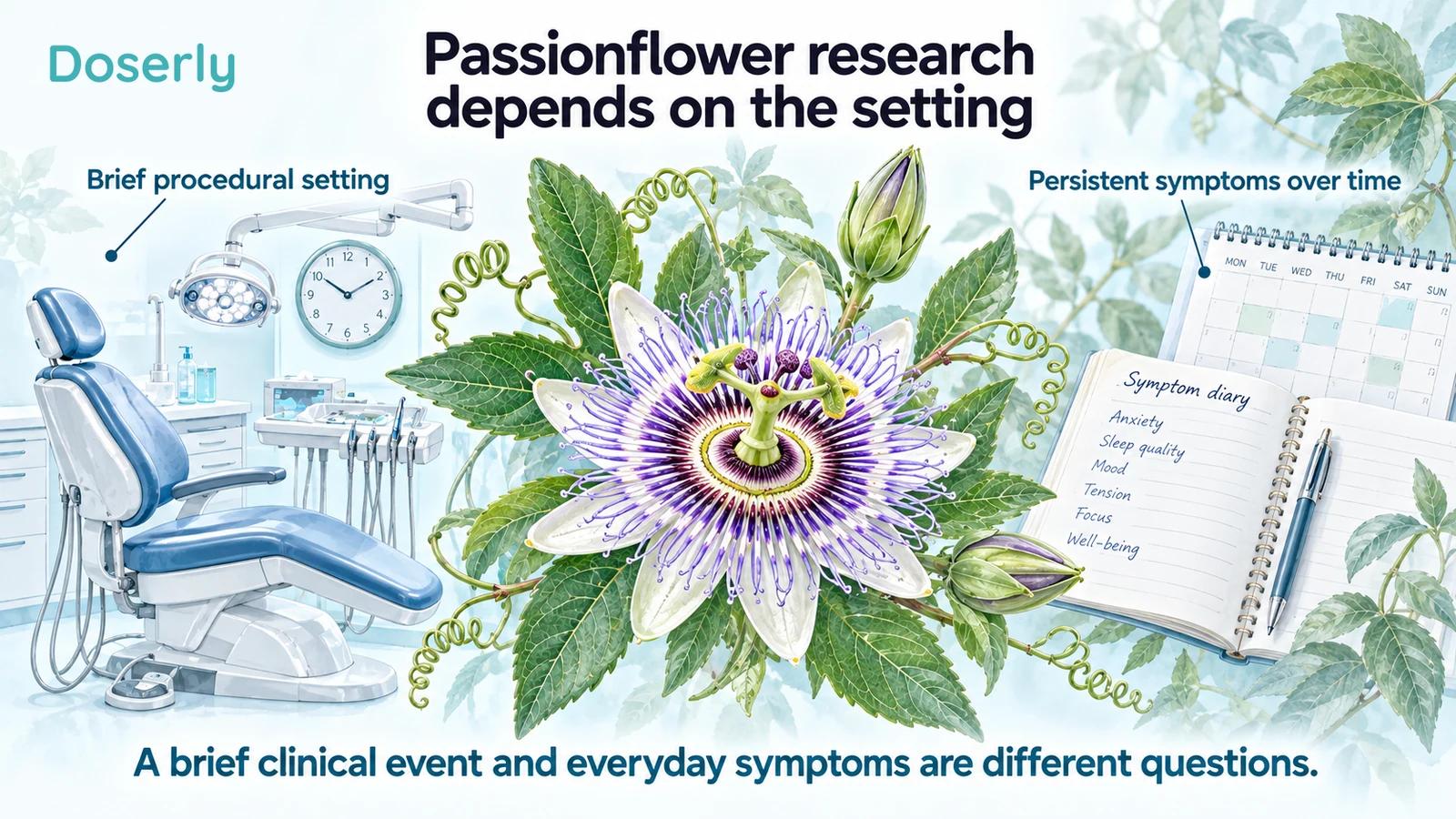
These settings all involve distress, but they ask different questions. A person waiting for an operation may need help with anxiety over the next hour. Someone living with persistent worry needs treatment that improves daily life over weeks or months. A brief effect in one situation cannot supply the missing evidence for the other.
The human findings are interesting enough to discuss, especially for procedural anxiety, but they remain limited and sometimes mixed. NCCIH also cautions that passionflower may interact with anesthesia medicines. A study in a monitored surgical setting is not a reason to take it yourself before a procedure. NCCIH passionflower guidance
Our passionflower guide covers the plant more broadly. Here, the focus is how the research setting changes what a result means for someone considering it for anxiety.
Situational anxiety and persistent symptoms need different answers
Anticipating a needle, an operation or a dental extraction creates a specific, time-limited situation. Investigators can measure anxiety shortly before the event and observe participants in a setting where staff, medicines and recovery procedures are already organized.
Persistent anxiety is different. The relevant questions include whether worry becomes less intrusive, whether sleep and concentration improve, whether someone resumes activities they have avoided and whether benefits continue. A treatment can look promising on a preoperative rating without answering any of those longer-term questions.
The distinction also affects safety. In a clinical procedure, researchers can select participants, specify a preparation and monitor them. A supplement bought for use at home may have a different composition, and the person taking it may use other medicines or have conditions excluded from the study.
That does not make procedural research irrelevant. It makes its relevance specific. If the concern is a forthcoming procedure, the evidence belongs in a conversation with the treating team. If the concern is everyday anxiety, studies of sustained treatment are the closer match.
What happened before spinal anesthesia?
A randomized, double-blind, placebo-controlled study enrolled 60 adults aged 25–55 scheduled for spinal anesthesia. Investigators measured anxiety, sedation, psychomotor performance and cardiovascular variables before treatment and around the procedure.
Passionflower reduced the rise in state-anxiety scores that occurred as spinal anesthesia approached. The report did not find significant differences between groups in psychomotor testing, sedation, hemodynamics or side effects. “State anxiety” refers to anxiety in the immediate situation, rather than a longstanding tendency or a diagnosis. Spinal-anesthesia trial, 2012
The wording matters: suppressing an increase before a stressful event is not the same as demonstrating remission of an anxiety disorder. It can still be valuable if it makes the clinical experience more tolerable. But the duration of observation and the selected surgical population restrict what can be inferred about daily use.
The lack of a significant sedation difference is also narrower than proving that passionflower never causes drowsiness. A trial can fail to detect a difference because the effect is small, uncommon or not well captured by the measure. Its safety findings apply to the observed participants and circumstances.
An outpatient-surgery trial found another short-term signal
In a 2008 study, 60 patients were randomized to a specified passionflower preparation or placebo 90 minutes before surgery. Anxiety ratings were lower in the passionflower group, with p<0.001, while sedation and recovery of psychomotor function did not significantly differ. Discharge timing was similar between groups. Ambulatory-surgery trial
This supports studying passionflower as a premedication under clinical supervision. It does not compare it with every standard approach to procedural anxiety, establish an optimal preparation or resolve interactions with all anesthetic regimens.
For someone worried about an operation, the most useful next action is to tell the team about the worry and every product already being taken. That information lets them address the anxiety within the planned care. Trying to reproduce a research intervention independently can change the medicines and monitoring conditions that made the experiment possible.
What does a comparison with midazolam establish?
A 2017 dental crossover trial included 40 volunteers undergoing removal of mandibular third molars on separate occasions. The researchers compared passionflower with midazolam, a benzodiazepine used in clinical sedation, and assessed questionnaires and physiological measures.
More than 70% described themselves as quiet or only a little anxious under both conditions. Heart rate, blood pressure and oxygen saturation did not significantly differ between protocols. Twenty percent reported complete amnesia with midazolam, while passionflower showed little or no effect on memory formation in the study. Dental-extraction comparison
Those observations are useful, but “no significant difference” is not automatically proof that two treatments are equivalent. Establishing noninferiority requires a study designed to rule out an unacceptably large loss of effectiveness, with a prespecified margin and enough participants. A small comparison that detects no difference can leave considerable uncertainty.
The study also addressed a clinical procedure, not self-managed dental fear outside care. Memory effects, cooperation, comfort and physiological safety are distinct outcomes. A less amnestic experience may be desirable for some people, but the choice of sedation must account for the procedure and the clinician's assessment.
A newer dental trial separates biomarkers from feelings
A 2025 study randomized 30 healthy patients aged 16–35 to passionflower, midazolam or placebo before third-molar extraction, ten per group. It measured anxiety questionnaires, physiological variables and salivary biomarkers.
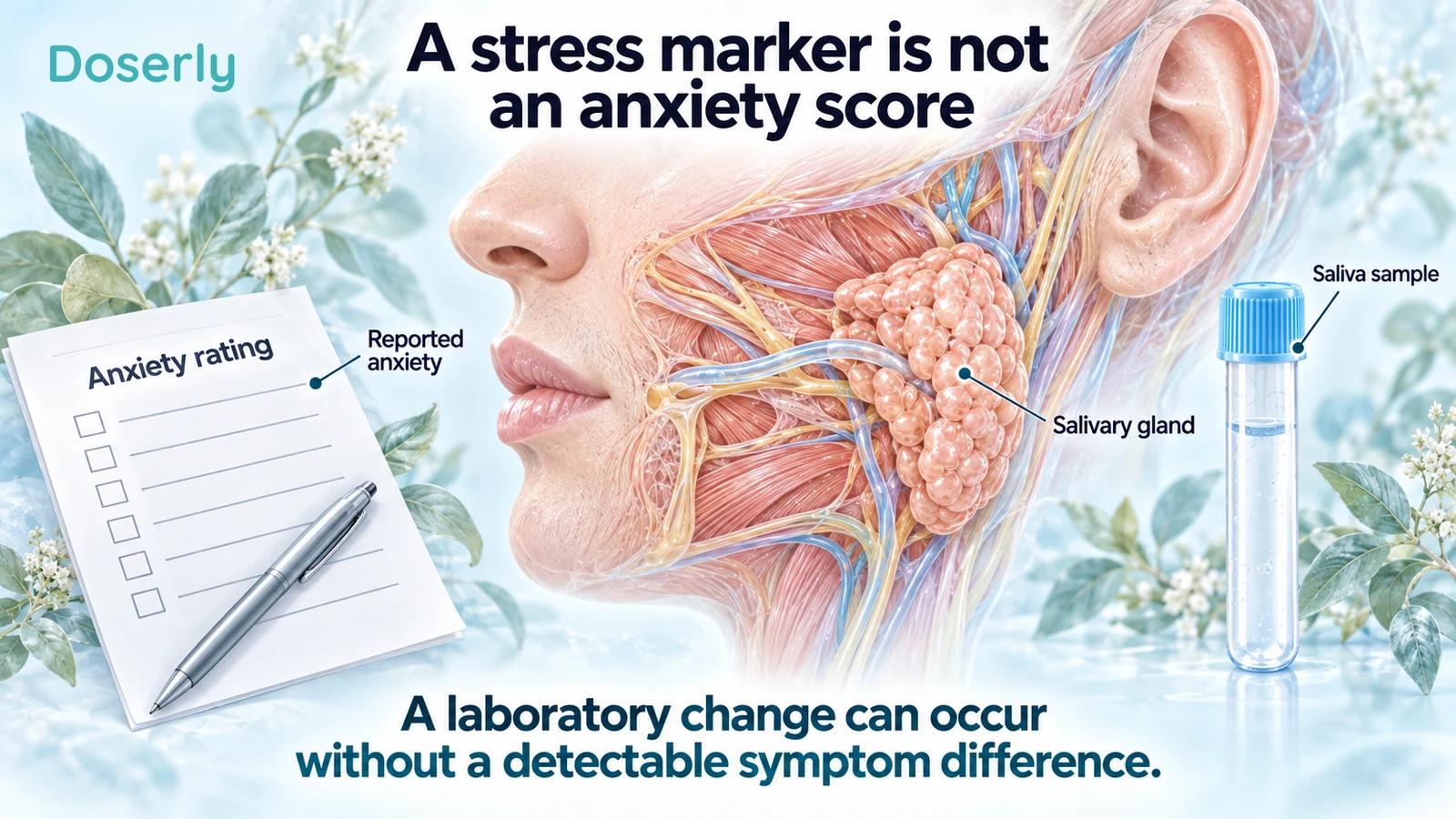
Postoperative salivary cortisol was lower in the passionflower and midazolam groups than with placebo. However, anxiety scores did not significantly differ between groups, and diastolic blood pressure was higher in the passionflower group. Salivary-biomarker trial
Cortisol is a hormone involved in the body's response to stress. A saliva measurement can help researchers study that response, but it is not a direct reading of how anxious someone feels. The result therefore supports a biological observation without establishing a detectable symptom advantage in this small experiment.
This is especially relevant to claims that a supplement “lowers stress” because a laboratory marker falls. If the desired benefit is feeling less frightened, the patient's experience matters. A biomarker may contribute to an explanation; it should not replace the outcome that motivated treatment.
Is there evidence for generalized anxiety disorder?
A 2001 pilot randomized 36 outpatients with generalized anxiety disorder to passionflower extract or oxazepam for four weeks. The design used matching placebo tablets or drops alongside the active treatment so the two regimens could be blinded. It did not include a group receiving only placebo.
Both groups improved, and the final comparison was not significantly different. Oxazepam acted more quickly, while more work-performance impairment was reported with oxazepam. Generalized-anxiety pilot
This is preliminary treatment evidence in a more relevant population for persistent anxiety. It is still a small, short active-comparator trial. Without a placebo-only group and a convincing equivalence design, it cannot establish that passionflower is as effective as oxazepam or that either observed improvement was entirely attributable to treatment in this particular experiment.
It also does not provide a reason to stop or replace prescribed medication. A person considering a change needs an assessment of the current treatment, symptoms, adverse effects and potential withdrawal risks. An old pilot can inform questions for that conversation without becoming a substitute for a treatment plan.
The gap is not merely the absence of a large participant count. Long-term management needs information about sustained benefit, relapse, function and tolerability. Four weeks of symptom ratings cannot answer how someone will do over a year, or whether a preparation helps when anxiety coexists with other conditions.
Stress and sleep trials extend the question, but do not merge it
A 2024 randomized trial studied 65 people with stress and insomnia, assigning a standardized passionflower extract or placebo for 30 days. It reported improvements in perceived stress and reported sleep time, along with other questionnaire outcomes. The sleep-time measure was subject reported, so it should not be described as a laboratory-recorded increase. Stress-and-sleep trial
This is a more sustained exposure than a preoperative experiment, but it still examines a particular preparation and selected symptom group over one month. A perceived-stress score is not itself a diagnosis of generalized anxiety disorder. The result is encouraging for that study's question without settling the broader treatment question.
A separate insomnia trial randomized 110 adults for two weeks and used polysomnography. Total sleep time increased by about 23 minutes in the passionflower group versus essentially no change with placebo; the between-group result was p=0.049. Insomnia trial, 2020
That sleep finding should remain a sleep finding. It does not show that anxiety caused the insomnia or that reducing anxiety was the mechanism. A person can have both problems, but an improvement in one does not automatically establish a treatment effect on the other.
What should a person do with this evidence?
Start by naming the problem more precisely than “stress.” Is it fear about one procedure, recurrent worry across daily situations, difficulty falling asleep or waking repeatedly? Include what you have stopped doing or find harder because of the symptoms. That gives a clinician a clearer target than a supplement category.
Bring the actual passionflower product or ingredient list if you use one. Research amounts and extract forms are not interchangeable instructions, and combination products add further uncertainty. The studies above do not establish that a larger amount works better or that combining passionflower with other calming products improves the balance of benefit and harm.
NCCIH lists drowsiness, dizziness and confusion as possible adverse effects. It advises against use during pregnancy because of possible uterine contractions, notes limited breastfeeding information and specifically warns about excessive nervous-system suppression when combined with anesthesia-related medicines. Tell the surgical team if you have taken passionflower within two weeks of a scheduled procedure. NCCIH safety guidance
The most defensible expectation is modest and specific: some small trials suggest a short-term effect on procedural anxiety, while the evidence for sustained treatment remains preliminary. The next useful decision is a discussion matched to the setting, the preparation and the outcome you want to improve.
Sources
- Spinal-anesthesia trial, 2012
- Ambulatory-surgery trial, 2008
- Dental midazolam comparison, 2017
- Dental salivary-biomarker trial, 2025
- Generalized-anxiety pilot, 2001
- Stress-and-sleep extract trial, 2024
- Polysomnographic insomnia trial, 2020
- NCCIH: passionflower usefulness and safety