
Peptides
October 16, 2026
Oral semaglutide and injections: why milligrams don't tell the whole story
On this page
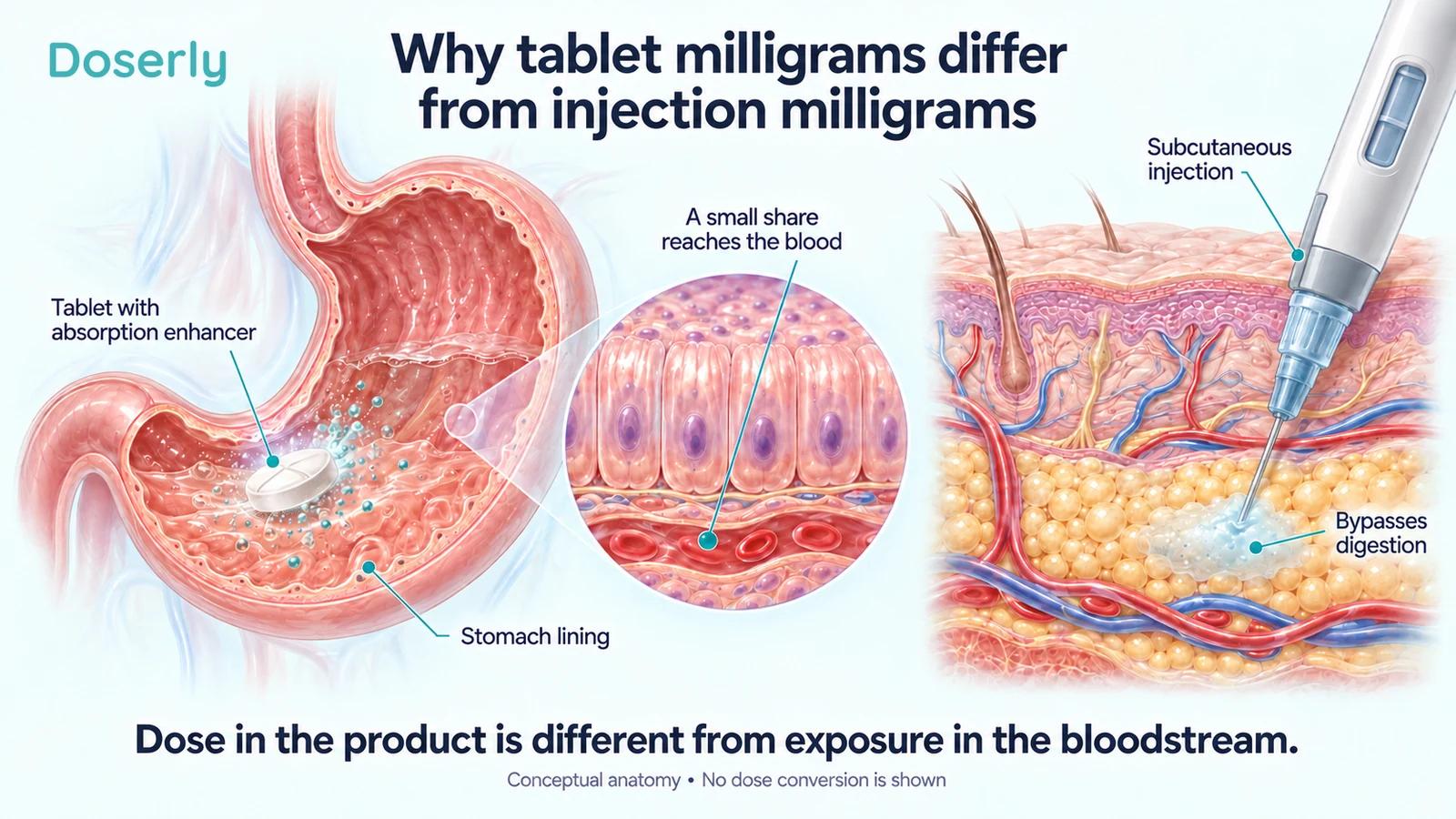
A semaglutide tablet can contain many more milligrams than a weekly injection. That does not make it many times stronger. The number on the package describes how much medicine is in the product, while the effect depends partly on how much reaches the bloodstream and how long it remains there.
Swallowing a peptide is a difficult way to deliver it. Digestive enzymes can break it down, and the stomach lining limits passage into the body. Approved oral semaglutide uses a carefully developed formulation to overcome some of those obstacles. An injection under the skin bypasses the digestive route. The difference is large enough that dividing one dose by the other gives a misleading answer. Original absorption research
This matters if you're comparing products, considering a switch or seeing a claim that a dissolving tablet is “equivalent” to an injection. Understanding the route helps you ask better questions without trying to calculate your own conversion.
Dose, absorption and exposure are different measurements
Dose is the amount administered. Bioavailability is the fraction that reaches the systemic circulation. Exposure describes the medicine present in the bloodstream over time. A pharmacokinetic study follows concentrations to learn how the body absorbs, distributes and clears a drug.
Researchers often summarize exposure as the area under a concentration-time curve, abbreviated AUC. Another measurement, the peak concentration, tells them the highest measured level. Two products could differ in peak level, timing or variability even when their average overall exposure is similar.
For semaglutide, the oral formulation's low bioavailability helps explain its larger milligram dose. A population pharmacokinetic analysis estimated bioavailability at about 0.8% under the studied recommended conditions for the earlier oral formulation. That estimate came from a model using clinical pharmacology data; it is not a fixed percentage that applies to every tablet, every person or every morning. Clinical pharmacokinetic analysis
For example, multiplying a tablet's milligrams by 0.008 would not tell you which injection to take. It would ignore the specific formulation, dose frequency, concentration pattern and variation between people. A product-switching instruction requires clinical evidence and prescribing guidance, not a single absorption percentage.
How does the tablet get through the stomach?
Oral semaglutide is formulated with an absorption enhancer called SNAC, short for salcaprozate sodium. Research investigated where absorption happens and how SNAC helps. Human and animal observations supported stomach absorption near the dissolving tablet; laboratory and animal work explored the underlying cell-level process. These portions of the research should not all be described as direct human tissue findings. Buckley and colleagues, 2018
The proposed mechanism includes a local change in the environment around the tablet that reduces peptide breakdown and helps semaglutide cross stomach-lining cells. “Local” matters: the formulation is designed around what happens close to the tablet while it dissolves. It is not simply a general supplement that makes any swallowed peptide absorb well.
The same active molecule can therefore behave differently when placed in a different delivery system. That is familiar in other areas of medicine: the ingredient matters, but so do the formulation and route. With oral semaglutide, the formulation is central to making meaningful absorption possible.
Our semaglutide guide explains the receptor effects after the medicine is absorbed. Here, the question is how the medicine gets to that point.
What did researchers actually observe in people?
One pharmacoscintigraphy study used imaging to follow tablet erosion and movement through the gastrointestinal tract. Twenty-six healthy men received a single 10 mg oral semaglutide dose with either 50 or 240 mL of water in a randomized crossover design. Each participant experienced both conditions at different visits, reducing some between-person differences. Tablet-erosion study
Complete tablet erosion occurred in the stomach with both water volumes. Slower erosion and later gastric emptying were associated with higher semaglutide exposure. The study's water-volume comparisons were not uniformly statistically clear: the AUC comparison had P=0.056, while the peak-concentration comparison had P=0.048.
Those results support the relevance of conditions around tablet dissolution. They do not establish that taking the smallest possible sip is a better treatment strategy. This was a single-dose mechanistic study in healthy men, using a research formulation and controlled conditions. Its measurements were drug levels, not long-term weight, glucose or cardiovascular outcomes.
The useful takeaway is that oral delivery is a physiological process influenced by the stomach environment. A tablet's printed dose cannot capture that process by itself.
Why do food and waiting time matter?
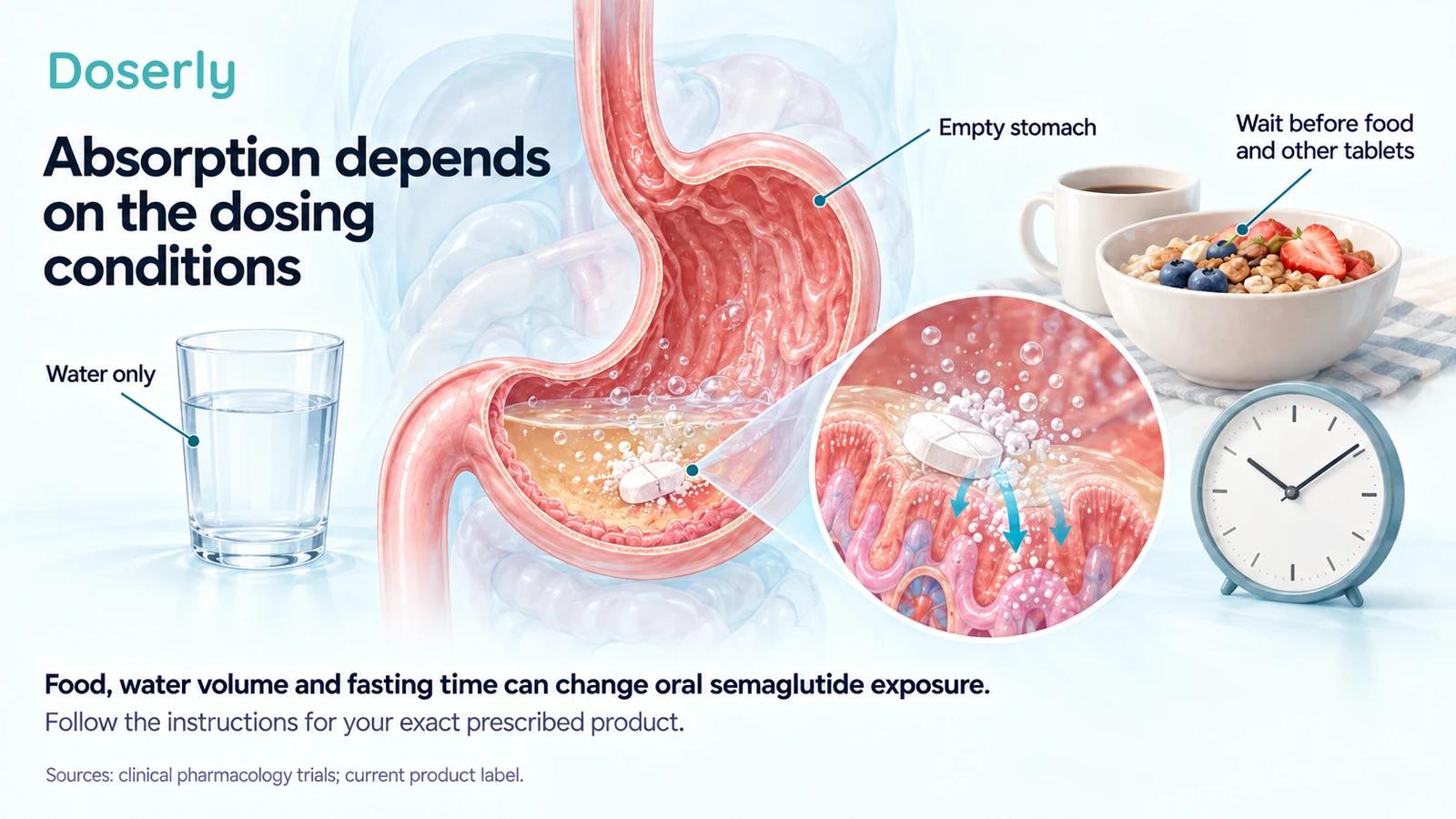
Separate clinical pharmacology trials examined food before dosing, water volume and the interval before eating afterward. In a food-effect trial with 78 healthy participants, exposure was limited or unmeasurable in the fed group, whereas all participants in the fasting group had measurable exposure. A second study with 161 healthy men tested different post-dose fasting periods and water volumes. Longer post-dose fasting increased exposure; the smaller tested water volumes did not differ significantly from one another. Dosing-conditions trials
This helps explain why approved tablet instructions are more specific than “take once daily.” The instructions are part of how the formulation was studied. Treating them as optional can change exposure even when the tablet strength stays the same.
The June 2026 US Wegovy label instructs patients to take the tablet in the morning on an empty stomach with water, up to four ounces, and wait at least 30 minutes before food, other drinks or other oral medicines. It also says to swallow the tablet whole rather than split, crush, chew or dissolve it. Always use the current instructions for your exact prescribed product and country. Wegovy prescribing information
This does not mean a longer fast is automatically better for an individual. A pharmacokinetic change is not a prescription to maximize absorption. The goal is consistent use of the tested product as prescribed, with any practical difficulties discussed with the prescriber or pharmacist.
Why is the tablet daily if semaglutide lasts so long?
Semaglutide remains in the body for a relatively long time after absorption. Oral delivery still produces variable absorption from one dose to another. Repeated daily dosing and the molecule's slow elimination help shape a more stable ongoing exposure than the absorption of any single tablet would suggest. Population pharmacokinetic analysis
The schedule therefore reflects the entire delivery system. It isn't evidence that tablets contain a different short-acting version of the active molecule. Likewise, weekly injection use does not mean that an injection has stopped working on the other six days.
This distinction is useful when interpreting sensations. Feeling more or less hungry on one day does not provide a reliable measurement of how much of that morning's tablet was absorbed. Appetite, meals, sleep and other circumstances vary too. A clinician assesses response over time and alongside the reason for treatment, rather than using a single day's appetite as a blood-level test.
Does oral semaglutide have clinical evidence of its own?
Yes. Oral treatment is not supported only by absorption experiments. For example, the SOUL cardiovascular trial randomized 9,650 adults with type 2 diabetes and atherosclerotic cardiovascular disease, chronic kidney disease or both. The primary cardiovascular event occurred in 12.0% with oral semaglutide and 13.8% with placebo, with a hazard ratio of 0.86. SOUL primary report
That is evidence for a specific tablet regimen in a specific clinical population. It is not a head-to-head comparison with injectable semaglutide. Different studies cannot be ranked simply by comparing their raw outcome percentages, because the participants' baseline risk and follow-up differ.
Current prescribing information also distinguishes products and indications. A statement such as “oral semaglutide is for diabetes only” may reflect an older approval landscape rather than the current US label. The June 2026 Wegovy label includes oral tablets for adult weight reduction and cardiovascular risk reduction in the indicated population. Current Wegovy label
The product name, formulation, indication and date belong together. Broad claims about “the semaglutide pill” can hide clinically important differences between an older study, a current approved product and an unapproved formulation sold online.
What can similar average exposure tell us?
When a label or study describes comparable average blood levels between regimens, that is useful pharmacological information. It helps regulators and clinicians understand how products relate. It does not mean every individual has identical exposure or that all clinical outcomes have been compared directly.
An average can conceal a wide range. Imagine two groups with the same average measurement: one could have tightly clustered values, while the other has much more variation. The average alone cannot distinguish them. This is a general statistical example, not a numerical claim about a particular semaglutide trial.
Switching decisions also involve tolerability, adherence, the treatment indication and practical use. Someone may prefer a tablet but find the morning routine difficult; another may prefer a weekly injection. Those preferences matter because a regimen needs to be usable consistently, but they don't determine a safe conversion by themselves.
The guide's route section provides more context for discussing formulations. Your pharmacist can check the exact product and instructions, especially when the brand or presentation changes.
Are drops, troches or compounded tablets equivalent?
The approved swallowed tablet's evidence does not automatically transfer to something held under the tongue, dissolved in the cheek or prepared with another formulation. These products encounter different tissue and delivery conditions. Sharing an ingredient name is not proof of comparable absorption, quality or clinical benefit.
FDA states that compounded medicines are not FDA approved and are not reviewed for safety, effectiveness and quality before marketing. Its GLP-1 warning page also describes dosing errors and concerns about semaglutide salt forms, which differ from the active ingredient used in approved medicines. FDA concerns about unapproved GLP-1 products
A useful question is: What human evidence supports this exact formulation and route? A study of an approved SNAC-containing swallowed tablet cannot answer that for a different product. Neither a larger milligram number nor an assertion of “better absorption” supplies the missing comparison.
What to clarify before changing products
Bring the actual product name and strength to the discussion. Clarify whether the amount refers to each tablet, each injection or a concentration in a vial. Also explain your usual meal timing and other morning medicines if a tablet is being considered.
Ask what outcome the clinician will use to assess response, when it will be reviewed and which symptoms should trigger contact. If a switch is appropriate, get written instructions for the specific starting date and product. Avoid filling in gaps by comparing package numbers or combining leftover products.
The key is simple: milligrams describe what is administered, while formulation and route help determine what the body receives. Oral semaglutide has a real clinical evidence base, but that evidence belongs to particular products used under particular conditions. Understanding those conditions makes the larger tablet number much less confusing.
Sources
- Buckley et al., 2018: stomach absorption, with human, animal and laboratory components.
- Overgaard et al., 2021: population pharmacokinetic modeling.
- Bækdal et al., tablet erosion, 2021: 26-person crossover imaging study.
- Bækdal et al., dosing conditions, 2021: food, fasting interval and water-volume experiments.
- Wegovy prescribing information, June 2026: current product-specific instructions and indications.
- SOUL, 2025: randomized oral-treatment cardiovascular outcomes.
- FDA: unapproved GLP-1 medicines: formulation and quality concerns.