
Supplements
October 16, 2026
Oral GABA and sleep: what the human trials actually show
On this page
GABA, short for gamma-aminobutyric acid, helps regulate communication between nerve cells. In the brain, it often reduces the likelihood that a receiving neuron will fire. That makes it relevant to sleep and explains why a supplement called GABA sounds like a straightforward way to quiet an alert mind at bedtime.
Swallowing GABA is a different biological event from releasing it between brain cells, however. A supplement must pass through the digestive system, enter circulation and potentially affect tissues before it could change sleep. The blood–brain barrier, the tightly regulated boundary between blood and brain tissue, complicates the story.
Does that mean oral GABA cannot help? No. Does its role in the brain prove a supplement will help? Also no. Human sleep trials can test whether people benefit even when the route of action remains uncertain. The available studies offer some encouraging signals, particularly for falling asleep, but they do not establish a dependable treatment for chronic insomnia. Our GABA guide introduces the supplement more broadly; this article focuses on what the sleep experiments can tell you.
What the blood–brain barrier question can answer
A molecule's presence in the bloodstream does not establish its concentration inside the brain. Transport across the barrier, metabolism and the locations of receptors all matter. A rise in blood GABA therefore cannot be read as a measurement of increased inhibitory signaling in sleep-related brain circuits.
The reverse inference is also too strong. A substance could conceivably affect sleep through processes outside the brain or through signals connecting the body and nervous system. Those possibilities need testing; naming a gut–brain pathway does not demonstrate that it explains a person's response to a capsule. The USP safety assessment describes the uncertainty around GABA's central availability and discusses peripheral effects. USP GABA assessment
It helps to keep three questions separate: was the substance absorbed, did it alter a relevant biological process, and did the person sleep or function better? An experiment can answer one without answering the others. For example, finding GABA in blood after ingestion answers an absorption question. It cannot tell someone who wakes repeatedly at night whether the supplement will reduce those awakenings.
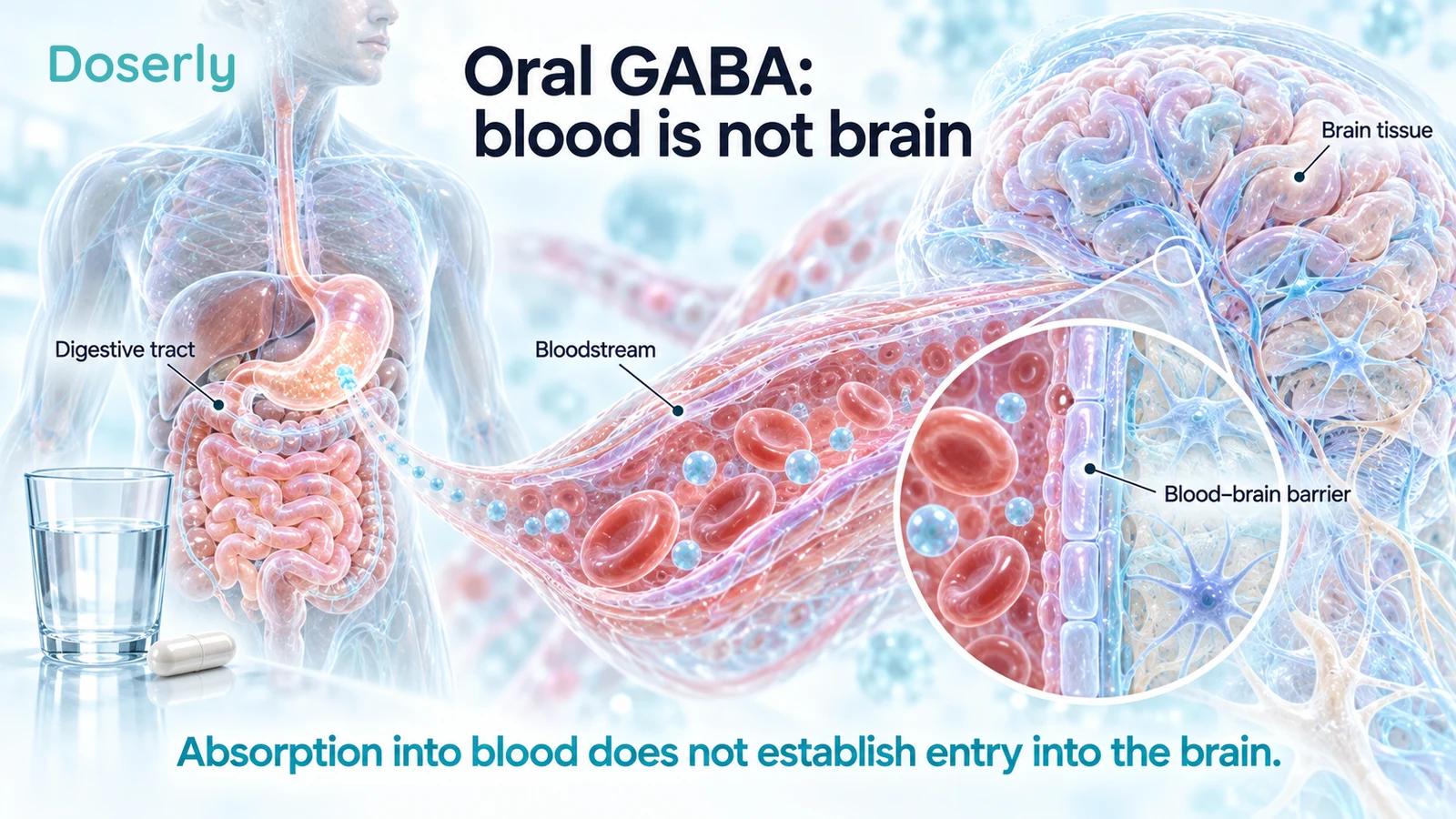
Conceptual anatomy, not a measured route of action. The illustration separates digestion and circulation from the regulated boundary around brain tissue; it does not show that supplemental GABA crosses that boundary.
The four-week insomnia study deserves a careful reading
A 2018 randomized, double-blind study assigned 40 adults with insomnia symptoms to fermented-rice-germ GABA or placebo for four weeks. Thirty received GABA, at 300 mg daily, and ten received placebo. The study used questionnaires and polysomnography, an overnight recording of physiological signals used to assess sleep.
The full report contains a more specific finding than its broad conclusion suggests. Sleep latency—the time taken to fall asleep—showed a significant group-by-time interaction, meaning that the change differed between treatments. Average laboratory latency changed from 13.4 to 5.7 minutes with GABA and from 7.0 to 15.2 minutes with placebo; the interaction had p=0.009. Other measures, including sleep efficiency and questionnaire scores, did not show significant treatment-by-time interactions. Some improved within the GABA group, but that is a different comparison. The groups also differed on some sleep measures at baseline. Byun and colleagues, full report and Table 2
This is a reason to take the sleep-onset finding seriously, with appropriate restraint. It is neither a completely negative trial nor proof that GABA improves every aspect of sleep. The small, uneven allocation leaves the placebo estimate especially vulnerable to the experiences of a few participants.
For a reader, the distinction is practical. If your main problem is taking a long time to fall asleep, the outcome is relevant. If you fall asleep easily but wake at 3 a.m., a sleep-onset result does not directly answer your question. And if you are sleeping longer but still feel exhausted, the outcome you care about may be daytime functioning rather than minutes asleep.
Why “improved in the GABA group” is not enough by itself
Imagine two groups taking part in the same sleep study. Both receive attention, keep a more regular schedule and hope that treatment will work. Both might sleep better over time, even if the capsule itself contributes nothing. That is one reason researchers include a placebo group.
A statistical test showing improvement in one group and no significant improvement in the other does not automatically show that the groups differ. Their estimates may be similar but have different precision. The direct comparison of changes is the relevant test of an added effect.
This matters particularly in studies with many sleep outcomes. An article may mention sleep quality, total sleep time, sleep efficiency, awakenings and several sleep stages. A positive result for one of those measures should remain attached to that measure. It should not become a general statement that the supplement restores sleep architecture or treats insomnia as a whole.
The useful conclusion is therefore narrower than a product slogan: there is a small controlled signal worth investigating for sleep onset, while broader and longer-lasting benefits remain uncertain. That conclusion leaves room for better trials without requiring readers to dismiss their own experiences.
What the earlier sleep and absorption experiment adds
A separate 2016 study used a randomized, single-blind crossover design, meaning participants received the different conditions during separate periods. Researchers assessed sleep using electroencephalography, or EEG, which records electrical activity through scalp sensors. They reported shorter sleep latency and more non-REM sleep after GABA. An absorption experiment found blood levels peaked around 30 minutes after ingestion and subsequently declined. The authors were affiliated with a GABA ingredient manufacturer. Yamatsu and colleagues
These findings connect two interesting observations: oral GABA can enter the blood, and a small sleep experiment detected differences in overnight measurements. They do not identify the route between those observations. In particular, the blood measurement cannot stand in for a brain measurement.
The crossover approach has a useful strength: each participant helps provide their own comparison. But blinding, the separation between treatment periods, night-to-night variation and the number of participants still affect confidence. Manufacturer involvement does not make a result false; it makes independent replication especially valuable before a finding becomes a broad commercial promise.
A later controlled trial did not reproduce a clear placebo difference
A 2022 follow-up randomized 54 people with insomnia to 75 mg of rice-germ-derived GABA or placebo for four weeks; 50 completed the study. Laboratory sleep latency fell from 9.0 to 4.8 minutes within the GABA group, but the change was not significant relative to placebo. Sleep-efficiency changes were not significant, and questionnaire scores improved in both groups. Low-dose GABA trial
This makes the sleep-onset evidence less consistent than the earlier positive finding alone suggests. It does not disprove the 300 mg result, and separate studies cannot establish a dose–response relationship: the participants, baseline sleep and random variation also differed. The later study was supported by the ingredient supplier, with the authors reporting that the funder had no role in study conduct or reporting. A direct, adequately powered comparison of preparations and amounts would be needed before concluding that more GABA is more effective.
New combination research does not isolate GABA
A 2026 exploratory study gave GABA together with L-theanine for four weeks. Results were available from 19 participants. Their average Pittsburgh Sleep Quality Index score fell from 9.42 to 6.26, a mean change of about 3.15 points. The study used 700 mg of GABA and 200 mg of L-theanine daily, and also examined wearable-derived measurements. These are descriptions of the research, not a dosing recommendation. Combined GABA and L-theanine study
The crucial design detail is that this was a single-arm study: everyone received the combination. There was no concurrent placebo group and no GABA-only or L-theanine-only comparison. The results cannot tell us how much improvement came from either ingredient, their combination, expectations or changes occurring over time.
A trial of the combination against placebo could establish whether that specific product adds benefit. Separate ingredient groups would then help determine whether combining them adds anything beyond one alone. Until those comparisons exist, the study supports further investigation rather than a claim that a higher GABA amount is more effective.
Feeling calmer and treating insomnia are different outcomes
Early GABA research also examined brief responses to stress. A 2006 paper described an EEG experiment in 13 volunteers and a separate stress experiment involving eight people crossing a suspended bridge. The latter assessed salivary immunoglobulin A, an immune-related measurement. These were small, short-term experiments, not trials of sustained insomnia treatment. Abdou and colleagues
Someone may reasonably hope that feeling calmer will make bedtime easier. But a response during an acute stress task is not equivalent to sleeping better night after night. Sleep problems can involve waking after sleep onset, irregular schedules, breathing disturbances, pain or worry about sleep itself. Those situations do not all depend on the same process.
The most informative outcome is the one that matches your difficulty. A laboratory change in brain-wave activity may help researchers develop a hypothesis. A patient deciding whether a treatment is worthwhile needs to know whether it changes symptoms, daily functioning and adverse effects enough to matter.
What do we know about safety?
The USP review found no consistent pattern of serious harm in the studies it examined, but the available evidence cannot establish safety for every duration, combination or population. Some studies observed temporary blood-pressure reductions, making additive effects with blood-pressure medicines a reasonable concern. Pregnancy and breastfeeding data were lacking. USP safety review
That is a different statement from “natural means harmless.” The practical question is whether a particular product fits a person's medicines, health conditions and activities. A pharmacist can review the full ingredient list, especially when a sleep product combines several substances. An adverse effect after a combination product may be difficult to attribute to any one ingredient.
Do not use the trials above as instructions to increase an amount, combine sedating products or substitute GABA for prescribed treatment. If a product causes drowsiness, that matters for driving and other activities requiring alertness, even if the reason for taking it was better sleep. A record of when symptoms began and what else changed is more useful than assuming every effect is evidence that the supplement is working.
A more useful starting point for persistent sleep problems
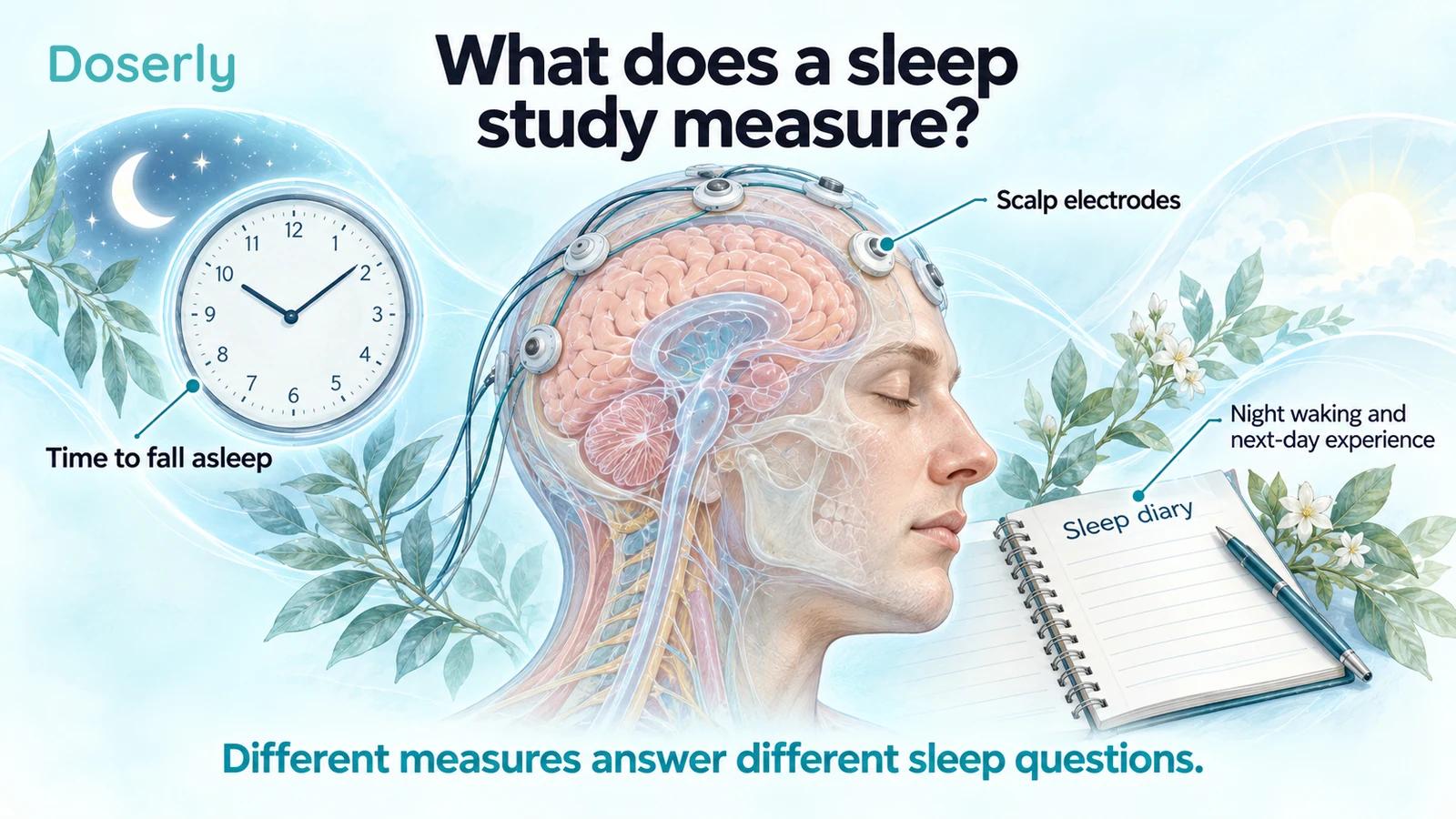
NHLBI recommends discussing sleep problems that interfere with daily activities and suggests keeping a sleep diary for one to two weeks before an appointment. Useful entries include bedtime, waking, naps, daytime sleepiness, caffeine, alcohol and exercise. Loud snoring or gasping also deserves attention because a sleep complaint may involve more than insomnia. NHLBI diagnosis guidance
For chronic insomnia, the American Academy of Sleep Medicine strongly recommends multicomponent cognitive behavioral therapy for insomnia, or CBT-I. This structured treatment addresses behaviors and thought patterns that maintain the problem; it is more than a list of sleep-hygiene tips. AASM behavioral-treatment guideline
You can bring interest in GABA into that conversation without making the blood–brain barrier debate the deciding issue. Ask which symptom the treatment is expected to improve, what change would count as worthwhile and what would lead to stopping it. The current evidence gives a plausible reason for further study, especially around sleep onset, but does not provide a reliable prediction for an individual sleeper.
Sources
- Yoon et al., 2022: low-dose controlled follow-up
- Byun et al., 2018: fermented-rice-germ GABA randomized trial
- Yamatsu et al., 2016: sleep and oral absorption experiment
- Combined GABA and L-theanine exploratory study, 2026
- Abdou et al., 2006: acute relaxation and stress experiments
- USP safety review, 2021
- NHLBI: assessing insomnia
- AASM behavioral and psychological treatment guideline, 2021