
Supplements
October 16, 2026
Omega-3s and the DO-HEALTH aging clocks: what the result means
On this page
Omega-3 fatty acids are part of cell membranes and contribute to signaling processes throughout the body. That makes them relevant to many aspects of health, but it does not make every omega-3 study a longevity trial. The 2025 DO-HEALTH analysis asked a specific question: could supplementation change blood-based estimates of biological aging over three years?
The researchers found small differences on several DNA methylation measures among participants assigned omega-3s. The result is worth understanding. The reported equivalent of a few months on an aging-clock scale was not a few extra months of life. The study did not follow participants to establish that lifespan increased by that amount. DO-HEALTH aging-clock analysis.
For someone considering fish oil or an algae-derived supplement, the next questions are practical. Which omega-3s were used? How old and healthy were the participants? Did the larger trial find improvements in everyday health? And does the combination with vitamin D and exercise provide a tested anti-aging regimen? Our fish oil guide covers EPA and DHA formulations if you want additional background.
EPA, DHA and the cells they become part of
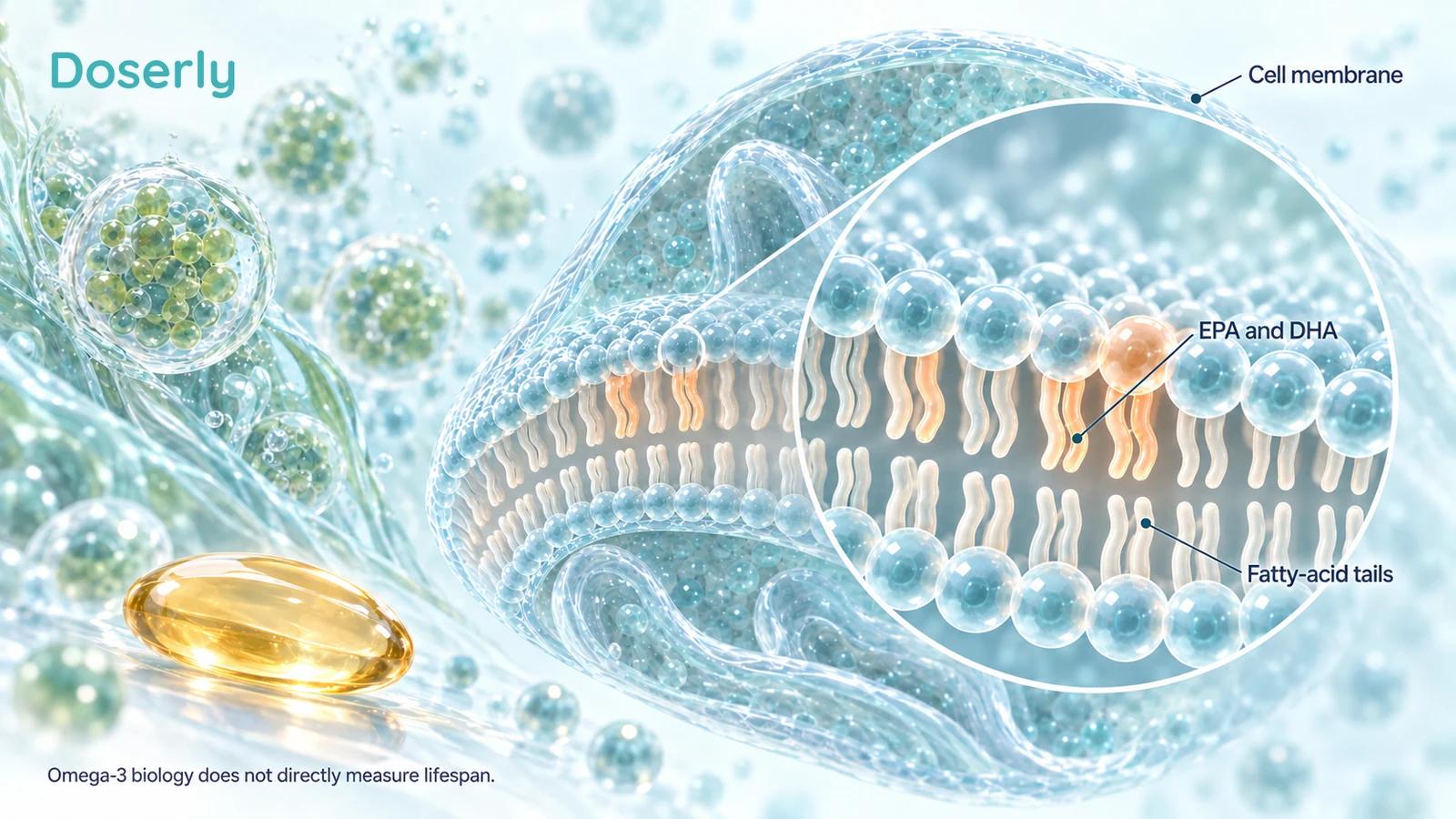
“Omega-3” refers to a family of fatty acids. EPA and DHA are long-chain members found in marine foods and supplements; microalgae are their original source in the marine food chain. Alpha-linolenic acid, or ALA, is found in foods such as flaxseed and walnuts. The body can convert some ALA into longer-chain omega-3s, but conversion is limited. NIH omega-3 fact sheet.
EPA and DHA can become components of the lipids forming cell membranes. They also contribute to signaling biology. Those roles explain why researchers might investigate effects on inflammation-related processes or measurements associated with aging. They do not identify a universal dose that makes every tissue younger.
An ingredient's normal biological role and a supplement's clinical effect are different questions. A person may already obtain a meaningful amount from food. Another may have low intake, a medical indication for a prescription product or a reason to avoid a particular formulation. The DO-HEALTH finding needs to be read within that wider context.
Who took part in DO-HEALTH?
The parent trial included 2,157 adults aged 70 or older in five European countries. Participants were generally healthy and living in the community. The three-year trial tested vitamin D3, marine omega-3s and a simple home strength-exercise program in a factorial design. That design assigned participants to combinations of the interventions, allowing researchers to examine individual and combined effects. DO-HEALTH primary trial.
The omega-3 intervention supplied 1 g daily, consisting of approximately 330 mg EPA and 660 mg DHA from marine algae. The vitamin D intervention supplied 2,000 IU daily. Strength exercise was scheduled for 30 minutes three times a week; its comparison was an attention-control flexibility program, not simply being told to do nothing. These are descriptions of the research, not a personal prescription. Trial methods.
The exercise comparison is especially important. If both groups have a structured activity program, the result estimates the additional effect of the tested strength program over that comparison. It cannot be summarized as a trial showing that movement is useless. Similarly, supplement assignment tests an addition to participants' existing circumstances; it does not describe a population deliberately deprived of the nutrients being studied.
The blood-sample analysis was a smaller study within the trial
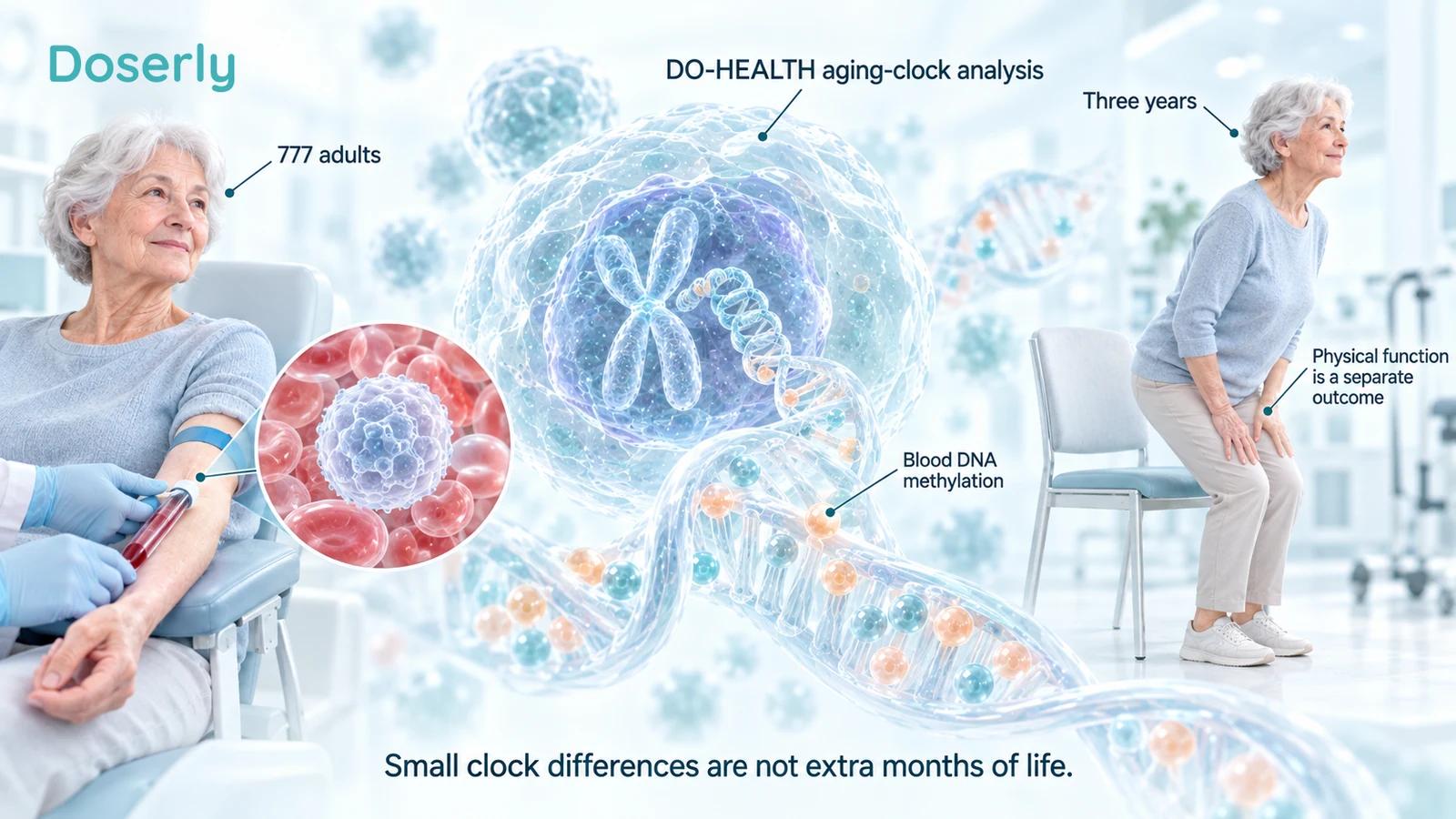
The aging-clock paper used 777 Swiss participants with suitable samples and consent. It was a post hoc analysis, meaning the specific analysis was developed after the original trial framework rather than being one of its original clinical endpoints. Blood methylation was assessed at baseline and after three years. The paper emphasized four next-generation measures: PhenoAge, GrimAge, GrimAge2 and DunedinPACE. Aging-clock report.
Omega-3 assignment showed small differences on PhenoAge, GrimAge2 and DunedinPACE. The reported standardized effect sizes ranged from 0.16 to 0.32, with a translation to approximately 2.9–3.8 months for relevant age-scale measures. The combination of omega-3s, vitamin D and exercise showed an additive finding on PhenoAge, not a consistent additive effect across every clock. Primary analysis.
Those details change the interpretation of a headline. “Three interventions slowed aging” can sound as though each intervention independently improved every test and that combining them produced a general rejuvenating effect. The actual pattern was more selective. The omega-3 signal appeared across several measures, while the combination result depended on which measure was examined.
What is being measured when a clock changes?
DNA methylation refers to chemical marks associated with DNA. A clock is an algorithm that combines measurements at many sites into an estimate. Different clocks were developed for different purposes, including estimating age, capturing health-related risk or tracking the pace of physiological change.
DunedinPACE was developed using repeated measurements of 19 indicators of organ-system integrity across two decades in a birth cohort. Researchers then built a methylation-based estimate of that pace and tested it in other datasets. Its associations with morbidity, disability and mortality make it a useful research tool. They do not prove that every intervention that changes its score will improve those outcomes. DunedinPACE development.
This distinction also explains why clock estimates cannot be casually added together. A lower PhenoAge estimate and a slower DunedinPACE estimate are two descriptions of related biological information. They are not two separate deposits of extra survival time. Nor does a three-year difference establish that the same benefit continues accumulating indefinitely.
If a treatment produced a sustained clock change that reliably predicted fewer clinical events across multiple trials, that would strengthen its use as a substitute endpoint. DO-HEALTH contributes to investigating that possibility. It does not complete the validation on its own.
Did the main trial show better health?
The original DO-HEALTH report did not establish improvements across its six primary endpoints under its prespecified statistical approach. These covered systolic and diastolic blood pressure, nonvertebral fractures, lower-extremity physical function, cognition and infections. Primary clinical results.
That does not mean every later analysis was negative. A separate falls analysis recorded 3,333 falls over approximately three years. Omega-3 assignment was associated with a 10% lower total-fall rate, with an incidence-rate ratio of 0.90 (95% CI 0.81–1.00; P=0.04). Vitamin D and the tested strength program did not reduce total falls in that analysis. DO-HEALTH falls study.
A fall rate counts events over time, including repeated falls in the same person. A 10% lower rate therefore does not mean that 10 of every 100 participants avoided a fall. The upper confidence limit also rounds to 1.00, underscoring that this was a modest and statistically borderline result rather than a large, precise effect.
The clock and falls findings cannot be combined into a claim that changing methylation prevented falls. Establishing that explanation would require an analysis linking the intervention, the marker change and the clinical outcome while addressing alternative explanations. It is better to discuss each finding at the level it was measured.
Why results from another omega-3 trial can differ
The US VITAL trial studied 25,871 adults and tested a different marine omega-3 formulation for primary prevention. Over a median 5.3 years, supplementation did not significantly reduce the primary outcomes of major cardiovascular events or invasive cancer. VITAL omega-3 trial.
VITAL and DO-HEALTH asked different questions in different populations. Their results should not be treated as a head-to-head comparison of two products. But VITAL is relevant when a clock result is expanded into a broad disease-prevention promise. Large clinical trials count outcomes directly, and their findings still matter even when a smaller biomarker analysis is encouraging.
Prescription omega-3 medicines are another separate category. They may use different compounds, amounts and eligibility criteria. Evidence for a prescription product in a high-risk group does not automatically validate an over-the-counter supplement for longevity. Likewise, a result in generally healthy older adults does not determine the best treatment for a person with high triglycerides or established cardiovascular disease.
Reading a bottle label after reading the study
The front of a bottle may emphasize the total weight of fish oil. The amounts of EPA and DHA can be different from that total. To understand what a product supplies, examine the serving size and the separately listed EPA and DHA amounts. An algae-derived product may supply one or both, depending on its formulation. NIH supplement-formulation discussion.
This is a comparison exercise, not a recommendation to copy the DO-HEALTH dose. Product identity, background diet, tolerability and the reason for use all belong in the decision. The trial did not establish that more EPA or DHA would produce a larger clock effect, or that changing the EPA-to-DHA ratio would preserve the finding.
For example, doubling a capsule count may double the total oil without matching the studied formulation. Adding a second product may create an exposure that no relevant trial tested. Neither approach follows logically from the reported clock differences.
Safety and the outcome you actually want
Omega-3 supplements can cause gastrointestinal discomfort or an unpleasant taste. Higher-dose trials have also raised concerns about atrial fibrillation in some cardiovascular-risk populations. People using anticoagulants should discuss the product and dose with their clinician rather than assuming a nutritional ingredient cannot interact with treatment. NIH safety and interaction review.
For someone whose goal is maintaining independence, it may be more useful to discuss walking, strength, balance, falls and nutrition than to focus exclusively on a commercial biological-age score. Those outcomes describe the activities the person wants to preserve. A methylation test can be interesting without being the best measure for choosing a supplement or evaluating a symptom.
Bring the specific study and the product label to that conversation. Ask whether the evidence fits your age and health status, which outcome is relevant, and what would count as a worthwhile benefit. Keeping a record of supplements and medication changes can help avoid duplication and make later symptoms easier to interpret.
DO-HEALTH supports continued research into omega-3s and biological-aging markers. Its strongest practical lesson is specificity: a defined formulation, selected older participants, several small clock differences and limited evidence about what those differences mean clinically. That is more useful than a promise that one capsule buys extra time.
Explore the research
- DO-HEALTH: DNA methylation clocks and the three interventions (2025).
- DO-HEALTH randomized trial: primary clinical outcomes (2020).
- DO-HEALTH: fall prevention analysis (2022).
- DunedinPACE biomarker development (2022).
- VITAL: Marine n−3 Fatty Acids and Prevention of Cardiovascular Disease and Cancer (2019).
- NIH: Omega-3 Fatty Acids.