
HRT
October 16, 2026
Bleeding on HRT: what NICE's 2026 update means for your next step
On this page
Bleeding after starting menopausal hormone therapy can be unsettling, especially if your periods had already stopped. Sometimes it reflects the way a new regimen affects the uterine lining. Sometimes it needs investigation for another cause. The dates matter, but they work alongside the amount of bleeding, the treatment you're using and your medical history.
NICE updated its menopause guidance on April 15, 2026. It now explains that bleeding is common during the first six months of systemic HRT or within three months of changing its dose or preparation, and advises prompt medical help for unscheduled bleeding beyond those periods. That is a framework for discussing bleeding, not permission to ignore a worrying episode until a calendar deadline. NICE NG23.
For someone keeping a symptom record, the most useful starting point is simple: record what happened and when, then contact the prescribing service with enough information to decide the next step. You don't need to diagnose the cause yourself, and bleeding does not automatically mean you must give up treatment that is helping.
Why the type of HRT changes the expected pattern
The uterus contains a lining called the endometrium. Hormones influence how that tissue grows and sheds. In sequential HRT, estrogen is combined with progestogen for part of each treatment cycle. A planned withdrawal bleed can occur around the end of the progestogen phase. Continuous combined HRT supplies both components continuously and aims for a bleed-free pattern, although early irregular bleeding can occur.
This makes “I had bleeding on HRT” an incomplete description. A predictable bleed on a sequential regimen and a new bleed after a long stable interval on continuous combined treatment are different situations. The Women's Health Concern patient factsheet explains this distinction and the early settling period. Patient factsheet.
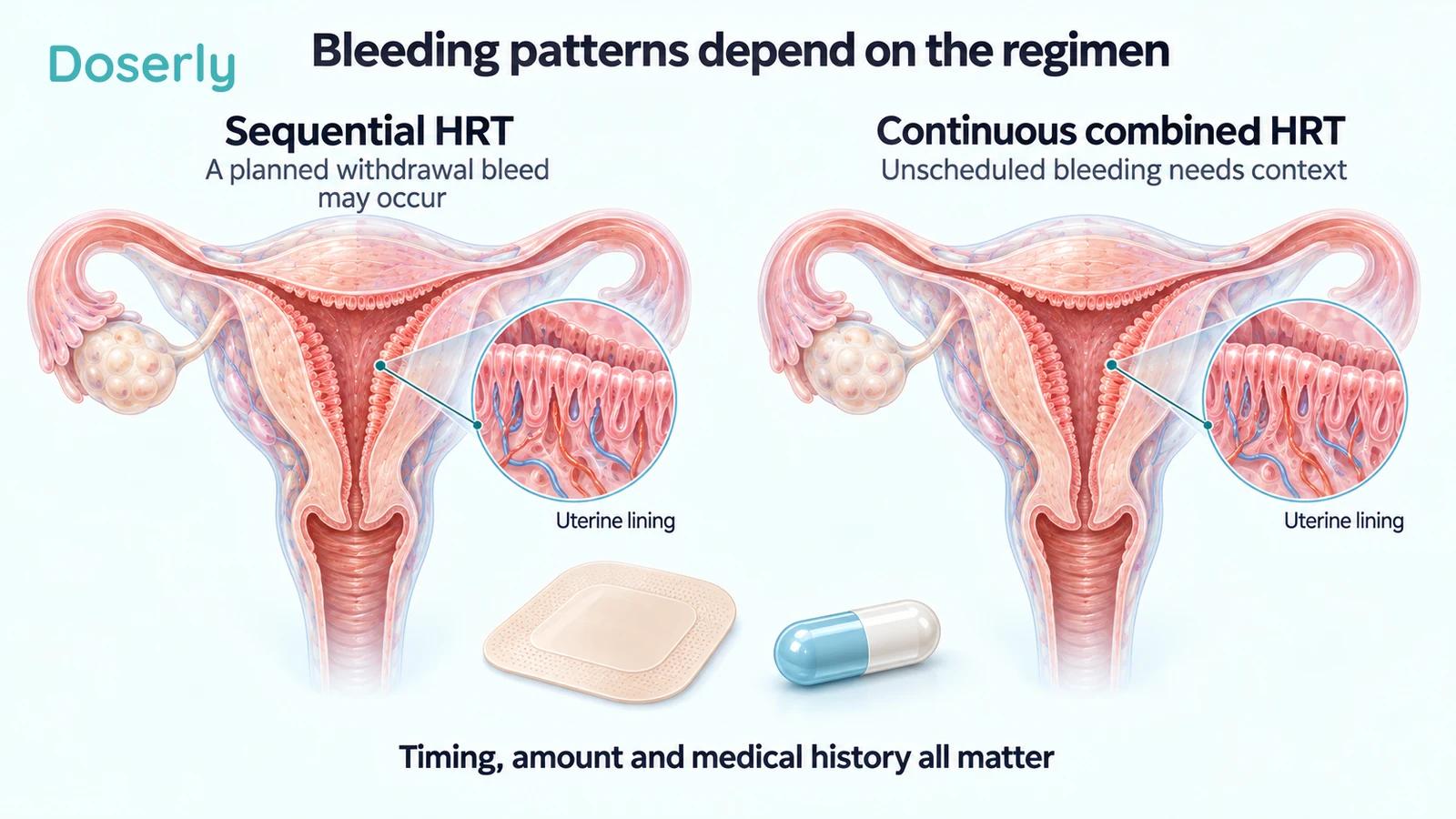
When describing an episode, explain whether it occurred when a bleed was expected, between expected bleeds, or after months without bleeding. Also mention whether you are still having spontaneous menstrual cycles. A clinician can interpret those details together rather than applying one definition to everyone.
What changed in April 2026?
The updated NICE recommendation names two separate timeframes: six months from starting systemic treatment and three months from a dose or preparation change. It also makes bleeding a subject for the three-month treatment review. A new recommendation acknowledges limited evidence about unscheduled bleeding on sequential or continuous HRT and points to the British Menopause Society's guidance. NICE NG23.
The practical difference is that a treatment change becomes part of the assessment. If a person reports bleeding, the relevant history includes both the original start date and later changes. Simply recording “on HRT for two years” leaves out whether the prescription was changed last month.
NICE's suspected-cancer guidance was updated alongside the menopause advice. Its rationale describes the uncertainty in this area and the availability of the specialist BMS pathway. It does not turn “taking HRT” into a diagnosis that explains all bleeding. NICE NG12 rationale.
What should be assessed before deciding to wait or investigate?
The British Menopause Society recommends reviewing the bleeding pattern, exact HRT preparation and cancer risk factors, with examination and selected investigations where appropriate. Its pathway allows clinician-led adjustments for some people at low risk with early bleeding. It recommends earlier investigation for heavy or prolonged bleeding, concerning timing or important risk factors. BMS joint guideline.
The distinction is between a reviewed plan and passive waiting. A reviewed plan has a reason, a follow-up date and clear instructions about what should prompt earlier contact. Without those, “give it time” can leave you unsure whether a new development changes the advice.
For example, tell the clinician if bleeding has changed from occasional spotting to prolonged flow, if it returns after a stable interval, or if there are associated symptoms. Describe missed medication, difficulties remembering different components and recent changes in how you use them. These details help identify potentially correctable problems without assuming they are the only explanation.
If bleeding is severe or you feel faint or acutely unwell, seek urgent care rather than waiting for a routine HRT review. The early-treatment timeframe does not override the need to assess an acute problem.
What does research in HRT users actually show?
One reason the guidelines require judgment is that bleeding in HRT users is not identical to unexplained postmenopausal bleeding in people who are not using hormones. Referral studies can help characterize the difference, but they do not tell an individual whether their bleeding is harmless.
A retrospective study published in 2022 reviewed referrals to a rapid-access gynecology clinic among women younger than 60. Of 214 HRT users presenting with postmenopausal bleeding, one had endometrial cancer, a detection proportion of 0.47%. This was a selected group sent for assessment, not a survey of everyone taking HRT. The age restriction also limits application to older patients. Retrospective cohort.
A separate 2026 report examined 343 symptomatic HRT users at one NHS tertiary center. Four endometrial cancers were detected, approximately 1.2%, alongside five other endometrial abnormalities. All patients underwent ultrasound and sampling under the center's protocol. The authors explicitly describe these figures as diagnostic yield among investigated patients, not the incidence of cancer in all HRT users. Contemporary NHS cohort.
Those results offer useful reassurance about how often serious disease was found in those settings, while also showing why assessment cannot be abandoned. They should not be averaged into a universal personal risk. The clinics, ages, referral criteria and regimens differ, and small numbers of cancers make estimates imprecise.
The 2026 study also observed that most abnormalities appeared within two years of treatment initiation. Its authors treated that as a hypothesis about possibly pre-existing disease, not proof that early bleeding is safe or that long-term use prevents disease. A new symptom still needs interpretation in its own clinical context.
What can ultrasound tell you?
A transvaginal ultrasound uses an internal probe to examine pelvic structures. One of its measurements is endometrial thickness. It can also help clinicians assess the lining's appearance and identify structural findings that may need further evaluation.
Within the BMS HRT pathway, a fully visualized, uniform lining measuring no more than 4 mm on continuous combined treatment or 7 mm on sequential treatment supports a low-risk assessment. Those thresholds depend on both the regimen and adequate visualization. They are not universal rules that any measurement below the cutoff closes the case. Persistent or worsening bleeding can require further assessment. BMS joint guideline.
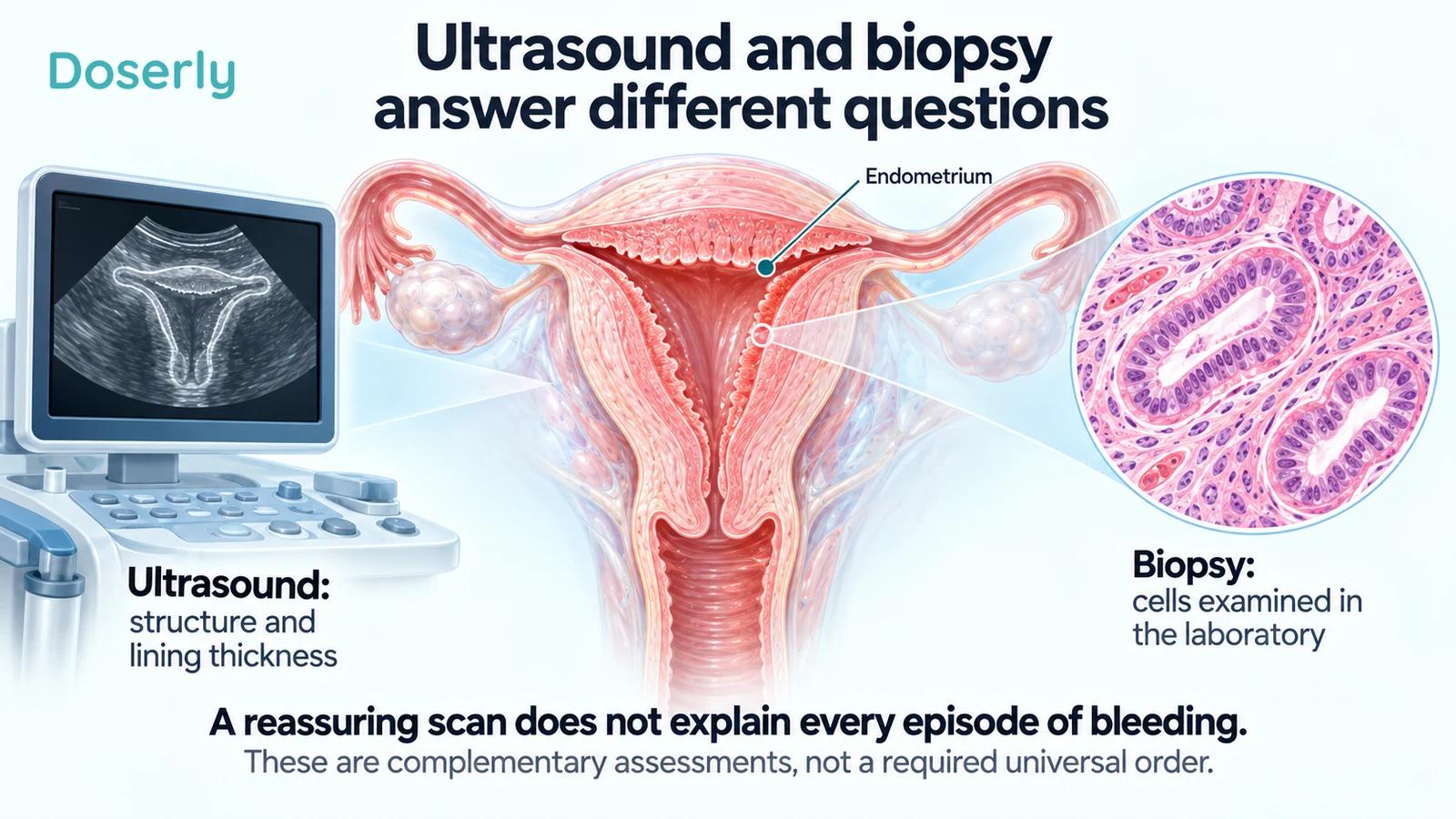
If you receive a scan report, useful questions include whether the lining was fully seen, how the measurement relates to your regimen, and what to do if bleeding continues. “Normal scan” is a summary; the follow-up plan should explain what it means for the symptom that led to the test.
Why US readers may receive different advice
Guidance changed in the United States too. ACOG's 2026 clinical update recommends ultrasound together with endometrial tissue sampling in the initial evaluation of most patients with postmenopausal bleeding. It revises the earlier approach in which a thin lining on ultrasound could more often be used without biopsy initially. ACOG 2026 clinical update.
The update still permits ultrasound alone for selected patients with a single episode, a fully visualized lining no thicker than 4 mm, no strongly associated cancer risk factors and reliable access to prompt reassessment. Continued or recurrent bleeding requires re-evaluation. This is broader postmenopausal-bleeding guidance, rather than an interchangeable copy of the UK HRT pathway.
If your clinician recommends sampling despite a reassuring thickness, that recommendation is not necessarily inconsistent with current guidance. Ask which pathway applies and which features of your history led to the recommendation. Country, patient population and the clinical question all influence how a scan is used.
What if bleeding returns after a reassuring investigation?
A reassuring result answers the question evaluated at that time. It does not create permanent immunity from future problems. Recurrent bleeding deserves a new conversation, especially if its pattern differs or the previous assessment was incomplete.
A prospective Dutch study followed patients after an initial episode of postmenopausal bleeding across four hospitals. It found that recurrence was associated with factors including HRT use and benign polyps at the first assessment. This was observational research: an association with recurrence does not prove HRT caused a particular lesion, and the study was not limited to one hormone regimen. Prospective recurrence study.
For the reader, the useful implication is practical. Keep the date and result of an earlier scan or biopsy, but also describe the new episode. That lets the clinician judge whether it resembles the previous pattern or needs a different investigation. A past benign explanation can be relevant without automatically explaining every later episode.
Making a bleeding record useful
A concise record usually communicates more than a retrospective estimate such as “it has been happening for a while.” Note the dates bleeding began and stopped, whether it was spotting or a heavier flow, whether it coincided with an expected withdrawal bleed, and whether there was pain or another new symptom. Add the original HRT start date and dates of dose or product changes.
Include the actual names of the estrogen and progestogen components. If there is an intrauterine device, note when it was inserted. If doses were missed or a patch repeatedly detached, record that too. The purpose is to make the treatment history clear, not to assign blame or decide the diagnosis from an app.
Our HRT monitoring guide explains how symptom review, bleeding history and selective investigations fit together. A record can support that assessment, but it should never become a reason to postpone contacting a clinician when bleeding is concerning.
What a clear plan should leave you knowing
Before the consultation ends, establish whether the next step is treatment review, investigation or both. Ask when you should expect follow-up, what changes should prompt earlier contact and how you will receive results. If a procedure is proposed, ask what it is intended to clarify and discuss comfort measures and any concerns about undergoing it.
NICE's updated timeline makes the conversation more precise. It helps distinguish early treatment-related bleeding from symptoms outside the expected interval, while leaving room for earlier assessment when the pattern or medical history calls for it. The aim is to protect both sides of good menopause care: effective symptom treatment and timely investigation of bleeding that needs an explanation.
Sources
- NICE NG23 recommendations, updated April 2026.
- NICE NG12 rationale and impact, April 2026.
- British Menopause Society joint bleeding guideline.
- Women's Health Concern patient factsheet, May 2026.
- Endometrial cancer detection in HRT users, retrospective cohort, 2022.
- Temporal clustering in symptomatic HRT users, NHS cohort, 2026.
- Recurrent postmenopausal bleeding, prospective Dutch cohort, 2024.
- ACOG updated guidance on ultrasound and endometrial evaluation, 2026.