
Supplements
October 16, 2026
NAC: why established medical uses do not prove every wellness claim
On this page
N-acetylcysteine, or NAC, has genuine medical uses. Acetylcysteine medicines are used to treat acetaminophen poisoning, and inhaled formulations help manage certain thick respiratory secretions. These are specific applications with defined formulations, routes, patient groups and monitoring.
That medical history makes NAC interesting as a supplement, but it does not establish every claim about daily detoxification, lung protection, mental health or healthy aging. A substance can be effective for one problem and ineffective for another. Even trials within the same broad disease category can reach different conclusions.
The useful approach is to keep the indication attached to the evidence. Our NAC guide covers broader product context. This article explains the main distinctions that matter when a familiar medicine is presented as an all-purpose wellness supplement.
What NAC contributes to glutathione biology
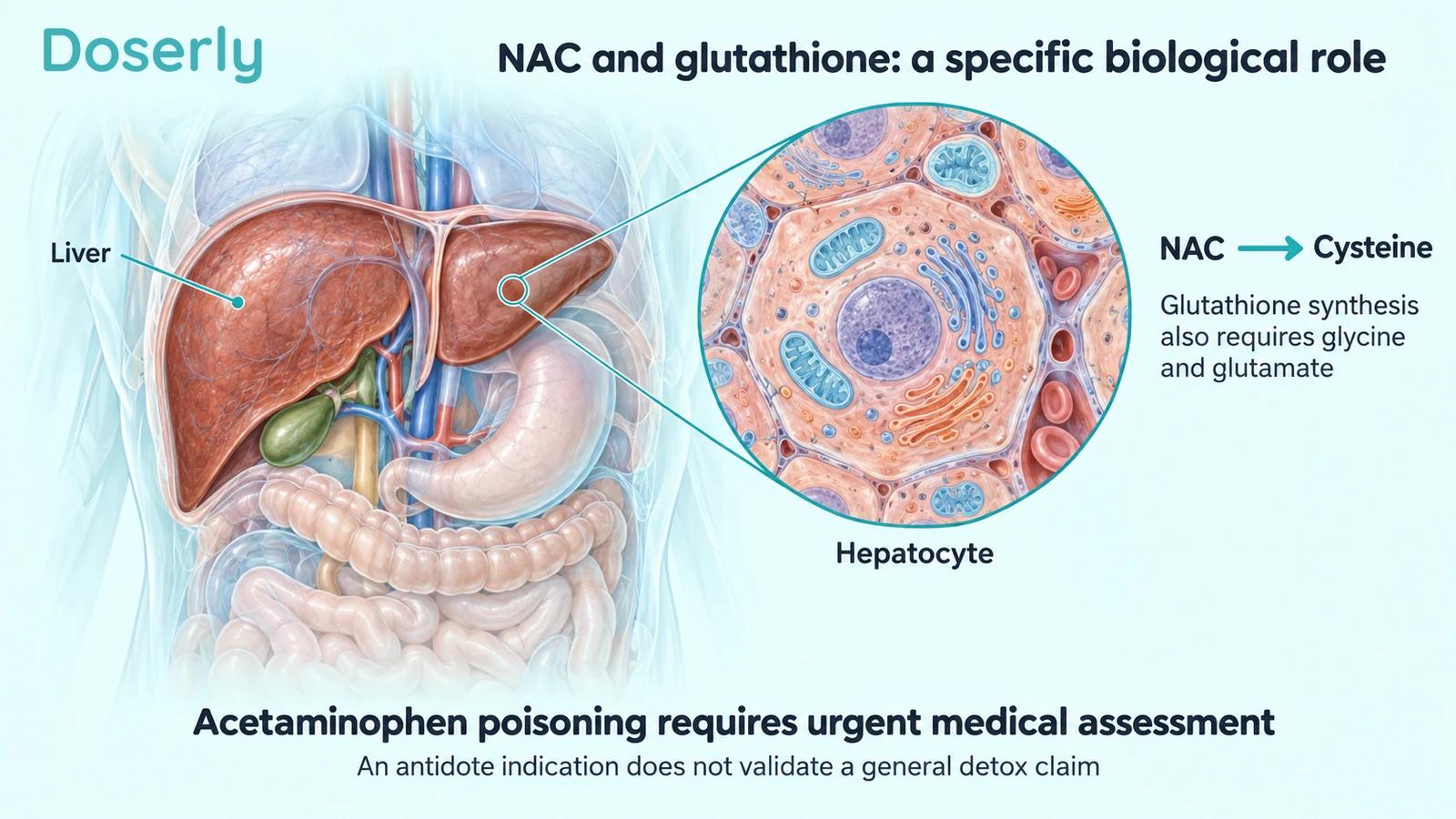
NAC can provide cysteine, one of the amino-acid building blocks used to make glutathione. Glutathione participates in antioxidant defense and the handling of certain reactive compounds. Its synthesis also requires glycine and glutamate, along with functioning cellular processes.
Providing a precursor is not the same as guaranteeing a particular increase in every tissue. The starting biological state matters, as do other available substrates and the outcome being measured. Research on combined glycine and NAC supplementation illustrates why investigators study these questions rather than assume that one ingredient explains the whole response. GlyNAC trial
“Antioxidant” therefore describes part of a biological rationale, not a complete clinical conclusion. To establish usefulness, a study still needs to show an appropriate benefit in the people and circumstances for which treatment is proposed.
The antidote use is a time-sensitive medical treatment
The prescribing information for intravenous acetylcysteine identifies it as an antidote used to prevent or lessen liver injury after potentially toxic acetaminophen exposure, including certain repeated excessive ingestions. Treatment decisions depend on the exposure history, timing, laboratory findings and clinical circumstances. Injection prescribing information
This is not evidence that an over-the-counter capsule makes excessive acetaminophen use safe. The route, amount, timing and monitoring in poisoning treatment are different from casual supplementation. Early symptoms can also be an unreliable guide to whether an exposure is dangerous.
If an acetaminophen overdose or repeated excessive use is possible, contact emergency services or a poison center promptly. Do not wait for symptoms or try to manage it with a supplement. This article intentionally does not provide an antidote schedule.
The broader reasoning matters beyond this one medicine. An antidote works within a defined toxicological problem. Its success does not establish that healthy people benefit from taking the same substance to remove unspecified “toxins.”
“Detox” needs a named exposure and an outcome
A meaningful detoxification claim identifies what substance is being handled, what biological process changes, and what improvement matters to the patient. In acetaminophen poisoning, there is a known exposure and a risk of liver injury. In many wellness claims, the proposed toxin and intended outcome are left undefined.
A supplement-induced change in glutathione or an oxidative-stress marker may be scientifically interesting. It does not by itself show better liver function, protection from alcohol-related injury or reduced risk from taking too much medication. Those are different questions requiring different evidence.
Nor does a normal laboratory result establish that a supplement prevented harm. Without an appropriate comparison, it is difficult to know what would have happened without it. NAC's established antidote role should not be used to encourage riskier exposures or delay medical assessment.
Inhaled acetylcysteine acts on respiratory secretions
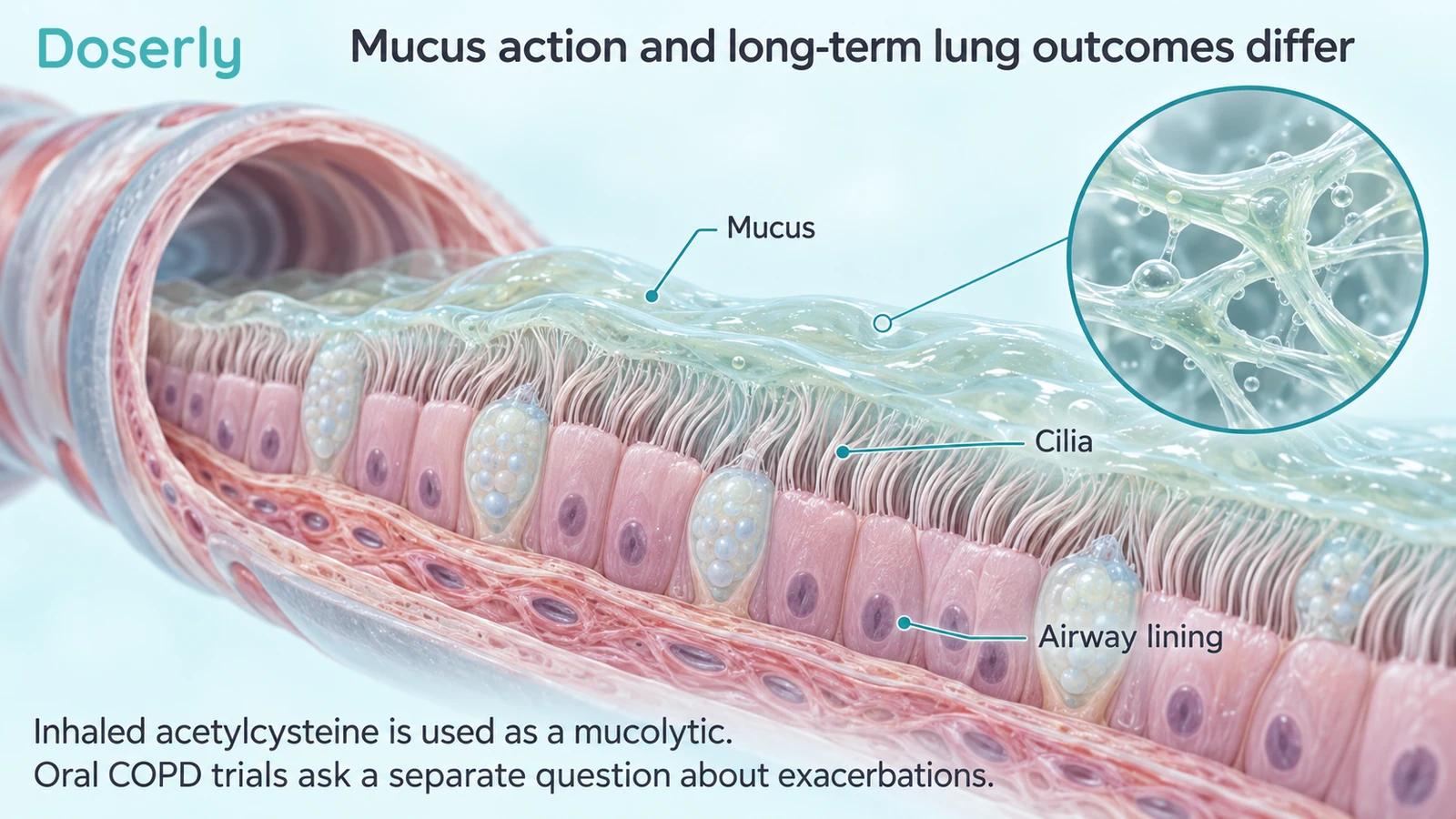
An inhaled acetylcysteine solution is a mucolytic: it helps reduce the viscosity of certain thick secretions. Its prescribing information describes use as an adjunct in respiratory conditions with abnormal mucus. The same label emphasizes that the preparation is not for injection and warns about possible bronchospasm. Inhalant prescribing information
That route-specific action is different from taking an oral supplement and expecting long-term protection against lung disease. A medicine delivered to the airway and a swallowed product do not automatically produce the same local exposure or clinical effect.
People should not nebulize supplement powders or substitute one formulation for another. Product sterility, excipients and intended route are part of medical safety, not incidental packaging details. The existence of an inhaled medicine does not authorize improvising an inhaled version of an oral product.
Oral COPD trials provide mixed, population-specific evidence
In the 2014 PANTHEON trial, 1,006 people with moderate-to-severe COPD in China were randomized to oral NAC or placebo for one year. The study used 600 mg twice daily. In the analyzed population, exacerbation rates were 1.16 versus 1.49 per patient-year, favoring NAC. PANTHEON
That is a clinically relevant outcome: exacerbations are episodes of worsening disease, not merely a blood-test change. However, it concerns a selected COPD population and an adjunctive treatment context. It does not show that NAC prevents COPD in otherwise healthy people or replaces inhaled treatment.
A 2024 trial randomized 968 people with mild-to-moderate COPD to the same daily schedule or placebo for two years. It did not find a statistically significant reduction in the annual rate of total exacerbations, and lung function did not significantly improve. The exacerbation rates were 0.65 versus 0.72 per patient-year. Mild-to-moderate COPD trial
Disease severity, baseline event rates, background treatment and study design can affect results. The trials support a discussion about selected clinical circumstances; they do not support one universal claim that NAC “protects the lungs.” The study amounts identify the experiments and are not a personal treatment recommendation.
Pulmonary fibrosis shows why combinations must remain distinct
In 2012, the PANTHER-IPF investigators reported harm from a combination of prednisone, azathioprine and NAC in people with idiopathic pulmonary fibrosis. At the interim analysis, there were 8 deaths versus 1 and 23 hospitalizations versus 7 in the combination and placebo groups, respectively. The combination arm was stopped early. Three-drug trial
That finding should not be rewritten as proof that NAC alone caused the excess deaths. The intervention contained three drugs, and the reported comparison concerned the combination.
The separate NAC-only comparison continued. Its 2014 report included 133 NAC recipients and 131 placebo recipients, with a planned 60-week assessment. NAC did not significantly preserve forced vital capacity, a measure of lung function, compared with placebo. NAC-only trial
These findings make two different points: a particular combination was harmful, and NAC alone did not provide the hoped-for lung-function benefit in the studied group. Keeping both statements intact is more accurate than describing all pulmonary-fibrosis research as either supportive or uniformly showing the same harm.
Mental-health findings do not generalize across diagnoses or ages
NAC has also been studied for specific psychiatric and behavioral conditions. A 2009 placebo-controlled trial enrolled 50 adults with trichotillomania, a condition involving recurrent hair pulling. Over 12 weeks, NAC improved hair-pulling symptoms; 56% were rated much or very much improved, compared with 16% receiving placebo. Adult trichotillomania trial
A 2013 trial in 39 children and adolescents did not find a significant benefit over placebo for the same condition. The investigators emphasized the difference from the adult findings. Pediatric trial
These studies are relevant to a defined diagnosis and a treatment conversation. They do not establish that NAC treats everyday stress, improves motivation or benefits every repetitive behavior. A positive adult trial also cannot supply a pediatric recommendation when the pediatric comparison was negative.
Mechanistic explanations involving glutamate or oxidative stress can guide research, but shared biological language does not make different diagnoses interchangeable. Treatment decisions need to consider the condition, evidence quality, behavioral therapies and the person's wider care plan.
GlyNAC research is about a combination
A randomized study published in 2023 assigned 24 older adults to glycine plus NAC, called GlyNAC, or an alanine placebo for 16 weeks. There were 12 participants per randomized group. The investigators reported improvements in glutathione-related measures, several metabolic or cellular outcomes and aspects of physical function. GlyNAC randomized trial
The study offers a reason for larger confirmatory trials. It does not establish that NAC alone reproduces the findings, because glycine was part of the intervention. Its small sample and numerous measurements also limit confidence about the size and generalizability of individual effects.
The trial did not show that participants lived longer or avoided age-related diseases. Describing improvements in selected “hallmarks of aging” is not equivalent to demonstrating slower clinical aging or extended lifespan. Those broader outcomes require different study designs and substantially longer follow-up.
For someone comparing NAC and GlyNAC labels, this is a practical distinction. Removing one ingredient or changing the formulation creates a different intervention. A shared ingredient name is not enough to transfer the whole evidence base.
Safety and tolerability depend on the route
Different acetylcysteine preparations have different precautions. Intravenous prescribing information includes serious hypersensitivity reactions and fluid-related considerations. Inhaled preparations can provoke bronchospasm and increase the volume of liquefied secretions requiring management. Oral use can cause gastrointestinal intolerance, and tolerability in one small trial does not establish universal safety. Injection label, inhalant label
These are not reasons to conflate all routes as equally risky. They are reasons to discuss the actual product and intended use. A clinician or pharmacist needs to know the formulation, other medicines, medical conditions and reason for taking it.
An adverse effect also should not be interpreted as proof of a “detox reaction.” New symptoms deserve ordinary assessment rather than an explanation that assumes the product is working. Pregnancy, breastfeeding, significant lung disease and treatment of a psychiatric condition add context that a supplement label cannot resolve.
A useful decision starts with a specific goal
Ask what problem is being addressed and which study supports that use. An established antidote indication, a positive COPD trial, a negative fibrosis trial and a small combination study all belong in the evidence map, but they answer different questions.
Next, identify what improvement would matter. Less coughing, fewer exacerbations, reduced hair pulling and a higher laboratory glutathione measurement are different outcomes. A mechanism can help explain a result; it should not replace the result.
If NAC is used within an agreed care plan, a dated record of the exact product, reason for use, other treatment changes and relevant symptoms can make follow-up more useful. Changing several supplements and medicines at once makes attribution difficult. Tracking provides context, not proof that NAC caused every subsequent change.
NAC's medical history is a reason to take its pharmacology seriously. The strongest interpretation preserves where it has established value, where human trials show conditional promise, and where the hoped-for benefit has not been demonstrated.
Sources
- Acetylcysteine injection prescribing information
- Acetylcysteine inhalant prescribing information
- PANTHEON COPD trial
- 2024 mild-to-moderate COPD trial
- PANTHER three-drug regimen
- NAC-only pulmonary-fibrosis trial
- Adult trichotillomania trial
- Pediatric trichotillomania trial
- GlyNAC trial