
Supplements
October 16, 2026
Milk thistle and liver health: a protective reputation is not permission to ignore the cause
On this page
An unexpected liver-test result can make a “liver support” product feel like an immediate, constructive response. Milk thistle is familiar, has a long history of use and is often described in reassuring language about protection.
The difficulty is that liver health is not one problem. An elevated enzyme, a viral infection, fat accumulation, medication-related injury and established scarring require different assessments. A supplement's reputation cannot determine which of those is present.
Milk thistle deserves an evidence-based discussion, including the findings that keep it scientifically interesting. But the useful question is specific: did a defined preparation improve a meaningful outcome in people with the condition being considered? That question is more demanding than whether the plant has antioxidant activity.
Start with what the test is measuring
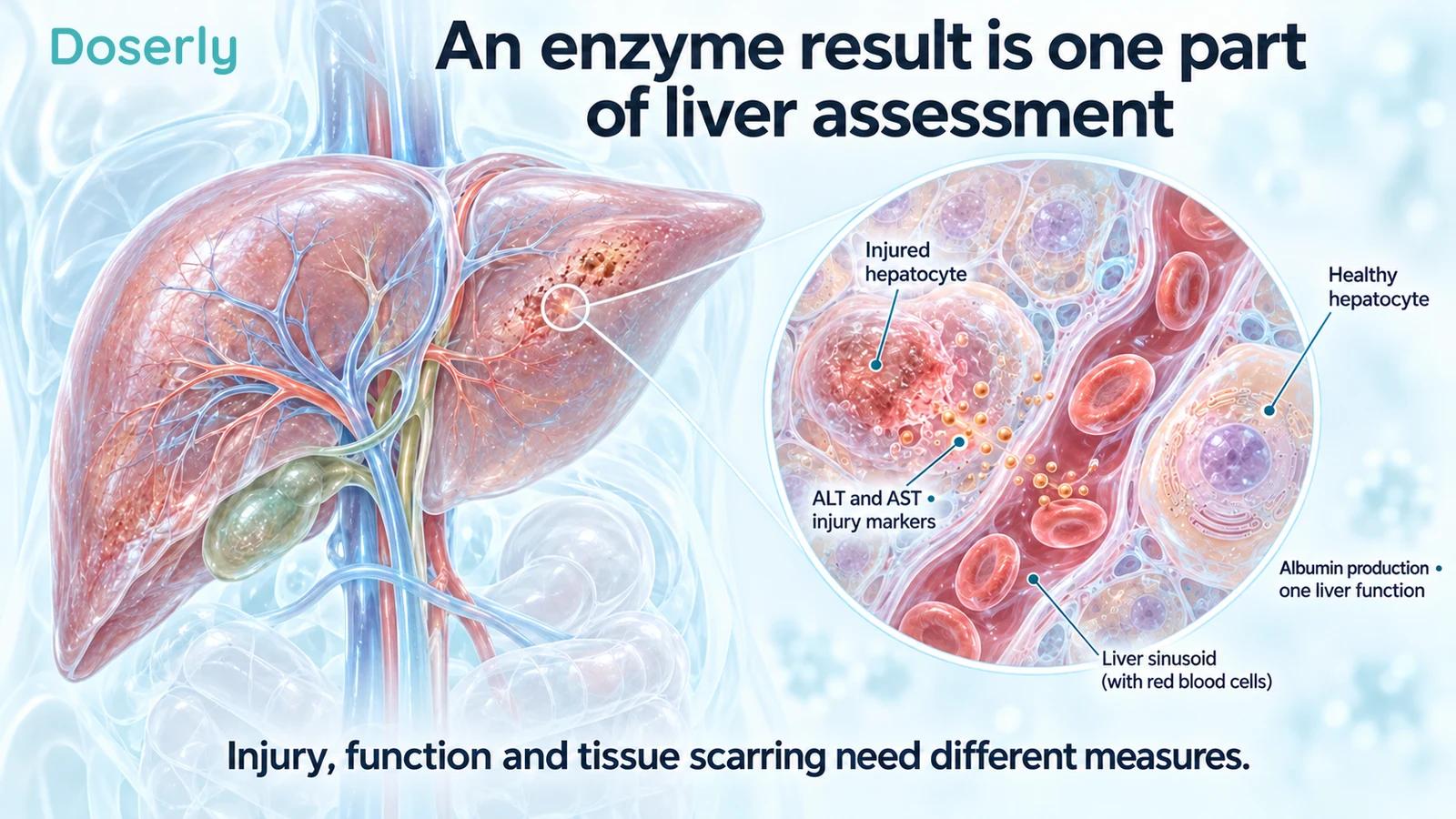
ALT and AST are commonly called liver enzymes. They help assess cell injury, but they are not a complete measure of how well the liver is functioning. AST also occurs in tissues outside the liver, including skeletal muscle.
Other measurements answer different questions. Albumin and clotting-related tests can contribute information about liver function, while their interpretation also depends on other clinical factors. The degree of enzyme elevation does not directly tell you the extent of liver damage. AASLD explanation of elevated liver enzymes.
This means a lower ALT result can be relevant without proving that fibrosis has reversed, an infection has cleared or a harmful exposure has become safe. Conversely, a result within a laboratory's reference range is not a universal certificate of liver health.
When a supplement study reports “improved liver markers,” identify the marker. Was it an enzyme concentration, a tissue score, imaging, symptoms or a serious clinical outcome? The phrase sounds comprehensive, but the underlying result may be narrow.
A clinician's task is to connect the pattern with the history and other findings. A supplement label cannot make that connection from a single number.
What the hepatitis C trial actually found
A 2012 multicenter randomized trial enrolled 154 people with chronic hepatitis C, elevated ALT and previous unsuccessful interferon-based treatment. Participants received one of two silymarin exposures or placebo for 24 weeks.
Only two participants in each group met the study's primary ALT response criterion. Changes in ALT, hepatitis C viral RNA and quality of life did not significantly favor silymarin over placebo. The trial therefore did not support using that preparation to reduce disease activity in the population studied. Read the primary JAMA trial.
That finding is stronger than a laboratory mechanism but narrower than a claim that every possible milk-thistle preparation has been disproved for every liver condition. It concerns a particular extract, exposure, duration and historical patient group.
It is also not a comparison with today's hepatitis C care. The CDC describes modern oral direct-acting antiviral treatments that cure more than 95% of people, commonly over eight to twelve weeks. An individual's regimen and follow-up require clinical assessment. CDC hepatitis C treatment information.
The practical implication is important: an old supplement trial should not make current treatment seem unavailable, ineffective or interchangeable with herbal support. When infection is the cause, evaluating treatment of the infection is central.
The fatty-liver evidence is more complicated than one headline
A 2017 randomized placebo-controlled trial studied 99 adults with biopsy-proven nonalcoholic steatohepatitis, then called NASH. After 48 weeks, the primary outcome—a reduction of at least 30% in the liver activity score—occurred in 32.7% of the silymarin group and 26.0% of the placebo group. That difference was not statistically significant.
There was, however, a favorable secondary fibrosis finding: at least a one-point histological reduction occurred in 22.4% versus 6.0%. The investigators said the possible fibrosis benefit needed confirmation in a larger trial. Read the 2017 study.
Both parts belong in an honest account. Describing the study only as a success hides the failed primary endpoint. Describing it as showing nothing hides a potentially useful secondary signal.
Secondary findings can generate important hypotheses, especially when they involve a meaningful feature such as scarring. But a favorable result among several measured outcomes needs to be interpreted alongside the study's main question, sample size and subsequent evidence. It is not automatically proof of protection from cirrhosis or future liver complications.
A later trial adds uncertainty rather than a simple confirmation
A 2019 multicenter trial randomized 78 people to two silymarin groups or placebo. After roughly 48 weeks, the primary histological response occurred in 15%, 19% and 12%, respectively, without a significant difference.
Interpretation was complicated by central pathology review: many participants' entry biopsies did not confirm the required eligibility criteria or could not be adequately assessed. The researchers considered the efficacy findings inconclusive in light of those limitations and the lack of a clear primary benefit. Read the 2019 trial.
This study should not be used to claim a precise zero effect in every appropriate patient. But its limitations do not convert a neutral result into evidence that the supplement works. They reduce confidence in what can be concluded.
The 2023 AASLD practice guidance did not recommend silymarin as a NASH treatment because meaningful histological benefit had not been established. That conclusion is about treating the disease, not denying that individual experiments can produce promising signals. AASLD practice guidance.
The names have changed; the study population still matters
Older studies use NAFLD and NASH. Current terminology commonly uses metabolic dysfunction-associated steatotic liver disease, or MASLD, and metabolic dysfunction-associated steatohepatitis, or MASH. The AASLD guidance collection includes the terminology update and newer disease-specific treatment guidance. AASLD current guidance index.
When discussing older trials, retaining their original diagnostic terms helps prevent the reader from assuming that every modern patient category was studied under identical criteria. Names provide context; inclusion criteria establish who actually participated.
It also matters that the treatment landscape continues to change. An old article about milk thistle is not a complete account of contemporary care. Decisions about fibrosis assessment, metabolic risk and disease-specific treatment belong within an up-to-date clinical plan.
For a reader, the most useful question is not whether “fatty liver” appears somewhere in a product's bibliography. It is whether the study's diagnosis, disease stage and outcome match the problem being evaluated now.
Treating a marker does not remove an exposure
Imagine a fictional person who starts milk thistle after an abnormal ALT result, changes alcohol intake at the same time and then sees a lower value. The change may be welcome, but it cannot isolate the supplement's contribution.
The same problem arises if weight, another medicine, an acute illness or the timing of the blood test changes. A before-and-after observation is clinically useful information; it is not automatically a controlled treatment effect.
More importantly, a favorable number should not become permission to continue a potentially harmful exposure. Trials in hepatitis C or NASH do not establish that milk thistle neutralizes alcohol-related harm or makes another drug safe for the liver.
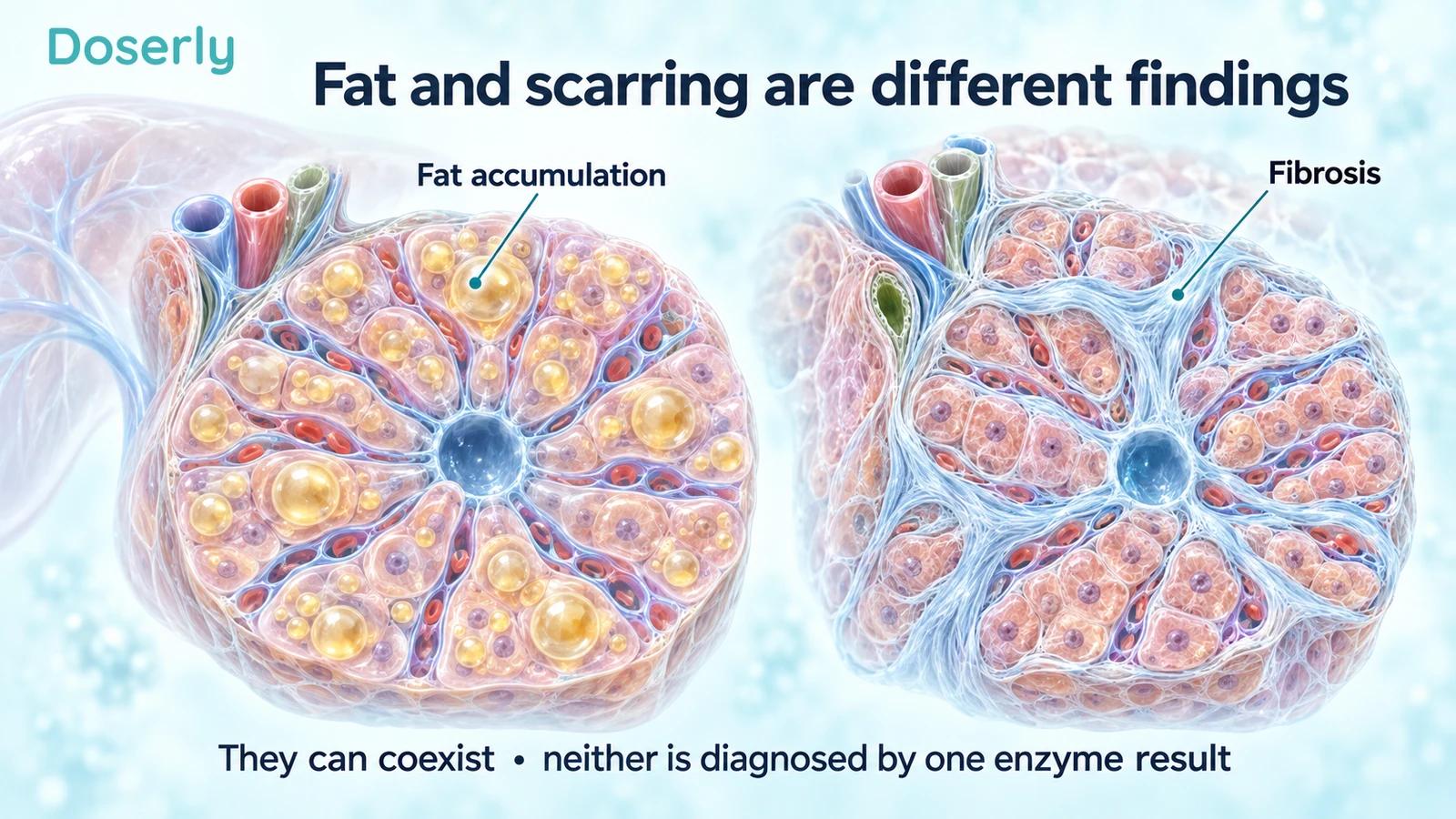
The underlying cause still needs attention. Liver disease can arise from several conditions, and more than one can coexist. Cirrhosis may have few symptoms until damage is advanced, so feeling well is not enough to exclude it. NIDDK cirrhosis information.
That does not mean every abnormal test signals advanced disease. It means the response should be proportionate assessment rather than either panic or reassurance purchased in a bottle.
“Milk thistle” and “silymarin” are not complete product descriptions
Silymarin is a mixture of compounds extracted from milk thistle. A plant name, an extract weight and a standardized preparation are related descriptions, but they are not interchangeable measures of exposure.
The NIH reports that human liver-disease studies have been conflicting or too limited for firm conclusions. It also notes concerns about commercial product quality, including differences between labeled and measured silymarin content and contamination in some products. NCCIH milk-thistle reference.
This creates two separate uncertainties. One concerns whether a preparation has a demonstrated benefit. The other concerns whether a purchased product contains what the label suggests. Solving the quality question would not, on its own, establish treatment efficacy.
The Doserly milk-thistle guide provides broader ingredient background. For a concrete review, retain the exact product label, manufacturer, serving size and any additional ingredients. A “liver blend” containing several botanicals deserves assessment as a mixture; it should not inherit reassurance from one ingredient's reputation.
Do not use the amounts described in a clinical trial as a self-directed treatment schedule. Research exposures belong to a particular protocol and patient population.
Tolerability is useful information, not proof of protection
Oral milk thistle is generally reported as well tolerated, with digestive symptoms such as nausea, gas or bloating among the common adverse effects. Allergic reactions are possible, especially in people sensitive to related plants. Evidence about use during pregnancy and breastfeeding is limited. Medicines and supplements should be reviewed together. NCCIH safety information.
A trial that found similar adverse-event rates between groups can provide reassurance about what was observed during that study. It cannot establish that every formulation is safe indefinitely, free from interactions or appropriate for someone with a different liver condition.
There is another practical risk: adding a new product can complicate the history when clinicians are trying to understand an abnormal test. That is a reason to report all exposures accurately, not to assume that the newest supplement must be responsible.
Avoid abruptly stopping prescribed treatment because it is processed by the liver. The right question is whether a particular medicine is implicated and what alternatives or monitoring are appropriate. That decision requires the clinical context the supplement label lacks.
Keep the original laboratory report as well as any personal summary. A note saying “liver numbers improved” loses the test name, units, reference range and date. Those details help distinguish a change in one injury marker from a broader assessment of liver function or tissue disease.
Build a record that helps identify the cause
Bring the actual laboratory results, including dates, units and reference ranges. “My liver numbers were high” loses the pattern that makes the results interpretable.
List prescription medicines, over-the-counter products and supplements with start dates and changes. Include alcohol intake as accurately as possible. The purpose is not to assign blame; it is to make the exposure history useful.
Then establish what the follow-up is intended to answer. Is the clinician checking whether an abnormality persists, investigating infection, assessing fat accumulation, estimating fibrosis risk or monitoring a known diagnosis? Different questions may require different information.
A routine record can help preserve that plan and show what changed between measurements. It should not reduce the goal to making one number look better. If new jaundice, confusion, bleeding or other significant symptoms appear, seek prompt medical assessment rather than waiting to see whether a supplement helps.
Milk thistle's reputation becomes less useful when it substitutes for identifying the problem. Its evidence becomes more useful when each result remains attached to the condition and outcome actually studied. The priority is a clear explanation of the liver concern and a plan that addresses its cause.
Sources
- Effect of silymarin (milk thistle) on liver disease in patients with chronic hepatitis C unsuccessfully treated with interferon therapy: a randomized controlled trial (2012)
- A Randomized Trial of Silymarin for the Treatment of Nonalcoholic Steatohepatitis (2017)
- Silymarin in non-cirrhotics with non-alcoholic steatohepatitis: A randomized, double-blind, placebo controlled trial (2019)
- How to approach elevated liver enzymes? (2025)
- AASLD Practice Guidance on the clinical assessment and management of nonalcoholic fatty liver disease (2023)
- Clinical Assessment and Management of Metabolic Dysfunction-Associated Steatotic Liver Disease
- Treatment of Hepatitis C
- Milk Thistle: Usefulness and Safety (2025)
- Definition and Facts for Cirrhosis