
Peptides
October 16, 2026
Melanotan I and afamelanotide: why the product matters
On this page
Afamelanotide and Melanotan I refer to the same peptide identity, but products carrying those names are not automatically interchangeable. Scenesse is an approved afamelanotide implant. A powder vial or nasal spray marketed for tanning is a different preparation, with different questions about its contents, delivery and clinical evidence.
That distinction is more than packaging. A formulation determines how a substance is presented to the body and released over time. The treatment tested in a clinical trial includes that delivery system, the amount administered, the route and the population receiving it. When one of those changes, the results may no longer answer the question being asked.
For someone comparing products, the useful question is therefore not simply “Is afamelanotide approved?” It is “Which product is approved, for whom, and what did that product demonstrate?” The US approval record identifies Scenesse as a prescription 16 mg subcutaneous implant. It does not list an interchangeable tanning powder or spray. Drugs@FDA, NDA 210797.
What is actually approved?
The US prescribing information indicates Scenesse to increase pain-free light exposure in adults with a history of phototoxic reactions from erythropoietic protoporphyria, or EPP. It is inserted by a healthcare professional trained in the implantation procedure. The label specifies one implant every two months. These details describe the approved medicine; they are not instructions for converting a vial into an equivalent treatment. Scenesse prescribing information.
EPP is a rare condition in which accumulated light-sensitive protoporphyrin makes light exposure painful. The intended benefit is greater tolerance of light in that disease context. It is not an approval to produce a cosmetic tan in otherwise healthy people.
The European authorization likewise concerns the Scenesse implant for adults with EPP. EMA describes approval under exceptional circumstances and continuing collection of benefit and safety information. EMA overview. The clinical context and follow-up obligations are part of the treatment's evidence, not incidental details that can be dropped when the active ingredient is advertised elsewhere.
Why develop an implant in the first place?
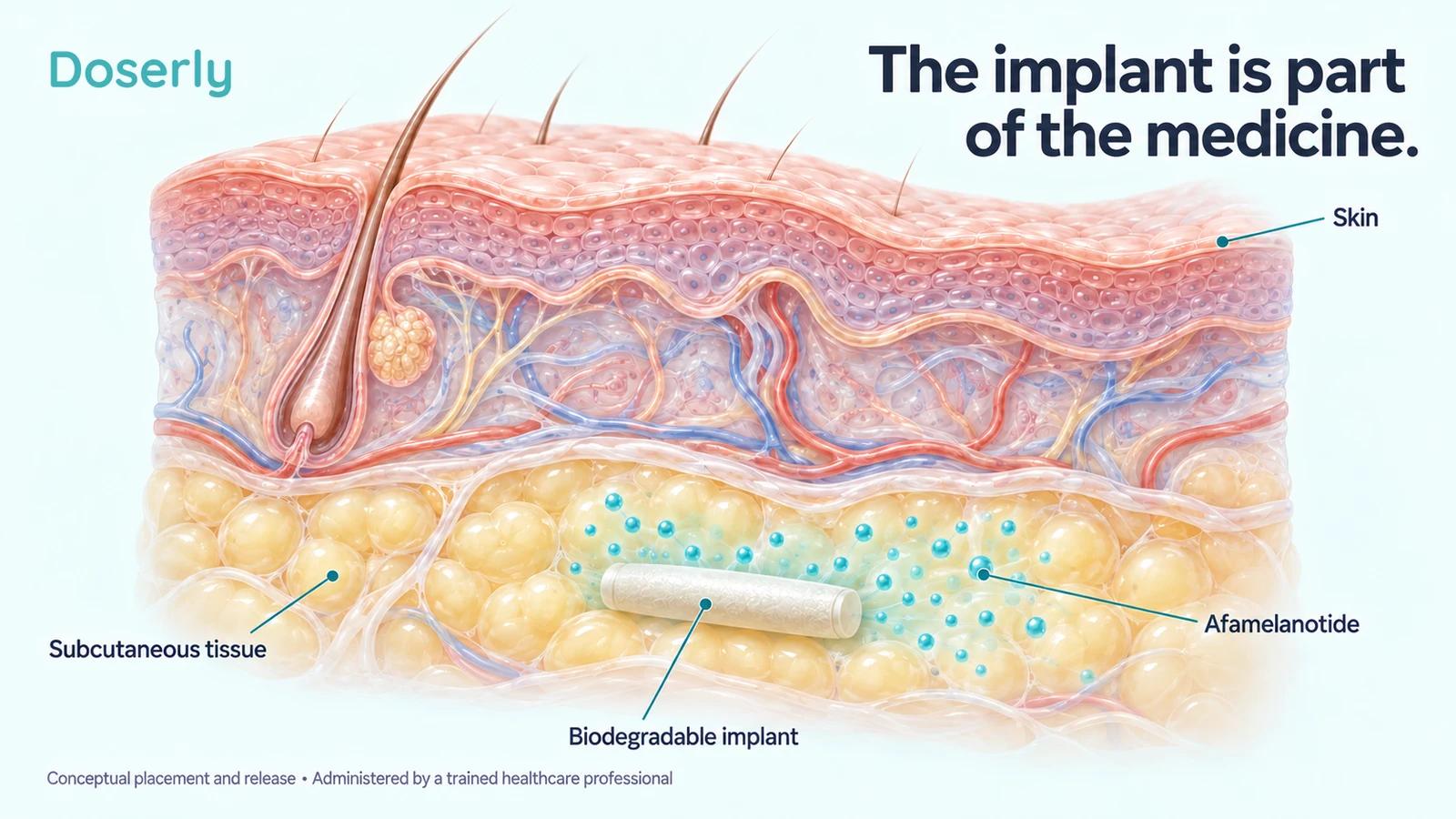
Afamelanotide's development included aqueous injections and several candidate implants. EMA's assessment describes rapid absorption of the aqueous formulation and the practical limitations of repeated injections. Researchers then evaluated biodegradable implants intended to release the peptide over a defined period. EMA assessment, pharmacokinetics section.
Different implant versions did not have identical release behavior. The development program examined plasma concentrations, tolerability and pigment responses to guide selection of a formulation. That history shows that the implant was not merely a convenient container for an already interchangeable dose. Its performance was a research question.
A biodegradable delivery system is designed to break down in the body. That does not mean any substance with the same ingredient can reproduce its release profile. Dissolving a powder and injecting it creates a different preparation. A nasal product introduces another route with its own absorption questions.
Why the number of milligrams doesn't establish equivalence
Milligrams describe an amount of substance. They do not describe how quickly it enters circulation, the highest concentration reached, how long exposure lasts or how much reaches a particular tissue. Those are pharmacokinetic questions: how the body handles a drug over time.
Two preparations containing the same nominal amount may produce different exposure patterns. A rapid rise followed by a decline is not automatically equivalent to release over several days. Repeated small administrations cannot be assumed to reproduce an implant either. Equivalence would need to be demonstrated, rather than calculated from the total milligrams printed on the packages.
The EMA development assessment specifically describes an early release phase followed by more sustained exposure with a candidate implant. It also documents differences between formulations. EMA assessment. That provides a concrete reason to preserve formulation details when discussing trial findings.
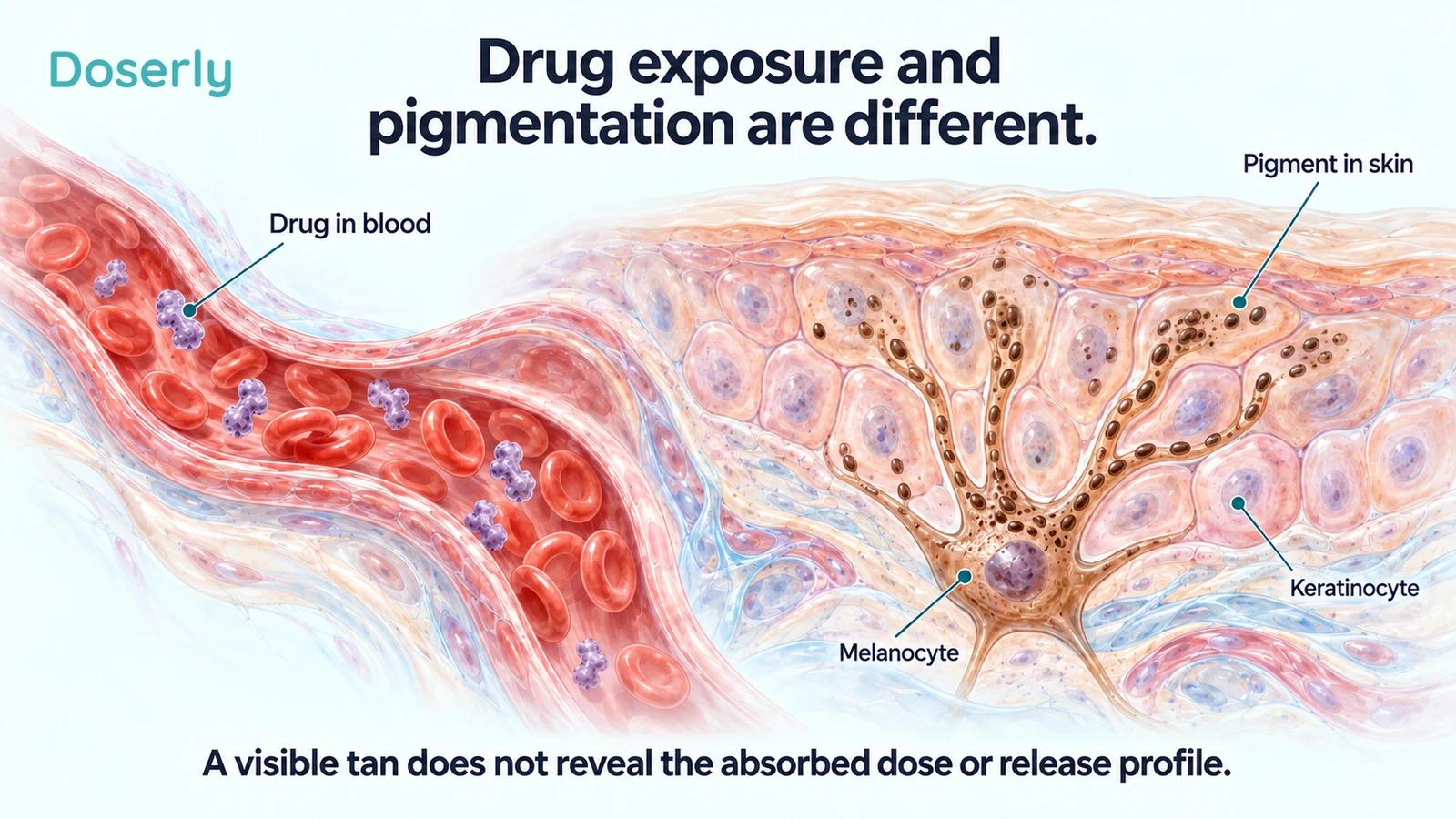
There is another timing issue: a biological response can outlast a readily measurable blood concentration. Pigmentation develops through cellular processes; it is not a direct readout of the amount of peptide currently circulating. A treatment interval therefore should not be mistaken for a claim that the product releases an identical amount continuously throughout that interval.
A visible tan cannot measure the absorbed dose
Afamelanotide stimulates pigment-related signaling through MC1R. Its effect on melanocytes and eumelanin provides a biological explanation for skin darkening. But a visible response does not identify the preparation's actual content or tell you how it was absorbed. Scenesse mechanism and pharmacology.
For example, someone may observe darker freckles after using a product. That observation is relevant to their clinical history, but it cannot validate a seller's purity claim, establish an exposure profile or show that the product matches the implant used in trials. It also does not prove that the person's risk from sunlight has been adequately reduced.
This distinction is useful when comparing anecdotes. Two people reporting similar color changes may have received different products, amounts or routes. They may also differ in skin characteristics and light exposure. Similar appearance is not evidence of pharmaceutical equivalence.
Product quality adds a separate question
Even before asking whether a route works, there is the question of what the product contains. Identity, quantity, impurities, contamination and storage are different properties. A claim about one does not establish all the others.
Health Canada's April 2026 advisory specifically lists unauthorized injectable products labeled Melanotan I and II among examples encountered by the agency. It warns that unauthorized peptide products may contain incorrect amounts, unlisted ingredients or contaminants, and that “research use” labeling does not exempt products from regulatory requirements. Health Canada advisory.
That warning should not be turned into a claim that every online vial contains the same defect. The point is that the approved medicine's evidence does not establish the quality of another product. A certificate or an ingredient name would need to be evaluated for what it actually verifies, including whether it applies to the specific finished batch being supplied.
For an injectable product, this distinction is particularly consequential. Evidence about the peptide's biological activity cannot substitute for evidence about a finished product's suitability for administration. “Same molecule” and “same medicine” are different claims.
Approval records refer to a named product and route
Regulators maintain product-specific records. In Australia, the ARTG entry identifies Scenesse afamelanotide 16 mg implant vial. Separately, the TGA warns that melanotan products marketed for tanning are not approved for that use and have not been assessed for quality or safety. Australian product entry, TGA tanning-product warning.
Those statements are compatible: an approved implant for a medical condition can coexist with unapproved products using a related ingredient name. Saying merely that “melanotan is legal” or “melanotan is illegal” loses the product, indication and jurisdiction needed to understand the claim.
This article is not a complete survey of every country's prescribing or import rules. For a real treatment decision, a clinician or pharmacist can check the current local authorization and the exact product. A foreign approval or a screenshot of a scientific paper is not sufficient confirmation of the product being offered to you.
Storage instructions also belong to the specific formulation
An implant's storage requirements are established for that manufactured product in its packaging. They should not be extended to an unidentified powder or a reconstituted mixture. The presence of water, the formulation's other ingredients and handling can change stability questions.
The current Scenesse label provides product-specific storage and handling information. US prescribing information. An older development study of a temporary temperature excursion should not be repackaged as general permission to store all afamelanotide preparations that way.
For patients using an approved medicine, the useful action is to follow the dispensing team's instructions and ask about any storage problem with the actual product. The ingredient name alone cannot resolve whether an excursion affected it.
What a proposed substitute would need to demonstrate
If a manufacturer or clinician claims another preparation is equivalent, the claim needs a defined comparison. Does it contain the same active ingredient in an accurately characterized form? Does it produce comparable exposure? Does the route introduce different local or systemic risks? Does it have evidence for the intended clinical outcome?
A study showing pigmentation in volunteers would answer a different question from an EPP trial measuring pain-free light exposure. A formulation could produce a visible effect without reproducing the clinical benefit or safety profile of Scenesse. The comparison needs to remain connected to the outcome a patient actually wants.
The original EPP trials used manufactured implants and placebo comparators. Their results cannot establish the performance of a preparation that was not administered in those trials. Randomized trial report. This is a limit of the evidence, not an assumption that every alternative must behave in the same unfavorable way.
How to make a product discussion concrete
Bring the exact product name, formulation, route and source to the clinician or pharmacist. Ask which authorization or human study applies to that preparation and which benefit it is intended to provide. If the answer refers only to “afamelanotide research,” ask whether the cited participants received the product being proposed.
Also ask how follow-up compares with the approved treatment's monitoring. The Scenesse label includes skin examinations and precautions for serious hypersensitivity; an alternative preparation does not remove the need to consider those issues. Prescribing information.
The Doserly Melanotan I guide explains the broader distinction between afamelanotide as a molecule and Scenesse as a medicine. Keeping those identities separate is the clearest way to understand what the clinical research can support.
Sources
- Drugs@FDA: Scenesse NDA 210797.
- Scenesse prescribing information.
- EMA: product overview.
- EMA: formulation development and clinical assessment.
- Health Canada: unauthorized injectable peptides.
- TGA: Scenesse product entry.
- TGA: melanotan tanning products.
- Langendonk et al.: implant trials in EPP.