
Peptides
October 16, 2026
Mazdutide's US phase 2 trial: what a different population adds
On this page
A trial conducted in another country can broaden confidence in a medicine's effects. It does not automatically prove that the participants represent everyone living there, or that the result applies equally across demographic groups.
Mazdutide's US phase 2 obesity trial is a useful example. It adds evidence from a different clinical setting to studies conducted in China, while exploring higher doses. Its strongest contribution is therefore specific: another randomized test of the medicine in a defined adult population, with additional information about dose response and tolerability.
To understand what it adds, look beyond the country in the title. The enrolled participants' age, sex, race, ethnicity, baseline weight and health conditions all matter. So do the small treatment groups and the way the analysis handled treatment discontinuation.
What the US study tested
The trial enrolled 179 adults at 24 US centers. Participants were aged 18–75 and did not have type 2 diabetes. Eligibility required a BMI of at least 30, or a BMI from 27 to below 30 with at least one weight-related condition.
Participants were randomly assigned to placebo or three mazdutide regimens: a 3–6 mg group, a 10 mg group and a 16 mg group. Treatment lasted 48 weeks, while the primary weight endpoint was assessed at week 32. The lower-dose group remained at 3 mg before increasing to 6 mg at week 32. These are trial regimens, not instructions for individual use. Original US phase 2 publication.
The timing detail prevents a common reading error. The week-32 result for the “3–6 mg” group is not a result after 32 weeks at 6 mg. A regimen label can describe a schedule extending beyond the time of the primary assessment.
For broader background on the molecule and its development, see the Doserly mazdutide guide.
Representation needs actual numbers
The public results record makes it possible to examine who enrolled rather than assuming diversity from the study location. Mean age was 47.7 years, and mean starting weight was 107.6 kg. The registry recorded 118 female and 61 male participants.
Race was recorded as White for 125 participants, Black or African American for 34, Asian for nine, American Indian or Alaska Native for one, and more than one race for six. Four were recorded as unknown or not reported; none were recorded as Native Hawaiian or Other Pacific Islander. Ethnicity was reported separately: 41 participants were Hispanic or Latino, 135 were not, and three were unknown or not reported. Posted registry results.
Those counts show enrollment across several demographic categories. They also show uneven representation. A group containing one participant cannot provide a stable group-specific estimate of efficacy or safety.
Race and ethnicity are recorded categories, not explanations for an individual's biological response. They can help identify gaps in recruitment and evidence, but should not be treated as simple substitutes for ancestry, social circumstances, access to care or clinical characteristics.
The appropriate conclusion is that the study expands the observed population. It does not establish equally precise evidence for every group listed in its baseline table.
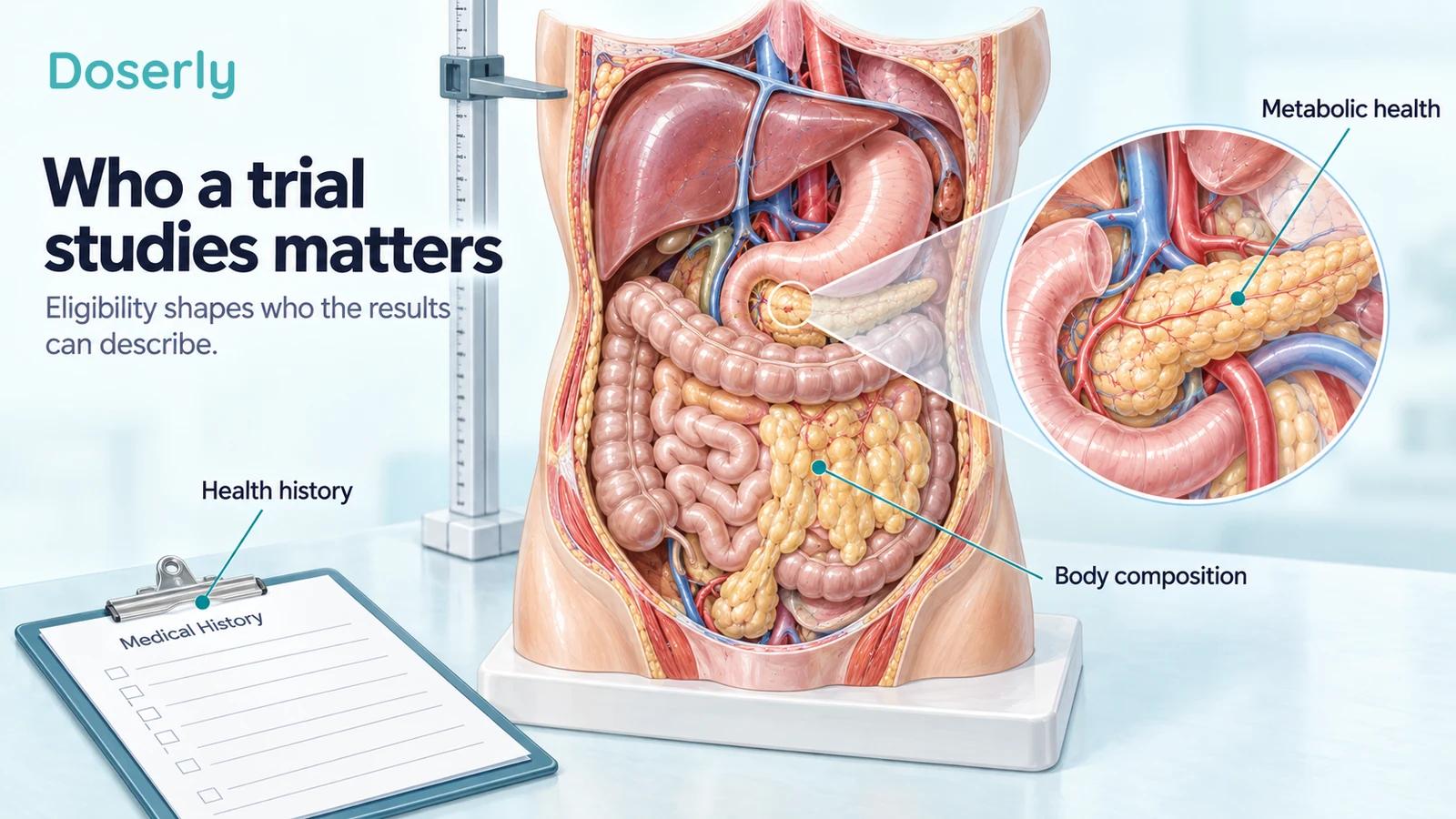
What changes when evidence comes from another setting?
An additional trial can test whether an earlier overall result appears again under a new combination of recruitment, clinical practice and participant characteristics. Consistency across studies is useful because a finding limited to one setting may be less informative for other settings.
That does not create a hierarchy in which a US study is inherently more trustworthy than a Chinese study. Randomization, trial conduct, outcome measurement, completeness of follow-up and transparent analysis are central to both.
GLORY-1, the Chinese phase 3 trial, randomized 610 adults and studied 4 mg and 6 mg mazdutide. Its participants had a mean age of 34.2 years, mean weight of 87.2 kg and mean BMI of 31.1. The study used Chinese BMI criteria for overweight and obesity. Those differences are relevant when comparing the populations with the US study. GLORY-1 publication.
But country and population changed at the same time as dose regimens and other study features. The studies cannot isolate which of those differences explains a difference in average weight loss. A larger response in one study is not evidence that nationality caused the response.
Small arms limit what subgroup comparisons can tell us
The US trial assigned 32 participants to the 3–6 mg regimen, 48 to 10 mg, 51 to 16 mg and 48 to placebo. Splitting those groups again by age, sex or race leaves still smaller numbers. Trial allocation and results.
This matters even when the overall treatment effect is clear. A study can be informative about its primary comparison while remaining unable to estimate reliable differences between subgroups.
For example, an apparently larger response in one small subgroup could reflect chance, baseline differences or an imprecise estimate. Conversely, failing to detect a subgroup difference does not prove that responses are identical. The analysis needs enough participants and a suitable comparison to answer that question.
A credible subgroup claim should identify whether the analysis was planned, provide uncertainty around the estimates, and test the difference between groups rather than simply noting that one group's result was statistically significant and another's was not.
These are interpretation principles, not a claim that this trial demonstrated a particular demographic interaction. The published overall result should not be converted into unsupported predictions for individual racial or ethnic groups.
The weight result also has an analysis definition
At week 32, the reported average weight changes were −7.3%, −15.6% and −18.1% in the three mazdutide groups, compared with −0.9% with placebo. The primary analysis used an efficacy, or hypothetical, estimand. US trial publication.
An estimand specifies the treatment effect being estimated, including how events such as discontinuation are handled. A hypothetical analysis addresses a defined scenario; it should not be read as a simple average of what every participant actually experienced regardless of treatment changes. ICH E9(R1) methods guidance.
That is especially important when readers compare the US percentages with numbers from another study. Matching the time point while ignoring the estimand can still produce an unfair comparison. Matching the drug while ignoring the regimen can do the same.
The result supports a dose-ranging efficacy signal within this trial. It does not by itself establish how much weight a particular patient will lose, or prove superiority over another medicine studied elsewhere.
Tolerability belongs beside efficacy
The original US report describes gastrointestinal events as the most common adverse events with mazdutide, generally mild to moderate. Treatment discontinuation because of adverse events was most frequent in the 16 mg group, at 20%, primarily associated with gastrointestinal disorders. Original report.
The practical point is not that every person at the highest dose had the same experience. It is that a dose's weight effect and its tolerability need to be read together. An average efficacy estimate cannot tell a reader whether they would be able or willing to remain on that regimen.
Nor should a small phase 2 trial be treated as a complete safety inventory. It can characterize common events and guide larger studies, while leaving uncertainty about rare events, longer exposure and people excluded from enrollment.
A favorable result in a selected adult population does not remove the need to understand suitability in someone with more complicated health conditions.
Eligibility can matter more than location
The registry lists exclusions relevant to applicability, including prior diabetes diagnoses apart from gestational diabetes, recent major cardiovascular events and a history of pancreatitis. It also contains protocol-specific cardiovascular and blood-pressure criteria. The full record should be read in its protocol context rather than reducing eligibility to age and BMI. Registry eligibility criteria.
For a patient with a condition excluded from a trial, the problem is not that the study was conducted in the wrong country. It is that the patient's clinical situation may be outside the evidence being summarized.
The same applies to age. Allowing enrollment up to 75 does not demonstrate that large numbers of older adults enrolled. An eligibility range describes who could enter; the baseline distribution describes who actually did.
And neither tells us everything about routine care. Trial participants receive structured contact and follow-up. The result belongs to that treatment setting as well as to the medicine and participants.

How the earlier Chinese phase 2 study fits
The earlier Chinese phase 2 study followed weight outcomes over 24 weeks and assessed mazdutide doses up to 6 mg in its reported part. Its authors identified the single-country population and relatively short treatment period as limitations for generalization. Original phase 2 study.
The US trial helps address part of that evidence gap by adding another setting and different regimens. It does not erase the need for larger or longer studies. Evidence accumulates by answering additional questions, not by making each earlier limitation disappear automatically.
It is also important to count studies correctly. The US journal article and its ClinicalTrials.gov results are two records of the same trial. They provide complementary detail, but they are not independent replications. Likewise, a conference presentation followed by a journal article does not double the number of participant groups studied.
This distinction keeps the apparent breadth of the evidence from growing simply because one trial generates several publications.
What would strengthen applicability further?
Larger studies could improve precision for the overall result and for groups represented by small numbers. Longer follow-up could help assess durability and less common adverse events. Studies focused on different clinical conditions could address questions the present eligibility criteria leave open.
Useful future reporting would include recruitment and retention across relevant groups, the reasons participants stopped treatment, and outcomes under clearly defined analysis strategies. If subgroup analyses are intended to guide care, they need designs and sample sizes that support those claims.
These are evidence needs, not assurances that every future study will answer them. A new trial should be assessed against its own protocol and results.
For an individual discussion, a more useful question than “Was it tested in my country?” is: “How similar am I to the people studied, and which important differences remain?” That invites attention to age, baseline health, medications, disease status and treatment goals without reducing applicability to one demographic label.
What the US trial establishes—and what it leaves open
Mazdutide's US phase 2 trial broadens the human evidence and provides additional information about higher-dose regimens. Its randomized comparison supports weight-reduction efficacy in the enrolled population, while the adverse-event findings make tolerability an essential part of the interpretation.
The demographic record is informative precisely because it shows both inclusion and gaps. It is stronger evidence than a vague claim of “diverse participants,” yet too small to justify precise predictions for every subgroup.
The most defensible reading is neither to dismiss earlier Chinese evidence nor to assume that the US result applies universally. Read the studies together, preserve their differences, and keep each clinical claim matched to the population, regimen, time point and analysis that produced it.
Sources
- US phase 2 mazdutide trial — randomized clinical trial, 2026.
- US trial registry and posted results — the same study, checked October 15, 2026.
- GLORY-1 Chinese phase 3 trial — randomized clinical trial, 2025.
- Chinese phase 2 mazdutide trial — randomized clinical trial, 2023.
- ICH E9(R1) estimands guidance — methods reference.