
Peptides
October 16, 2026
Mazdutide and uric acid: a promising blood result is not yet a gout claim
On this page
Mazdutide trials have reported reductions in serum uric acid alongside weight loss. That is a legitimate finding, not merely a speculative mechanism. The next question is what the finding establishes.
A lower blood urate concentration can be relevant to gout, but a weight-management trial does not become a gout-treatment trial simply because it measures urate. Fewer painful flares, reduced crystal deposits, better joint function and sustained urate control are related outcomes that need to be assessed in the right population.
The strongest interpretation is therefore precise: mazdutide has shown a serum-urate signal in randomized obesity studies, while a clinical claim about treating gout requires evidence focused on gout. Understanding the original numbers helps preserve both the interest of the finding and its limits.
Uric acid, urate and gout are connected—but different
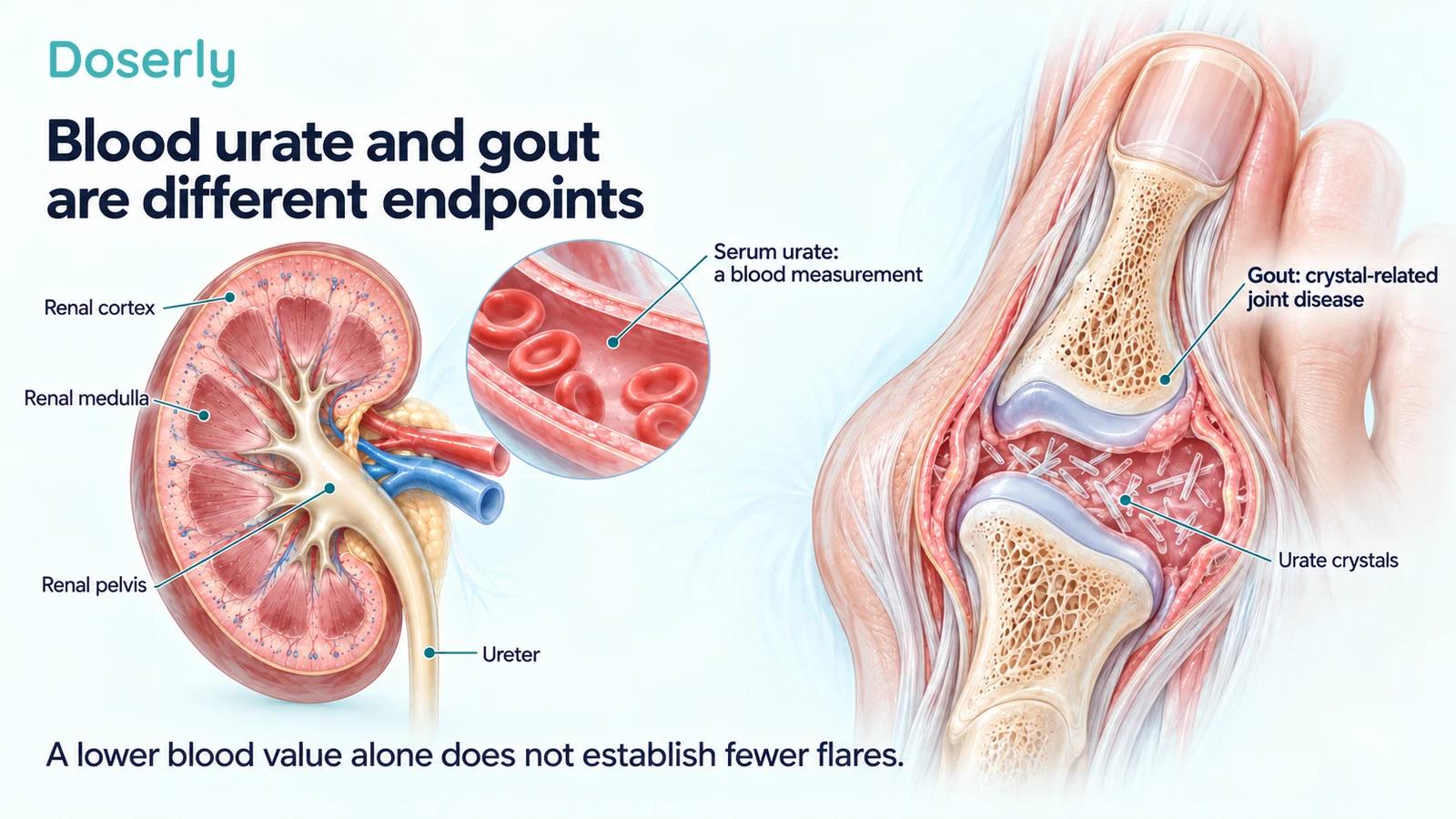
Uric acid is produced during the breakdown of purines. In discussions of blood testing, “serum uric acid” and “serum urate” commonly refer to the measured concentration. Gout involves deposition of monosodium urate crystals and the inflammatory response those crystals can provoke.
High blood urate increases the possibility of crystal-related disease, but not everyone with a high value develops gout. A laboratory finding of hyperuricemia is therefore not identical to a clinical diagnosis of gout. The kidneys play an important role in handling urate, and gout can involve complications beyond a single painful episode. NIAMS gout overview.
That distinction matters for trial design. A group selected for overweight or obesity can contain people with high urate, people with normal urate and people with different histories of gout. An average laboratory change across that group does not tell us the rate of gout flares in patients with established disease.
It also matters for individual interpretation. A lower average value in a trial is not evidence that every participant reached an appropriate clinical target.
What GLORY-1 measured
GLORY-1 enrolled 610 Chinese adults with overweight or obesity without type 2 diabetes. The trial's primary endpoints concerned weight reduction at week 32. Serum uric acid change at week 48 was among its prespecified key secondary endpoints, analyzed with the two mazdutide dose groups pooled.
In that pooled analysis, estimated serum uric acid change was −36.70 micromoles per liter with mazdutide, compared with +7.91 micromoles per liter with placebo. The estimated between-group difference was −44.61 micromoles per liter, with a 95% confidence interval from −56.56 to −32.65. GLORY-1, Table 3.
The distinction between those numbers is useful. The −36.70 figure describes change in the treated group. The −44.61 figure accounts for the comparator's change as well. Neither is a percentage.
The paper's conversion factor, 59.48 micromoles per liter per mg/dL, puts the between-group difference at approximately −0.75 mg/dL. That is an arithmetic conversion of the published estimate, not a separately measured result.
The trial reported hyperuricemia in 40.2% of participants at baseline. It was not a trial restricted to patients with recurrent gout, and the pooled urate result should not be described as a gout-remission rate.
“Secondary” does not automatically mean unreliable
A secondary endpoint can be prespecified, clinically interesting and statistically supported. The important questions are how it was selected, analyzed and interpreted.
In GLORY-1, serum uric acid belonged to the key secondary analysis framework, and the paper states that type I error was controlled for the primary and key secondary endpoints. The pooled urate comparison in Table 3 was reported as significant within that framework. GLORY-1 methods and Table 3.
That is stronger than an unplanned search through laboratory values after seeing the results. It supports taking the serum-urate finding seriously.
But statistical support for a laboratory endpoint does not change the endpoint's identity. A well-supported change in serum urate remains a serum-urate result. It does not supply unmeasured flare counts, tophus changes or long-term kidney outcomes.
There is no need to minimize the finding to avoid overclaiming. The accurate position is that the biomarker result is real evidence within the trial's scope, and its clinical extension requires another evidentiary step.
The earlier phase 2 result adds context
A 2023 randomized Chinese phase 2 study also measured serum uric acid. At week 24, estimated reductions were −81.9, −88.2 and −105.9 micromoles per liter across the three mazdutide groups, compared with −33.3 with placebo.
The corresponding differences versus placebo were −48.6, −54.9 and −72.6 micromoles per liter. The table notes that its statistical tests were nominal and were not adjusted for multiple comparisons. Original phase 2 study, Table 3.
Two details prevent misleading comparisons. First, the placebo value moved downward in this study and upward in GLORY-1, so comparing the treated-group changes alone obscures the different control responses. Second, the studies used different durations, regimens, populations and analysis details.
The earlier result supports consistency of a direction of effect on serum urate. It does not establish that a particular dose is best for gout, or that the larger within-group decline predicts better gout outcomes.
It also illustrates why reports should distinguish prespecified testing with multiplicity control from nominal secondary analyses. Both can inform the evidence, but they do not carry identical statistical qualifications.
Why a group average is not a treatment target
Suppose two hypothetical patients both have a 0.75 mg/dL reduction. If one starts much farther above a relevant target, their final values will differ. This simple example is not a reconstruction of individual mazdutide data.
A mean change also does not show how many people maintained a target over repeated visits. Some may have larger reductions, some smaller reductions, and some may have changes in the other direction. The distribution and durability matter.
For gout care, the American College of Rheumatology's 2020 guideline describes a treat-to-target approach using serial serum urate measurements, while also identifying gout flares and tophi as important outcomes. It distinguishes established gout from asymptomatic hyperuricemia. The guideline does not provide a recommendation for mazdutide. ACR gout guideline.
The relevant lesson is methodological: a trial claiming gout benefit should tell readers more than the average movement in a blood value. It should show whom it treated, what control was achieved and how the disease behaved over time.
What would a gout-focused study need to assess?
A study designed to test mazdutide for a gout-related role would need a clearly defined population and a treatment question. Preventing a first flare in people with high urate is different from reducing recurrent flares in people with established gout. Adding treatment to existing care is different from replacing an established therapy.
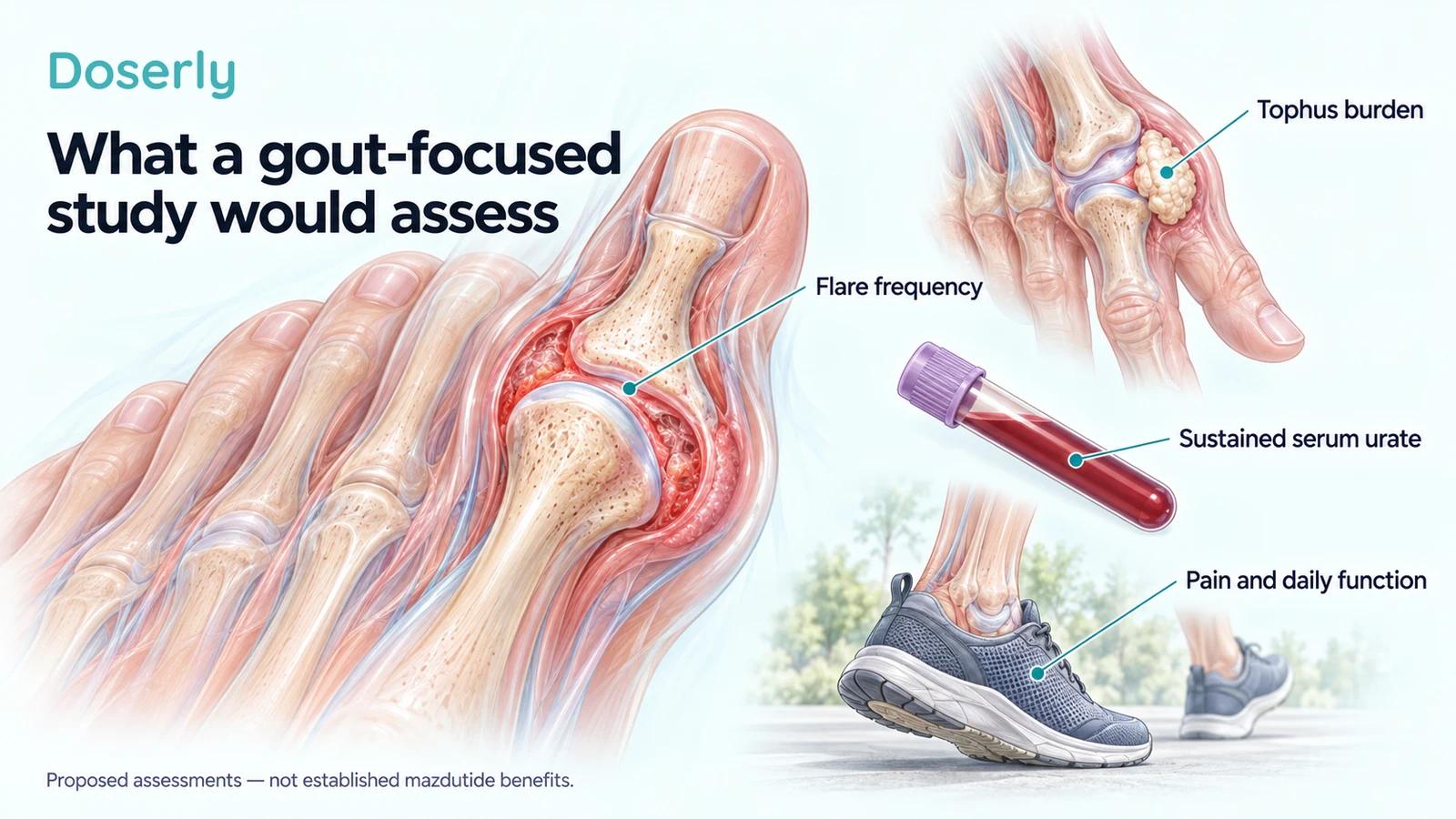
Useful assessments could include:
- Sustained serum-urate control, with repeated measurements and a prespecified target.
- Flare frequency, severity and the need for treatment during follow-up.
- Tophus burden where relevant to the enrolled population.
- Pain, physical function and patient-reported effects.
- Adverse events, discontinuation and the burden of continued treatment.
Those are proposed study requirements, not benefits demonstrated by mazdutide. A suitable comparator and sufficient follow-up would be essential to distinguish treatment effects from fluctuations in symptoms and background care.
The study would also need to account for existing gout medicines, renal function and other factors that can influence urate or flare risk. Without that context, even a favorable laboratory change could be difficult to translate into a clinical decision.
Mechanistic explanations need their own evidence
Mazdutide activates glucagon and GLP-1 receptors. Its developers and investigators have proposed mechanisms that could connect those actions with changes in metabolic measurements, including serum urate.
The GLORY-1 discussion considers possible roles for glucagon-related purine metabolism and uric-acid excretion. Those explanations are hypotheses about how the observed change might arise; the trial does not isolate their individual contributions. GLORY-1 discussion.
Weight loss, changes in intake, altered metabolic state and direct pharmacological effects may be difficult to disentangle in an obesity trial. A decline in urate occurring alongside weight loss does not show which pathway caused it.
Likewise, a proposed renal mechanism should not be illustrated as proven kidney protection. The organ involved in handling a biomarker is not automatically an organ whose clinical outcomes improved.
For receptor and development background beyond this focused question, see the Doserly mazdutide guide. The narrower interpretation here remains tied to the measured blood endpoint.
Newer obesity results do not automatically answer the gout question
GLORY-2 adds later phase 3 evidence for a 9 mg mazdutide regimen over 60 weeks in Chinese adults with obesity, including participants with type 2 diabetes. Its primary outcomes concerned weight reduction. The original abstract describes 461 treated participants and common gastrointestinal adverse events. GLORY-2 publication.
That study expands the obesity evidence. Its headline weight result is not a gout endpoint. A reader should not assume that a larger weight change establishes a larger clinical gout benefit.
The available original abstract reviewed for this article does not provide a detailed urate analysis, so no GLORY-2 urate number is quoted here. That is preferable to borrowing an estimate from a promotional summary without checking its population, analysis or supplement.
A growing research program can make a hypothesis more interesting while still leaving the specific disease claim unresolved.
Safety and treatment purpose still matter
An additional laboratory benefit would have to be considered alongside treatment burden. The mazdutide obesity trials report gastrointestinal adverse events, and their tolerability results belong to the regimens and populations studied.
For a person who has both obesity and gout, the treatment goals may overlap, but the evidence requirements do not disappear. A medicine chosen for one condition should not be assumed to replace a separate treatment merely because a related laboratory value moves favorably.
That is a question for individualized clinical care, including the person's gout history, current medicines, renal function and reason for considering weight-management treatment. The obesity studies alone do not support stopping a prescribed urate-lowering medicine or selecting a mazdutide dose to treat gout.
This is also why a “bonus benefit” headline can be misleading. It can make an exploratory clinical possibility sound like an established reason to use the treatment for a second disease.
A useful way to read the next uric-acid claim
First, check whether the reported number is a change within the treated group or a difference versus placebo. Then check units: micromoles per liter and mg/dL cannot be compared numerically without conversion.
Next, identify whether the study pooled doses, selected a subgroup or included everyone in a broader obesity cohort. Look for the time point and whether the finding was prespecified and adjusted for multiple testing.
Finally, ask whether the headline's disease outcome was actually measured. “Lowered serum urate” and “prevented gout flares” are different statements. So are “improved a blood marker” and “protected the kidneys.”
Mazdutide's serum-urate results justify a focused research question. The evidence reviewed here supports a biochemical effect in the obesity populations studied. A claim about treating gout, preventing its complications or replacing established gout therapy needs evidence that directly addresses those outcomes.
Sources
- NIAMS: gout — disease background.
- GLORY-1 mazdutide trial — original methods and urate table, 2025.
- Chinese phase 2 mazdutide trial — original secondary-endpoint table, 2023.
- ACR guideline for gout management — disease-specific endpoint and treatment context, 2020.
- GLORY-2 mazdutide trial — later obesity trial, 2026.