
Supplements
October 16, 2026
Maca and libido: a benefit would not prove testosterone increased
On this page
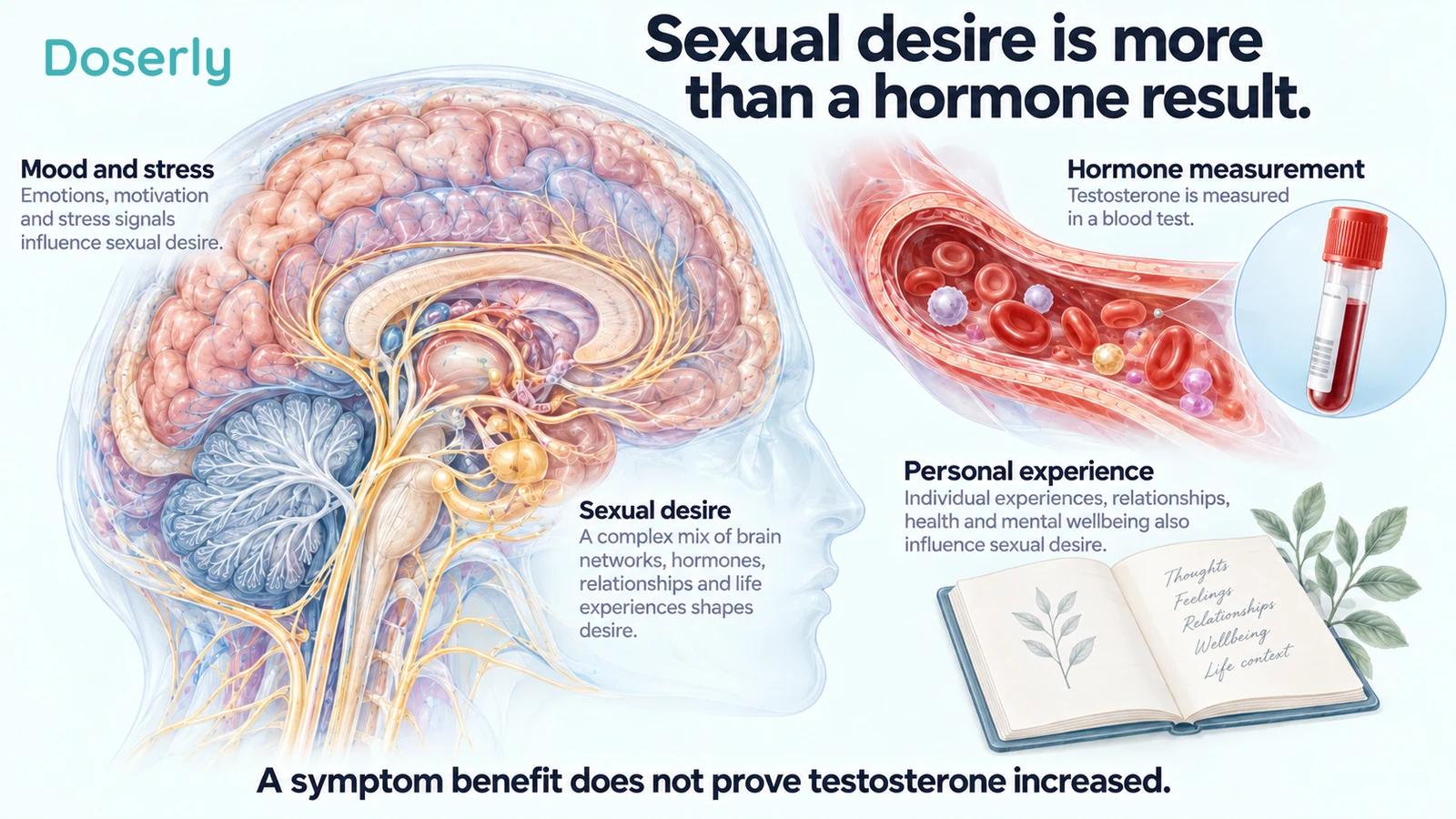
A person can feel more sexual desire without their testosterone rising. Maca research makes that distinction unusually clear: several trials have examined sexual symptoms alongside hormone measurements, and the results do not support treating those outcomes as interchangeable.
There are encouraging findings, but they come from relatively small studies of different preparations and populations. Healthy men, men with mild erectile dysfunction, postmenopausal women and people experiencing antidepressant-related sexual effects do not represent one clinical problem.
The most useful reading is therefore specific. What changed: desire, erection quality, a questionnaire score or a blood result? Who was studied, and how convincing was the comparison with placebo? Those questions reveal more than the familiar description of maca as a “natural testosterone booster.”
What the early desire trial actually found
A 2002 randomized, double-blind, placebo-controlled study followed healthy men aged 21–56 for 12 weeks. It compared two amounts of a gelatinized maca preparation with placebo and assessed self-reported sexual desire, mood and hormone measurements. Primary trial.
The investigators reported an improvement in desire from eight weeks onward. Testosterone and estradiol did not differ between maca and placebo groups. Their analysis did not attribute the desire finding to changes in those hormones or to the measured depression and anxiety scores.
This supports a narrow but useful conclusion: a reported desire benefit in this experiment was not evidence that testosterone had increased. It does not prove maca has no hormonal effects under every possible circumstance, nor does it reveal the exact biological explanation for the reported change.
It also was not an immediate-effect study. An improvement observed after several weeks cannot justify a promise of an on-demand effect before sex. The timing, preparation and outcome belong together when the finding is described.
Sexual desire and sexual function are different measurements
Desire concerns interest or motivation. Erections concern a physiological response. Orgasm, comfort, satisfaction and distress add other dimensions. A questionnaire may measure several of these, but its total score can conceal which part changed.
This matters when an advertisement turns a study about one dimension into a broad “performance” claim. A higher desire score does not establish improved erection quality, and improved erection quality does not establish fertility. Likewise, a person can be dissatisfied with sexual function despite having a testosterone result within the laboratory reference range.
Low desire also has many possible contributors. The NHS identifies relationship difficulties, stress, depression, medicines, menopause-related changes and physical health conditions among them. Treating the relevant cause is more targeted than assuming every concern reflects low testosterone. NHS clinical overview.
There is no single frequency of sexual interest that everyone must achieve. The clinical question is whether a change bothers you, causes distress or accompanies another problem worth evaluating.
The mild erectile-dysfunction trial reported a modest difference
A 2009 trial randomized 50 men with mild erectile dysfunction to a dry maca extract or placebo for 12 weeks. Both groups improved on the five-item International Index of Erectile Function. The mean score increase was 1.6 points with maca and 0.5 with placebo. Primary trial.
The difference between those average changes is about 1.1 points. That is a more informative description than saying the result was statistically significant. It conveys the scale of the reported advantage without implying that everyone recovered normal function.
The study also assessed subjective well-being. Those findings may be relevant to how participants felt, but they do not establish that maca treats every cause or severity of erectile dysfunction. The participants had mild symptoms, the sample was small and the observation lasted three months.
A fair interpretation leaves room for a modest effect while avoiding an equivalence claim with established erectile-dysfunction treatments. Such a claim would need a suitable direct comparison, not a favorable result against placebo in a small trial.
A newer study also separates symptoms from testosterone
A trial published in 2023 studied men over 40 with aging-related symptoms and described its target population as eugonadal: men who were not being studied as a conventional testosterone-deficiency treatment group. The full report says 88 were randomized and 80 completed follow-up, with 41 in the maca group and 39 in the placebo group. Primary trial.
Over 12 weeks, the investigators reported advantages in several symptom questionnaires, including aging-male symptoms and sexual function. They did not find a significant between-group difference in the changes in total or free testosterone.
The full report also describes baseline imbalances in hormone and some lipid measurements. Its findings should be viewed with that context, the sample size and short duration in mind. It adds a symptom signal; it does not establish that maca corrects hormone deficiency.
The distinction is particularly important because the paper’s title refers to symptoms of late-onset hypogonadism. Having symptoms that resemble a condition is not identical to meeting its diagnostic criteria. The participant definition is more informative than a title read in isolation.
The postmenopausal study was very small
A 2008 crossover trial was completed by 14 postmenopausal women. Each received maca for six weeks and placebo for six weeks, in different orders. Researchers assessed symptoms and several hormone-related measurements. Primary trial.
They reported improvements in psychological and sexual-dysfunction measures without differences in estradiol, follicle-stimulating hormone, luteinizing hormone or sex hormone-binding globulin. This is another example of a symptom finding that should not be translated into “hormones were restored.”
A crossover design can help compare treatments within the same person, but 14 participants still provide limited information about the range of responses and uncommon harms. The result does not establish a substitute for menopause care, particularly when discomfort, vaginal dryness or other treatable symptoms contribute to low desire.
Nor should a preliminary questionnaire finding be presented as treatment for clinical depression. The study measured psychological symptom domains in a particular group. That is a narrower question than establishing an antidepressant treatment.
The antidepressant-related trial has an important negative result
A 2015 placebo-controlled trial randomized 45 women with sexual dysfunction associated with SSRI or SNRI treatment after their depression had remitted. Forty-two had follow-up data for the modified intention-to-treat analysis. The study lasted 12 weeks. Primary trial and full report.
The full results show that average changes in the two overall sexual-function questionnaire scores did not differ significantly between maca and placebo. Some remission thresholds and subgroup findings favored maca, particularly among a very small postmenopausal subgroup, but those estimates were uncertain.
That balance is easy to miss if only the encouraging abstract conclusion is repeated. The exploratory findings can justify further study. They do not demonstrate a dependable remedy for antidepressant-related sexual dysfunction.
The report also explored associations with testosterone. An exploratory correlation does not show that a hormone change caused improvement or establish a general testosterone-boosting effect.
The practical response to medication-related sexual symptoms is a conversation with the prescriber. Stopping an effective antidepressant or changing its dose without guidance can create another problem while leaving the original symptom unresolved.
The preparation is part of the evidence
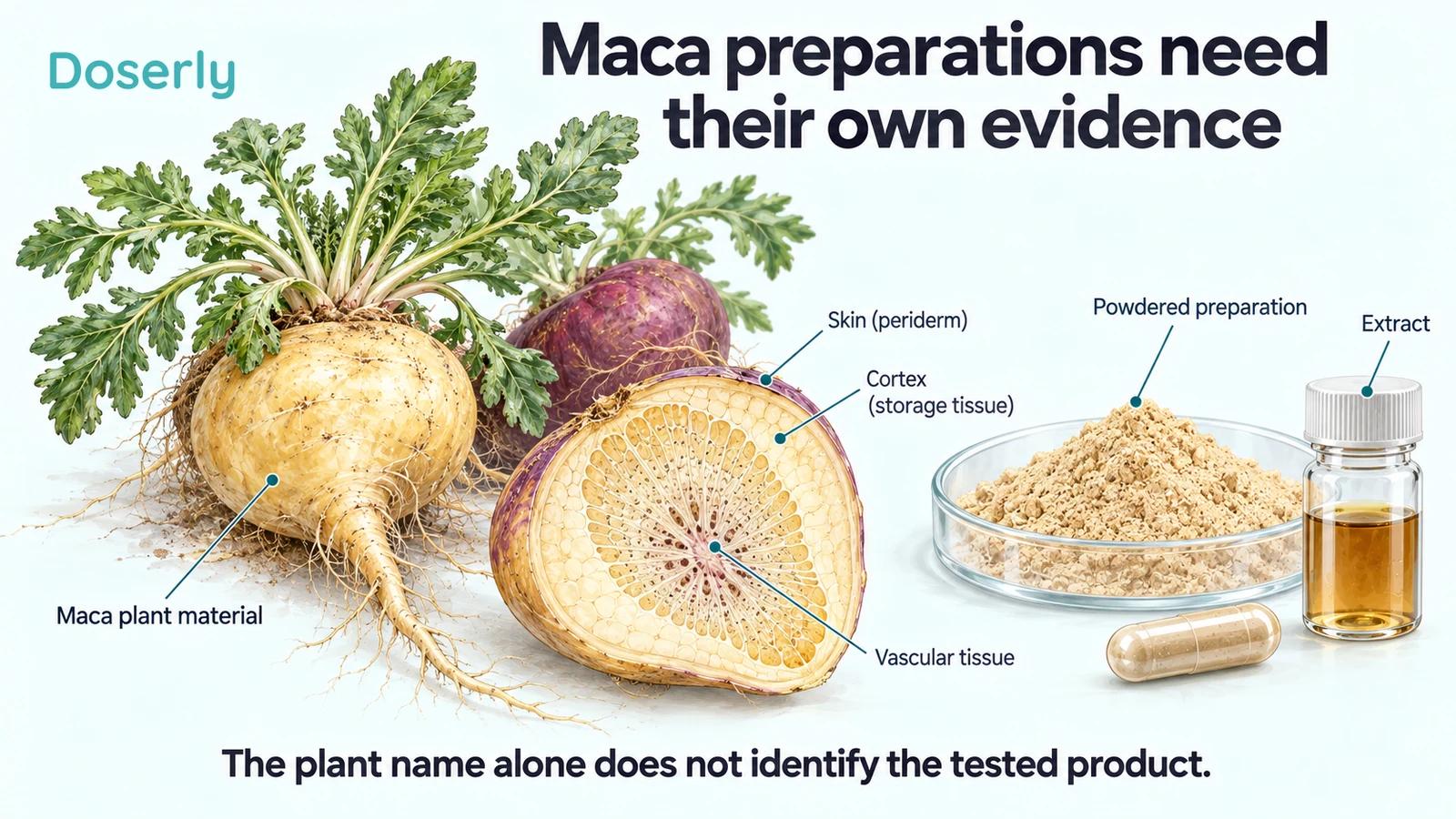
Maca products may be described as powder, gelatinized preparations or extracts, and some specify plant color or other processing details. The trials above did not all test the same material. An amount of one preparation is not automatically interchangeable with the same amount of another. The study amounts identify the tested preparations; they are not individualized dosing advice.
The Doserly maca root guide provides broader ingredient background. For interpreting a claim, look for the product description in the actual study: botanical identity, preparation, amount, duration and any accompanying ingredients.
A color label alone does not prove superior sexual benefits. Neither does a concentrated-looking extract ratio establish equivalence to a clinical trial. These details may be relevant to composition, but a clinical claim still needs a matching clinical result.
The same principle applies to blends. If a capsule combines maca with several botanicals and nutrients, a standalone maca trial cannot establish the benefit or safety of the whole mixture. If the mixture produces a change, it does not identify which ingredient was responsible.
What would a worthwhile benefit look like?
For someone concerned about desire, a meaningful outcome might be less distress and a return of interest that feels welcome. For someone with erectile difficulty, it might be more reliable function. For someone with medication-related symptoms, it might be improved sexual well-being while maintaining effective treatment of the underlying condition.
These are not interchangeable with a higher laboratory number. A study can produce a statistically significant result that is too small to matter much to an individual. Conversely, an important symptom can deserve attention even when hormone testing is normal.
A useful trial should therefore report the size of the difference, the comparison group, how many people benefited and how harms were assessed. It should also make clear whether a subgroup analysis was planned or explored after the main results were available.
Personal tracking can help describe a concern, but it has limits. Sexual experience changes with circumstances, stress, relationships and expectations. A favorable week after starting a product does not establish causation; an unchanged blood test does not invalidate what someone reports feeling.
Safety requires more than a reassuring study conclusion
Several maca studies described the preparation as well tolerated over the period tested. That is useful, limited information. Small studies lasting weeks cannot reliably identify uncommon harms, interactions or consequences of years of use.
In the 2015 antidepressant-related trial, three participants discontinued because of adverse events such as vomiting or flu-like symptoms; the investigators could not confidently attribute those events to maca. Reporting both the overall tolerability and the uncertain events is more accurate than saying no adverse effects occurred.
A product’s composition adds another layer. The FDA explains that dietary supplements are not approved before sale in the same way as drugs and advises discussing their use with a health professional, including possible interactions. FDA supplement guidance.
That discussion is especially relevant when someone takes prescription medicines, uses several supplements, has an ongoing medical condition or is considering use during pregnancy or breastfeeding. These trials do not establish safety in all such circumstances.
Put a low testosterone result in its own clinical context
If hormone deficiency is the concern, maca’s libido literature should not replace the diagnostic process. The Endocrine Society recommends compatible symptoms together with consistently low testosterone, confirmed with repeat morning fasting testing, before diagnosing hypogonadism in men. Clinical guideline.
If low desire is the concern, describe its onset, whether it is persistent or situational, and whether pain, erection problems, mood changes or medicines are involved. The NHS advises seeking help when low desire worries you or may be linked to medication.
The evidence for maca leaves room for possible symptom benefits in selected settings. It does not establish a dependable testosterone treatment, a universal sexual enhancer or a replacement for investigating a persistent problem. Keeping those distinctions intact makes the positive findings more useful—and the decision more honest.
Sources
- Sexual desire and testosterone trial, 2002
- Mild erectile-dysfunction trial, 2009
- Symptoms in eugonadal men, 2023
- Postmenopausal crossover trial, 2008
- Antidepressant-related sexual dysfunction trial, 2015
- NHS: low sex drive
- FDA dietary supplement guidance
- Endocrine Society testosterone guideline