
TRT
October 16, 2026
Low SHBG: why a low total testosterone result needs context
On this page
A low total testosterone result can be unsettling, especially when you have been looking for an explanation for fatigue, reduced sexual desire or changes in body composition. One additional blood measurement can change how that result is interpreted: sex hormone-binding globulin, or SHBG.
SHBG is a protein made mainly in the liver that carries sex hormones in blood. When its concentration is low, total testosterone can be low even when the unbound, or free, testosterone concentration remains within the relevant laboratory range. That is one reason a low number on the first report does not automatically establish testosterone deficiency. MedlinePlus: SHBG blood test
There is an equally important second point: low SHBG does not guarantee normal free testosterone. Both can be low. The task is to understand the whole pattern and the symptoms, rather than to use SHBG either as an automatic reason to start testosterone or as a reason to dismiss someone who feels unwell.
What SHBG changes about the measurement
Testosterone circulates in several forms. Some is tightly bound to SHBG, some is more loosely attached to albumin, and a small portion is unbound. A total testosterone assay counts across those fractions. Free testosterone assessment focuses on the unbound portion.
A change in binding proteins changes the relationship between total and free hormone. Consequently, two men with similar total testosterone concentrations can have different free concentrations if their SHBG differs. Conversely, two men with comparable free testosterone can have different totals.
This is a relationship between measurements, not a claim that one number always matters and the other never does. Total testosterone remains an important part of assessment. Free testosterone becomes especially helpful when binding proteins make the total difficult to interpret. The Endocrine Society recommends assessing free testosterone when SHBG is altered or total testosterone is near the lower boundary. Clinical practice guideline
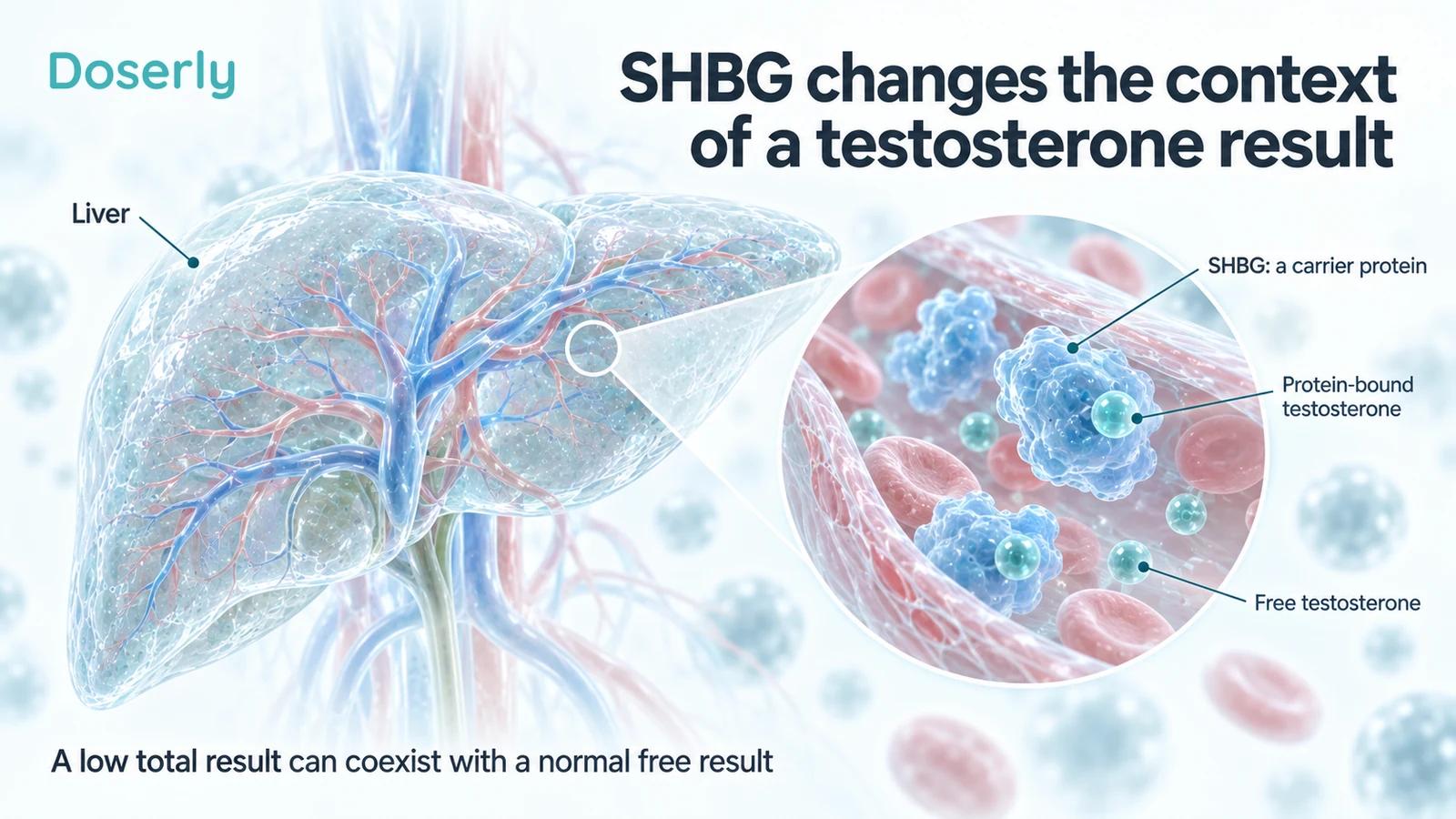
SHBG is produced mainly in the liver and circulates with bound hormone. The enlarged protein and testosterone shapes explain binding; they are not to scale and do not show a patient's measured proportions.
Why low SHBG often appears with obesity
Low SHBG is common in men with obesity and metabolic conditions. This can make a low total testosterone result more common without an equivalent reduction in free testosterone. In other men, obesity is associated with changes in hormone regulation that reduce free testosterone as well.
These are different physiological patterns that can coexist across a population. Calling every low total result in a man with obesity “testicular failure” misses the binding-protein issue. Calling every result “just low SHBG” misses the possibility that hormone production is also impaired.
Obesity is also not the only explanation for low SHBG. Thyroid conditions, some medications and other health factors can affect the result. The history and accompanying tests determine which possibilities deserve investigation; SHBG alone cannot identify the cause. MedlinePlus explanation
Our guide to obesity-related hypogonadism explains how clinicians assess testosterone in this setting. The word hypogonadism means inadequate gonadal function; in men being assessed for testosterone deficiency, the diagnosis involves more than body size and one laboratory flag.
What researchers found when total and free results disagreed
The European Male Ageing Study provides a useful example. A 2016 analysis included 3,334 community-dwelling men aged 40–79 and compared groups defined by total and calculated free testosterone.
Men with low total but normal calculated free testosterone were generally younger and more obese, with lower SHBG. They did not show the same androgen-deficiency pattern as men whose free testosterone was low. Men with normal total but low free testosterone were older, had higher SHBG and reported more sexual and physical symptoms. Antonio and colleagues
This study helps explain why the free result can clarify a discordant total result. It was observational: researchers measured and compared people rather than randomly assigning them to treatment. It therefore does not prove that treating every man in the low-free group will help, or that every man in the normal-free group has no health problem.
Its population matters too. These were middle-aged and older community-dwelling men. The findings cannot be transferred without qualification to adolescents, women, people using anabolic steroids or everyone already receiving testosterone therapy.
Did the same distinction matter over time?
A prospective EMAS analysis followed biochemical changes and symptoms over 4.3 years. The cumulative incidence of developing low total with normal free testosterone was 4.9%; the incidence of developing low values for both was 1.9%.
New or worsening sexual symptoms were associated with the group in which both total and free testosterone became low, rather than the group with low total alone. The symptoms examined included reduced desire, erectile difficulties and fewer morning erections. Rastrelli and colleagues
Those percentages describe the study's biochemical categories, not the probability that a particular reader needs TRT. The groups were not treatment arms, and the study did not test a prescription strategy. It does add a time dimension: whether free testosterone fell alongside total testosterone helped distinguish the pattern associated with new symptoms.
Both analyses come from EMAS, so they should not be presented as completely independent confirmations from unrelated populations. Their value lies in answering complementary questions within a well-characterized research program.
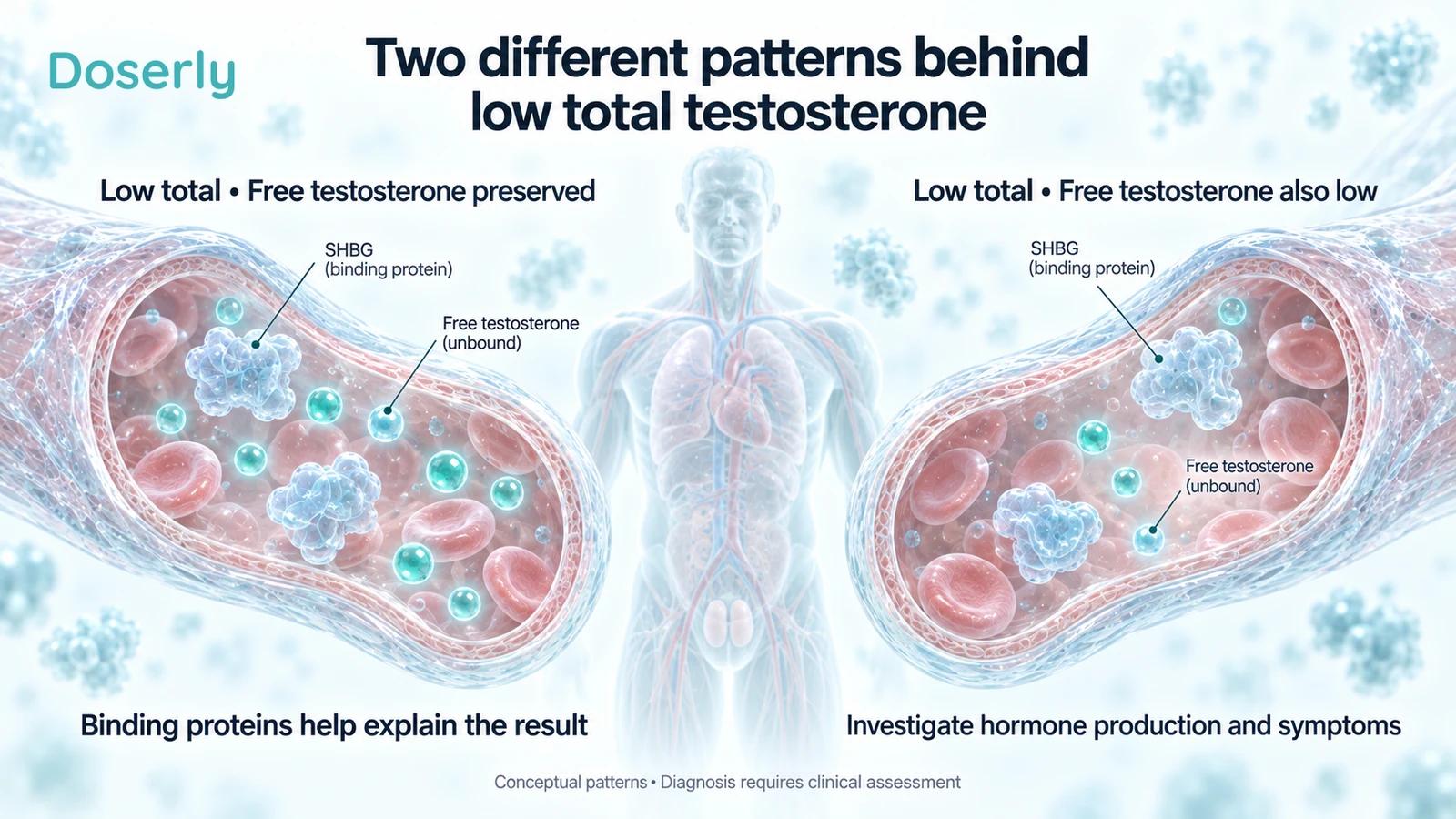
Low total testosterone can occur with preserved or reduced free testosterone. The illustrated hormone counts are conceptual, not measured concentrations. Symptoms, repeat tests and the underlying cause determine the clinical interpretation.
How to read your own combination of results
If total testosterone is low, SHBG is low and free testosterone is within the appropriate range, ask whether altered binding helps explain the total. That pattern deserves a clinical interpretation rather than an automatic diagnosis based on the total alone.
If total and free testosterone are both consistently low, the next question is why. Low SHBG has not explained away the entire finding. A clinician may need to investigate how the brain, pituitary gland and testes are communicating and consider the wider medical history.
If free testosterone is borderline or the laboratory method is unclear, uncertainty remains. A number generated by an unsuitable assay or an undocumented online calculation is not a strong foundation for a long-term treatment decision.
It can help to bring the results as one set: total testosterone, SHBG, albumin where relevant, the free testosterone method, the reference intervals and the collection date. Presenting the isolated low value removes information needed to understand it.
Free testosterone needs a trustworthy method
Free testosterone may be measured using equilibrium dialysis or estimated from total testosterone, SHBG and albumin. A calculation depends on both the measurements and the equation.
In a laboratory comparison involving 146 men and 183 women, different equations produced systematically different results relative to direct equilibrium dialysis. The investigators found that the Vermeulen calculation was a relatively robust approximation, while still tending to overestimate the measured value. Fiers and colleagues
This matters near a diagnostic boundary. A calculated result should be interpreted using an appropriate reference interval, rather than comparing it with an unrelated laboratory's range. Adding decimal places does not remove method uncertainty.
The Endocrine Society also advises against direct analog free testosterone immunoassays. Ask which method was used if the report simply says “free testosterone.” The word “direct” does not by itself establish that the laboratory performed equilibrium dialysis. Guideline recommendations
Why the first test may need repeating
A diagnostic blood draw is a sample of a changing biological system. The Endocrine Society recommends confirming low testosterone on separate fasting mornings and interpreting it alongside compatible symptoms. Acute illness and temporary medication exposures can complicate that assessment. Endocrine Society guideline
Repeating under appropriate conditions helps answer whether the finding persists. Repeatedly recalculating the same sample on different websites does not provide that information; it changes the mathematical interpretation of one collection.
Before the repeat, ask what conditions the clinician wants standardized. Record whether you were ill, whether the collection instructions were followed, and what medicines or hormones you were taking. Do not stop prescribed medicines simply to make the result easier to interpret.
If you already use testosterone, tell the clinician the formulation and timing of the last dose. Treatment-monitoring results answer a different question from tests intended to establish your untreated hormone production. A result obtained during treatment cannot simply be read as your original baseline.
What LH and FSH add
When a deficiency is established, its cause affects the next steps. Luteinizing hormone, or LH, is a pituitary signal that stimulates testicular testosterone production. Follicle-stimulating hormone, or FSH, is involved in sperm production. Their relationship to testosterone helps distinguish problems originating mainly in the testes from problems involving upstream signaling.
Our guide to primary and secondary hypogonadism explains these patterns and the investigations they can prompt. Primary and secondary refer to where the problem arises; they are not measures of how distressing symptoms feel.
For the reader, the useful question is: “Does the whole hormone pattern suggest altered binding, reduced production, or both?” That question leaves room for an explanation that fits all the results. Asking only whether a single testosterone number is below a cutoff can prematurely narrow the discussion.
A low SHBG result also should not become a substitute for investigating persistent symptoms. Even if the hormone pattern is reassuring, ongoing symptoms deserve an explanation and a care plan.
Can weight change alter the numbers?
Longitudinal EMAS research included paired testosterone results for 2,395 men, assessed roughly four years apart. Weight loss was associated with increases in testosterone and SHBG, while weight gain was associated with decreases. Camacho and colleagues
Because total testosterone and SHBG can move together, a rise in total testosterone does not by itself reveal exactly how much free testosterone changed. Nor does an improved number automatically quantify an improvement in sexual function, energy or fertility.
This was observational research, not a guarantee that a particular amount of weight loss will produce a specified hormone increase. It supports viewing the hormone results in the context of changing health, rather than assuming that an initial result is a permanent personal characteristic.
For follow-up, record major changes in weight, illness, sleep and medicines alongside symptoms and laboratory values. The goal is not to assign every fluctuation to one cause; it is to make the timeline intelligible enough for a clinician to assess.
Should the goal be to raise SHBG?
Usually the more useful goal is to identify the underlying health issue and decide whether there is clinically meaningful hormone deficiency. An SHBG value is information, not a symptom that necessarily needs treatment in isolation.
A supplement or medication that changes SHBG could change total testosterone without solving the problem that brought you to care. Conversely, a normal-looking total could obscure a low free result in someone with high SHBG. The relationship needs to be interpreted, not optimized toward a preferred number.
That distinction also prevents a common misunderstanding: explaining a low total result through binding proteins does not mean the symptoms are imaginary. It means the explanation may require looking beyond testosterone, or investigating several contributors together.
Questions for the follow-up appointment
Bring the complete report and ask a few specific questions:
- Does low SHBG explain the difference between my total and free testosterone?
- Was free testosterone measured or calculated with an appropriate method?
- Are the results persistent under suitable testing conditions?
- What does the pattern suggest about the cause, and what would change the plan?
If free testosterone is preserved, ask what will be done about the symptoms that remain. If it is consistently low, ask how the cause will be investigated before treatment is selected. Either way, low SHBG helps refine the question; it does not supply the whole answer.
Sources
- MedlinePlus: SHBG blood test
- Endocrine Society clinical practice guideline, 2018
- Antonio and colleagues: discordant total and free testosterone, 2016
- Rastrelli and colleagues: prospective EMAS symptom findings, 2018
- Fiers and colleagues: validation of free testosterone calculations, 2018
- Camacho and colleagues: weight change and hormones in EMAS, 2013