
Peptides
October 16, 2026
LL-37 wound research: why wound size and wound cause matter
On this page
A wound-healing headline can sound straightforward: a peptide helped ulcers heal. The underlying study may tell a more specific story—one kind of ulcer, a topical formulation, background wound care and a particular measure of improvement.
LL-37 has been studied in people with chronic wounds, so this is not an area supported only by laboratory experiments. But the human results are mixed. A small early venous-ulcer trial produced encouraging findings; a larger trial did not show a significant benefit across its full study population. An exploratory analysis of larger wounds raised a further question rather than settling it.
To understand these results, three details deserve attention: why the wound exists, how large it was at the start and what researchers counted as healing. Those details determine whether a finding applies to the clinical problem being discussed.
The cause of a wound is part of the treatment question
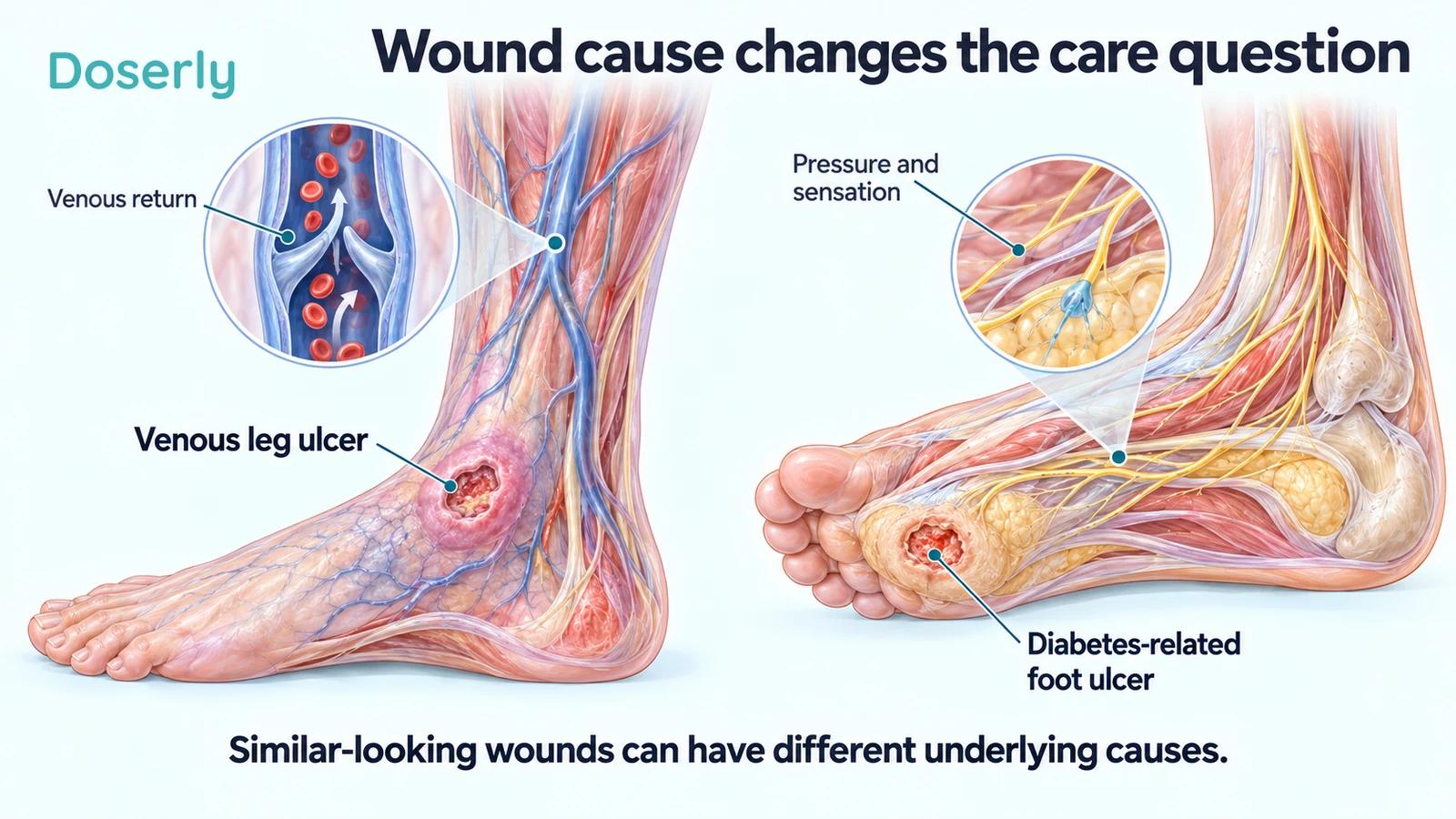
A venous leg ulcer and a diabetes-related foot ulcer are not interchangeable labels. Venous ulcers are associated with problems returning blood from the leg. Diabetes-related foot ulcers may involve pressure, reduced protective sensation, impaired circulation and other factors in different combinations.
This is why wound care begins with assessment rather than selecting a topical ingredient from a headline. NICE’s current compression guidance describes compression as central to care for venous ulcers when arterial supply is adequate. The IWGDF offloading guideline addresses reducing mechanical stress for diabetes-related foot ulcers, with choices depending on the ulcer and patient.
An experimental topical treatment is therefore being added to a clinical situation with an existing cause and care plan. If the cause remains unaddressed, a promising molecular mechanism may not be enough. If background care improves, wounds can also improve in the control group.
That does not make a trial less useful. It makes the comparison more clinically relevant: does the new treatment add benefit to the care people should already receive?
The early venous-ulcer trial was a starting point
The 2014 first-in-human randomized study included 34 participants with hard-to-heal venous leg ulcers. After a placebo run-in, participants received one of three topical LL-37 strengths or placebo during a four-week blinded treatment phase, followed by additional observation.
The lowest tested strength showed a statistically significant improvement in the modeled healing-rate constant compared with placebo. The intermediate strength had a numerical increase that did not reach the same conventional significance threshold in that comparison. The highest strength did not show the expected improvement.
This pattern is important because it does not support a simple “more peptide, more healing” interpretation. Nor does a modeled healing-rate constant mean that six times as many wounds closed, or that every wound healed six times sooner. The measure has a specific mathematical meaning within the study.
With only 34 participants divided across four groups, the trial was useful for exploring formulation and response. It was not a definitive estimate of how a broad wound-care population would benefit. The next step was a larger comparison with a clinically meaningful endpoint.
The larger study was negative overall
The 2021 HEAL LL-37 trial used a randomized, double-blind, placebo-controlled design. It evaluated topical LL-37 alongside compression therapy in people with hard-to-heal venous leg ulcers. The publication describes 148 treated participants and a full analysis set of 144.
Across the full study population, the investigators did not identify significant improvement in healing with LL-37 compared with placebo. Confirmed complete wound closure was the primary efficacy variable. That overall result needs to appear before any favorable subgroup finding.
The authors then reported a post hoc analysis suggesting benefit in participants whose target ulcers measured at least 10 square centimeters at randomization. The subgroup was small, and the trial was not designed or powered to establish efficacy within it. The authors called for a further adequately powered study.
The fair reading is therefore neither “LL-37 has no possible role” nor “LL-37 is proven for large wounds.” The trial did not demonstrate benefit in the full population it tested. Its subgroup observation offers a more focused hypothesis for future research.
Why the size finding needs confirmation
Wound size can plausibly matter. A larger ulcer represents a different starting challenge from a small one, and a trial may reasonably consider size when arranging treatment groups. But biological plausibility does not remove the statistical problem created by looking for differences within subsets after examining the data.
A post hoc finding can reflect a real treatment interaction, chance variation or features of the smaller groups. A convincing next study would define the relevant size range before enrollment, recruit enough participants and specify the outcome and analysis in advance.
The cutoff itself also needs careful handling. Ten square centimeters is an area, not a length or depth. It does not mean a wound ten centimeters across. More importantly, a research cutoff is not a self-treatment rule. Measuring an ulcer above that threshold would not establish that LL-37 is appropriate for it.
The distinction between a stratification factor and a confirmatory subgroup result is subtle but useful. Researchers may account for size during randomization without having designed the trial to prove a treatment effect separately in every size category. The strength of the conclusion still depends on the analysis plan and the amount of evidence within the subgroup.
Area reduction and complete closure answer different questions
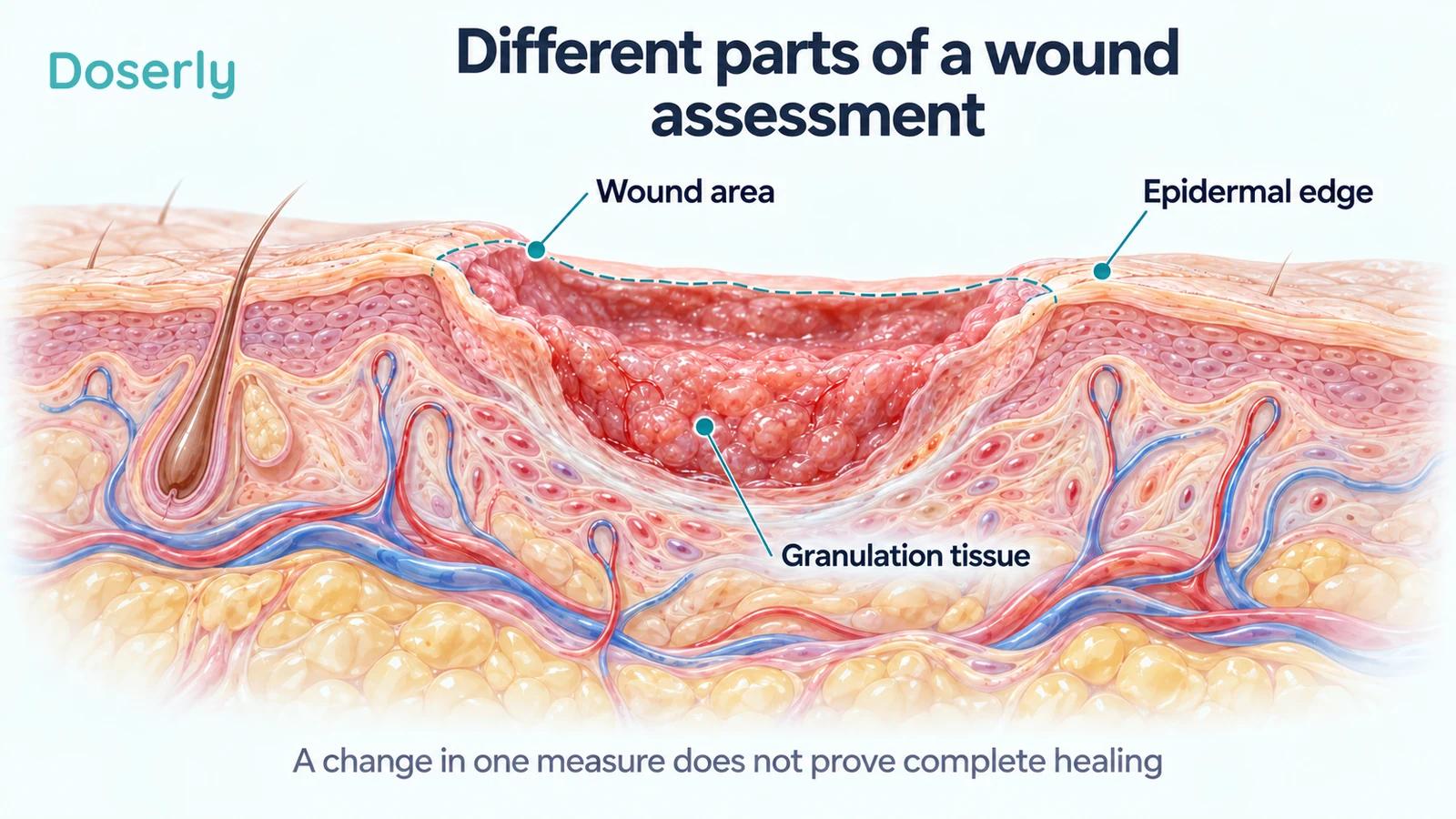
Wound studies often track several outcomes because no single measurement captures every aspect of recovery. Area reduction describes how much the visible wound surface has changed. Granulation describes the development of tissue within the wound bed. Complete closure asks whether the surface has become fully covered, using the study’s specified definition and confirmation process.
A wound can improve on one measure while remaining open. A smaller ulcer may still need dressings and ongoing care. A wound bed with more granulation tissue may be progressing, but that observation does not automatically establish durable closure.
Percentage change also depends on the starting value. In a hypothetical example, reducing a wound from 20 to 10 square centimeters is a 50% reduction, as is reducing one from 2 to 1 square centimeter. The percentage is identical, while the remaining wound area is very different. Neither wound is closed.
This is why summaries should name the measured outcome rather than compressing every favorable result into “healing.” The term can mean a rate estimate, a surface-area change, a tissue-quality score or confirmed closure. Readers need to know which one the evidence supports.
The diabetic-foot trial measured granulation separately
A 2023 randomized double-blind trial evaluated LL-37 cream in 25 people with diabetic foot ulcers: 13 received LL-37 and 12 placebo. During four weeks of observation, the LL-37 group showed greater improvement in the granulation index.
The between-group changes in wound area were not statistically significant. The study also did not establish significant reductions in the measured inflammatory markers or aerobic bacterial colonization. The positive granulation finding therefore should not be relabeled as proven infection clearance or complete ulcer healing.
The corresponding trial registry lists granulation, bacterial and inflammatory outcomes. Its enrollment figure is an estimate from an older record; the published paper provides the actual analyzed group of 25. Registry plans and published results serve different purposes and should not be mixed together.
This trial adds a useful human observation, but it is small and short. It does not answer whether the cream reduces recurrence, major complications or long-term care needs. Those questions require their own follow-up and adequate sample sizes.
A wound with bacteria is not always an infected wound
It is tempting to connect LL-37’s antimicrobial laboratory activity with any improvement in an ulcer. The clinical picture is more complicated. Bacteria may be present on a chronic wound without causing a clinically apparent infection.
NICE’s leg-ulcer infection guidance distinguishes colonization from infection and emphasizes managing underlying causes such as venous insufficiency and edema. It does not recommend antibiotics simply to promote healing in an ulcer that is not clinically infected.
That distinction matters when interpreting an experimental wound treatment. If an ulcer becomes smaller, the result does not tell us which mechanism produced the change. If a bacterial count changes, it does not alone establish improved wound closure. If infection was not the clinical question, the trial should not be advertised as proving an infection treatment.
For the patient, new spreading redness, increasing pain, warmth or fever belongs in a clinical assessment rather than a comparison of peptide products. Wound research should help clarify care, not delay evaluation of a worsening problem.
Topical tolerability does not establish injectable safety
The human wound trials discussed here used topical preparations. Their safety observations belong to those formulations, exposure patterns and selected participants. Even an encouraging local tolerability finding does not establish the safety of injecting LL-37 for a different purpose.
The FDA’s current LL-37 safety discussion identifies concerns about immunogenicity for certain routes, impurities and ingredient characterization, along with insufficient safety information. That uncertainty should remain visible when human topical research is cited.
Likewise, a study formulation should not be treated as interchangeable with a product sold under the same peptide name. The preparation, manufacturing quality and route are part of what was tested. A clinical paper cannot certify an unrelated vial or cream.
These are limits on extrapolation, not a reason to overlook the human studies. The studies are most useful when their scope stays intact: specific topical preparations evaluated as part of wound care, with mixed efficacy findings and incomplete answers about longer-term outcomes.
Questions that make the evidence useful in practice
For someone living with a persistent wound, the first question is what is preventing healing. That may involve circulation, pressure, sensation, edema, infection or several factors together. The wound-care team can explain which factors are present and what the current plan addresses.
When discussing an experimental option, ask what benefit it is expected to add to that plan. Is the evidence from the same wound type? Was the study’s main result positive? Is the claim based on a small subgroup? Did researchers measure closure, granulation or something else? What follow-up would identify whether the treatment is helping?
A record of clinician-measured wound size, prescribed care, appointments and symptoms can make changes easier to review. Measurements should be interpreted consistently; a casual photograph or a change in lighting is not a substitute for a clinical assessment. Tracking can support the conversation without turning a research cutoff into a treatment decision.
The Doserly LL-37 guide covers the peptide’s wider evidence. In wound research, the strongest conclusion is specific: there are human topical studies worth examining, but the larger venous-ulcer trial was negative overall, and promising subgroup or granulation findings still need confirmation for the outcomes that matter most to patients.
Explore the research
- Early randomized venous-ulcer trial, 2014.
- HEAL LL-37 trial, 2021.
- Diabetic-foot-ulcer trial, 2023 and registry.
- NICE compression guidance, 2025.
- IWGDF offloading guideline.
- NICE leg-ulcer infection guidance.
- FDA discussion of LL-37 safety uncertainty.