
Peptides
October 16, 2026
LL-37 kills microbes in a laboratory. Why that is not an infection-treatment claim
On this page
A clear zone appears around a sample on a laboratory plate. Bacterial growth slows in a culture. A microscope shows a disrupted microbial membrane. These findings can be scientifically important, but they answer a narrower question than whether a treatment will help a person with an infection.
LL-37 is a human host-defense peptide with antimicrobial and immune-signaling activities. Its laboratory effects have made it an interesting research candidate. They have not established that a self-administered LL-37 preparation can safely treat an infection.
The gap is not simply a matter of waiting for larger studies. Researchers must establish what happens to the peptide in biological fluids, whether it reaches the relevant organisms, how those organisms respond and whether the exposure harms human tissue. Each of those questions can change the meaning of an impressive laboratory result.
What an antimicrobial experiment actually measures
Researchers can measure antimicrobial activity in several ways. A growth-inhibition assay asks whether organisms multiply under specified conditions. A killing assay asks whether viable organisms remain after exposure. A membrane experiment may examine how the peptide interacts with a simplified lipid system. These are related tests, but their outcomes are not interchangeable.
The minimum inhibitory concentration, or MIC, is the lowest concentration that prevents visible growth under the assay’s conditions. It is not a recommended dose for a person. It does not specify how to achieve an active concentration in an infected lung, wound or bloodstream, or whether doing so would be safe.
Even the word “microbes” can hide important distinctions. Results for one bacterial species do not establish activity against every bacterium. Results for a bacterium do not establish treatment of a viral illness or fungal infection. A claim becomes more useful when it names the organism, the model and the measured outcome.
The 1998 LL-37 conformation study examined how ion composition, acidity and peptide concentration affected structure and antibacterial activity. Its findings already showed why a single concentration, detached from the experimental conditions, gives an incomplete account of what LL-37 does.
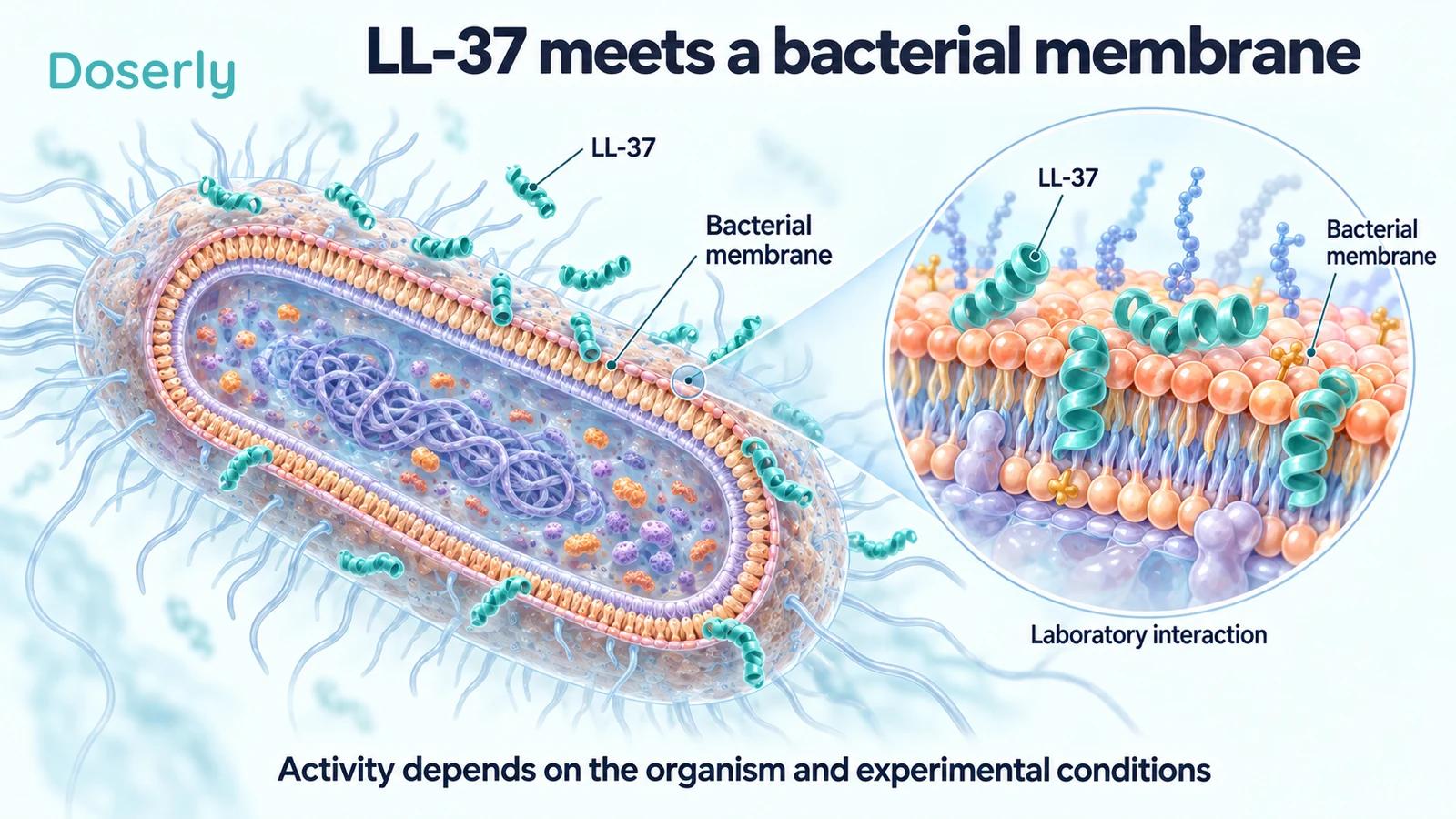
The surrounding fluid can change the result
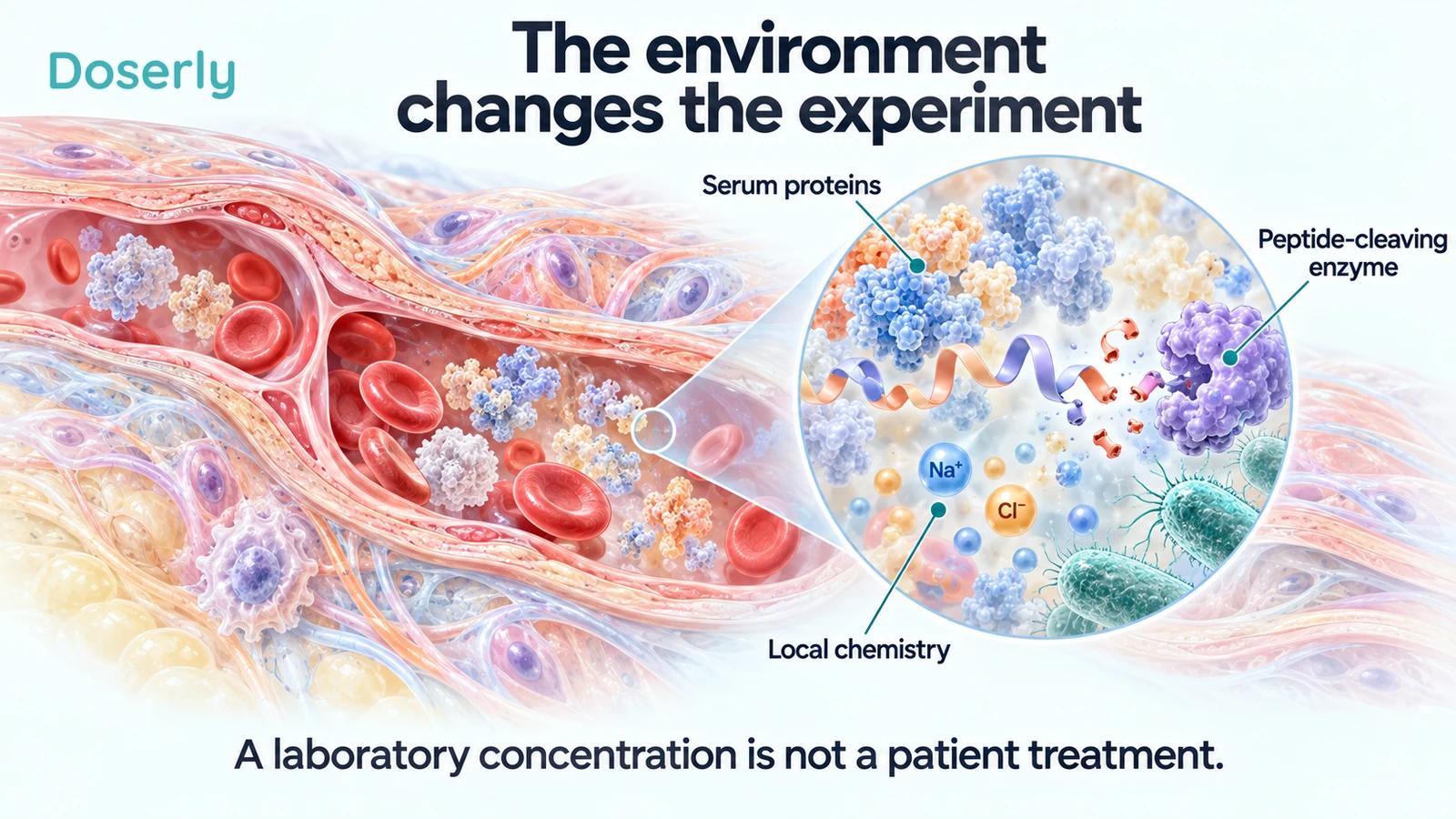
A peptide in a controlled laboratory solution does not encounter the same environment as a peptide in blood or inflamed tissue. Proteins, salts and other molecules can affect how much peptide remains available to interact with microbes.
In a 2005 study comparing LL-37 with modified fragments, human serum markedly reduced LL-37’s antibacterial activity in an assay using E. coli. The researchers also measured effects on human cells and compared the parent peptide with shorter variants. Changing the molecule altered the balance of properties.
That is a drug-development problem, not a minor technical footnote. A preparation must work in the environment where it will be used. If a useful activity is weakened by biological fluids, increasing the amount is not automatically a solution: other effects may increase too.
The fragment comparison also limits what can be claimed about LL-37 itself. A modified peptide designed to behave differently is a different intervention. Its favorable laboratory result cannot simply be credited to the unmodified molecule. Development may build on LL-37 biology while eventually producing something with a different sequence, formulation or delivery method.
Bacterial enzymes can alter the peptide
Microbes do more than sit passively in contact with a treatment. Some produce enzymes that break down proteins and peptides in their surroundings. The consequences depend on which enzyme acts and where it cuts.
A 2004 study of enzymes produced by Staphylococcus aureus found that aureolysin cleaved LL-37 and reduced its antibacterial activity. Another enzyme, V8 protease, produced a fragment that retained antibacterial activity in the tested system. The result was therefore not simply “all enzymes destroy LL-37.” It showed that specific cleavage patterns matter.
For translation into treatment, the question becomes whether enough active material remains at the relevant site for long enough. A concentration measured at the start of an experiment may not describe the exposure later in the experiment, much less in a patient.
This also explains why activity can differ between organisms or settings. The same peptide may encounter different enzymes, binding partners and physical barriers. A successful assay under one set of conditions provides a reason to investigate those differences; it does not make them disappear.
Effects on human cells belong beside antimicrobial activity
An antimicrobial candidate has to affect the target organism at an exposure that patients can tolerate. The fact that the body naturally produces LL-37 does not remove that requirement.
The early conformation work reported effects on eukaryotic cells as well as bacteria. The 2005 fragment study specifically examined human red blood cells and cultured vascular cells. Together, these experiments show why researchers assess selectivity: an activity that damages microbes may coexist with effects on host cells under some conditions.
Laboratory cytotoxicity does not tell us that every possible clinical formulation will cause the same harm. Nor does it identify a safe self-injection amount. It establishes a concern that formulation, exposure and human safety studies need to address.
The useful question is not whether LL-37 can ever affect bacteria. It is whether a specified product can produce a clinically helpful effect with an acceptable balance of harms. That balance must be measured for the intended route and patient population, not assumed from the peptide’s origin.
Biofilm effects are another distinct outcome
LL-37 also attracted attention through experiments involving biofilms: communities of microbes associated with a surface and a surrounding matrix. A 2008 Pseudomonas aeruginosa study found effects on biofilm formation at concentrations below those needed to inhibit free-floating bacterial growth in its assay.
The investigators also examined previously grown biofilms and reported changes in their architecture. That is more nuanced than a claim that the peptide merely kills all bacteria. It suggests effects on behaviors involved in attachment and community organization.
However, a thinner laboratory biofilm is not the same outcome as curing a chronic infection. The experiment does not establish delivery to an infected implant, eradication of organisms in living tissue or freedom from recurrence after treatment ends.
This matters when interpreting the phrase “biofilm disruptor.” Disruption may refer to less attached material, altered structure, changed gene expression or reduced viable organisms. Those measurements need to be named. They do not all carry the same clinical meaning, and none alone establishes that an infection has resolved.
Combining LL-37 with an antibiotic is not automatically helpful
A common assumption is that two antimicrobial influences should work better together. Actual interactions can be more complicated.
A 2020 primary study found that exposure to LL-37 temporarily reduced susceptibility to vancomycin in a particular methicillin-resistant S. aureus strain. The investigators used laboratory experiments, mathematical modeling and an insect infection model. The altered susceptibility was transient and non-inherited, rather than a demonstrated permanent resistance mutation.
This does not establish that LL-37 causes vancomycin treatment failure in humans. It does challenge the assumption that adding an endogenous antimicrobial peptide must improve an antibiotic’s effect. The exact organism, exposure and combination need testing.
It also illustrates why mechanistic enthusiasm should remain open to unexpected results. A molecule can have direct antimicrobial activity in one experiment while provoking a bacterial response that changes susceptibility to another agent. Biology is not a simple sum of favorable labels.
What would make an infection-treatment claim credible?
A credible claim would identify the infection and the product. “Supports immunity” is too vague to evaluate. A trial for a defined bacterial wound infection would answer a different question from a trial for pneumonia, bloodstream infection or prevention of infection after surgery.
The clinical comparison would also matter. Researchers would need to specify whether LL-37 replaced an existing treatment, was added to standard care or was used in a setting where no established treatment existed. Outcomes should tell us something meaningful about patients: clinical resolution, need for additional treatment, complications, recurrence or other prespecified measures appropriate to the infection.
Microbiology could strengthen that picture. Culture results and organism-specific findings may help show whether the target pathogen was affected. But a negative surface sample does not necessarily establish that every relevant tissue compartment is clear, just as a visible wound improvement does not by itself prove antimicrobial action.
Safety belongs in the same trial framework. The intended route, duration, formulation and patient characteristics affect what needs monitoring. A result from a topical preparation cannot be treated as evidence for an injected preparation simply because both contain LL-37.
Why a wound-healing paper cannot fill every gap
Wound healing and infection treatment overlap in clinical practice, but they are different research questions. A wound can shrink through processes involving tissue repair, pressure management or circulation without demonstrating eradication of a pathogen.
Conversely, reducing microbial burden may not close a wound if the underlying mechanical or vascular problem persists. For this reason, a study that measures wound area should not automatically be described as proving that its intervention treats infection. The actual endpoint and the wound’s cause matter.
When reading a human LL-37 claim, it is worth checking whether the paper studied a defined infection at all. Was infection required for enrollment? Were microbial outcomes measured? Was the primary goal closure of an ulcer? The answer determines how far the finding can travel.
This distinction also protects useful research from exaggerated expectations. An intervention being explored for one component of wound care does not need to be an all-purpose antimicrobial to be scientifically interesting. Its potential value should be judged against the question it actually tested.
Current safety uncertainty is part of the evidence
The FDA’s current discussion of LL-37 as a bulk substance for compounding identifies concerns about immunogenicity for certain routes, peptide-related impurities and active-ingredient characterization. It also states that available safety information is insufficient to determine whether administration would cause harm.
That is not a measured adverse-event rate, and it should not be presented as one. It is an explicit information gap and a set of concerns that cannot be resolved by pointing to the peptide’s natural presence in the body.
A purity certificate or a laboratory paper cannot establish a treatment plan for an infection. If someone is being evaluated for a suspected infection, the relevant conversation is about the diagnosis, organism where identifiable, severity and established treatment options. Experimental peptide use should be disclosed to the treating clinician so it does not become an invisible part of the medication history.
The Doserly LL-37 guide brings together the broader research context. The laboratory findings are worth understanding on their own terms: they reveal biological activity and development challenges. They do not establish a general infection treatment, a substitute for prescribed antimicrobial care or a safe injection protocol.
Explore the research
- LL-37 structure and antibacterial activity under different conditions, 1998.
- Serum inhibition, cytotoxicity and modified fragments, 2005.
- LL-37 cleavage by S. aureus enzymes, 2004.
- Biofilm formation and architecture experiments, 2008.
- Transient vancomycin-susceptibility changes, 2020.
- FDA safety concerns for LL-37 bulk substance.