
Peptides
October 16, 2026
LL-37 and inflammation: one peptide can have opposing effects
On this page
LL-37 is sometimes described as anti-inflammatory and sometimes as a contributor to inflammatory disease. Both descriptions can come from real experiments. The apparent contradiction becomes easier to understand when we ask which cells, signals and conditions were involved.
Inflammation is not one switch. A peptide can reduce a response to one microbial molecule while increasing another cell’s signaling or helping the immune system recognize material it would otherwise ignore. Those effects do not average into a predictable “immune balance” benefit for a person.
LL-37 research is especially instructive because it spans bacterial-signal experiments, human mast cells, psoriasis tissue and rosacea-like animal models. Together, these studies show a biologically active molecule whose consequences depend on context. They do not establish that adding LL-37 is a general treatment for inflammation.
Start with the signal, not the adjective
An anti-inflammatory result usually means that a particular response became smaller in a particular experiment. Researchers might measure a cytokine, an enzyme response or a cell’s reaction to a defined stimulus. That result can be useful without describing the whole immune system.
For example, a 2005 study of LL-37 and related fragments examined neutralization of bacterial lipopolysaccharide, or LPS, alongside antimicrobial activity, cell toxicity and immune-cell attraction. LPS is a component of the outer membrane of certain bacteria that can provoke inflammatory signaling. Interfering with that stimulus is a specific mechanism.
It does not follow that every inflammatory pathway will be reduced. A cell encountering LL-37 may also respond through a receptor, interact with other molecules or release mediators. Whether the overall consequence is helpful depends on the biological problem, not just on the direction of one assay result.
This is why a paper’s methods can be more useful than the broad label in a summary. “Reduced an LPS-associated response in this model” tells us what happened. “Reduces inflammation” leaves out the conditions that made the statement true.
The same peptide can affect different stimuli differently
A 2013 cell study examined how human LL-37 influenced responses to poly(I:C), an experimental mimic of double-stranded RNA. The work described enhancement of this signaling context, in contrast to LL-37’s ability to reduce LPS-induced responses. It also found that the mouse counterpart, mCRAMP, did not reproduce the same effect in that system.
Two distinctions follow. First, the initiating stimulus matters: a bacterial membrane component and an RNA-like stimulus are not interchangeable. Second, related peptides from different species cannot always be treated as equivalent.
These are reasons to specify the experiment, not reasons to choose whichever result supports a preferred story. A molecule with several interactions may genuinely produce different outcomes under different conditions. Calling it uniformly calming or uniformly activating obscures what researchers are trying to understand.
The experiment also does not show that a person with a viral illness benefits from LL-37. A response to a laboratory RNA mimic is a mechanistic observation. Clinical benefit would require evidence about the illness, formulation, exposure and outcomes in people.
Mast cells provide a concrete example of activation
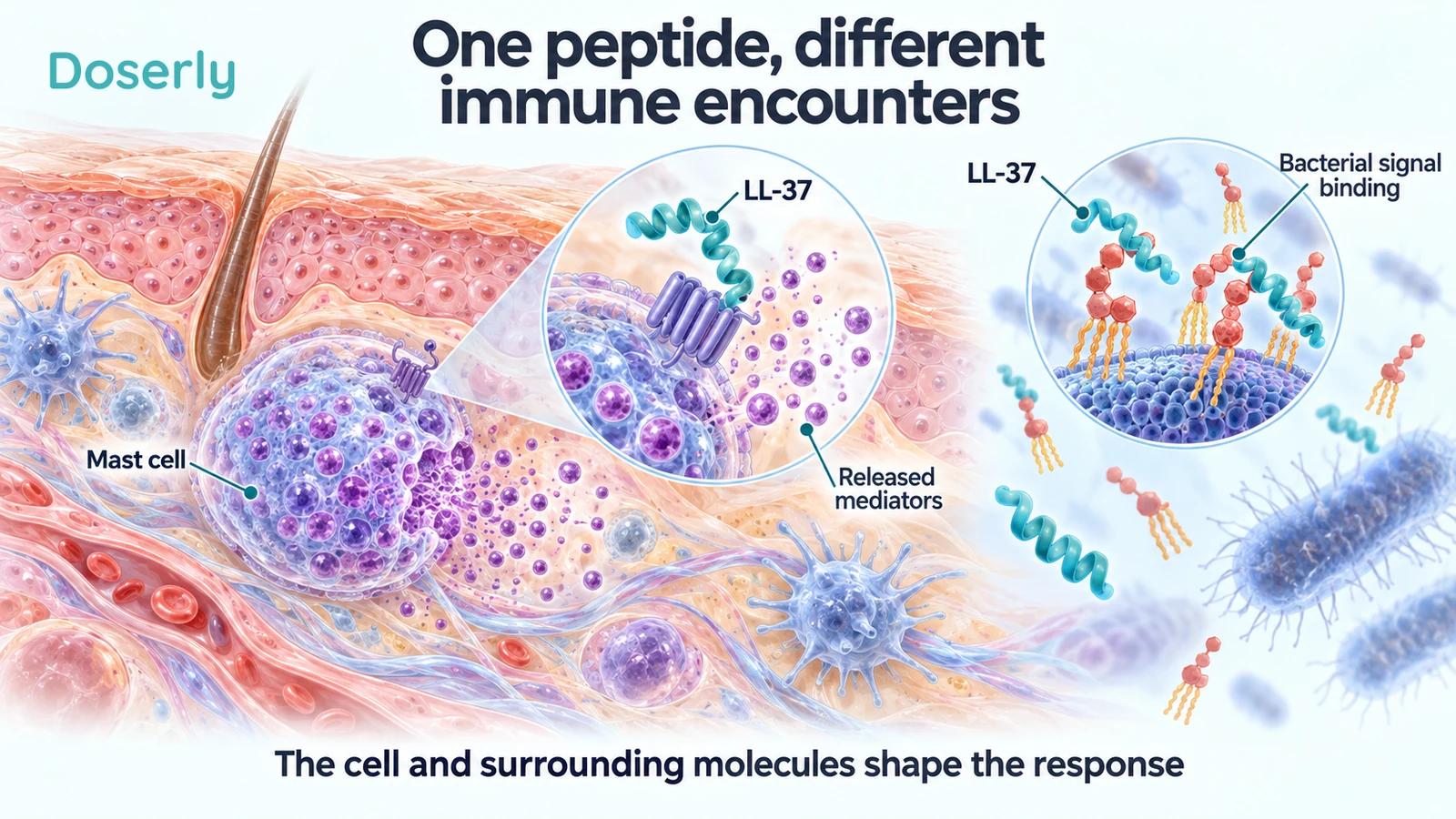
Mast cells contain granules that can release biologically active mediators. In a 2011 study using human mast-cell systems, researchers identified the receptor then called MrgX2, now commonly written MRGPRX2, as a mediator of LL-37-induced responses.
Cells expressing the receptor responded to LL-37 with calcium signaling and degranulation. Reducing receptor expression reduced the response. This combination of observations helps support a mechanism: the receptor was involved in how those cells reacted under the study conditions.
That is different from saying that every exposure to LL-37 causes an allergic reaction. A receptor-mediated response in cultured cells does not establish an adverse-event frequency in patients, and mast-cell activation is not synonymous with every form of allergy.
Still, the result directly challenges a blanket claim that LL-37 only suppresses inflammation. It can activate a cell type capable of releasing inflammatory mediators. When evaluating a proposed clinical use, that possibility belongs alongside any favorable antimicrobial or LPS-neutralizing effect.
Rosacea experiments connect cells to a tissue model
A 2014 rosacea study tested the contribution of mast cells to cathelicidin-initiated skin inflammation. In the animal component, mice lacking mast cells did not develop the same rosacea-like features after LL-37 exposure as the comparison mice. The researchers also studied the effects of a mast-cell stabilizer and included a small human investigation of topical cromolyn.
The species and interventions need to remain separate. The induced skin model was in mice. The human component was not a trial showing that administering LL-37 treats rosacea. It investigated a different intervention in people with the disease.
Animal models are useful because investigators can manipulate a pathway and observe the consequences in a way that would not be appropriate in people. Their purpose is to clarify mechanisms and generate testable ideas. They do not provide a direct estimate of what an unsupervised LL-37 injection would do to a particular person’s skin.
The relevant insight is that a host-defense pathway can participate in inflammatory pathology. A molecule does not have to be foreign to contribute to disease, and a protective role in one setting does not guarantee a protective role in every setting.
LL-37 can change how immune cells encounter self-DNA
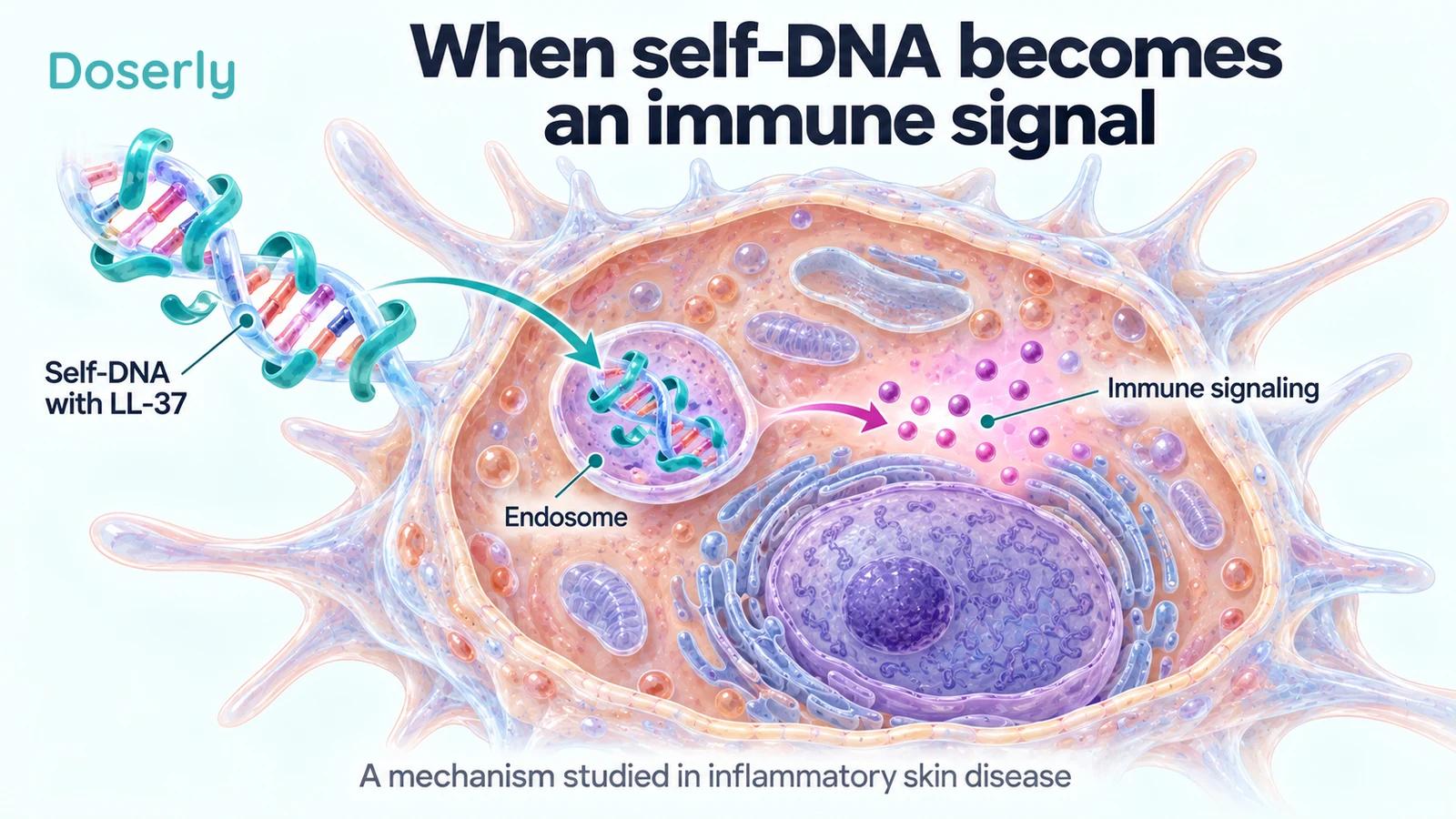
A 2007 study in Nature described another mechanism. LL-37 formed complexes with self-DNA and enabled activation of plasmacytoid dendritic cells, a cell population capable of producing interferon signals. The work connected this process with inflammatory skin biology in psoriasis.
“Self-DNA” means DNA originating from the body’s own cells. The finding was not that LL-37 changes a person’s genes. It concerned how extracellular material is packaged and encountered by immune-sensing machinery. Location and molecular partners can change whether material triggers a response.
This is a useful contrast with LPS neutralization. In one experimental context, binding a microbial component can reduce a response. In another, binding nucleic acid can help it reach a compartment where signaling occurs. Binding is not inherently anti-inflammatory; the outcome depends on what is bound and what happens next.
Nor does this mechanism establish that LL-37 exposure will cause psoriasis in someone without the condition. Mechanistic disease research identifies plausible contributors and interactions. It does not by itself quantify an individual’s risk or show that one pathway explains the entire disease.
The peptide can also become a target of adaptive immunity
The innate immune-sensing story is not the only connection to psoriasis. A 2014 study in Nature Communications identified T cells that recognized LL-37 in a substantial proportion of the studied patients with moderate-to-severe plaque psoriasis. The investigators examined these cells in relation to inflammatory cytokines, skin involvement and disease activity.
An autoantigen is a body-derived target recognized by the adaptive immune system. That is a different role from carrying DNA to an innate immune sensor. The two mechanisms can be discussed together without treating them as the same process.
The study’s existence does not make an LL-37 measurement a standalone diagnostic test, nor does it establish that everyone with psoriasis has the same response. It shows why the phrase “the body already makes it” is not enough to establish that adding more is beneficial.
The paper has a published correction concerning author affiliations, which was checked during this review. Its core observation remains a mechanistic finding in a defined patient group, not a clinical trial of LL-37 supplementation or a universal explanation for autoimmune disease.
Concentration, location and timing matter together
A physiological molecule is normally encountered in a particular environment. Experimental administration can change where it appears, how much is present and how long the exposure lasts. Those changes can affect which interactions become important.
Concentration alone is not a complete guide. An identical nominal amount in two laboratory systems may encounter different proteins, cells or stimuli. A topical formulation and an injection also create different exposure questions. Neither can be evaluated merely by asking whether LL-37 is normally present somewhere in the body.
Timing adds another layer. A brief response during defense against a threat may have a different meaning from persistent signaling in inflamed tissue. A study that measures an early response does not necessarily establish what happens after repeated exposure or during a chronic disease course.
These considerations explain why a context-dependent molecule can remain scientifically interesting while being difficult to translate into a broadly useful medicine. Researchers may need to target a specific interaction, location or formulation. The label “immune modulator” does not accomplish that targeting by itself.
A favorable marker is not the same as symptom relief
Suppose an experiment shows less of one inflammatory mediator. To interpret it clinically, we would still need to know whether people had less pain, fewer flares, better function or another meaningful improvement. We would also need to know what happened to other pathways and adverse effects.
The reverse caution applies to concerning laboratory results. A cell experiment showing activation does not prove that every clinical exposure causes harm. It identifies a mechanism that deserves attention in safety assessment. Both favorable and unfavorable findings should retain the same discipline about what the model can establish.
This symmetrical reading avoids two common mistakes: using a positive mechanism as proof of treatment benefit, and using a negative mechanism as a precise prediction of harm. Neither shortcut replaces a properly designed human study.
A clinical trial can connect exposure to outcomes because it specifies the product, population, comparison and follow-up. Without that connection, a list of pathways describes biological possibilities. It does not tell a person which direction their symptoms will move.
What the current evidence means for treatment claims
The FDA’s LL-37 compounding safety discussion identifies insufficient safety information and concerns involving immunogenicity, peptide-related impurities and ingredient characterization. Those concerns are distinct from the disease mechanisms above, but both argue against assuming that natural origin settles clinical safety.
For someone with an inflammatory skin condition, a useful discussion starts with the diagnosis and established care options. A proposed intervention should have a clear clinical aim and evidence relevant to that condition. A general claim that LL-37 “balances inflammation” does not identify either.
If an experimental peptide has already been used, documenting the exact product, route, dates and any symptom changes can help a clinician evaluate the history. A flare occurring afterward is worth reporting, but timing alone does not establish cause. Similarly, improvement after use may have other explanations, including ongoing treatment or the natural course of the condition.
The Doserly LL-37 guide provides the wider research context. The inflammatory studies support a precise conclusion: LL-37 can engage several immune mechanisms, and the consequences vary with the setting. That complexity is a reason to study targeted applications carefully, not a basis for a universal anti-inflammatory claim.
Explore the research
- LPS neutralization and other LL-37 activities, 2005.
- Stimulus-specific signaling with human LL-37 and mouse mCRAMP, 2013.
- LL-37 receptor signaling in human mast cells, 2011.
- Mast cells in rosacea-like inflammation, 2014.
- Self-DNA–LL-37 complexes and dendritic cells, 2007.
- LL-37 as a T-cell autoantigen in psoriasis, 2014, with affiliation correction.
- FDA LL-37 safety discussion.