
Peptides
October 16, 2026
LL-37 and biofilms: attractive laboratory findings need clinical confirmation
On this page
A laboratory biofilm becomes thinner after exposure to LL-37. Fewer bacteria attach to a surface. A stain detects less material remaining in a well. Each result can support an antibiofilm finding, but none automatically means that an infection in a person has been eradicated.
LL-37 research contains several interesting biofilm observations. Some occur at concentrations below those required to stop free-floating bacterial growth. Others depend on the organism, the age of the biofilm or the assay used to measure it. Those details are the evidence, not distractions from it.
The practical question is how far the findings travel. A mechanism that helps explain host defense may inform future treatments or device coatings. It does not establish a general “biofilm-clearing” injection regimen, and it does not diagnose a biofilm-related illness from persistent symptoms alone.
A biofilm is a community, not just a pile of bacteria
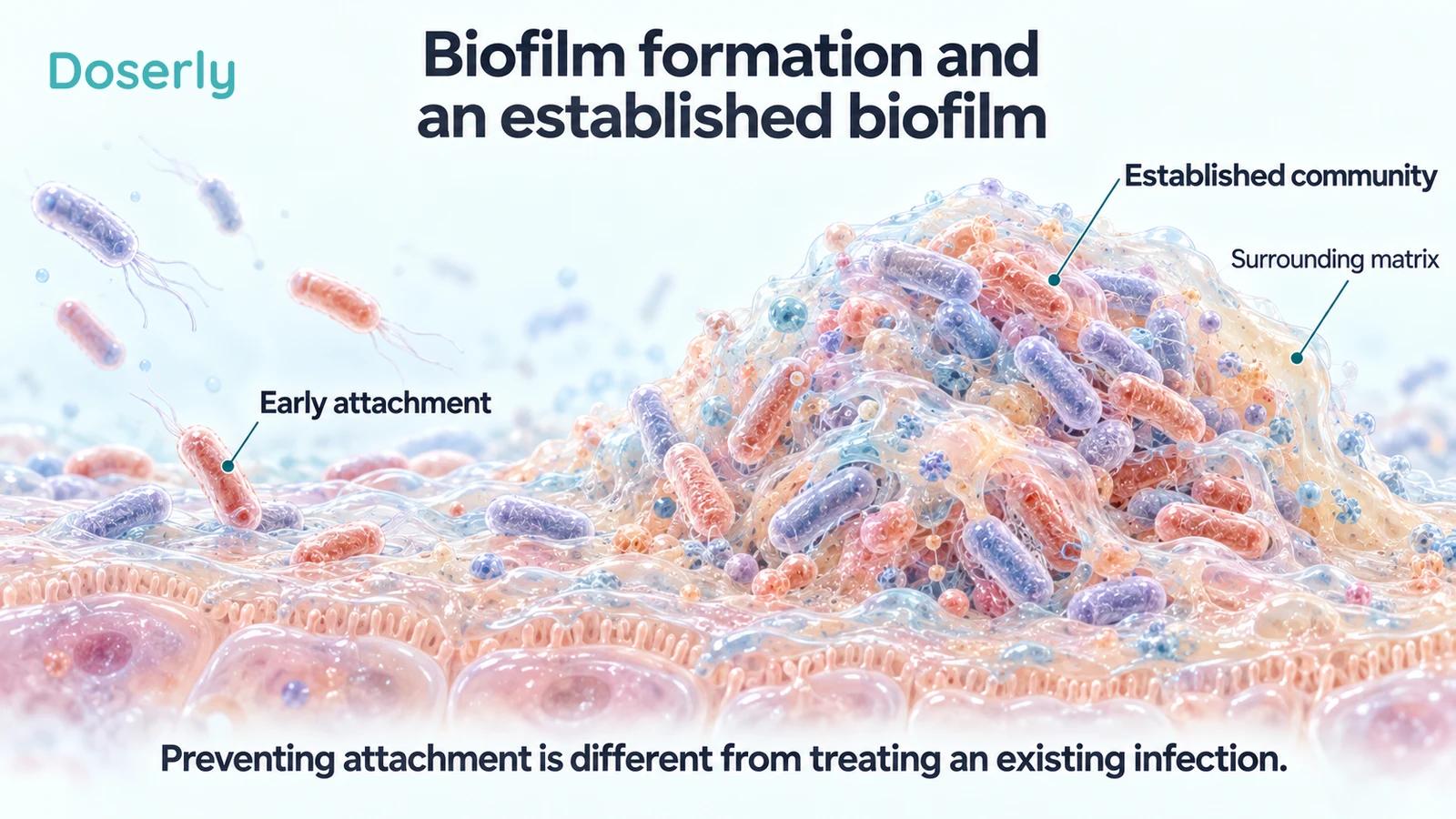
In a biofilm, organisms associate with a surface and with material around them. Researchers may examine attachment, the development of a structured community, the surrounding matrix or the behavior of cells within that community.
That is different from testing bacteria freely suspended in liquid, often called planktonic bacteria. A compound may affect attachment without killing the organisms. It may reduce growth before attachment occurs. It may alter a developed biofilm’s structure while leaving viable organisms behind.
The distinction matters because “antibiofilm activity” can refer to any of several outcomes. To understand a paper, we need to ask when treatment started and what was measured afterward. Prevention of new attachment and treatment of an established community are related development goals, but they are not the same experiment.
A clinical infection adds another layer. Living tissue, immune responses, biological fluids and the location of the organisms all affect what a treatment must accomplish. A laboratory surface is useful for isolating a mechanism; it does not reproduce every feature of an infected wound, airway or medical device.
What the influential Pseudomonas study showed
A 2008 study of Pseudomonas aeruginosa helped establish interest in LL-37’s antibiofilm effects. The investigators observed reduced biofilm formation at concentrations below those that inhibited planktonic growth in their assay.
They also studied previously grown biofilms in a flow-cell system. LL-37 exposure changed the architecture of those communities. Further experiments implicated changes in attachment, surface movement and signaling systems involved in biofilm development.
This is more specific than a story about a peptide killing every bacterium. It suggests that LL-37 can influence how a community develops and maintains its structure. The study provides evidence for biological activity under defined conditions.
It does not establish clinical eradication. The experiments did not measure recovery from a human infection, recurrence after treatment or whether an injected product reaches the relevant site at an effective and tolerable exposure. Those are separate questions, even if the laboratory mechanism is compelling.
The phrase “below the MIC” also needs context. MIC refers to growth inhibition under a particular assay. Activity below that value can help distinguish a biofilm-related effect from ordinary growth suppression, but it does not identify a safe or effective dose for a patient.
Less attachment may have more than one explanation
A 2018 comparison of host-defense peptides illustrates why investigators must examine what happens before a biofilm forms. The researchers measured effects on the starting bacterial population as well as later attachment. Much of the attachment prevention observed across tested peptides was associated with antimicrobial effects on the initial planktonic bacteria.
That does not make the result uninteresting. Reducing the organisms available to attach can still prevent a biofilm in an experiment. It does mean the mechanism differs from selectively disrupting a mature matrix or changing a biofilm-specific signaling pathway.
Consider an explicitly hypothetical comparison. If a surface begins with fewer viable bacteria because an agent acts before attachment, it may accumulate less material later. A final photograph alone cannot tell whether the agent prevented attachment, killed the starting organisms or acted on an established community.
Researchers address this by testing viability, varying the timing of exposure and using more than one readout. A consumer summary that omits those controls may make the effect sound more targeted than the experiment actually demonstrates.
The measurement method can change the apparent answer
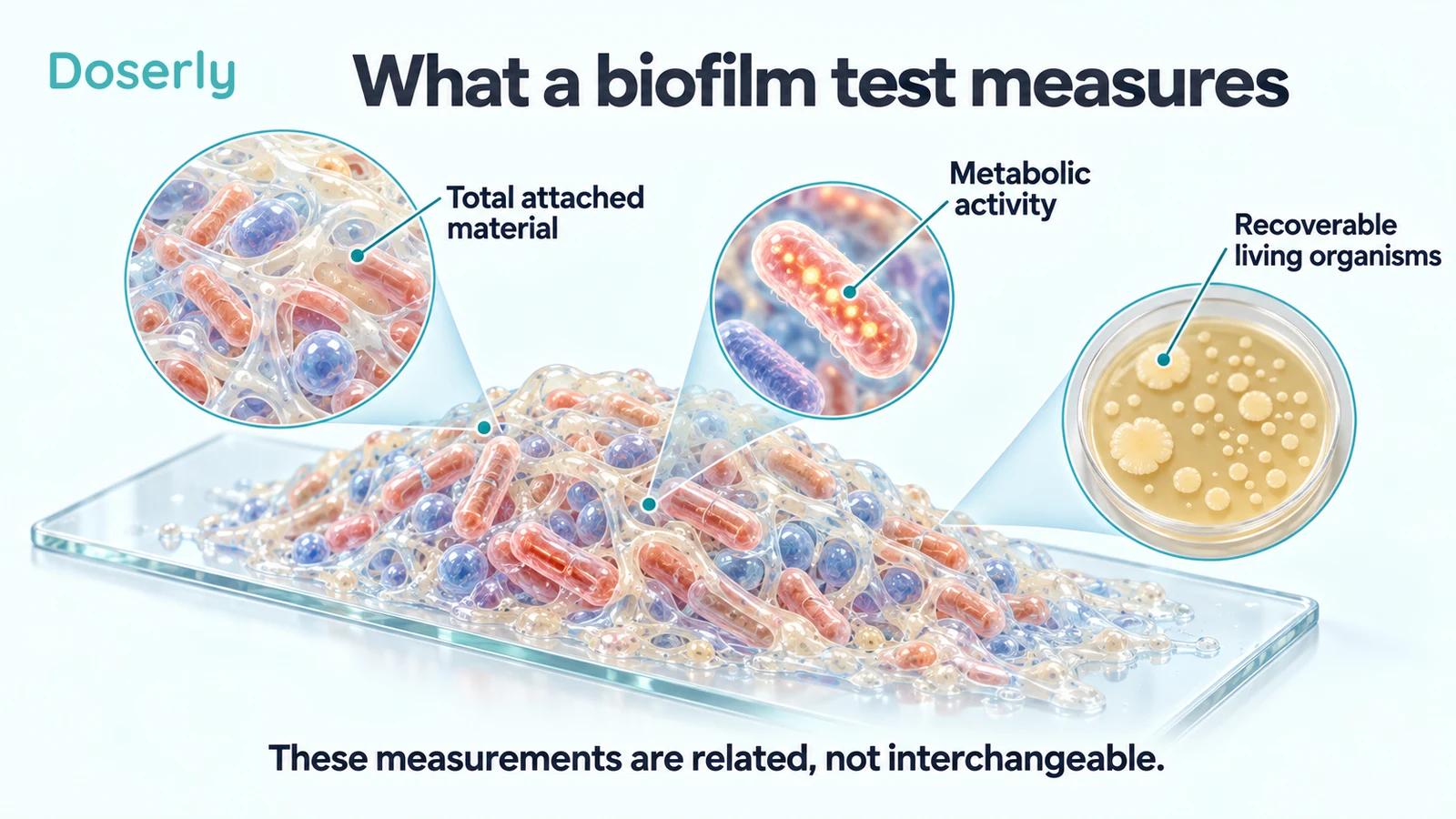
One common assay uses crystal violet to quantify material attached to a surface. It is useful for measuring biomass, but attached material is not identical to the number of living organisms. Other assays measure metabolic activity, microscopy reveals structure, and culture-based methods assess organisms that can be recovered and grown under specified conditions.
A 2017 study of LL-37 and two shortened mimetics compared results across several organisms and assays. Its crystal-violet and metabolic-assay findings differed. It also found that activity against early biofilms varied by organism; LL-37’s effects were not uniform across the tested systems.
This is a concrete reason not to translate “less staining” into “all microbes killed.” A treatment can change the matrix, cell metabolism or the amount of material adhering to a well without producing the same change in every measure.
Multiple readouts can make an interpretation stronger when they address complementary questions. When they disagree, that disagreement is part of the finding. It may reveal how the intervention works or show that a simple label is inadequate.
Organism and matrix composition matter
A biofilm is not one universal material that responds identically to every intervention. Different organisms produce different surface structures and matrix components. Even a result within one species may depend on the strain and experimental environment.
A 2010 study of uropathogenic E. coli examined curli, protein fibers associated with bacterial surfaces and biofilm biology. The investigators found that curli could bind LL-37 and help protect bacteria from its antimicrobial activity. LL-37 could also interfere with the formation of new curli fibers.
Those two observations can coexist. A structure already present may protect organisms, while the peptide affects production of new structure. This makes timing and the state of the community important rather than incidental.
The work combined mechanistic experiments with infection-model investigations. It did not establish LL-37 as a treatment for recurrent urinary tract infection in humans. Its value is in showing a specific interaction that future development would need to account for.
A claim that LL-37 “breaks down biofilms” across the body discards these distinctions. The evidence is more useful when attached to a named organism, a particular structure and a defined experimental stage.
Biological fluids and enzymes complicate delivery
A candidate antibiofilm agent must remain active where it is needed. Laboratory exposure in a controlled medium does not establish that a peptide will retain the same properties in blood, wound fluid or other tissue environments.
The 2005 LL-37 fragment study found that serum reduced the parent peptide’s antibacterial activity in its assay. A 2004 S. aureus enzyme study showed that one bacterial proteinase could cleave and inactivate LL-37, while another produced an active fragment. These are distinct, experimentally observed interactions.
Neither paper proves that LL-37 always fails in living tissue. They identify obstacles that a clinical formulation or delivery strategy must address. The amount added to a laboratory well is not necessarily the amount of active peptide available at a target site over time.
This is one reason researchers investigate modified peptides, protective formulations and surface-bound approaches. Such work may be promising, but the resulting product must be evaluated on its own. A derivative or coating is not interchangeable with an unmodified peptide injected elsewhere in the body.
Antibiotic combinations need direct testing
Another attractive idea is to loosen a biofilm and let an antibiotic finish the job. That is a testable hypothesis, not a guaranteed effect of combining two agents with antimicrobial reputations.
A 2020 study involving LL-37 and vancomycin found a transient reduction in vancomycin susceptibility in a particular S. aureus strain after LL-37 exposure. The work included laboratory experiments, modeling and an insect infection model. It was not a human biofilm-treatment trial.
Its relevance is methodological: combinations can behave unexpectedly. A favorable effect on attachment or matrix structure does not establish that every antibiotic combination will be helpful. Organism, concentration, exposure sequence and the chosen endpoint all need investigation.
The study also should not be overstated in the opposite direction. It does not prove that every LL-37–antibiotic combination is harmful, or that the observed change is permanent inherited resistance. The reported phenomenon was temporary and specific to the tested conditions.
Clinical confirmation would need a defined infection
A useful human trial would begin with a clinically meaningful problem and a specified product. It would identify the organism or infection setting as appropriate, explain the intended role of LL-37 and compare outcomes against relevant care.
The endpoints would need to go beyond a laboratory image. Depending on the condition, researchers might assess clinical resolution, complications, recurrence, additional procedures or the need for further antimicrobial treatment. Microbiological findings could support the interpretation, but the patient outcome remains essential.
Follow-up matters because a temporary reduction in attached material may not prevent regrowth. A short experiment can identify activity without establishing durability. The question of what happens after exposure stops deserves explicit attention.
Safety and delivery would be part of the same program. A device coating, a topical preparation and an injection create different exposures and development requirements. Evidence for one approach cannot validate all the others simply because LL-37 appears somewhere in their description.
Persistent symptoms do not identify a biofilm by themselves
The term “biofilm” can become an explanation for almost any symptom that has not improved. The laboratory papers reviewed here do not support that use. They study defined organisms and models; they do not provide a symptom-based test for hidden biofilms throughout the body.
For a person with a persistent or recurrent problem, the useful next question is what diagnosis and evidence support the proposed explanation. A clinician may need to reassess the source of symptoms, the presence of infection, the organism and the adequacy of previous treatment. Calling a condition biofilm-related does not remove the need for that assessment.
Nor does an experimental antibiofilm mechanism establish a reason to delay prescribed care. The FDA’s LL-37 safety discussion identifies insufficient safety information and concerns involving immunogenicity and peptide characterization. Those uncertainties remain relevant even when the laboratory images are persuasive.
Reading the next biofilm headline
Start by identifying the model: a culture plate, a flow cell, an animal model or people with a defined infection. Then ask whether the intervention prevented formation or acted on a pre-existing community. Finally, identify the readout: biomass, metabolism, viable organisms, structure or a clinical outcome.
Check the molecule too. Results for LL-37 fragments, mimetics or engineered delivery systems should not be silently transferred to unmodified LL-37. Check whether a concentration is an experimental condition rather than an instruction for human use.
The Doserly LL-37 guide offers the wider context. The biofilm research supports a real scientific interest: LL-37 can influence microbial communities in several laboratory systems. Clinical treatment claims require the next connection—evidence that a defined preparation safely improves a defined infection in people.
Explore the research
- Pseudomonas biofilm experiments, 2008.
- Host-defense peptide comparison, 2018.
- LL-37, KE-18 and KR-12 across organisms and assays, 2017.
- E. coli curli and LL-37, 2010.
- Serum effects and LL-37 fragments, 2005.
- S. aureus proteinases and LL-37, 2004.
- Transient vancomycin-susceptibility changes, 2020.
- FDA LL-37 safety discussion.