
Peptides
October 16, 2026
LL-37 and autoimmune disease: why stronger immunity isn't the goal
On this page
LL-37 is a peptide involved in the body's early response to microbes and tissue injury. That makes it sound like an appealing way to support immunity. But if you have psoriasis, lupus or inflammatory arthritis, a stronger immune response is not necessarily the response you need. Some immune reactions protect tissue; others help sustain the inflammation causing symptoms.
Researchers have found that LL-37 can participate in both kinds of activity. It can interact with microbes, carry the body's own genetic material into immune cells, and become a target of immune recognition itself. Those are different biological actions, with different implications for treatment. There is no established clinical benefit from adding LL-37 to treat the autoimmune conditions discussed here. The strongest relevant findings explain disease biology, rather than test LL-37 as a medicine for those diseases.
This distinction matters because a naturally occurring molecule can be useful in one location and problematic in another. We'll look at what researchers actually found in human samples and experimental systems, what those findings cannot predict about injections, and which questions are useful when someone proposes LL-37 for an immune-related problem. Our LL-37 guide provides broader background on the human treatment research.
What does LL-37 normally do?
The immune system includes rapid responses to injury and infection, often called innate immunity, and more specific responses involving T cells and antibodies, called adaptive immunity. These systems communicate. A molecule associated with an early defense response may also influence the cells that organize a longer-lasting response.
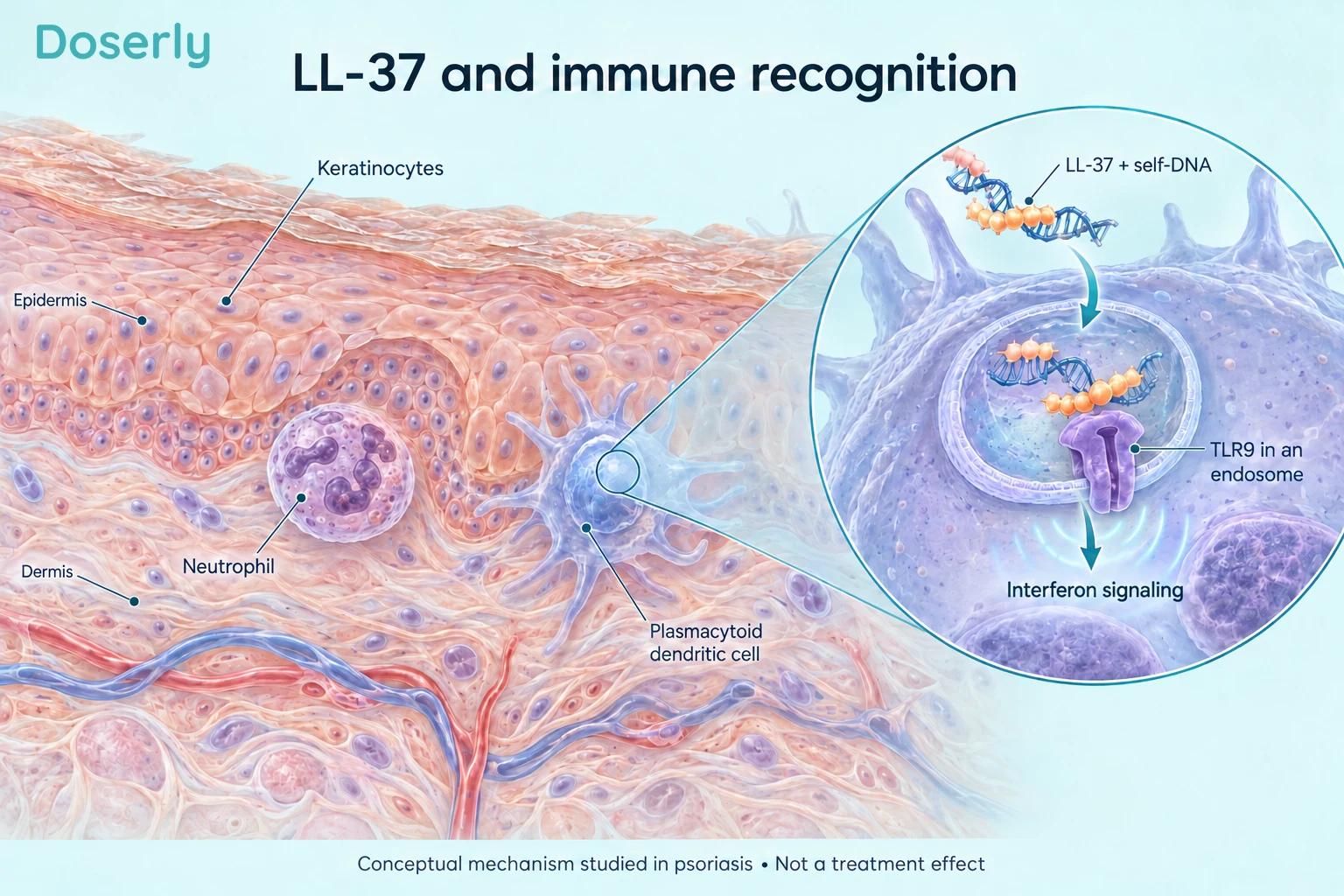
LL-37 is part of that conversation. In skin, it is associated with keratinocytes, the cells making up much of the outer layer, and with immune cells such as neutrophils. Calling it an antimicrobial peptide describes one important function, not everything it does. In psoriasis research, investigators found substantial LL-37 expression in affected skin and examined how it interacted with immune cells. Lande and colleagues, 2014.
The word “natural” therefore doesn't settle whether more would help. The relevant questions are where the peptide is, what it encounters, and which cells respond. Even an identical amino-acid sequence supplied from outside the body would have to be evaluated as a treatment, with its own exposure, formulation and safety data. Normal production inside tissue is not a clinical trial of a commercial preparation.
How can the body's own DNA become an inflammatory signal?
DNA carries genetic information. When cells are damaged or die, some of their contents can appear outside them. Immune cells need ways to distinguish that material from a threatening infection; otherwise, routine tissue turnover could provoke inappropriate responses.
A 2007 study identified an important exception in psoriasis. LL-37 bound self-DNA, meaning DNA originating in the person's own cells, and helped deliver it into compartments inside plasmacytoid dendritic cells. There, a receptor called TLR9 could recognize it and trigger production of type I interferons, immune signaling proteins. The location mattered: simply having DNA outside a cell was different from delivering it to a receptor inside an endosome, a membrane-enclosed compartment. Lande and colleagues, 2007.
This helps explain how a defense peptide could amplify inflammation without an invading microbe being the central problem. It is a mechanistic finding, not evidence that every person with psoriasis has the same pathway operating to the same degree. Nor does it tell us the likelihood of a flare after someone receives a particular LL-37 product.
RNA can take a related route
RNA is another type of genetic material. A 2009 study found that LL-37 could also bind RNA released from dying cells, protect it from degradation and help it reach immune-cell compartments. The receptors involved were not identical to the DNA pathway: RNA complexes activated TLR7 in plasmacytoid dendritic cells and TLR8 in myeloid dendritic cells. The latter cells produced inflammatory signals including TNF-alpha and IL-6. Ganguly and colleagues.
The distinction is useful even if the receptor names are unfamiliar. “Stimulates immunity” leaves out what was stimulated. Different cells can respond to different combinations of peptide and genetic material, producing different signals. An antimicrobial laboratory result cannot tell you whether these additional responses would be desirable in inflamed skin.
These experiments examined mechanisms and tissue findings. They did not compare an LL-37 treatment with standard psoriasis care or show improvement in itch, plaques or daily function. A treatment claim would need those clinical outcomes, alongside a sufficiently careful assessment of adverse effects.
In psoriasis, LL-37 can itself become an immune target
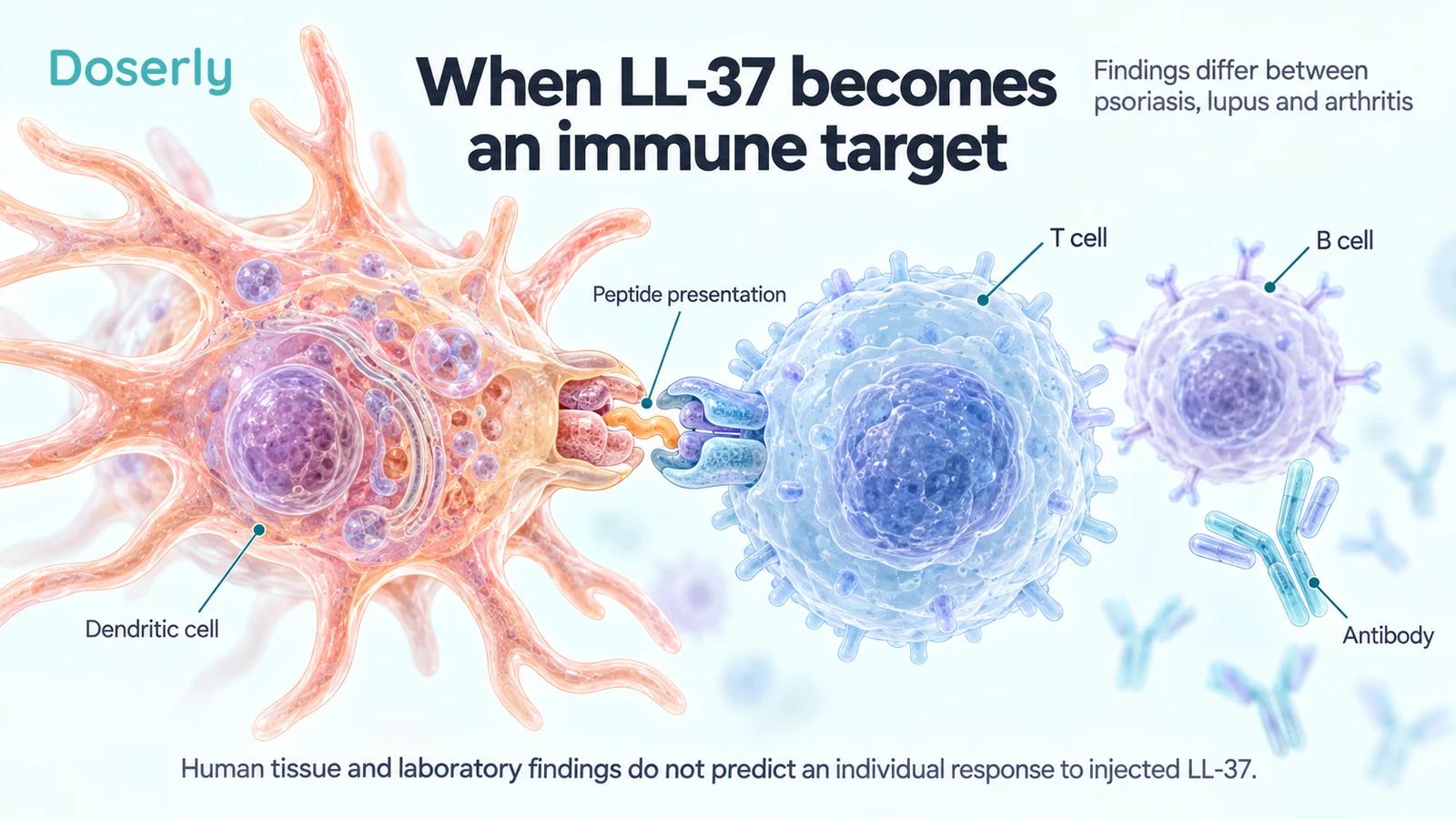
There is a second, separate finding: immune cells can recognize the peptide itself. A molecule targeted by an immune response against the body's own tissue is called an autoantigen.
In the 2014 psoriasis study, circulating T cells from 24 of 52 patients, about 46%, proliferated in response to LL-37 in laboratory testing. The researchers also examined the cells' inflammatory signals and their presence in affected skin. Responses were associated with disease activity. These were experiments using patient samples, not treatment outcomes after giving participants LL-37. Psoriasis autoantigen study.
That percentage should not be converted into a person's chance of reacting to an injection. It describes a particular sample and laboratory response. It is not a validated screening test for choosing a peptide regimen. A negative result in a hypothetical laboratory assay would not establish that a preparation is safe; a positive result would need interpretation within the clinical condition being assessed.
The practical insight is narrower and more useful: LL-37 isn't simply an external threat-fighting agent in psoriasis. It can be part of what the immune system recognizes during the disease.
What changes in lupus?
Systemic lupus erythematosus, usually called lupus, can involve multiple tissues and a variety of immune abnormalities. A 2020 study found LL-37-responsive circulating T cells in 45% of the patients examined. Their activity correlated with anti-LL-37 antibodies and disease activity. In laboratory experiments, these T cells supported B cells in producing antibodies. Lupus patient-sample and laboratory study.
The researchers also studied citrullinated LL-37, a chemically modified form of the peptide, and detected it in affected skin and kidney tissue. Some responses to the modified form were stronger than responses to the unmodified peptide. This is one reason names alone can conceal important differences: a peptide modified in inflamed tissue may be recognized differently from its original form.
These findings do not establish that LL-37 causes lupus by itself or that all patients have the same response. They show why the disease environment matters. A pathway identified in psoriasis cannot simply be assigned the same role in lupus, even when the peptide has the same name.
Arthritis adds another tissue context
In psoriatic arthritis, researchers examined joint fluid, joint tissue and blood. A 2018 study identified responses to native and modified LL-37, with some antibody measurements associated with inflammation or disease activity. Results differed according to the sample compartment and the form of the peptide tested. That complexity is important: a result in joint fluid isn't automatically a blood test ready for routine diagnosis. Psoriatic arthritis study.
Rheumatoid arthritis research has focused in part on carbamylated LL-37, another modified form. A 2021 study combined human samples, laboratory experiments and genetically modified mice. Antibodies against this form were associated with radiographic bone erosion in patients, while immune complexes enhanced bone-resorbing cell activity in experimental systems. An immune complex is an antibody bound to its target. Rheumatoid arthritis study.
An association with erosions is not proof that the antibody caused every patient's damage. Equally, an experimental effect on bone-resorbing cells is not a clinical trial showing that an injection will worsen arthritis. Together, the findings give researchers specific processes to investigate rather than a universal rule that raising or lowering LL-37 will solve inflammatory disease.
Is rosacea the same kind of evidence?
No. Rosacea is an inflammatory skin disorder, but it should not be casually relabeled as the same autoimmune process as lupus or psoriasis. It does provide another example of why a host-defense peptide can participate in inflammation.
A 2007 investigation found increased cathelicidin expression and altered peptide processing in human rosacea skin. Experiments in mice showed that relevant peptides and changes in processing could produce skin inflammation. The human observations and mouse interventions answer different questions: one describes tissue changes in a disease; the other tests whether selected changes can provoke inflammation in a model. Yamasaki and colleagues.
For a reader, the useful lesson is specificity. A mouse skin reaction is not a quantified human injection risk. It is also not evidence that the same substance treats facial redness. The finding deserves attention without being stretched into either a promise or a prediction.
What do we know about immune reactions to supplied LL-37?
The disease studies above cannot supply an incidence rate for reactions to an injected product. They examine endogenous biology, patient samples or experimental systems. Product-related immunogenicity is a separate question: can a preparation provoke an immune response when administered, and does that response have clinical consequences?
FDA flags potential immunogenicity with some routes of compounded LL-37, alongside concerns about peptide impurities and characterization of the active ingredient. The agency says available safety information is insufficient to determine whether administration would cause harm. This is a statement of unresolved safety concerns, not a measured probability of an autoimmune flare. FDA compounding safety information.
It would therefore be inaccurate to say that an injected product must be harmless because the body already makes LL-37. It would also be inaccurate to claim that these papers prove an injection inevitably causes autoimmune disease. The information needed to quantify that risk is different from the evidence establishing a biological mechanism.
What would a meaningful benefit look like for you?
If the problem is psoriasis, relevant benefits might include less severe skin disease, less itch and better daily functioning. If the problem is arthritis, they might include less pain and swelling, preserved function and protection against joint damage. A change in one immune marker would not establish all those outcomes.
That gives a clinician conversation a concrete starting point. Explain the symptom or diagnosis you want help with, then ask what human study supports the proposed intervention for that problem. Ask whether participants actually received the same molecule and formulation, what the comparison treatment was, and whether improvement concerned symptoms or only a laboratory measurement.
It is also useful to separate a concern about infection from a concern about autoimmune disease. Someone taking an immune-modifying medicine may worry about infections while still needing control of damaging inflammation. Those concerns call for individualized clinical assessment; they do not make an untested “immune boost” a demonstrated solution.
A dated record of symptoms, prescribed treatment changes and suspected reactions can help you describe the situation clearly. It cannot establish causation by itself, but it gives the clinician more useful information than a general impression that immunity feels stronger or weaker. For background before that discussion, see the LL-37 guide's risks section.
Sources
- Lande et al., 2007: self-DNA delivery and dendritic-cell activation.
- Ganguly et al., 2009: self-RNA complexes and TLR7/TLR8.
- Lande et al., 2014: LL-37 as a psoriasis T-cell autoantigen.
- Lande et al., 2020: LL-37-specific T cells in lupus.
- Frasca et al., 2018: antibodies in psoriatic arthritis.
- O'Neil et al., 2021: carbamylated LL-37 in rheumatoid arthritis.
- Yamasaki et al., 2007: cathelicidin processing in rosacea.
- FDA: potential safety risks in compounding.