
Peptides
October 16, 2026
Light tolerance in EPP: what extra time outdoors can mean
On this page
For someone with erythropoietic protoporphyria, an ordinary trip outside can require calculations that other people never make. Where is the shade? How far is the walk from the car? Can the activity be interrupted if symptoms begin? A treatment that makes those decisions less restrictive may matter even when its benefit is expressed as a modest number of minutes.
That is why light tolerance is a meaningful outcome in EPP. But the phrase can describe several different measurements: time before warning symptoms, accumulated pain-free sunlight exposure, or time spent outside during daily life. Those measurements are related, but they are not interchangeable.
Afamelanotide research becomes easier to interpret when the number is connected to the question asked. A higher exposure total can reflect improved tolerance, more opportunities to go outdoors, a change in confidence, or some combination of these. The patient’s symptoms and circumstances help explain which interpretation fits.
Why light exposure is a disease outcome
EPP involves accumulation of protoporphyrin, a light-sensitive substance. When light interacts with it, patients can develop painful phototoxic reactions. Visible light is important, particularly near the blue-violet part of the spectrum; this is not simply an unusually easy tendency to get an ordinary UV sunburn. EPP clinical consensus guideline.
This distinction affects both treatment and measurement. A sunscreen’s UV protection rating does not fully describe protection against the wavelengths relevant to EPP. The treating team may recommend clothing, shade and other individualized measures that address the person’s pattern of photosensitivity.
A study also cannot assume that everyone experiences the same exposure during a “sunny day.” Skin coverage, location, time of day, direct versus indirect light and time spent behind glass can change the circumstances. Minutes are a convenient unit, but they do not capture all the light reaching the skin.
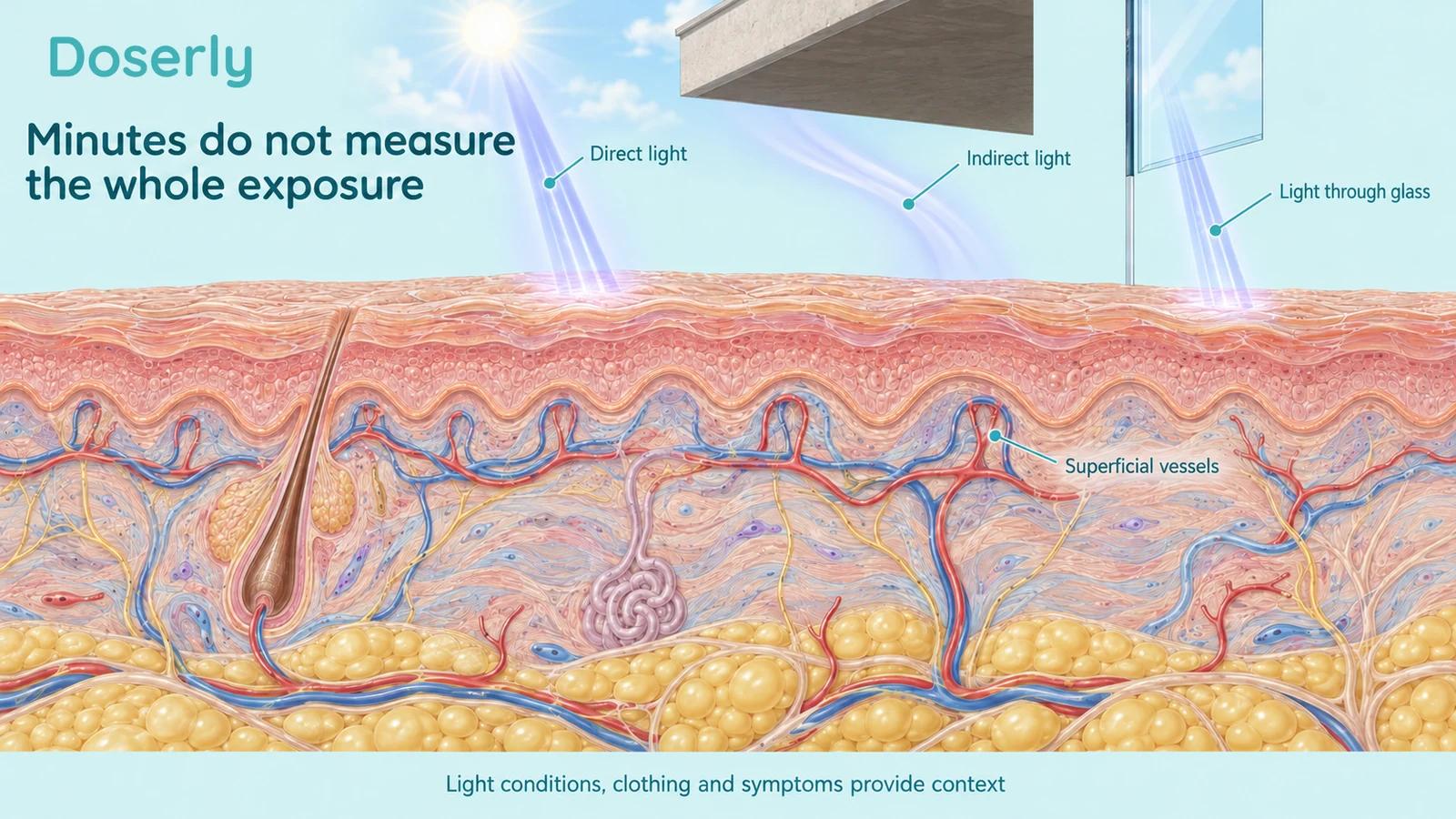
Symptoms can start before an obvious skin change
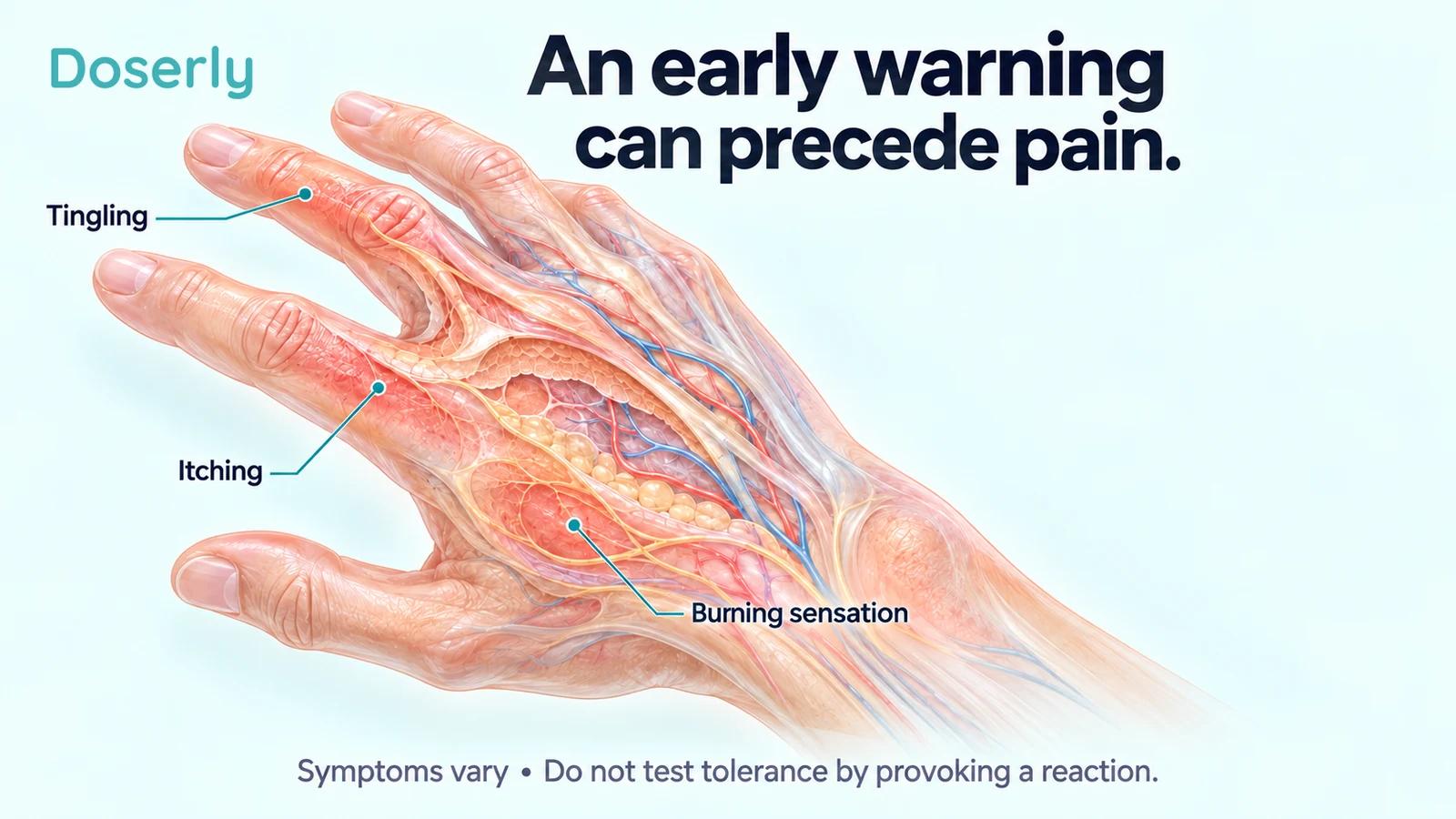
Patients may experience tingling, itching or burning before a more severe reaction. The early warning phase is often called a prodrome. It can be clinically useful because it may signal the need to leave the exposure before pain becomes more intense.
In a 2023 study of 35 people with EPP, researchers combined symptom surveys with light measurements in a subset. Participants described substantial pain and sensitivity, but visible skin changes varied. Some reported never having visible symptoms. The study was small, all participants were White, and the skin findings were self-reported rather than examined by a physician. Light-related symptoms study.
The practical implication is that the absence of redness in a photograph cannot establish the absence of a reaction. Nor should a person wait for a visible mark to regard their symptoms as real. For research, photographs alone would miss part of the disease burden.
Three ways a study can count “more time”
Time to symptoms asks how long a person can remain in an exposure before early warning signs or pain begin. The exact stopping point matters: tingling and severe pain are not the same endpoint.
Accumulated pain-free exposure adds up time meeting a study’s definition across days or months. It can be useful for comparing randomized groups, but a total of several dozen hours does not describe one continuous outing.
Time spent outdoors records behavior in ordinary life. It may include shade, different clothing and activities that a direct-sunlight endpoint would exclude. It tells us something valuable about participation, even though it is not a pure laboratory measurement of biological tolerance.
Before comparing two results, check which of these was measured. Dividing an accumulated trial total by the number of days does not produce an individual daily allowance. Likewise, a maximum reported exposure should not be presented as the amount every participant could reliably tolerate.
What the randomized afamelanotide trial contributes
The 2015 publication reported US and European placebo-controlled trials in adults with EPP. In the US trial, the median accumulated pain-free time in direct sunlight over six months was 69.4 hours with afamelanotide and 40.8 hours with placebo. The outcome used diary entries within specified daytime hours. Randomized trial report.
That comparison supports a benefit in the studied population. It does not mean that every treated person gained the difference between the two group medians, or that the participants were instructed to spend that many hours outdoors. The study measured what happened under its protocol; it did not issue a safe-exposure quota.
The European trial used a different diary framework and observation period. EMA also identified major problems with data handling in earlier European studies and relied on the US study for pivotal efficacy evaluation. Those qualifications are important when interpreting apparently different effect sizes. EMA assessment.
What everyday treatment studies add
A Dutch postauthorization study followed 117 patients receiving afamelanotide in clinical practice. Compared with baseline, time outside increased by an estimated 6.1 hours per week. Reactions were less painful, while their number and duration did not show a significant difference. This was an observational cohort, not a new placebo-controlled trial. Dutch clinical-practice study.
That combination is informative. More time outside with less painful reactions can represent improvement even if the count of reactions does not fall. The person may now be encountering situations they previously avoided.
However, the same findings cannot show exactly how much improvement was caused by the medicine alone. Seasons, habits, expectations and which patients remain in follow-up can influence an uncontrolled comparison. Real-world evidence adds context to randomized evidence; it does not remove the need to consider those influences.
A Swiss observational study reported a median maximum phototoxic burn tolerance time of 10 minutes before treatment and 180 minutes during treatment. These were patient-reported experiences, with different numbers contributing baseline and treated observations, rather than a standardized challenge imposed on every participant. Swiss follow-up study. The large difference should retain that description whenever it is quoted.
Why confidence may change more slowly than symptoms
Avoiding light can be a learned response to repeated painful experiences. Even if a treatment helps, a person may not immediately change established routes, clothing or social plans. Someone who can tolerate more exposure might initially spend little additional time outside because they have not yet gained confidence in the change.
Conversely, increased confidence can lead to more exposure and reveal residual symptoms. Neither pattern automatically means that the treatment failed. It means the outcome reflects a person responding to their condition, not just a drug acting on isolated tissue.
These behavioral explanations are plausible interpretations, not measurements of what every patient thinks. A useful follow-up discussion asks about both capability and choices: what became easier, what still feels unsafe, and what activities remain avoided. The answers can explain why an exposure diary and a patient’s overall assessment do not move in perfect parallel.
Why an extra interval can matter
Consider an illustrative situation: someone can complete a short walk from a parking area but usually cannot stay for an outdoor family activity. An improvement may allow more participation, even if they continue using shade and protective clothing. Another person may value being able to make a routine journey with less fear of an interrupted day.
These are examples, not reported outcomes from a specific trial participant. Their purpose is to show why the same numerical change can have different practical value.
Qualitative research supports asking about these details. Development work for the EPP Impact Questionnaire included interviews with 17 adults and six adolescents. Participants described effects on daily activities, work, and social and emotional functioning. The study helped identify concepts important to patients; it was not an afamelanotide efficacy trial. EPP questionnaire development study.
A diary should explain the day, not encourage a challenge
If a clinician recommends keeping a symptom record, the most useful entries describe ordinary circumstances. Note the activity, approximate exposure, whether the light was direct or indirect, skin coverage, early symptoms and any later reaction. Include activities avoided because of concern about symptoms, since a symptom-free day spent entirely indoors has a different meaning from a comfortable day with usual activities.
Recording the reason an activity ended can also help. Did symptoms begin, did the activity simply finish, or did the person leave preemptively? Those explanations distinguish a measured limit from a limit that was never reached.
A record is not a reason to remain exposed until pain occurs. Deliberately provoking a reaction to obtain a more impressive number can undermine the purpose of tracking. Discuss uncertainty or changing symptoms with the treating team rather than treating a previous successful outing as a guaranteed threshold.
Improvement does not answer every health question
Afamelanotide’s approved US indication is to increase pain-free light exposure in adults with a history of EPP phototoxic reactions. The label still advises maintaining sun and light protection. A favorable response does not establish protection against all UV-related harm. Current prescribing information.
More time outside also should not be assumed to normalize vitamin D. A 2024 observational study analyzed 1,774 measurements from 230 people with EPP. Afamelanotide alone was not associated with a significant average increase in vitamin D, whereas cholecalciferol-containing treatment groups had higher levels. Vitamin D cohort study. Vitamin D assessment and treatment remain separate clinical questions.
Similarly, a person’s improved light tolerance does not demonstrate that the underlying protoporphyrin accumulation has resolved. Symptom benefit, laboratory monitoring and other aspects of EPP care should each be assessed on their own terms.
Reading a light-tolerance result well
A useful interpretation names the population, the exposure definition, the observation period and the comparison. Then it asks what else changed: pain severity, reaction frequency, daily activities and the need for protection.
For a patient, the most relevant question may be whether an ordinary activity has become more manageable without unacceptable symptoms or adverse effects. For a researcher, it may be whether a prespecified endpoint differs between randomized groups. Both questions matter, but one number rarely answers them completely.
The Doserly afamelanotide evidence guide places these outcomes alongside formulation and safety information. Light tolerance deserves to be taken seriously as a patient-centered benefit, while keeping the exact measurement and its limits visible.
Sources
- EPP clinical consensus guideline.
- Light-related symptoms and dosimetry study.
- Langendonk et al.: randomized afamelanotide trials.
- EMA: Scenesse assessment.
- Wensink et al.: Dutch clinical-practice cohort.
- Swiss observational light-tolerance study.
- Mathias et al.: EPP Impact Questionnaire development.
- Scenesse prescribing information.
- Kluijver et al.: vitamin D cohort.