
Supplements
October 16, 2026
Leucine and muscle: a signal still needs the full meal
On this page
Leucine is often described as an anabolic switch. The metaphor captures part of its biology: this essential amino acid helps regulate pathways involved in muscle-protein synthesis. It becomes misleading when the switch is treated as a substitute for the amino acids, energy and physical stimulus needed to maintain or build tissue.
A useful human study can show that adding leucine improves the response to a particular meal. That does not establish that isolated leucine can replace the meal, increase muscle mass over months or prevent muscle loss during inactivity. Those claims require different experiments.
Leucine can influence muscle metabolism, but a stronger short-term signal is not a reliable promise of extra muscle. The evidence is most informative when the actual supplement is kept visible: leucine alone, leucine added to protein and a multinutrient drink are not the same intervention.
Leucine has two roles in the discussion
Leucine is both an amino acid used in proteins and a nutrient signal. Describing only the signaling role can make it sound as though muscle tissue is built by issuing an instruction. Protein synthesis also requires the amino acids being assembled into new proteins.
Human feeding experiments investigate both nutrient supply and signaling, but they cannot remove the rest of the body's metabolism from the picture. Someone receiving a leucine-containing supplement still has dietary intake, existing amino-acid pools and continuous protein turnover. A response to that supplement does not show that other amino acids are dispensable.
The L-leucine guide explains the ingredient. The distinction to carry through this article is simple: a study of leucine enrichment tests a modification to a nutritional context. It is not automatically a test of leucine as a stand-alone replacement for protein.
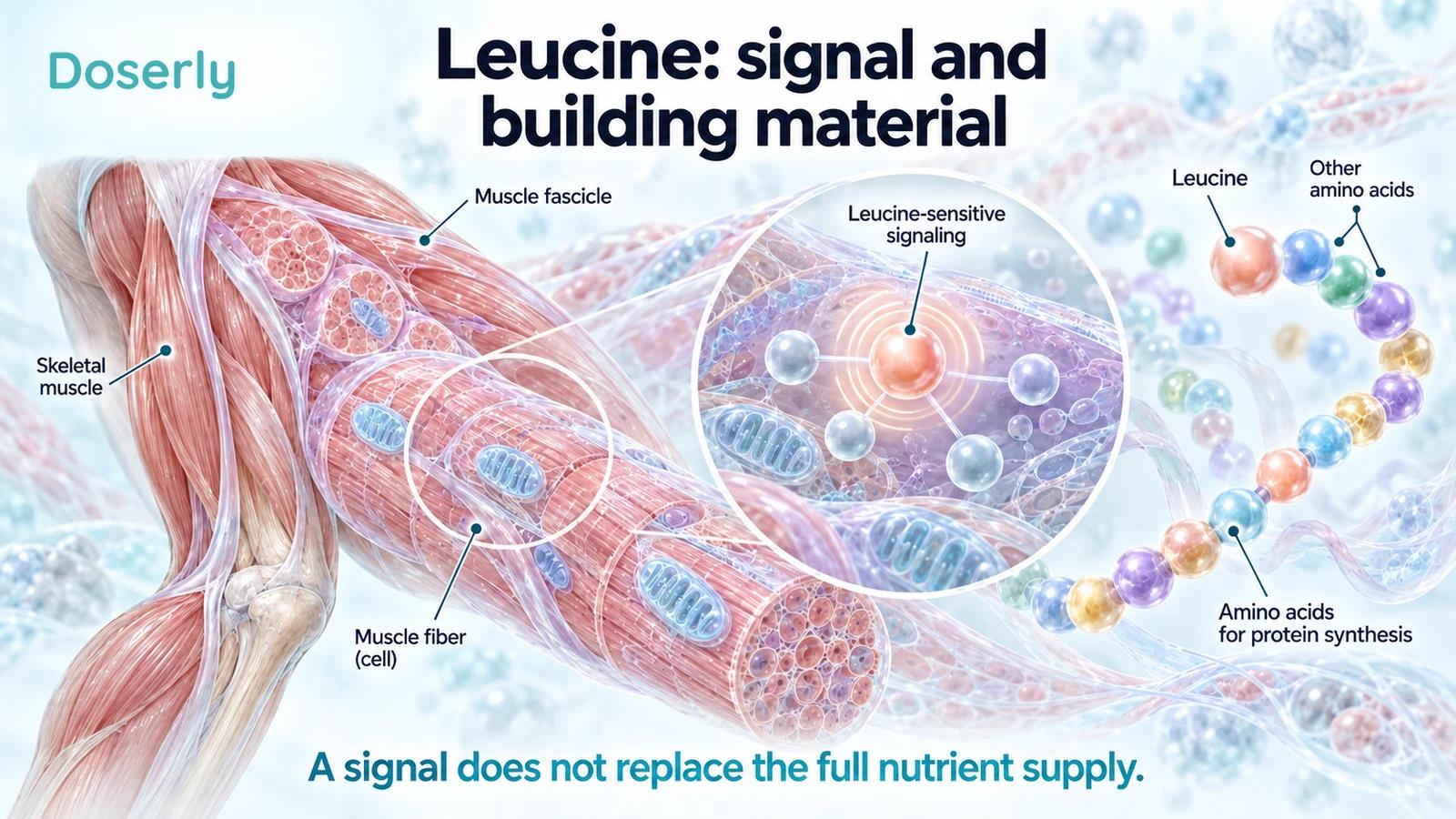
Conceptual anatomy and signaling. Colored beads and nodes are schematic, with enlarged cellular structures; the illustration does not depict a literal molecular switch or a measured treatment effect.
What the six-day study in older women actually compared
A 2018 study randomized 22 healthy older women to two drinks, consumed twice daily for six days. One supplied 25 g of whey protein with approximately 3 g of leucine. The other supplied 10 g of milk protein with enough added leucine to bring the total to approximately 3 g.
The participants performed resistance exercise with one leg, allowing researchers to examine exercised and rested muscle. Labeled-amino-acid and deuterated-water methods measured acute and integrated myofibrillar protein synthesis. Devries and colleagues
Both drinks increased acute synthesis. Over the supplementation period, integrated synthesis increased similarly in the exercised leg. The detailed results were not identical in every condition: the acute exercised-leg response was greater with the leucine-enriched lower-protein drink, while the rested-leg integrated increase reached statistical significance with whey but not with the enriched drink.
The lower-protein intervention still contained 10 g of milk protein per serving. Calling it a leucine-only study would remove a central part of the intervention. The finding supports a particular enrichment strategy over a short period, not replacing complete nutrition with isolated leucine.
Six days also cannot establish sustained muscle growth, preserved independence or reduced falls. The authors called for longer interventions. A title emphasizing leucine content should be read alongside the actual drinks, study duration and measured outcomes.
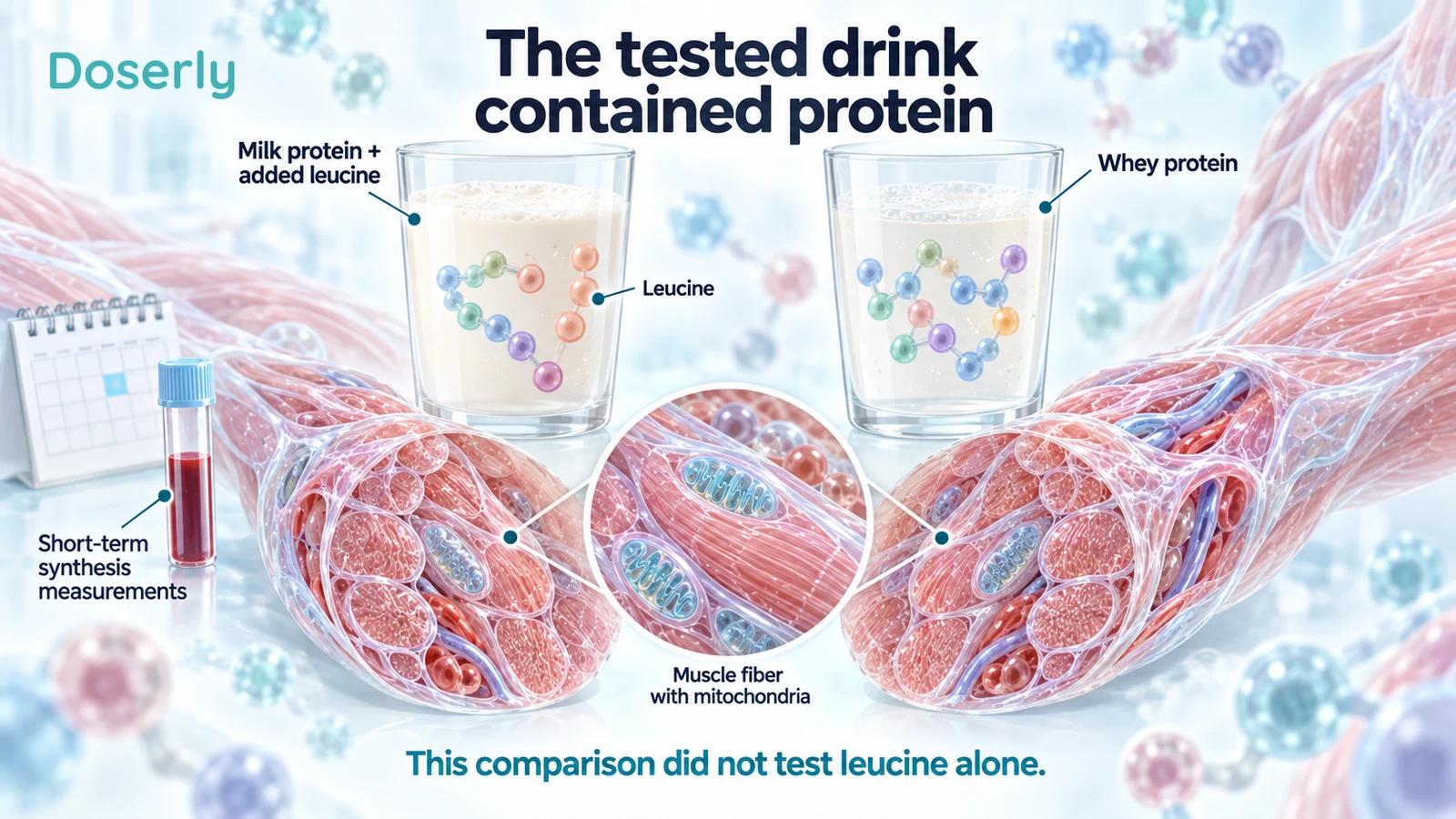
The tested comparison contained protein in both drinks. The sampling vial represents part of tracer research; muscle biopsies and isotope measurements, not an ordinary blood test alone, were used to measure synthesis.
Short-term synthesis can improve without a change in lean mass
A 2012 study examined older adults consuming a diet providing the recommended dietary allowance for protein. Investigators supplemented meals with leucine for two weeks and measured muscle metabolism before and after the intervention. The metabolic test days themselves did not include the leucine supplement.
Basal synthesis and the response to a lower-protein test meal were greater after supplementation. Fat-free mass did not change. Two-week leucine study
This is evidence that the measured metabolic response can change under particular dietary conditions. It is not evidence that two weeks of increased synthesis necessarily produce a detectable increase in body composition. The before-and-after design also provides less protection against alternative explanations than a concurrent randomized placebo comparison.
A short study may be too brief to detect a small change in muscle mass. That possibility explains a limitation; it does not license claiming the unmeasured long-term benefit. The useful next step is to examine longer studies rather than extrapolate indefinitely from the metabolic result.
Three and six months of isolated leucine were less encouraging
A randomized placebo-controlled trial in 30 healthy older men tested 7.5 g of leucine daily, divided across the main meals, for three months. Muscle mass and strength did not increase relative to the studied conditions. The trial also found no improvement in its glycemic or lipid measures. Verhoeven and colleagues
A separate six-month trial studied 60 older men with type 2 diabetes using the same total daily amount. Participants habitually consumed adequate dietary protein. Leucine did not improve muscle mass, strength, body composition or glycemic control compared with placebo. Leenders and colleagues
These findings do not mean leucine has no biological role. They show that adding isolated leucine did not produce the hoped-for clinical or body-composition benefit in those populations and circumstances. That is exactly the distinction an “anabolic switch” headline tends to skip.
The diabetes trial is also not a reason to use leucine for blood-sugar treatment. A plausible nutritional mechanism and an actual treatment benefit are separate questions, and the measured glycemic outcomes were negative.
When protein intake and training were already supported
A 2025 randomized placebo-controlled study followed 19 prefrail or frail older women through 12 weeks of resistance training. Their diet was optimized to provide approximately 1.2 g/kg of protein daily. Participants received either 7.5 g of leucine per day or an alanine placebo.
The overall program improved muscle-protein synthesis, lean mass, muscle-fiber size, strength and measures related to frailty. Leucine did not add an anabolic benefit. Training and optimized-protein trial
This is particularly relevant to the question of what remains for an isolated supplement to do when the wider nutritional and exercise program is already addressed. The trial was small, so it cannot exclude every possible effect. It does not support attributing the program's improvements to leucine when both groups received training and protein support.
The distinction matters for tracking progress. If someone begins resistance exercise, improves meals and adds a supplement at the same time, improved strength cannot be assigned to the supplement alone. A comparison group helps separate those contributions in research; a personal log cannot fully reproduce that control.
Leucine did not prevent short-term immobilization losses
A 2026 double-blind randomized trial studied 24 younger and 24 older adults during three days of one-leg immobilization. Participants received leucine or an energy-matched carbohydrate supplement with each main meal. Researchers measured daily muscle-protein synthesis and quadriceps cross-sectional area.
Synthesis was lower in the immobilized leg, and muscle size declined. Leucine did not prevent those changes in either age group. Immobilization trial
The setting is different from an ordinary gym routine, but it directly tests a common extrapolation: that a strong nutritional signal can substitute for muscle use. Under this protocol, it did not.
The result should not be expanded into a claim that nutrition is irrelevant during recovery or that every rehabilitation strategy fails. It shows a limit of the tested isolated supplement. Someone recovering from injury or surgery needs an appropriate clinical and rehabilitation plan, not a promise that a powder can replace movement when movement becomes safe again.
Positive multinutrient trials cannot identify leucine's share
The PROVIDE study randomized 380 older adults with sarcopenia to a vitamin D and leucine-enriched whey-protein supplement or an energy-matched control for 13 weeks. The active supplement improved appendicular muscle mass and chair-stand performance relative to control.
The estimated additional appendicular mass gain was 0.17 kg, and the chair-stand improvement was approximately one second. However, the primary handgrip and overall Short Physical Performance Battery outcomes did not differ significantly between groups. PROVIDE trial
These findings are meaningful evidence about the combined nutritional product. They cannot determine how much of the result came from whey protein, leucine, vitamin D or their combination. A trial isolating individual components would be needed to answer that attribution question.
It is also important to retain the primary-versus-secondary distinction. Describing the study only as a positive “strength trial” would hide the lack of between-group differences in its primary measures. Describing it as entirely negative would hide the favorable muscle-mass and chair-stand results. Accurate interpretation keeps both visible.
Why a universal leucine threshold is too simple
A threshold is appealing because it turns a complex meal into a target number. The studies here show why that number cannot settle every decision. The same leucine amount can accompany different quantities of protein, and a response can differ between rested and exercised muscle or between a short test and a training program.
Age, baseline diet, health, energy intake and the intervention's composition also define the studied conditions. A dose used in older adults with a particular nutritional constraint is not automatically the ideal dose for a young athlete. The amounts reported above describe experiments; they are not personalized dosing instructions.
A further problem is treating all outcomes as one ladder. Blood leucine, pathway activation, synthesis, lean mass, strength and everyday function are related, but none guarantees the next. A claim about one should be supported by a study that measured it, rather than by substituting a more convenient marker.
That does not make mechanistic research unimportant. It helps explain why a formulation might work and which questions deserve testing. The limit is using that explanation as if the longer-term outcome had already been established.
Put the supplement decision back into the whole routine
Before focusing on isolated leucine, identify whether there is an actual nutritional gap. Review ordinary meals, appetite, protein-containing foods and the feasibility of your training routine. A supplement that makes eating easier solves a different problem from one marketed as a way to exceed the results of an already adequate diet.
If you use a leucine-enriched product, record what else it contains. A whey drink with added leucine belongs in the log as a combined product, not as leucine alone. That makes it easier to interpret tolerance, cost and any changes when comparing it with another serving.
Use outcomes that match the goal. Consistent training performance, functional tasks and measurements collected over time are more relevant to sustained progress than an immediate feeling after a drink. Soreness and a temporary change in body weight cannot identify a leucine effect.
For an older person with weakness, poor appetite or unintentional weight loss, the priority is an assessment of nutrition and function. The evidence includes selected populations with structured support; it does not justify self-treating every decline with a single amino acid. The EAA guide offers context on broader amino-acid formulations, which also require their own evidence rather than being assumed equivalent.
Leucine's signaling role is real. The practical claim needs to stay narrower: enrichment can improve some short-term responses, while isolated supplementation has repeatedly failed to deliver added muscle or functional benefits in several longer and disuse trials. Building a useful routine still requires the rest of the nutritional and training context.
Sources
- Leucine-matched milk and whey interventions in older women
- Two-week leucine supplementation and muscle-protein synthesis
- Three months of leucine in healthy older men
- Six months of leucine in older men with type 2 diabetes
- Training, adequate protein and leucine in prefrail or frail older women
- Leucine during immobilization in younger and older adults
- PROVIDE: vitamin D and leucine-enriched whey in sarcopenia