
Supplements
October 16, 2026
Lemon balm for calm: what single-herb and combination trials show
On this page
Lemon balm, or Melissa officinalis, is an aromatic leafy herb often used in teas and extracts intended for relaxation. Its appeal is easy to understand: many people want to feel less tense without becoming sleepy, mentally slow or dependent on a complicated bedtime routine.
Those goals are related, but they are not identical. Feeling calmer during a demanding task, sleeping better over several weeks and treating an anxiety disorder require different evidence. Lemon balm research includes small experiments relevant to each question, alongside studies of products that contain several other ingredients.
A result for a combination belongs to the combination. It cannot establish how much lemon balm contributed, whether the other ingredients were necessary or whether the mixture worked better than lemon balm alone. That distinction becomes particularly useful when a label describes a blend as synergistic. Our lemon balm guide provides broader background; here we'll examine what the actual human comparisons show.
First, identify the preparation being discussed
Lemon balm is not lemon fruit, lemon essential oil or lemon verbena. The botanical name matters because similar common names can lead to entirely different plants appearing in a search result or on a product shelf. The European Medicines Agency's melissa-leaf assessment concerns Melissa officinalis leaf preparations. Its traditional-use conclusions concern mild stress symptoms and helping sleep, rather than proof from large modern treatment trials. EMA melissa-leaf assessment
Within that plant category, an infusion, a standardized extract and an extract delivered in a phospholipid carrier are still different interventions. Extract production determines what is concentrated, while a carrier may change how a preparation is delivered. Neither the word “standardized” nor an attractive percentage on a label demonstrates a particular clinical benefit by itself.
For a reader, this means that a cup of tea does not inherit the exact effects of an extract used in a laboratory study. It also means that a newer formulation should be assessed on its own results, rather than treated as an automatic upgrade simply because it has a different delivery system.
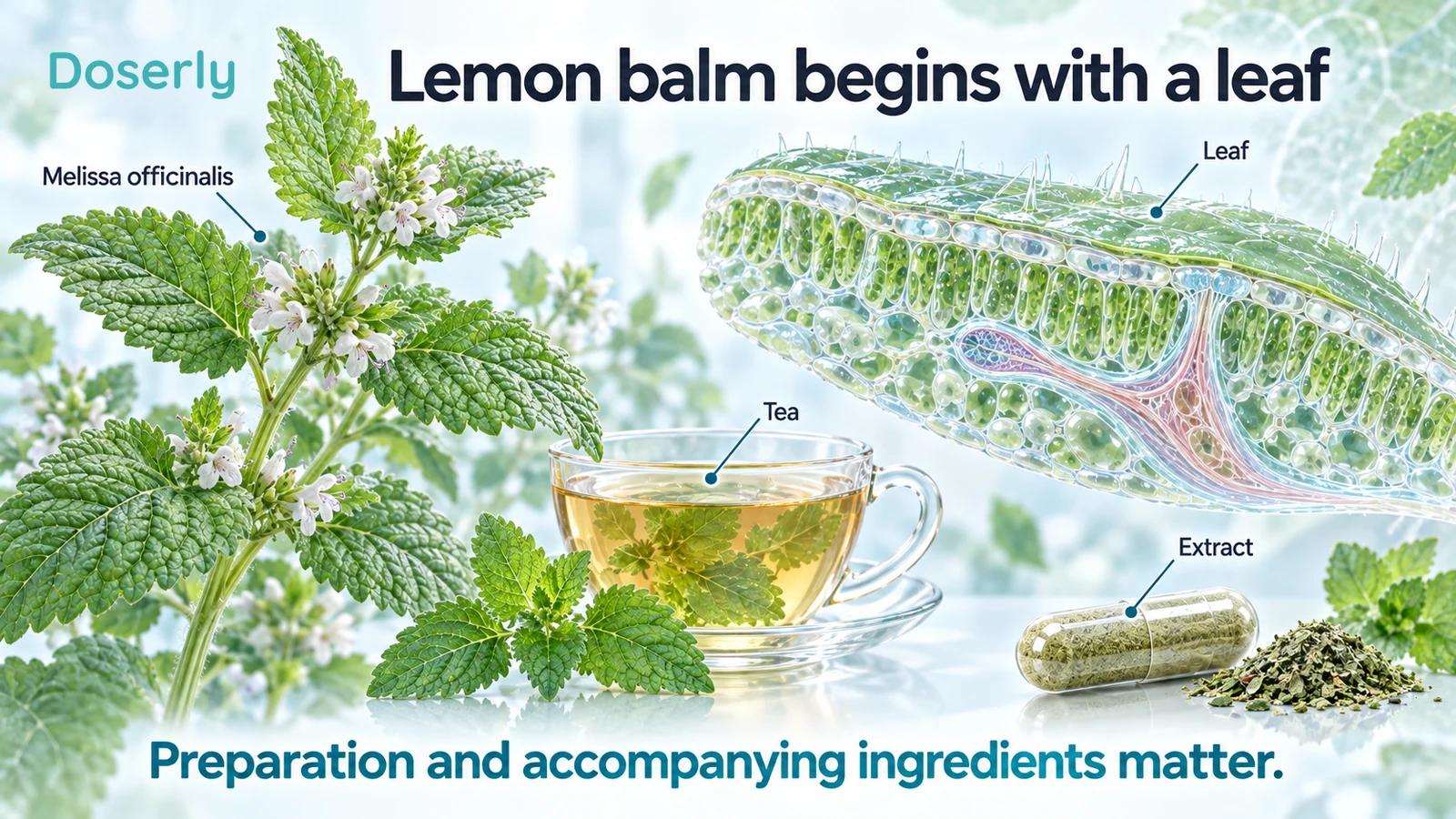
Conceptual botanical illustration of the leaf and preparation types. The image does not establish equivalent chemical content or equivalent effects between tea and an extract.
What did lemon balm alone do during a stress task?
A 2004 randomized, double-blind crossover experiment tested 18 healthy volunteers. On separate days, participants received placebo or a standardized lemon balm extract at 300 or 600 mg. Researchers assessed mood and performance around a demanding 20-minute multitasking exercise, with the post-treatment assessment one hour after ingestion.
At 600 mg, participants reported greater calmness but lower alertness. At 300 mg, mathematical processing became faster without reduced accuracy. These were specific results at different amounts, not a uniform improvement across all outcomes. Kennedy and colleagues, 2004
The study provides a reason to investigate an acute calming effect. It does not establish that daily use treats an anxiety disorder or that the same preparation improves work performance throughout a day. It also makes the tradeoff visible: a state described as calmer may not be the state someone wants before driving, operating equipment or doing demanding mental work.
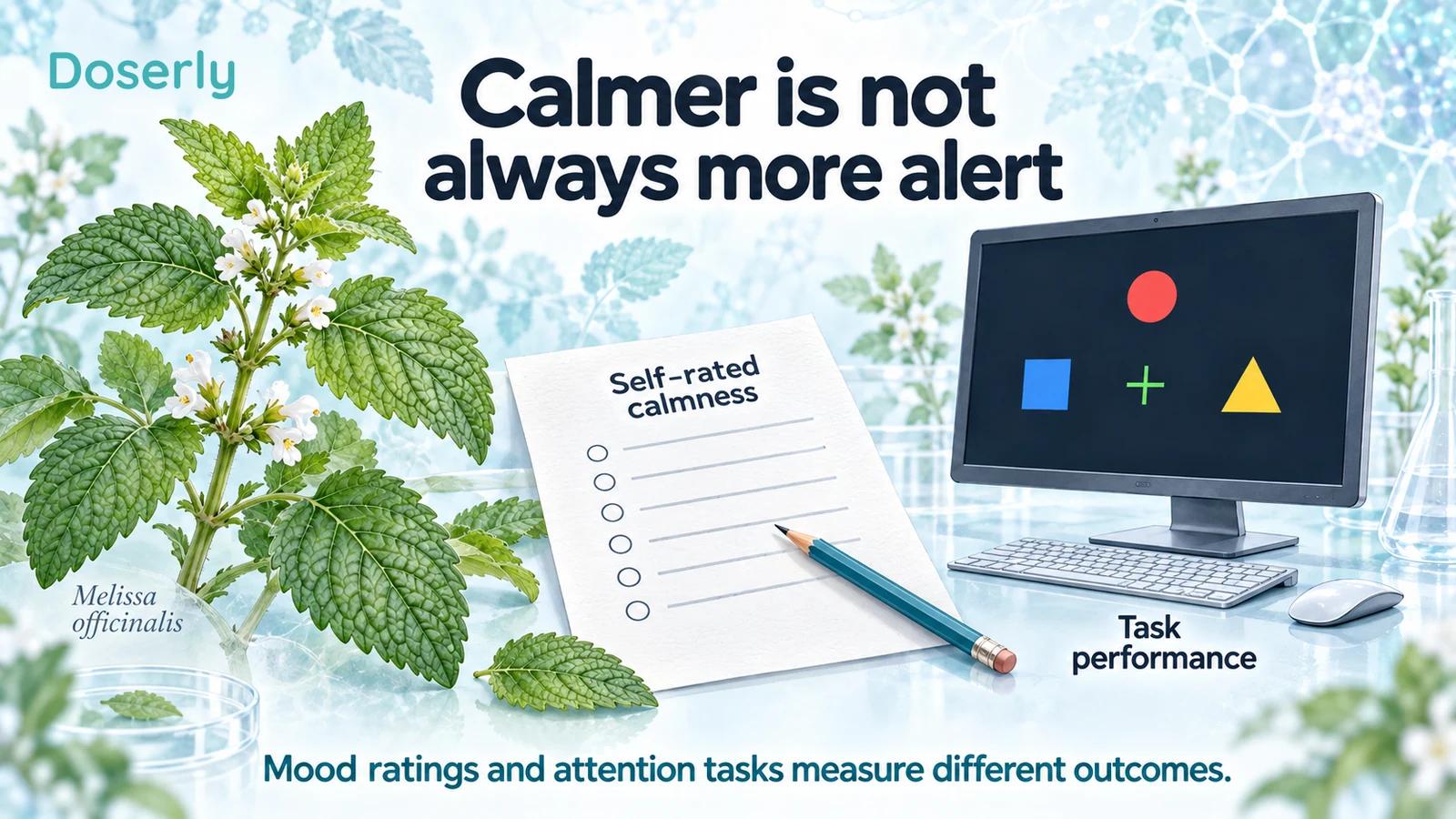
If your goal is to feel less tense while remaining alert, both sides of that experience matter. “Relaxation” is not a single measurement. An intervention could improve one mood rating while leaving another unchanged or making a performance task harder. That is why studies that measure behavior alongside feelings are more informative than those that ask only whether participants felt relaxed.
The valerian combination did not behave like a simple dose ladder
In a 2006 crossover study, 24 healthy volunteers received a lemon balm–valerian combination or placebo on separate days. The three amounts—600, 1,200 and 1,800 mg—referred to the combination, not to lemon balm alone. Researchers repeated laboratory stress assessments over several hours.
The lowest amount reduced anxiety ratings during the task. The highest produced an increase in anxiety at one assessment, and all three amounts worsened performance on the Stroop component, a task involving attention and conflicting information. Some broader performance measures also worsened. Lemon balm–valerian experiment
That pattern does not support a simple “more is more calming” assumption. Nor can it identify which herb produced which effect. Valerian was present in every active condition, and there was no separate lemon-balm-only arm within this comparison.
For someone comparing products, the missing comparison matters. Suppose a blend improves an anxiety score against placebo. That still leaves several possibilities: one ingredient might account for most of the effect, both might contribute, or one might add side effects without additional benefit. A comparison of the blend with each ingredient is needed to distinguish those possibilities.
Synergy is an even more demanding claim. It means the combined effect exceeds what would be expected from the components under a defined model; it is not simply another word for “contains two herbs.” The study above explored the whole product under acute stress and should be described at that level.
A six-week sleep trial tested the blend directly
A 2024 randomized trial studied 64 adults with impaired sleep. The active formulation contained L-theanine together with lemon balm, valerian and saffron extracts. After six weeks, 31 active-treatment participants and 27 placebo participants had completed follow-up. Researchers assessed wrist-actigraphy measurements, sleep questionnaires and other outcomes.
The combination did not improve objective or subjective sleep more than placebo. Mean Pittsburgh Sleep Quality Index scores fell by 3.11 points with the active product and 3.86 with placebo; the difference was not significant. Sleep-efficiency changes also did not significantly differ between groups, with p=0.49. Gutiérrez-Romero and colleagues, 2024
This is a useful trial precisely because it tested a recognizable consumer proposition: several ingredients with calming reputations in one formulation. Improvement over time occurred, but it was not greater with the active blend. Describing only the reduction in the active group's questionnaire score would miss the study's central answer.
The result does not prove lemon balm can never help sleep. A different preparation or population could behave differently. It does show that a plausible ingredient list is not sufficient to predict an added benefit. If your interest is specifically that tested product, its own controlled result is more relevant than positive studies of separate ingredients elsewhere.
What do the longer single-extract studies contribute?
A 2011 pilot followed 20 volunteers with anxiety symptoms and sleep disturbances for 15 days while they took a standardized lemon balm extract. Clinician-rated symptoms improved, but the study was open label and had no placebo group. Participants and researchers knew treatment was being given. Cases and colleagues
The findings helped identify outcomes worth studying. They cannot establish how much improvement was caused by the extract because there was no contemporaneous untreated or placebo comparison. Large response percentages from a small uncontrolled study are especially easy to overinterpret when quoted without the design.
A 2026 report examined a phospholipid-based preparation in 32 adults with poor sleep and/or emotional distress. It compared daily amounts of 200 and 400 mg over three weeks and reported improvements in sleep and psychological measures, with larger changes for some outcomes at the higher amount. This too was an open-label dose-comparison study, without a placebo arm. Melissa phospholipids study, 2026
The presence of two amounts does not remove the need for a control. A dose comparison can explore a pattern, but without blinding and placebo it cannot fully separate treatment effects from expectations and other changes. The authors called for placebo-controlled trials. The findings should therefore be presented as preliminary, not as confirmation that the formulation treats persistent anxiety or insomnia.
Food delivery is another variable, not a trivial detail
A 2014 paper studied lemon balm in beverages and yogurt using controlled crossover experiments in healthy young adults. Mood and cognition were assessed after a multitasking challenge. Some outcomes improved, while others showed behavioral costs, and effects depended partly on the food or drink used to deliver the extract. Anti-stress effects of lemon balm-containing foods
That result is relevant to the many gummies, drinks and powders now presented as interchangeable ways to get the same calming ingredient. The delivery format can be part of the intervention. Taste, accompanying nutrients, preparation and how the product is consumed may differ from a capsule experiment.
It would be premature to use this study to rank every commercial format. Its value is more specific: it shows why researchers describe the food matrix—the material carrying the ingredient—and why a claim should stay attached to what was actually tested. A pleasant drink may be useful as a routine without proving the extract inside it has a particular pharmacological effect.
How to read a calming-product label without overcomplicating it
Start with the full ingredient list, rather than the largest word on the front. If the product contains lemon balm, valerian and several other substances, a trial of lemon balm alone is background information, not a direct test of the product. Conversely, a successful study of that blend would not prove each ingredient's advertised benefit.
Next, identify what the study measured. A single afternoon stress challenge is relevant to an acute response. It is not the same as weeks of reduced worry, fewer nighttime awakenings or better functioning at work. Match the outcome to the problem you want to discuss rather than treating every mention of stress or sleep as interchangeable.
Finally, consider the tradeoff you would find acceptable. A calmer feeling accompanied by reduced alertness may be unhelpful during the day. A product that feels pleasant but leaves persistent sleep impairment unchanged may not be addressing the main problem. Keeping those goals explicit makes it easier to recognize a useful change and to avoid mistaking any noticeable sensation for benefit.
What should come before combining more ingredients?
The EMA assessment recognizes a traditional-use role for melissa leaf; that is a distinct regulatory basis from established efficacy demonstrated through adequate clinical trials. It should not be translated into a guarantee for every modern multi-ingredient supplement. EMA assessment
If you already use medicines or other calming products, ask a pharmacist to assess the actual combination. The small experiments above do not establish the safety of adding several products together, long-term daily use or use in every health condition. Amounts reported here describe research interventions, not a personal regimen.
Persistent anxiety, sleep disruption or reduced daily functioning deserves a clinical assessment, including what the symptoms are, how long they have lasted and what else is being taken. Lemon balm can be part of that conversation. The evidence supports curiosity about specific preparations and outcomes, while leaving much less certainty about broad promises of calm, sharper thinking and better sleep from a single blend.
Sources
- Kennedy et al., 2004: lemon balm and acute laboratory stress
- Kennedy et al., 2006: lemon balm–valerian combination
- Gutiérrez-Romero et al., 2024: four-ingredient sleep trial
- Cases et al., 2011: open-label pilot
- Melissa phospholipids study, 2026
- Scholey et al., 2014: lemon balm-containing foods
- EMA: melissa-leaf traditional-use assessment