
Peptides
October 16, 2026
Weight-loss peptides: why lean mass and muscle are different claims
On this page
When a weight-loss study reports that participants lost lean mass, it is reasonable to wonder what happened to their muscles. Muscle helps you move, lift, maintain balance, and carry out everyday tasks. Preserving those abilities matters while treating obesity.
The first step is to understand the measurement. Lean mass on a body-composition scan is not a direct measurement of skeletal muscle alone, and it is not a strength test. That does not make a decline unimportant. It changes what can accurately be concluded from it.
Semaglutide's STEP 1 trial provides a useful example because its main weight-loss findings and smaller body-composition analysis are often discussed together. We'll separate those results, explain why absolute and relative lean mass can move in opposite directions, and consider what other measurements help describe muscle health. Our semaglutide guide covers the broader medicine and its clinical uses.
What does a body-composition scan measure?
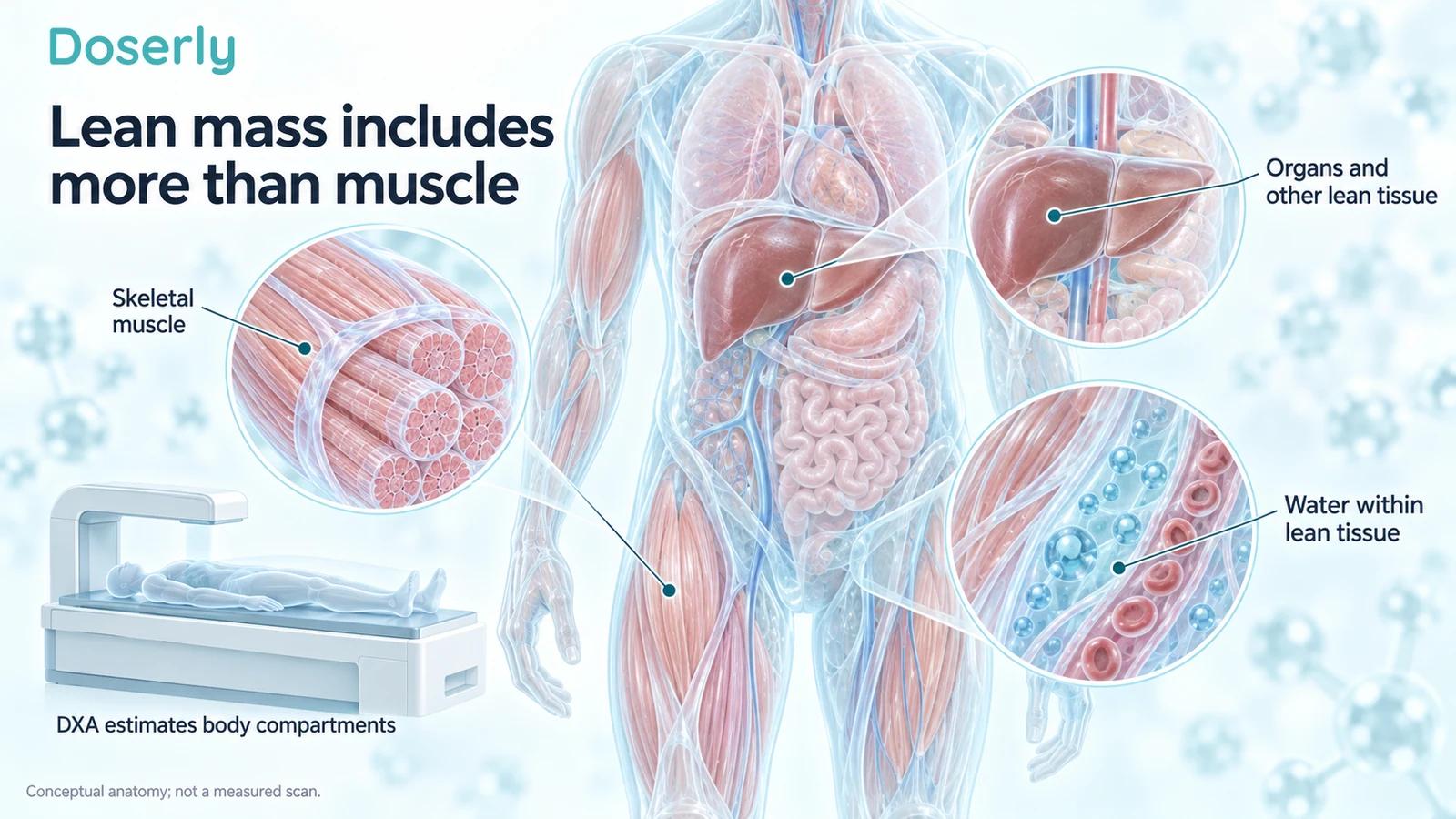
Dual-energy X-ray absorptiometry, usually written DXA or DEXA, estimates body compartments from how tissues attenuate X-rays. Its outputs distinguish fat, lean soft tissue, and bone mineral. The categories are useful, but they are not a microscopic inventory of contractile muscle fibres.
Lean soft tissue includes skeletal muscle as well as organs and other nonfat soft tissues. Water is contained within those tissues and contributes to the measurement. “Fat-free mass” and “lean mass” are sometimes used loosely in public discussion, although their technical definitions and treatment of bone can differ.
Consequently, a change in whole-body lean mass cannot be translated kilogram for kilogram into a loss of muscle protein. More specific imaging and functional measurements are needed to answer more specific muscle questions.
The original SURMOUNT-1 body-composition report discusses this distinction when interpreting DXA findings during weight reduction. Its results describe changes in measured compartments, not a direct assay of muscle strength. SURMOUNT-1 body-composition report
The main STEP 1 result was about body weight
STEP 1 randomized 1,961 adults with overweight or obesity, without diabetes, to semaglutide or placebo alongside lifestyle intervention for 68 weeks. In the main trial, average body-weight change was approximately −14.9% with semaglutide and −2.4% with placebo. Wilding and colleagues, 2021
Those are changes in total body weight. They do not specify how much came from fat, muscle, water, or other tissues. They also describe group averages in a selected trial population, not a prediction for a particular reader.
The trial's principal weight-loss result should therefore be kept separate from a statement about body composition. A person can lose a substantial amount of weight while different compartments change at different rates. Knowing the total is important, but it is only one part of the question.
The participants were not a trial population of lean competitive bodybuilders. Extending these findings to a healthy athlete cutting weight would introduce a different baseline body composition, training context, and clinical purpose.
What the smaller STEP 1 analysis found
An exploratory DXA analysis included 140 participants from nine sites, with a body-mass-index restriction of 40 or below. It was a subgroup of the larger study, not the full 1,961-person population.
At week 68, the semaglutide group had reported reductions of 19.3% in total fat mass and 9.7% in total lean body mass from baseline. At the same time, lean mass as a proportion of total body weight increased by 3.0 percentage points. Original STEP 1 body-composition poster
These figures answer different questions. The percentage reduction describes the change relative to that compartment's starting amount. The percentage-point increase describes its share of the smaller total body weight.
The poster is a primary report of an exploratory analysis, with less methodological detail than a full dedicated trial publication. Its findings support discussion of body composition. They should not be presented as a direct measurement of strength, a diagnosis of sarcopenia, or proof that all measured lean loss was skeletal muscle.
How can lean mass fall while its percentage rises?
The denominator changes. If total weight falls proportionally more than lean mass, lean mass becomes a larger share of the remaining weight even though its absolute amount is lower.
Here is a deliberately simplified arithmetic example, not data from STEP 1. Suppose someone starts at 100 kg with 55 kg classified as lean soft tissue. The lean fraction is 55%. Later, total weight is 85 kg and lean soft tissue is 51 kg. The lean fraction is now 60%.
The person in this example has four fewer kilograms of measured lean tissue and a five-percentage-point higher lean proportion. Both statements are mathematically correct. Neither says how much muscle protein changed or whether the person became stronger.
This is why “a higher proportion of lean mass” should not be shortened to “gained lean mass.” It is also why reporting only the decline can omit a substantial fat reduction. A balanced account names the compartment, the absolute or relative measure, and the clinical question being asked.
“Percent of weight lost” is a third calculation
Another common headline describes how much of the total weight reduction was lean tissue. That is a ratio of two changes: lean-mass loss divided by total weight loss.
It is different from the percentage reduction in lean mass from its own baseline. A 10% reduction in a starting lean compartment does not mean that 10% of the lost weight came from lean tissue.
To calculate the share accurately, the numerator and denominator need to come from compatible measurements in the same population and analysis. Mixing the main trial's average weight change with a different subgroup's body-composition figures can create a deceptively precise result.
Even a correctly calculated share remains a compartment measurement. Calling it “the percentage of weight loss that was muscle” adds a biological interpretation that DXA alone does not support. If the source says lean mass, keeping that wording is both clearer and more accurate.
What tirzepatide adds—and what it does not
The SURMOUNT-1 DXA substudy provides a separate example. It included 160 participants with baseline and end-of-study scans, pooling the tirzepatide treatment groups for the body-composition analysis. Over 72 weeks, fat and lean mass both decreased, with a larger proportional decline in fat mass. SURMOUNT-1 body-composition report
That supports the broader point that substantial weight reduction can include changes in both compartments. It does not establish that tirzepatide and semaglutide have identical effects, nor provide a head-to-head comparison of muscle preservation.
The studies differed in participants, follow-up, analyses, and the medicines themselves. Comparing selected percentages across them is not equivalent to randomizing otherwise comparable people to the two drugs.
For someone choosing treatment, the body-composition literature contributes to a wider discussion of expected benefits, tolerability, nutrition, physical function, and clinical circumstances. A single cross-trial percentage should not carry the whole decision.
Scan conditions can affect the result
Body-composition measurements are estimates taken under particular conditions. Consistency matters when comparing one scan with another.
A study in 31 physically active young adults examined repeated DXA measurements across two days, including repositioning, normal daily activity, and breakfast. Daily activities and food intake changed lean-mass estimates and their variability. Nana and colleagues
This does not mean that every long-term lean-mass change is a measurement artifact. It means that short-term differences need appropriate context and that standardized measurement conditions improve interpretation.
If you have repeated scans, ask whether the same equipment, positioning, preparation, and analysis procedures were used. A report should be interpreted with those details rather than assuming that every small difference reflects newly gained or lost muscle.
The distinction is especially useful when someone posts frequent body-composition screenshots. A precise-looking number can still include ordinary measurement variability. Trends, consistent procedures, and relevant clinical observations are more informative than treating each decimal as a direct tissue count.
Muscle health includes strength and performance
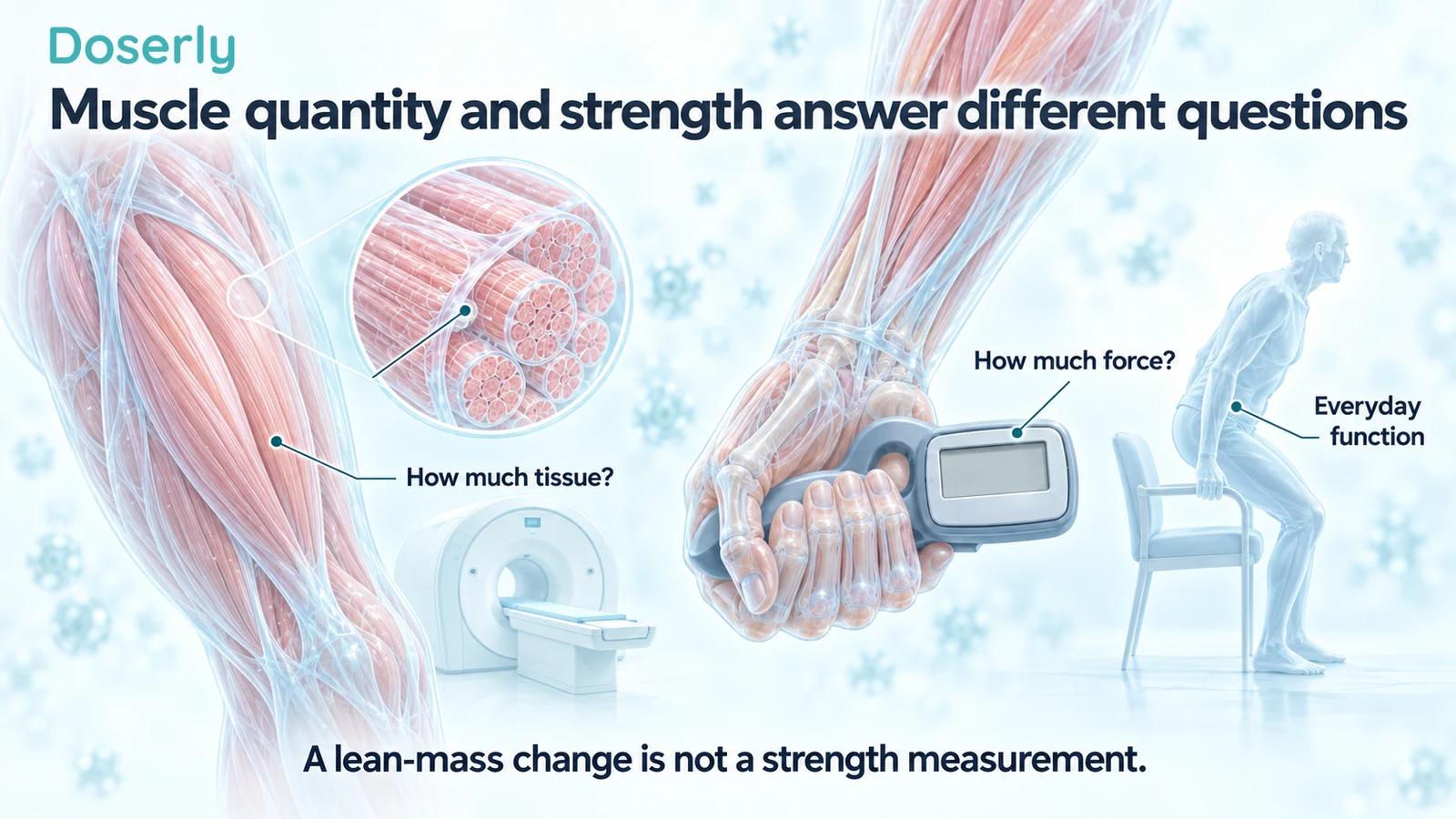
Skeletal muscle has functions that cannot be reduced to mass. Force production, coordination, endurance, pain, and the ability to perform everyday tasks may all affect what a person can do.
The European Working Group's revised sarcopenia consensus places low muscle strength at the centre of identifying probable sarcopenia, uses low muscle quantity or quality to confirm it, and considers physical performance when assessing severity. EWGSOP2 consensus
That framework is not a diagnosis to apply from a social-media scan. It shows why a lean-mass result alone is insufficient to conclude that someone has developed clinically important muscle failure.
A clinician might choose grip strength, a chair-rise assessment, walking performance, or more specific testing depending on the person and the question. A trained athlete and an older adult with mobility limitations may need different assessments. The important point is that function should be measured when the concern is function.
Exercise research offers useful context
A randomized study in 160 older adults with obesity compared weight management combined with aerobic exercise, resistance exercise, or both, alongside a control group. The combination improved physical function more than either exercise mode alone, while resistance-containing approaches better limited lean-mass loss than aerobic training alone. Villareal and colleagues, 2017
This was not a semaglutide or tirzepatide trial. It therefore cannot quantify how much muscle any particular exercise programme preserves during treatment with those medicines. It does show why evaluating the accompanying care matters, rather than considering medication and the scale in isolation.
A suitable plan depends on baseline fitness, limitations, symptoms, and health conditions. Someone struggling to eat adequately or becoming weaker needs an individualized assessment, not a generic instruction to add more training.
The useful clinical aim is to support health and function during weight treatment. Monitoring can include what the person can do, what they can comfortably eat, how treatment is tolerated, and whether the rate and pattern of change remain appropriate.
When a lean-mass result deserves more attention
The same numerical change can have different implications in different people. A person who begins with limited strength, recent illness, or difficulty carrying out daily activities may have less functional reserve than someone without those problems.
A decline accompanied by worsening weakness, difficulty rising from a chair, reduced walking ability, or persistent poor intake deserves discussion with the treating clinician. Those observations do not establish a cause, but they make the concern more specific than a scan percentage alone.
Conversely, feeling better or walking more easily does not prove that all tissue changes are harmless. Improvement in one domain and a concern in another can coexist. The goal is to assess both rather than choosing the most reassuring or alarming number.
Bring the actual report and a description of the change in your daily life. That allows the clinician to consider measurement conditions, nutritional intake, other medicines, and whether further functional or body-composition assessment is useful.
A better way to read the next headline
Before accepting a claim about “muscle loss,” identify the measurement. Was it total body weight, DXA lean mass, a direct muscle imaging measure, or a strength test? Then check whether the number describes change from baseline, change in body-weight proportion, or the share of weight lost.
Next, identify who was studied and whether the result came from the main trial or a smaller exploratory subgroup. Keep those details attached to the number when discussing it.
The available studies support a nuanced conversation: weight-loss treatment can substantially reduce fat mass while measured lean mass also declines. That finding matters, but it is not a complete description of muscle health. Strength, performance, nutritional status, and the individual's clinical goals help determine what it means.
Our semaglutide guide provides the broader treatment context. For the muscle question, the most useful follow-up is specific: what changed in body composition, what changed in function, and what should the care plan do about it?
Sources
- Wilding et al., STEP 1 main trial, 2021 — total weight outcomes.
- King et al., original STEP 1 exploratory DXA poster — 140-participant body-composition analysis.
- SURMOUNT-1 body-composition report, 2025 — separate tirzepatide DXA substudy.
- Nana et al., 2012 — effects of daily activities on DXA measurements.
- EWGSOP2 sarcopenia consensus, 2019 — strength, muscle quantity, and performance.
- Villareal et al., 2017 — exercise modes during weight loss in older adults.