
Peptides
October 16, 2026
Ipamorelin's postoperative trial: what the human study actually found
On this page
Ipamorelin has been studied in people, but one of its most informative published clinical trials asked a question far removed from muscle gain or better sleep. It tested whether intravenous ipamorelin could help hospitalized adults recover gastrointestinal function after bowel surgery.
The trial did not demonstrate a statistically significant advantage over placebo in its key or secondary efficacy analyses. Its safety record also deserves more attention than the short phrase “well tolerated” can provide. Understanding both findings is more useful than treating “human study” as a universal endorsement.
Here we examine why the trial was conducted, what the measured result means, and why it cannot validate fitness claims or a different route of administration. Our ipamorelin guide provides the broader overview of its ghrelin-receptor activity and development history.
Why investigate a growth hormone secretagogue after bowel surgery?
Ipamorelin is a ghrelin-receptor agonist and growth hormone secretagogue. Its development was not limited to the possibility of raising GH. Ghrelin-related signaling also offered a rationale for investigating gastrointestinal movement.
In a rat model of postoperative ileus, researchers performed abdominal surgery and intestinal manipulation, then examined gastrointestinal transit and related recovery measures. Repeated intravenous ipamorelin improved several measured outcomes compared with vehicle, including fecal output and food intake. A single administration did not produce the same pattern across all outcomes. Venkova and colleagues, 2009.
That animal work supplied a testable rationale: a compound with this receptor activity might affect postoperative gut function. It did not establish that the same effect would occur in people, or that the mechanism would improve athletic recovery.
The difference is clinically important. Recovering bowel movement after abdominal surgery is not the same process as repairing muscle after exercise. Using the shared word “recovery” does not make the outcomes interchangeable. The trial needs to be read in the setting its investigators actually studied.
What problem was the trial trying to address?
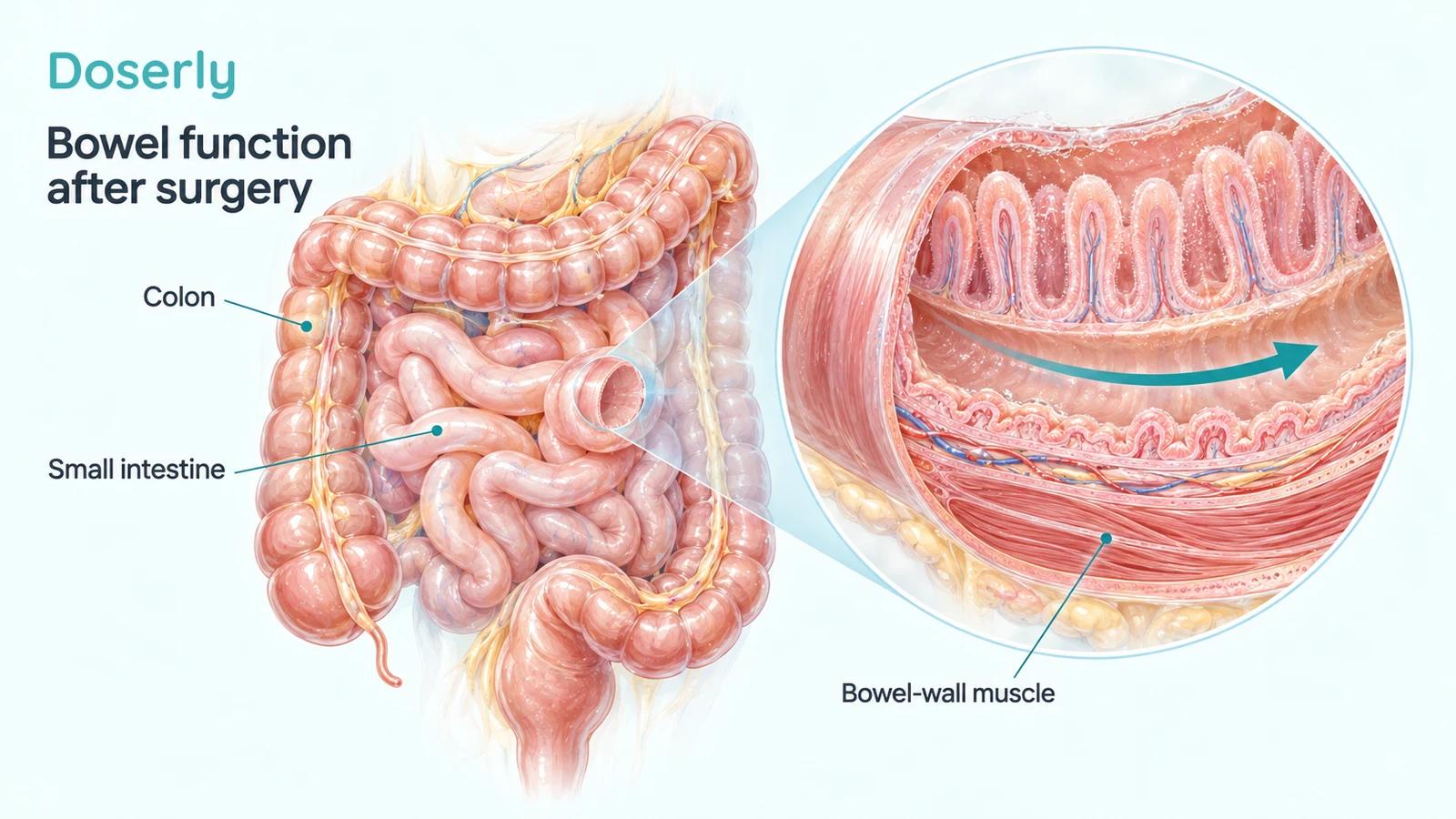
Postoperative ileus refers to impaired return of gastrointestinal movement after surgery. For a patient, the practical issue involves whether the digestive tract can resume useful function, including tolerating food. It is not simply a hormone concentration that can be checked with a blood test.
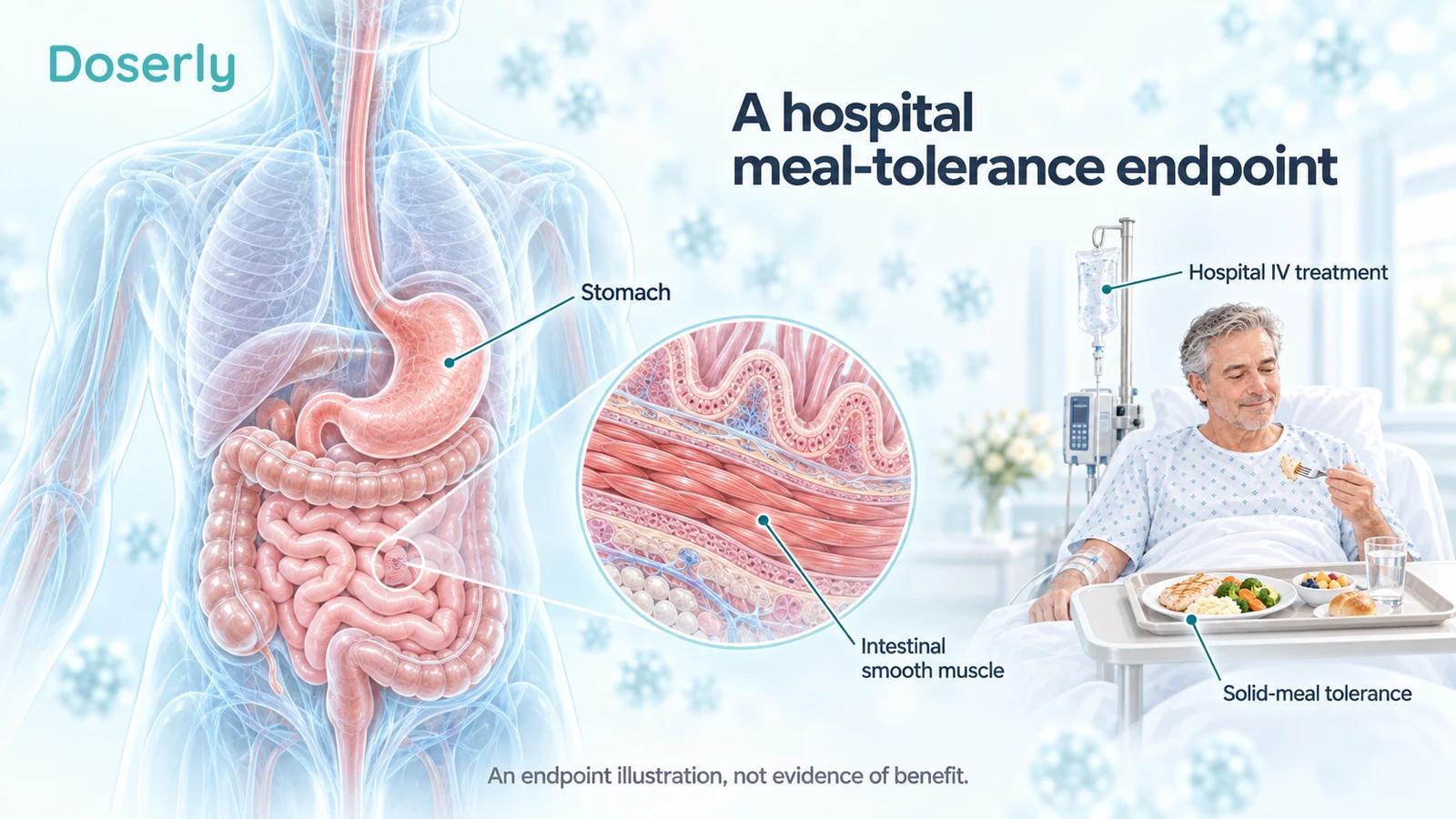
The study therefore chose a patient-relevant measure: time to tolerating a standardized solid meal. That is a more direct clinical question than whether ipamorelin changes GH, but it remains a specific outcome. Meal tolerance does not measure wound strength, muscle growth, sleep quality or every aspect of readiness to leave hospital. A patient can meet this particular milestone while still requiring assessment of other postoperative concerns.
A standardized meal also makes the comparison more interpretable than asking whether someone “felt recovered.” The investigators defined a common event and measured time to it. The usefulness of that design depends on preserving the definition when the result is summarized.
Readers should especially notice where the clock starts. In this trial, the key comparison measured time from the first study-drug dose, rather than total time from the operation. Omitting that detail can make a result appear to describe a different recovery interval. Beck and colleagues, 2014.
Who participated, and how was treatment given?
The published study was a multicenter, randomized, double-blind, placebo-controlled phase 2 trial. It enrolled 117 adults undergoing small- or large-bowel resection by open or laparoscopic surgery; 114 formed the safety and modified intention-to-treat populations. Treatment was administered intravenously twice daily, beginning on postoperative day one and continuing for up to seven days or hospital discharge. Published trial.
Those details define the evidence. The participants were surgical inpatients, the route was intravenous and the observation concerned short-term postoperative care. The trial was not an experiment in healthy people using subcutaneous injections for months.
The registry entry, NCT00672074, confirms the phase 2 design, actual enrollment of 117 and completed status. Its broad registered outcome is recovery of gastrointestinal function; the paper provides the more specific reported meal-tolerance comparison. ClinicalTrials.gov.
The distinction between 117 enrolled and 114 analyzed should also be retained. Neither number is a sample of healthy fitness users. Changing the denominator or removing the surgical context can make the evidence look broader than it was.
What did the meal-tolerance result show?
The median time from first treatment to a tolerated standardized meal was 25.3 hours with ipamorelin and 32.6 hours with placebo. The reported comparison had a p-value of 0.15, and the investigators found no significant differences in the key or secondary efficacy analyses. Beck trial results.
Subtracting the medians produces a 7.3-hour numerical difference. It does not establish that ipamorelin reliably saves each patient that amount of time. Medians describe the center of each group's observed distribution; they do not provide an individual prediction or, by themselves, establish a treatment effect.
This is why “patients ate seven hours sooner” is an incomplete summary. It presents a favorable numerical contrast while dropping the uncertainty in the planned comparison. The appropriate account includes both the observed values and the lack of statistical significance.
The opposite overstatement is also unhelpful. A nonsignificant result is not proof that the true effect is exactly zero. The authors identified the study's small size and the range of underlying conditions as limitations. The result failed to establish benefit under the studied conditions; it did not settle every possible future research question.
For a clinical claim, however, that distinction does not rescue a positive advertisement. A possibility that a larger or different study might find an effect is not the same as evidence that the effect has been demonstrated.
Why the safety summary needs more than one phrase
The paper's abstract described the regimen as well tolerated and reported treatment-emergent adverse events in 87.5% of the ipamorelin group and 94.8% of the placebo group. That aggregate comparison does not show that every type of event was less frequent with ipamorelin, nor does it prove superior safety.
FDA's 2024 review provides additional detail. Serious adverse events occurred in 10 ipamorelin recipients and nine placebo recipients. It also describes higher proportions of low potassium and high glucose findings in the ipamorelin group. Two treated participants died after colon-cancer surgery complicated by leaks at the bowel connection. FDA states that the relationship of the deaths to ipamorelin was unclear, while identifying the findings as safety concerns. FDA ipamorelin briefing document.
This requires careful language. It would be wrong to say that the trial proved ipamorelin caused the deaths. It would also be wrong to remove the deaths from the discussion simply because causation was uncertain. Serious postoperative complications can have multiple possible explanations, and the uncertainty is part of the safety record.
The two descriptions—most participants tolerated the short regimen, and serious events require scrutiny—are not mutually exclusive. A useful benefit-risk account considers severity and type of event, not only the percentage of participants with any event at all.
Why intravenous findings cannot validate a home injection routine
A trial's route of administration is part of the intervention. Intravenous dosing delivers the drug directly into the circulation; a different route introduces different exposure questions. The surgical trial cannot establish equivalence to a product, formulation or schedule that it did not test.
An earlier pharmacokinetic study in healthy men used short intravenous infusions of ipamorelin and measured drug exposure and GH response. It estimated an elimination half-life of about two hours. That is useful pharmacological information, but it is still not a long-term subcutaneous safety or fitness-outcome trial. Gobburu and colleagues, 1999.
Even a matching ingredient name leaves several differences unresolved: formulation, actual identity, route, exposure, population and duration. A proposed combination with another peptide adds another intervention rather than reproducing the single-agent trial.
FDA's current compounding safety information specifically notes limited information for other injectable routes in the context of ipamorelin's intravenous study. It also raises concerns about immunogenicity and peptide-related impurities. These are reasons to preserve the exposure context, not reasons to invent a precise risk estimate for an unstudied regimen. FDA peptide safety information.
Was there a larger postoperative study?
A separate registry entry, NCT01280344, describes a phase 2 dose-finding study after small- or large-bowel resection. It lists an actual enrollment of 320 and a completed status. At the time of this review, the registry did not contain posted results. ClinicalTrials.gov, NCT01280344.
That entry should not be added to the 117-person publication as if both supplied published positive efficacy results. Registration and completion describe a study's existence and progress. They do not tell us that its primary endpoint succeeded.
The lack of posted results in this registry also should not be converted into a claim that no data were ever collected or that the result was necessarily unfavorable. Those are different assertions. The defensible conclusion is that the accessible registry does not provide a result that can validate the claim being made.
For a reader encountering an impressive total participant count, this distinction is useful. Ask which study reported which outcome. A program can contain several studies while only part of its outcome evidence is publicly available in an interpretable form.
What belongs in real postoperative recovery care?
Bowel recovery takes place within a broader surgical-care plan. The ASCRS and SAGES enhanced-recovery guideline addresses coordinated care, including pain management, mobility, fluid management and feeding. For elective colorectal surgery, it recommends offering a regular diet within 24 hours, with care adapted to the patient's clinical circumstances. ASCRS/SAGES enhanced-recovery guideline.
That context helps explain why the rest of a trial's care matters. A drug is tested alongside surgery, anesthesia and postoperative management. Differences in those practices can affect how a result applies elsewhere. A peptide does not become a complete recovery strategy because it has a plausible effect on motility.
For someone currently recovering from surgery, the surgical team's instructions should guide eating, medications and activity. Difficulty tolerating food or a change in recovery needs clinical assessment; this trial is not a basis for adding ipamorelin independently. The article's purpose is to explain the evidence, not to replace a postoperative plan with an experimental intervention.
What this trial can—and cannot—contribute to the discussion
The study is valuable precisely because it tested a defined human clinical question. It provides information about a short intravenous regimen in surgical patients, a specific meal-tolerance endpoint and observed adverse events. Those facts are more concrete than an unspecified claim that ipamorelin has been “clinically tested.”
It did not establish a significant improvement in the reported efficacy comparisons. It did not test muscle gain, sleep enhancement or general rejuvenation. Its safety findings cannot be transferred unchanged to healthy people using a different route for longer periods, and uncertainty about causation does not justify omitting serious events.
A fair reading therefore keeps the clinical setting, efficacy result and safety uncertainty together. The postoperative program offers a real piece of ipamorelin's human research history. It offers no shortcut around the need for separate evidence when the product, population or promised benefit changes.
Explore the research
- Published postoperative ipamorelin trial
- Original 117-participant study registry
- Later 320-participant study registry
- Rat postoperative-ileus experiment
- Human intravenous pharmacokinetics
- FDA ipamorelin scientific review
- FDA peptide safety information
- ASCRS/SAGES postoperative enhanced-recovery guideline