
Peptides
October 16, 2026
Ipamorelin is called selective: what was it selective for?
On this page
Ipamorelin is a synthetic peptide that can stimulate the release of growth hormone. It is often described as “selective,” a word that sounds reassuring if you are wondering about unwanted hormonal effects. The useful question is what the researchers selected for, what they compared it with, and which outcomes they actually measured.
The original answer was specific. In animal experiments, ipamorelin stimulated growth hormone while producing an ACTH and cortisol response that resembled growth hormone–releasing hormone more closely than two other growth hormone–releasing peptides did. That was an interesting pharmacological finding. It was not a demonstration that ipamorelin acts only on muscle, cannot affect appetite or blood sugar, or is safe for months of use in people. Original selectivity study.
Understanding the distinction lets you keep the real finding without stretching it into a promise. It also explains why later researchers studied ipamorelin for bowel recovery after surgery, an application that may seem surprising if you first encountered it through fitness discussions.
Start with the hormones being compared
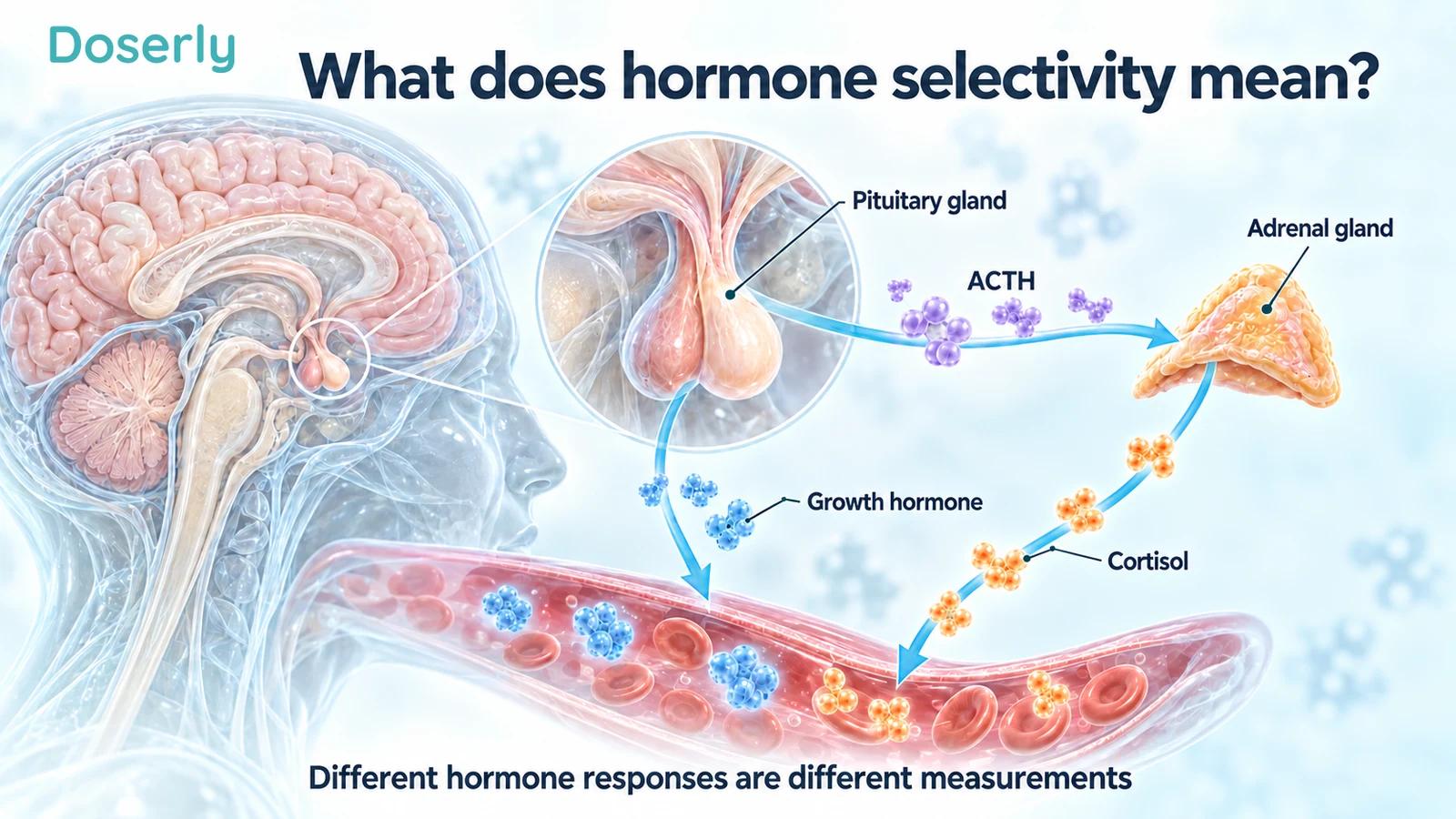
Growth hormone, often shortened to GH, is released by the pituitary gland at the base of the brain. The gland responds to several signals, including growth hormone–releasing hormone, or GHRH. A secretagogue is a substance that stimulates a cell or gland to release something. Calling ipamorelin a GH secretagogue describes an observed hormonal action.
The pituitary produces other hormones too. Adrenocorticotropic hormone, usually called ACTH, signals the adrenal glands, which sit above the kidneys. Those glands produce cortisol. ACTH and cortisol belong to a different hormonal system from GH, even though researchers can measure all three in blood.
A compound that raises GH could therefore have more than one endocrine effect. Scientists developing secretagogues wanted to know whether GH release could be separated from stimulation of ACTH and cortisol. That question was central to the original ipamorelin work. The study used cell experiments and animals to characterize how the compound behaved. It did not begin as a trial of better sleep, recovery or healthy aging. Raun and colleagues.
What did “selective” mean in the original paper?
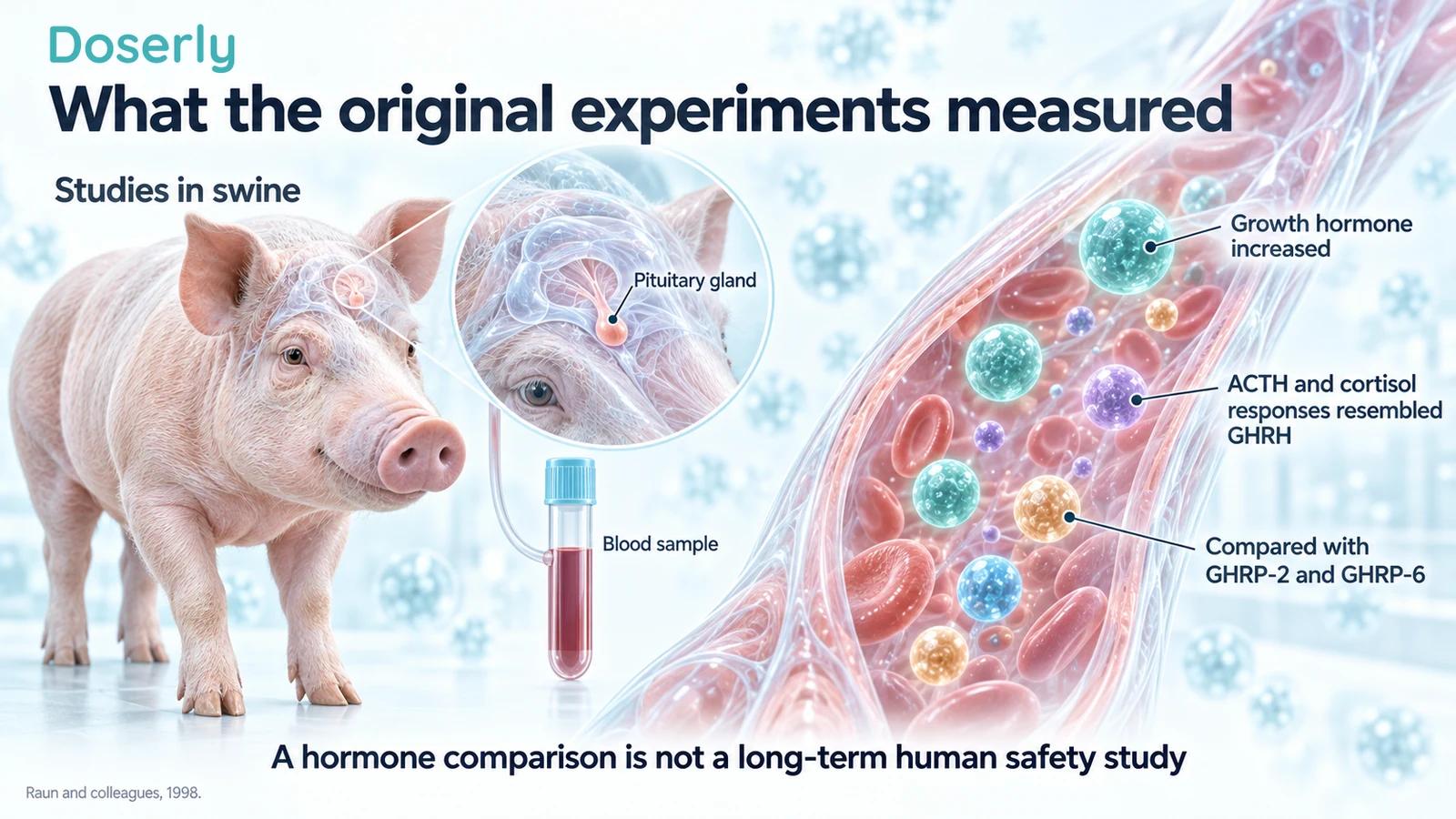
The 1998 paper described ipamorelin as a five–amino acid peptide. Researchers tested GH release from rat pituitary cells, then studied hormonal responses in rats and conscious swine. Its GH-releasing activity was compared with established experimental peptides, including GHRP-6 and GHRP-2.
The important selectivity experiments were in swine. GHRP-2 and GHRP-6 increased ACTH and cortisol. Ipamorelin did not increase those hormones to levels significantly different from the response after GHRH. None of the secretagogues tested changed the measured FSH, LH, prolactin or TSH levels in that comparison. That last point matters: the study does not support presenting every unchanged hormone as a special advantage unique to ipamorelin.
The researchers also examined high exposures relative to the amount needed to stimulate GH. Even there, the ACTH and cortisol pattern remained distinct from the other GHRPs. That supports the experimental characterization of selectivity. It does not provide a dose conversion or safety margin for someone injecting a different formulation under the skin. Original experimental report.
Notice the wording: “not significantly different from GHRH” is a comparison between responses. It is not identical to “zero cortisol under every circumstance.” The distinction is especially important when an acute animal experiment becomes a broad statement about chronic human treatment.
Selective receptor action and selective outcomes are different ideas
You may encounter selectivity discussed at two levels. One concerns which receptor a compound activates. A receptor is a protein that receives a chemical signal and starts a response inside a cell. The other concerns which changes appear when researchers measure an animal or person.
These descriptions are related, but they answer different questions. A receptor can participate in several biological functions. Activating that receptor does not mean that only one organ or one clinically desirable response will be affected. A drug can also have downstream effects through the hormone it successfully releases.
Ipamorelin is discussed as an agonist of the ghrelin receptor: it activates a receptor involved in ghrelin signaling. Ghrelin biology includes appetite and gastrointestinal function as well as GH release. A human experiment giving ghrelin itself, for example, measured increased food intake during an infusion. That supports the broader biological role of the pathway; it does not tell us the size of an appetite response to ipamorelin. Human ghrelin experiment.
This is why “selective” needs a noun after it. Selective for a particular receptor, selective for a measured hormone response, and selectively beneficial for a person's goal are different claims. Only the first two can be addressed by the kinds of experiments usually quoted in ipamorelin marketing.
What has been measured directly in people?
A 1999 pharmacology study administered ipamorelin intravenously to healthy male volunteers. There were five dose levels, with eight men at each level. Researchers measured the compound in blood and the accompanying GH response. They estimated a terminal half-life of about two hours and observed a GH peak around 0.67 hours after administration. Human pharmacokinetic study.
Those findings establish that ipamorelin can provoke a measurable GH response in people under those conditions. They also help describe how exposure changes over time. They do not measure muscle growth, recovery from training, sleep quality or long-term glucose control. A short pharmacology study can answer its own question well while leaving those other questions open.
The route is part of the result. Intravenous administration places a drug directly into circulation. A product injected under the skin must first be absorbed, and a different formulation may behave differently. The two-hour figure should therefore not be turned into a validated timetable for a self-designed regimen. It describes the studied exposure, not an established treatment schedule for wellness.
A later human study examined a clinical problem: recovery of bowel function after surgery. That takes us beyond hormone measurements, but into a very different population from healthy adults seeking body-composition changes.
Why was a “selective GH peptide” studied for bowel recovery?
After abdominal surgery, the bowel can temporarily move food and gas poorly. Researchers investigated whether activating the ghrelin pathway could help restore gastrointestinal function. This is a reminder that the biological system does more than release GH.
In the randomized phase 2 ipamorelin trial, 117 patients were enrolled and 114 were included in the safety and modified intention-to-treat populations. Treatment was intravenous, given during the early postoperative period for up to seven days or discharge. The main efficacy measure was time to tolerate a standardized solid meal.
Median times were 25.3 hours with ipamorelin and 32.6 hours with placebo. The difference did not meet statistical significance, with p=0.15, and the paper reported no significant differences in the key or secondary efficacy analyses. Postoperative trial.
The study therefore did not establish the proposed bowel-recovery benefit. It also did not test fitness claims. Its value here is in showing the difference between a peptide's hormonal description and the clinical outcomes that still require direct investigation.
Does the label rule out appetite or fat effects?
It does not. One relevant animal experiment compared ipamorelin and GH in mice with different GH backgrounds. Ipamorelin increased fat-related measures, including relative fat-pad weights, and the authors concluded that GH secretagogues could increase adiposity through mechanisms not dependent on GH. Increased feeding was one possible contributor. Mouse adiposity study.
This does not mean that ipamorelin inevitably causes fat gain in humans. Mice, exposure patterns and experimental conditions differ from ordinary clinical use. But it does show why the statement “it releases GH selectively, therefore every effect must be a GH effect” is too simple.
It also prevents an equally tempting shortcut: assuming that a compound associated with GH must reduce body fat. A net change in weight or body composition reflects several processes. Hormone release, food intake, fluid balance and tissue changes are distinct measurements. The result cannot be predicted from the name of the pathway alone.
For someone considering a peptide because of unwanted weight gain, a human trial measuring body composition would be much more informative than an animal endocrine comparison. The available selectivity finding does not substitute for that trial.
What safety questions remain outside the original comparison?
The original hormone panel did not address product quality, immune reactions, injection complications, delayed adverse effects or the consequences of repeated GH-axis stimulation. A cortisol result cannot rule out problems that have nothing to do with cortisol.
FDA's ipamorelin assessment identifies limited human evidence and important gaps in information for proposed subcutaneous use. It also discusses peptide aggregation and impurities as potential contributors to immune responses. These are concerns about the product and its administration as well as about the intended molecular action. FDA briefing; FDA safety-risk information.
Safety findings from the postoperative trial require context too. Serious events occurred in patients recovering from major surgery, including two deaths among ipamorelin recipients. FDA states that it is unclear whether those deaths were related to ipamorelin. It would be wrong either to claim that the drug caused them or to omit them while describing the trial as proof of safety. FDA review of the clinical study.
The reasonable conclusion is narrower: the available studies do not establish a reliable long-term safety profile for wellness use. That is an evidence gap, not a quantified prediction of harm for a particular person.
How to discuss a selectivity claim without losing the useful science
If a clinician or product description uses the word selective, ask which comparison supports it. The answer may be entirely reasonable: a particular paper measured GH, ACTH and cortisol and found a different response pattern from other secretagogues. That is much more informative than an unexplained claim that a peptide is “clean.”
Then connect the discussion to your actual goal. If you want better sleep, the relevant outcomes include time asleep, awakenings and daytime functioning. If you want stronger muscles, the outcomes include strength and physical performance. A blood hormone response may help explain how a treatment could work, but it does not tell you whether those goals improve.
It is also worth separating the molecule from the product being offered. The name ipamorelin does not establish that a formulation, route or combination matches a clinical study. Ask what was tested, how long participants were followed and what monitoring was used.
A dated symptom and medication record can help make a clinical conversation more specific. It should not be treated as a home experiment proving that a peptide is safe or effective. The useful purpose is to describe changes accurately and identify questions that need medical evaluation.
What can you reasonably take from the term?
Ipamorelin's selectivity is a real experimental observation with a defined setting. It concerns the relationship between GH release and certain other hormonal responses, especially ACTH and cortisol, in the original animal comparisons.
The term cannot carry all the claims sometimes attached to it. It does not establish appetite neutrality, muscle gain, better sleep, absence of glucose effects or long-term safety. Those are separate clinical questions, and some involve effects that would remain relevant even if the original endocrine finding were reproduced perfectly in people.
For a broader explanation of its receptor biology and human research, the Doserly ipamorelin guide brings those topics together. When considering any proposed use, begin with the problem you want to improve and the evidence that directly addresses it.
Explore the research
- Ipamorelin, the first selective growth hormone secretagogue (1998): Abstract reviewed; animal responses do not establish human safety.
- Pharmacokinetic-pharmacodynamic modeling of ipamorelin, a growth hormone releasing peptide, in human volunteers (1999): Acute intravenous study; no chronic sleep or muscle efficacy endpoints.
- Growth hormone (GH)-independent stimulation of adiposity by GH secretagogues (2001): Mouse study; cannot estimate human appetite or body-composition effects.
- Ghrelin enhances appetite and increases food intake in humans (2001): Ghrelin, not ipamorelin; acute small study.
- Prospective, randomized, controlled, proof-of-concept study of the Ghrelin mimetic ipamorelin for the management of postoperative ileus in bowel resection patients (2014): Abstract via Europe PMC freshly reviewed; full safety details cross-checked against FDA; small heterogeneous surgical sample.
- FDA Briefing Document: Ipamorelin-Related Bulk Drug Substances, October 29, 2024 (2024): Advisory briefing, not itself a final legal determination; safety events do not prove causality.
- Certain Bulk Drug Substances for Use in Compounding that May Present Significant Safety Risks (2026): Dynamic regulatory page; not a quantitative individual risk estimate.