
Peptides
October 16, 2026
Ipamorelin and muscle gain: what has actually been measured?
On this page
Ipamorelin can stimulate growth hormone release. That gives researchers a reason to investigate effects on tissues influenced by the GH system, including muscle. It does not tell us how much muscle someone will gain, whether they will become stronger, or whether the benefits would outweigh unwanted effects.
For a reader interested in training or preserving strength with age, the important gap is straightforward: the main published human ipamorelin studies reviewed here measured short-term hormone responses and postoperative bowel recovery, not a sustained muscle-building benefit. Human hormone study; clinical bowel-recovery trial.
There are relevant animal findings and human trials of other GH-related treatments. These can explain why the question remains scientifically interesting. They also show why “more growth hormone,” “more lean mass” and “better muscle function” should not be used as interchangeable results.
What would meaningful muscle gain look like?
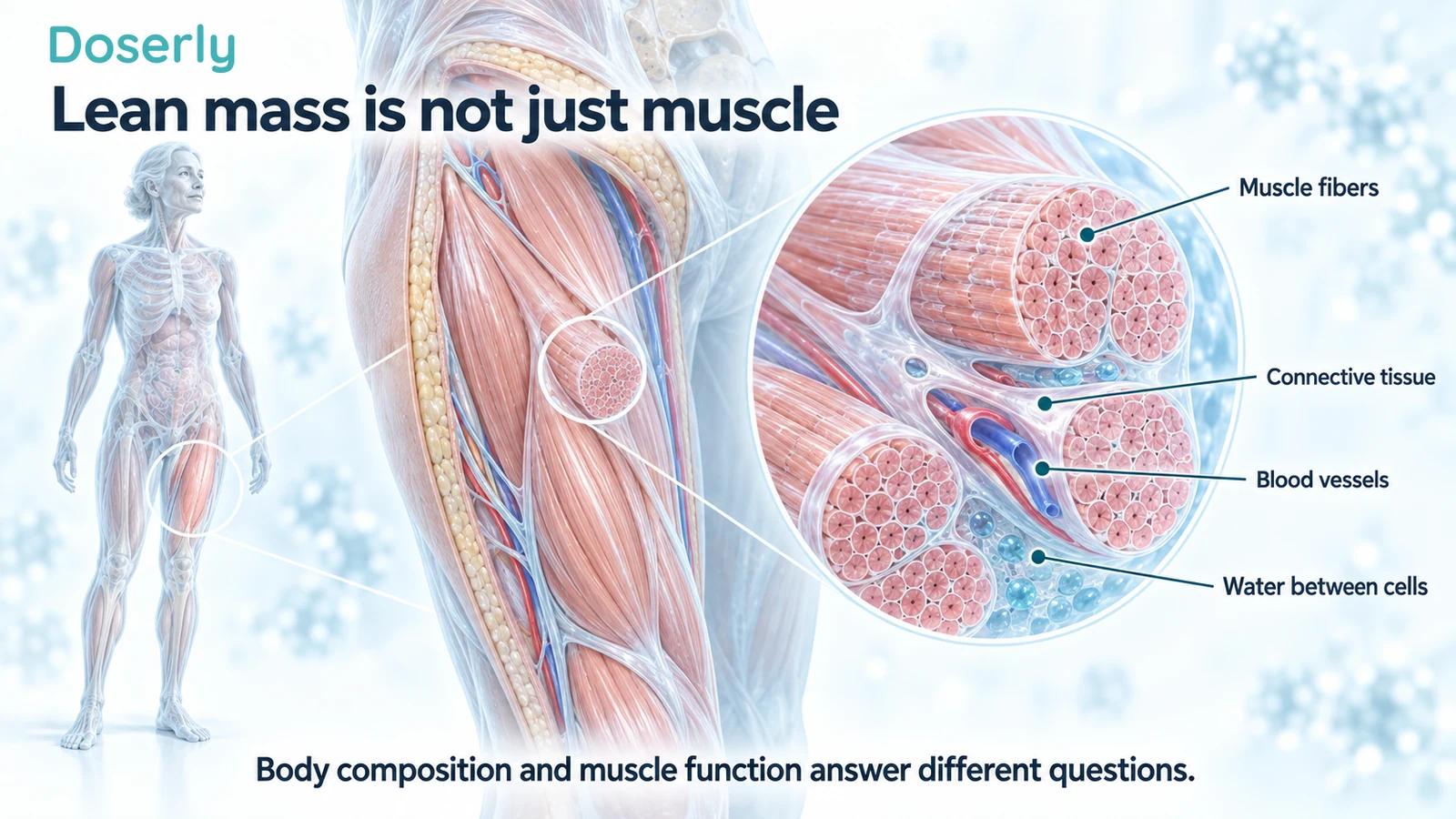
Muscle gain usually means an increase in skeletal muscle tissue, particularly the fibers that produce force. Researchers can examine muscle size using imaging, study tissue samples, and measure physical performance. Each approach contributes a different part of the answer.
Fat-free mass is broader. It includes body components other than fat, including water and tissues that are not skeletal muscle. A change in this measurement can be real without representing the same amount of new contractile muscle.
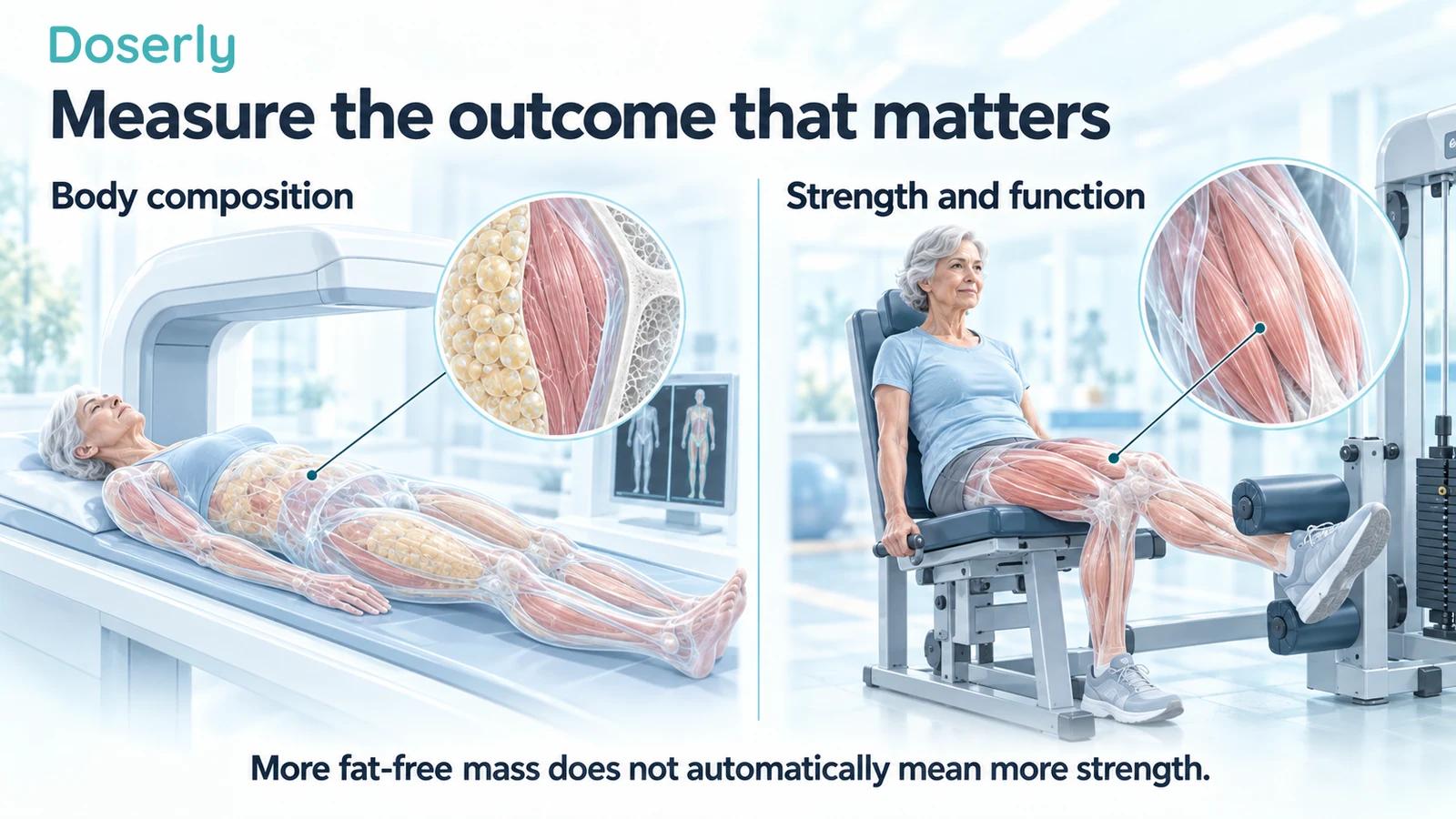
Strength adds another dimension. It depends on muscle as well as neural coordination, technique, pain, motivation and the specific test. Physical function is broader still: climbing stairs, getting out of a chair or carrying groceries may matter more to someone than a change on a scan.
These are not abstract distinctions. Human GH trials have found changes in body composition without matching improvements in several muscle outcomes. That is why a claim about gaining muscle should identify what was actually measured. Resistance-training trial.
What does the direct human ipamorelin evidence show?
The pharmacology study in healthy men demonstrated GH release following intravenous ipamorelin. Its purpose was to describe how exposure and hormonal response changed over time. It did not follow a resistance-training program or measure whether participants gained muscle over months. Gobburu and colleagues.
The later phase 2 trial involved patients after bowel surgery. That is a clinically important population, but the study focused on gastrointestinal recovery during a short postoperative treatment period. It did not test ipamorelin as an intervention for sarcopenia, the age-associated loss of muscle and function, or as an aid to athletic hypertrophy. Beck and colleagues.
FDA's review similarly identified major gaps in clinical evidence for proposed ipamorelin uses and routes. Its assessment does not supply a human muscle-gain effect size that the published studies omitted. FDA briefing.
Therefore, a specific promise such as gaining a certain amount of muscle in a certain number of weeks cannot be derived from these studies. The hormonal mechanism may be plausible, but the size, reliability and durability of a clinical benefit remain unestablished.
The rat strength study addressed a particular injury model
One ipamorelin experiment examined adult female rats receiving a glucocorticoid, methylprednisolone. Glucocorticoids can create a catabolic setting: a state favoring tissue breakdown. The investigators studied whether ipamorelin could counteract reductions in muscle performance and bone formation during three months of treatment.
The combined-treatment group had greater maximal calf-muscle tension and greater bone-formation activity than the group receiving the glucocorticoid alone. This was a measured preclinical result, not simply a proposed pathway. Rat muscle and bone study.
But the question was recovery from an experimentally imposed drug effect in rats. It was not whether healthy adults following a training program build more muscle with ipamorelin. Preventing loss under a specific injury condition and increasing performance beyond an otherwise healthy baseline are different goals.
Even a strong animal result cannot determine the appropriate human exposure, the long-term risks, or the expected benefit in a different setting. The study supports further investigation of a defined biological question. It does not provide a bodybuilding protocol.
A separate mouse study complicates the fat-loss story
Another experiment compared GH and ipamorelin in mice with different GH backgrounds. The investigators found increased adiposity with GH secretagogue treatment, including changes in fat-pad weights and body-fat measurements. They concluded that some effects could occur independently of GH, potentially involving increased feeding. Mouse adiposity study.
This should not be converted into a claim that humans taking ipamorelin will necessarily gain fat. It is useful for a more limited reason: it challenges the assumption that every consequence of a GH secretagogue must match the expected consequences of GH itself.
For someone pursuing “recomposition,” or more muscle with less fat, both sides of that goal need measurement. An increase in body weight alone cannot identify what changed. A hormone response alone cannot tell us whether appetite, fat mass, muscle tissue or fluid balance moved in a favorable direction.
That makes direct human body-composition studies especially important. Without them, the expected net result remains uncertain.
What a larger MK-677 trial teaches about lean mass
MK-677 is an oral ghrelin mimetic, not ipamorelin. A randomized trial enrolled 65 healthy adults aged 60–81 and assessed body composition and other outcomes. The primary body-composition comparisons were made after one year.
Fat-free mass increased by an average of 1.1 kg with MK-677 and decreased by 0.5 kg with placebo. Despite that difference, the study did not demonstrate improved strength or function. Its authors noted that the trial was insufficiently powered to evaluate functional outcomes conclusively. MK-677 trial.
This means two things can be true together. A treatment can produce a statistically clear change in a body-composition measure, while the evidence for a practical strength benefit remains uncertain. It would be inaccurate either to advertise the mass change as proven functional rejuvenation or to say the study proved that functional improvement is impossible.
The trial also recorded increased appetite, transient swelling and muscle pain, and changes in glucose regulation. Those are findings about MK-677. They are not numerical predictions of ipamorelin risk, but they illustrate why benefit and tolerability should be measured together rather than inferred from a rise in GH.
Injected GH is another useful comparison, with its own limits
A 12-week randomized study assigned 16 young men to resistance training with GH or with placebo. Fat-free mass and total body water increased more in the GH group, but the added hormone did not produce greater gains in the measured muscle size, strength or quadriceps protein-synthesis outcomes. Yarasheski and colleagues.
The result helps explain why a bigger body-composition number does not necessarily mean more muscle-building benefit from a training program. The researchers measured the training outcomes directly rather than assuming they followed from hormone exposure.
A separate eight-week randomized trial studied 96 recreational athletes. GH increased lean body mass through increased extracellular water and improved a laboratory measure of sprint capacity; other performance measures did not significantly change. The sprint effect was not maintained six weeks after discontinuation. Athlete trial.
That finding should not be flattened into “GH never affects performance.” It also should not be generalized into broad strength, endurance or ipamorelin claims. Different outcomes can respond differently, and a drug's effect on one performance test does not establish improvement across all athletic tasks.
Why an IGF-1 increase cannot settle the question
Insulin-like growth factor 1, or IGF-1, is part of the GH signaling system. A clinician may use it to help assess endocrine activity in an appropriate clinical context. It is not a direct measurement of how much new muscle a person has built.
A higher laboratory value can show that the endocrine system responded to treatment. To establish that the response predicts muscle gain, investigators would need to demonstrate a reliable relationship between that change and meaningful muscle outcomes in the relevant population.
The related-drug studies above show why that extra step matters. Hormone changes, body-composition changes and functional outcomes did not move in a simple one-to-one relationship. The appropriate clinical target cannot therefore be reduced to maximizing a laboratory result.
For someone with a suspected endocrine disorder, interpretation also depends on the overall clinical assessment. A healthy older adult with an age-related change is not automatically equivalent to a patient with established pituitary disease.
Why personal progress can be difficult to attribute
Imagine someone who starts ipamorelin during a new strength program and gains weight while lifting more. Several explanations may contribute: training adaptation, greater food intake, changes in fluid balance, technique improvements or the proposed treatment. Observing them together does not separate their contributions.
That is why controlled trials keep background training and assessment as comparable as possible. A well-designed study can ask whether the peptide adds something beyond what the control group achieves under similar conditions.
A personal record remains useful, but its purpose is narrower. Training loads, symptoms, body weight and clinician-ordered measurements can help describe what happened. They cannot establish a reliable drug effect or rule out delayed adverse effects.
Adding another peptide or hormone makes attribution more difficult still. Evidence for one component does not establish that a combination produces the same benefit, a larger benefit or acceptable combined risk.
What a useful ipamorelin muscle trial would need
The first decision would be who needs treatment. Healthy trained adults, older people with weakness and patients recovering from a catabolic illness are different populations. They may have different capacities for improvement and different risks.
The study would then need a prespecified primary outcome. Muscle volume, strength and physical function could all be relevant, but choosing the outcome before examining results reduces the temptation to highlight whichever measure happens to look favorable.
An appropriate comparison would also account for exercise and nutrition. If one group trains more consistently or eats substantially differently, the trial cannot cleanly attribute the result to the peptide. Follow-up should be long enough to distinguish transient fluid changes from sustained tissue and functional changes.
Safety assessment would need to accompany those outcomes. The uncertainties FDA identified for ipamorelin formulations and routes cannot be resolved by a promising mechanism or an unrelated drug's trial. FDA assessment.
Bringing the question back to your goal
If your concern is declining strength, begin by describing the limitation: stairs, lifting, walking speed or a specific activity. If your goal is training progress, distinguish changes in body size from changes in performance. That makes it easier to discuss evidence that addresses the outcome you actually value.
The existing literature does not establish ipamorelin as a proven muscle-building treatment in humans. Its hormone response is documented, and certain animal experiments are informative, but the practical benefit remains a separate unanswered question.
The Doserly ipamorelin guide provides the broader context on its biology and human studies. When evaluating a muscle claim, the most useful question is simple: what improved in people, and how was it measured?
Explore the research
- Pharmacokinetic-pharmacodynamic modeling of ipamorelin, a growth hormone releasing peptide, in human volunteers (1999): Acute intravenous study; no chronic sleep or muscle efficacy endpoints.
- Prospective, randomized, controlled, proof-of-concept study of the Ghrelin mimetic ipamorelin for the management of postoperative ileus in bowel resection patients (2014): Abstract via Europe PMC freshly reviewed; full safety details cross-checked against FDA; small heterogeneous surgical sample.
- Growth hormone (GH)-independent stimulation of adiposity by GH secretagogues (2001): Mouse study; cannot estimate human appetite or body-composition effects.
- The growth hormone secretagogue ipamorelin counteracts glucocorticoid-induced decrease in bone formation of adult rats (2001): Glucocorticoid-injured rat model, not healthy human hypertrophy.
- Effects of an oral ghrelin mimetic on body composition and clinical outcomes in healthy older adults: a randomized trial (2008): MK-677, not ipamorelin; functional outcomes underpowered.
- The effects of growth hormone on body composition and physical performance in recreational athletes: a randomized trial (2010): Injected GH, not ipamorelin; too small to establish safety.
- Effect of growth hormone and resistance exercise on muscle growth in young men (1992): Small trial of GH rather than ipamorelin.
- FDA Briefing Document: Ipamorelin-Related Bulk Drug Substances, October 29, 2024 (2024): Advisory briefing, not itself a final legal determination; safety events do not prove causality.