
Peptides
October 16, 2026
Ipamorelin and appetite: ghrelin biology goes beyond growth hormone
On this page
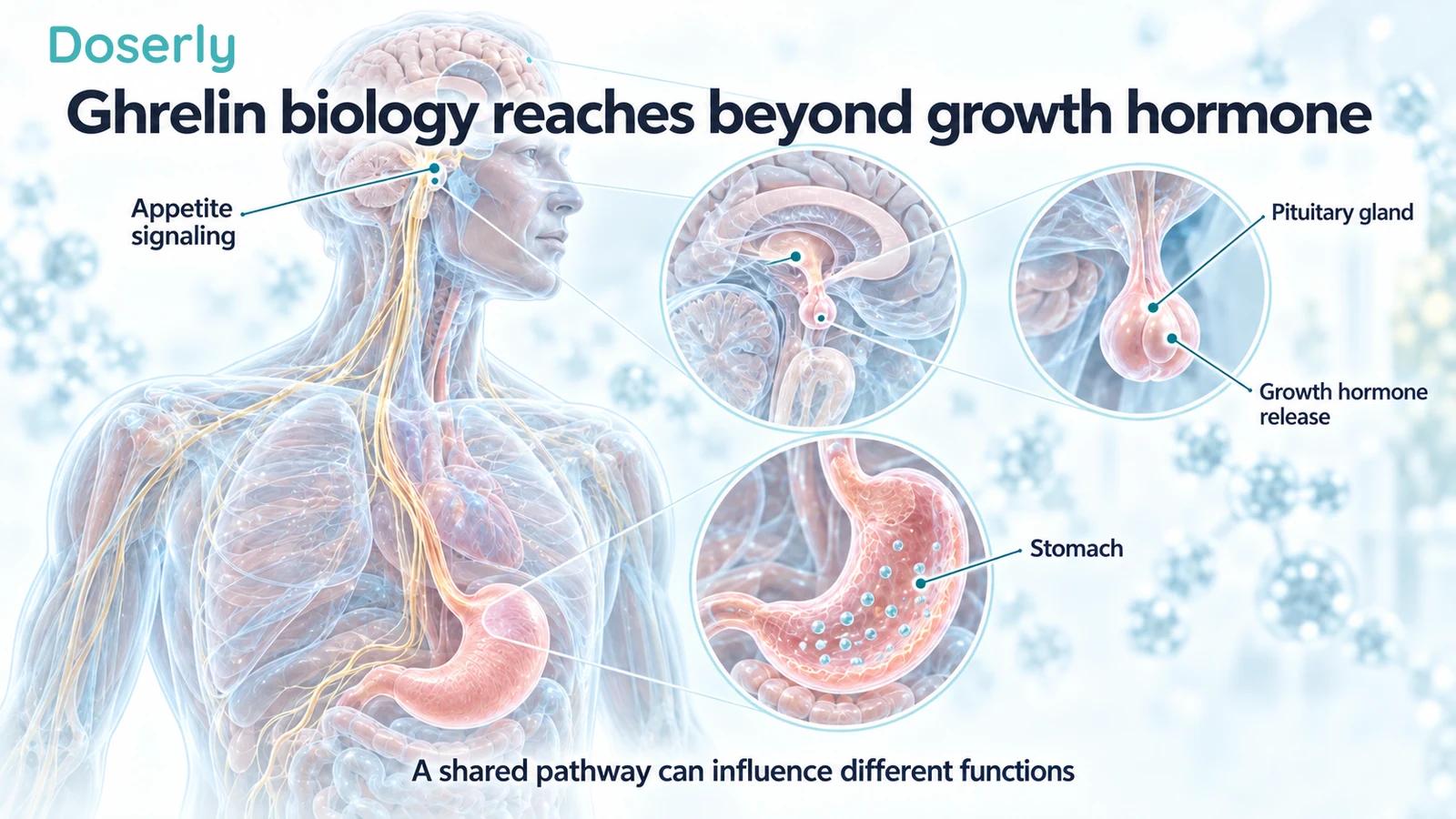
Ipamorelin is often introduced as a growth hormone–releasing peptide. That description is accurate as far as it goes, but its connection to the ghrelin receptor raises other questions. Ghrelin-related biology includes appetite and gastrointestinal activity, so it is reasonable to ask whether ipamorelin might change hunger or the way the gut moves food.
The answer is more nuanced than either “it only affects GH” or “it must make everyone hungry.” Human experiments show that ghrelin itself can increase food intake. Ipamorelin animal experiments have examined feeding, fat accumulation and bowel transit. The human ipamorelin clinical trial focused on meal tolerance after surgery and did not establish a clear efficacy benefit. These are different kinds of evidence. Human ghrelin study; ipamorelin trial.
Understanding those distinctions is useful whether your concern is unwanted hunger, poor appetite, weight change or digestive symptoms. None of those problems can be understood fully from a growth hormone measurement alone.
What is ghrelin doing in this discussion?
Ghrelin is a hormone produced largely in the stomach. It interacts with a receptor involved in GH release and other functions. Ipamorelin activates this receptor pathway, which is why it is described as a ghrelin mimetic or ghrelin-receptor agonist.
A mimetic reproduces some activity associated with another substance. It does not necessarily reproduce every effect, with the same timing or magnitude. Molecules acting through a shared receptor can differ in their exposure, tissue access and downstream responses.
The original ipamorelin selectivity experiments compared GH and other hormone responses, especially ACTH and cortisol. They did not establish that appetite or gastrointestinal actions were absent in humans. “Selective GH release” should not be expanded into “no possible effects anywhere else.” Original selectivity paper.
For broader background on the compound and its clinical limitations, the Doserly ipamorelin guide connects the endocrine and gastrointestinal research.
The body's own ghrelin changes around meals
One human physiology study collected frequent blood samples over 24 hours in ten healthy participants eating meals on a fixed schedule. Ghrelin levels rose before meals and fell after eating. The pattern supported a possible role in meal initiation. Cummings and colleagues.
Nobody received ipamorelin in that experiment. The investigators measured endogenous ghrelin, meaning the hormone already produced by the body. This helps explain normal physiology, but it is not a trial showing what happens after pharmacologically stimulating the receptor.
The scheduled meals matter too. A hormone pattern around anticipated eating does not establish that one circulating level is the sole cause of hunger. Eating behavior has several influences, and the study was not designed to separate all of them.
For a reader, the practical lesson is that a ghrelin result and a hunger experience are connected questions, not interchangeable measurements. A single hormone measurement would not describe the full pattern of appetite across a day.
What happened when researchers gave ghrelin to people?
A small randomized, blinded crossover experiment compared intravenous ghrelin with saline in nine healthy volunteers. Participants ate more energy from a free-choice buffet during ghrelin infusion: the reported average increase was 28%. Appetite ratings also increased. Wren and colleagues.
The same study did not find a change in gastric emptying using its paracetamol-absorption test. That detail is valuable because it separates eating more from moving stomach contents faster. The two outcomes did not have to change together.
A later study included twelve lean participants and twelve with overweight or obesity. It again found increased food intake during ghrelin infusion, with responses differing by dose and group. Druce and colleagues.
These are direct human treatment experiments with ghrelin. They support a role for ghrelin signaling in appetite and food intake. They do not give an ipamorelin-specific percentage, nor do they establish the long-term effect of repeated use on body weight.
Hunger, intake and weight are three different outcomes
Hunger is a subjective experience. A person may feel a stronger desire to eat without necessarily consuming more if meal availability or behavior limits intake. Conversely, someone may eat more without describing a dramatic change in hunger.
Food intake can be measured during a meal or over a longer period. A buffet experiment provides a controlled way to study an acute response, but it does not automatically predict what someone eats over several weeks.
Body weight adds further complexity. It includes fat, lean tissues, water and material in the gastrointestinal tract. A change on the scale does not reveal which component changed, or whether appetite was responsible.
That is why the time frame and measurement matter. A study of one meal cannot establish sustained fat gain. A body-weight change cannot establish muscle gain. And a hormone response cannot substitute for any of these outcomes.
What the ipamorelin mouse findings add
A mouse study compared GH and the secretagogue ipamorelin in animals with different GH backgrounds. Ipamorelin increased fat-related measures, including relative fat-pad weights. GH secretagogue treatment also increased feeding in GH-intact mice, and the authors concluded that adiposity effects could occur through mechanisms independent of GH. Mouse study.
The study is relevant because it directly tested ipamorelin in an experimental system. It argues against assuming that GH release fully explains every body-composition effect of the compound.
It remains an animal study. The result cannot tell a human reader how hungry they will feel, how much they will eat or whether their weight will change. Differences in species, dose exposure and experimental conditions limit that translation.
The appropriate conclusion is neither a human fat-gain warning with a made-up probability nor a dismissal of the finding. It is a reason that appetite and body composition should be measured directly in human ipamorelin research.
Why researchers investigated postoperative bowel recovery
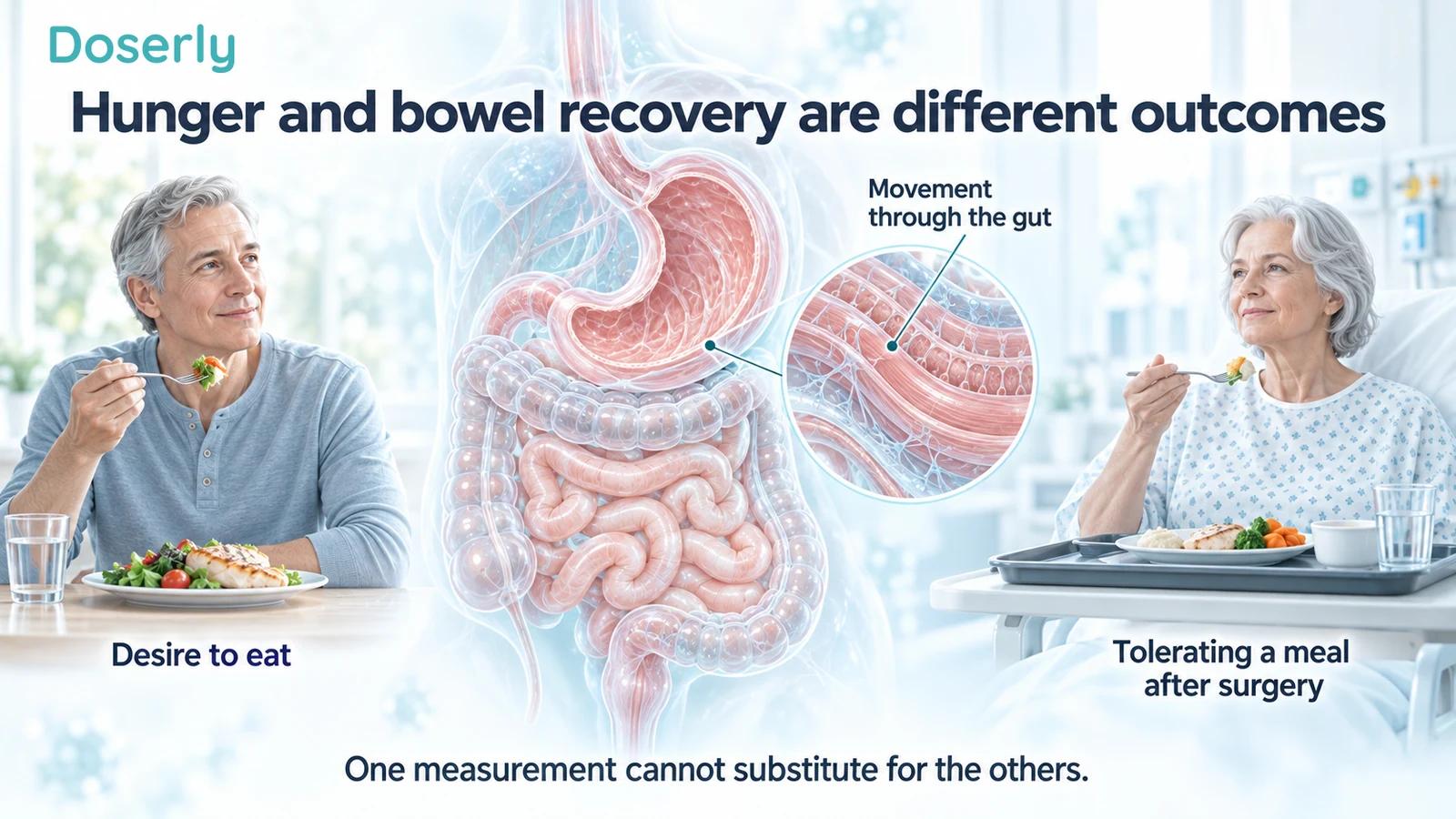
After abdominal surgery, gastrointestinal movement can be temporarily impaired. This is called postoperative ileus. The clinical problem involves the ability to move and tolerate gastrointestinal contents, not simply a lack of desire to eat.
In a male-rat surgical model, investigators measured time to the first bowel movement, fecal output, food intake and body weight. A single ipamorelin exposure shortened the time to first bowel movement at the tested effective dose but did not improve every later outcome. Repeated administration produced a different pattern, including increased cumulative fecal output and food intake. Rodent ileus study.
That is a more specific finding than “ipamorelin improves digestion.” The experimental context was surgery, the species was rat, and the results varied with the exposure pattern and endpoint.
The work supplied a rationale for a human trial. It did not itself establish a treatment for ordinary constipation, early fullness, poor appetite or another chronic digestive complaint.
What did the human ipamorelin trial find?
The phase 2 randomized, blinded trial enrolled 117 adults undergoing bowel resection; 114 entered the safety and modified intention-to-treat populations. Participants received intravenous ipamorelin or placebo during the postoperative period, for up to seven days or until discharge.
The key efficacy endpoint was time from the first study dose to tolerance of a standardized solid meal. Median times were 25.3 hours with ipamorelin and 32.6 hours with placebo. The comparison was not statistically significant, with p=0.15. The report also found no significant differences in the key secondary efficacy analyses. Human trial.
Meal tolerance is more than being hungry. FDA's account describes a standardized amount of food, a defined eating period and restrictions involving vomiting or worsening nausea. This made the endpoint clinically relevant to postoperative recovery, while also distinguishing it from a simple appetite score. FDA trial review.
The study does not establish that ipamorelin improves routine digestive health. It also does not prove that every gastrointestinal effect is absent. It provides a limited, inconclusive efficacy result in a particular surgical setting.
Can someone call ipamorelin appetite-neutral?
The evidence reviewed here does not justify a broad guarantee of appetite neutrality in humans. The original endocrine selectivity result did not test that claim, and the available human clinical evidence does not provide a robust long-term appetite comparison in typical wellness users.
The opposite blanket claim is also unsupported. Human ghrelin infusion and mouse ipamorelin findings do not establish that every human ipamorelin user will experience clinically important hunger or weight gain.
A useful description is therefore specific: the pathway has established appetite biology, ipamorelin has relevant animal findings, and direct human estimates for everyday appetite effects remain limited.
If appetite changes after starting a product, the timing is worth documenting. But the observation should be considered alongside changes in meals, activity, illness, other medicines and the exact product. It should not be interpreted automatically as proof of a desirable GH response.
Why an appetite effect would not establish a digestive treatment
A person with poor appetite may need help eating enough, but the reason for the problem matters. Someone with nausea, early fullness or postoperative complications has a different question from someone simply wanting to increase calorie intake.
Likewise, improving one transit measure would not necessarily resolve symptoms or restore normal nutrition. The Wren ghrelin study illustrates this separation: food intake changed without a measured change in gastric emptying using that study's method. Human ghrelin experiment.
The clinical ipamorelin trial deliberately studied a defined postoperative outcome rather than assuming that a receptor mechanism would improve all digestive complaints. That same discipline is useful in clinical conversations: name the symptom and the outcome that would count as improvement.
Using an experimental peptide to pursue appetite or gut effects also raises safety and formulation questions. FDA's assessment identifies gaps in route-specific evidence and concerns about peptide-related impurities and immune reactions. A plausible gastrointestinal mechanism does not resolve those issues. FDA assessment.
A more useful way to track and discuss changes
If you notice an appetite change, describe it in concrete terms. Are you hungry sooner after meals, eating larger portions, feeling full unusually early or avoiding food because of nausea? Those patterns are not the same.
A dated record of meals, symptoms, medication changes and weight can help a clinician understand what happened. It cannot determine causality on its own, but it is more informative than labeling every change “ghrelin.”
Bring the exact formulation and any other hormones or peptides into the discussion. A mixture containing several active compounds makes it harder to attribute an effect to ipamorelin. Persistent or troubling symptoms deserve clinical assessment rather than interpretation as evidence that a protocol is working.
What the research can tell you now
Ghrelin biology is broader than GH release, and ipamorelin's classification should not obscure that. Human ghrelin studies demonstrate acute effects on food intake. Ipamorelin animal studies raise specific questions about feeding, fat accumulation and bowel transit. The human postoperative trial did not establish a clear recovery benefit.
For everyday appetite or digestive goals, those findings do not yet provide a dependable prediction of benefit or harm from ipamorelin. The most useful next question is the specific one: which symptom or outcome is being treated, and has that outcome improved in people receiving this exact compound?
The ipamorelin guide provides the wider context, including why hormone selectivity, gastrointestinal activity and long-term safety need separate evidence.
Explore the research
- Ghrelin enhances appetite and increases food intake in humans (2001): Ghrelin, not ipamorelin; acute small study.
- Ghrelin increases food intake in obese as well as lean subjects (2005): Ghrelin, not ipamorelin; acute meal experiment.
- A preprandial rise in plasma ghrelin levels suggests a role in meal initiation in humans (2001): Observational hormone measurement, not treatment trial.
- Growth hormone (GH)-independent stimulation of adiposity by GH secretagogues (2001): Mouse study; cannot estimate human appetite or body-composition effects.
- Efficacy of ipamorelin, a novel ghrelin mimetic, in a rodent model of postoperative ileus (2009): Rodent surgery model does not establish human efficacy.
- Prospective, randomized, controlled, proof-of-concept study of the Ghrelin mimetic ipamorelin for the management of postoperative ileus in bowel resection patients (2014): Abstract via Europe PMC freshly reviewed; full safety details cross-checked against FDA; small heterogeneous surgical sample.
- Ipamorelin, the first selective growth hormone secretagogue (1998): Abstract reviewed; animal responses do not establish human safety.
- FDA Briefing Document: Ipamorelin-Related Bulk Drug Substances, October 29, 2024 (2024): Advisory briefing, not itself a final legal determination; safety events do not prove causality.