
Supplements
October 16, 2026
Inositol for PCOS: choose the outcome before debating the ratio
On this page
Inositol can sound unusually precise for a supplement: two forms, a prominently advertised 40:1 ratio, and a proposed connection to insulin signaling. But polycystic ovary syndrome, or PCOS, is not a single nutritional problem with one universally correct ratio. It can affect ovulation, menstrual cycles, androgen-related symptoms and metabolic health in different combinations. The person seeking more predictable periods may have a different priority from someone trying to conceive. NICHD’s PCOS overview.
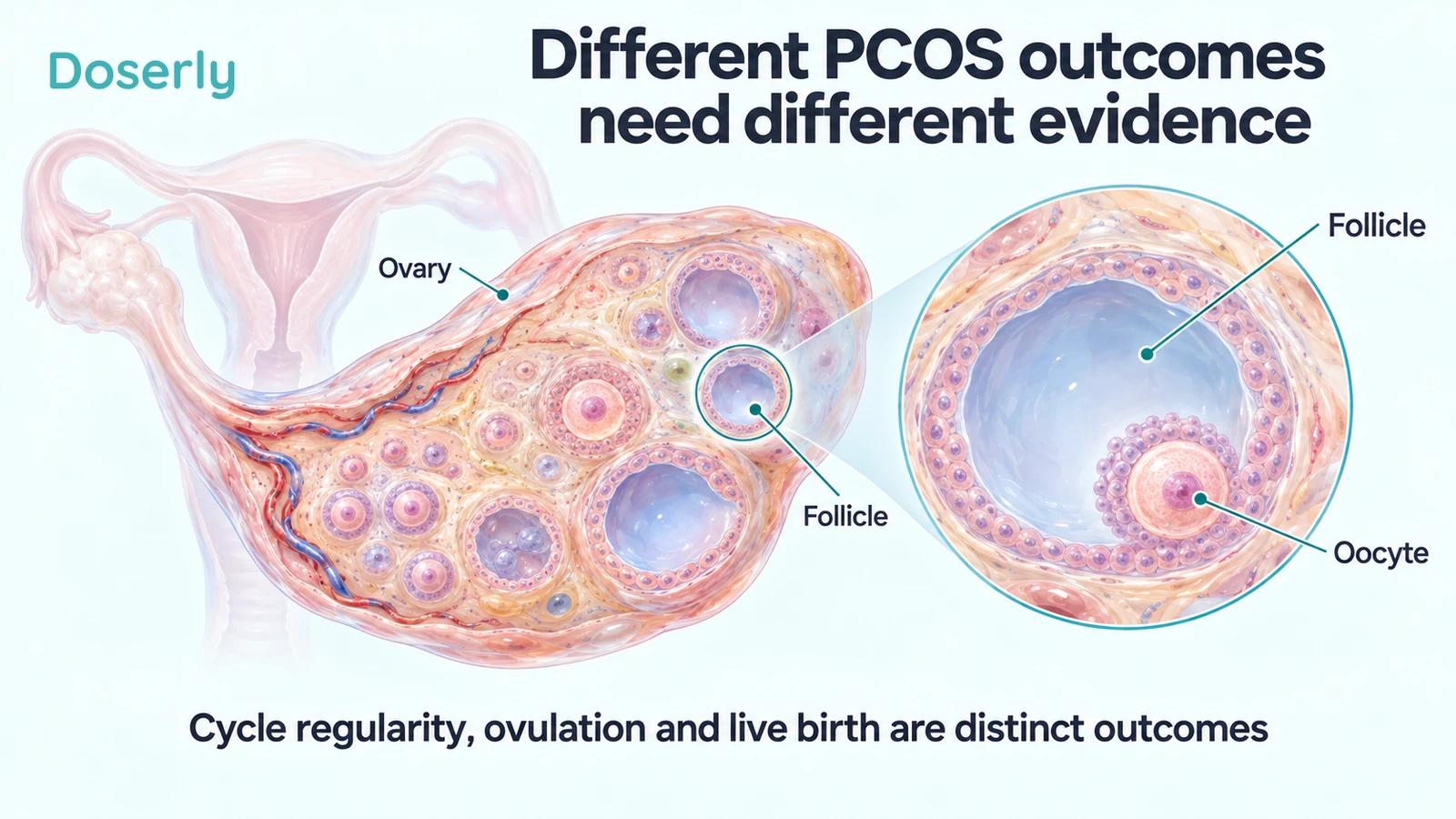
That distinction should come before choosing a powder or capsule. The relevant question is whether a particular preparation improves the outcome that matters to the person, with tolerability and evidence strong enough to justify its use. A change in a laboratory marker does not automatically establish an improvement in ovulation, and ovulation is not the same outcome as a live birth.
The 2023 international PCOS guideline allows consideration of inositol based on individual preferences, while recognizing limited clinical benefit and insufficient evidence to recommend a specific type, dose or combination. For infertility treatment, it considers inositol experimental because benefits and risks remain uncertain. International evidence-based PCOS guideline.
The Doserly inositol guide provides ingredient background. Here, the focus is how to interpret the ratio claim and separate metabolic, cycle, fertility and pregnancy evidence—including important research published after the guideline.
Why inositol entered PCOS research
Myo-inositol, often abbreviated MI, and D-chiro-inositol, or DCI, are related forms of inositol. Inositol compounds participate in cellular signaling, including processes related to insulin action. That creates a plausible reason to investigate them in PCOS, where insulin resistance is common. Plausibility, however, does not establish the size or reliability of a supplement’s clinical effect. The guideline evidence review.
A proposed biological pathway can help researchers choose what to measure. It cannot tell a person whether a particular product will regulate cycles, reduce unwanted hair growth or improve the chance of having a baby. Those outcomes depend on more than the presence of one signaling compound.
The same applies to the word “physiological” in ratio marketing. A ratio described in a body fluid is an observation about that compartment. It is not automatically the ideal oral supplement ratio for every tissue and every person. Establishing that would require trials comparing relevant formulations and measuring clinically meaningful outcomes, rather than assuming that swallowing a ratio reproduces it at the target tissue.
A ratio does not specify an exposure
A 40:1 label means forty parts MI to one part DCI. It does not, by itself, specify the daily amount. As an arithmetic example, 400 mg plus 10 mg and 2,000 mg plus 50 mg have the same ratio but very different total quantities. These examples explain the label; they are not dosing recommendations.
The serving size matters too. A ratio may refer to the amount in one capsule, one scoop or a full daily serving. Additional ingredients may include folic acid or other supplements. Comparing products therefore requires the amount of each ingredient and the number of servings, not just the large ratio printed on the front.
This is especially relevant when someone already uses another combination product. Two bottles can contain overlapping ingredients without sharing a marketing category. A complete label review is more informative than the statement “I take inositol,” because it preserves the details needed to compare the routine with the research.
What the small ratio-comparison trial found
A frequently cited 2019 study compared seven MI:DCI formulations in 56 people with PCOS, with eight in each group, over three months. The investigators reported the strongest ovulation and related findings with the 40:1 formulation. The study compared active inositol preparations; it did not include a no-inositol placebo group. Nordio and colleagues, 2019.
Eight people per formulation is a small basis for a universal recommendation. A change in the outcome of one participant can noticeably change a group percentage. Multiple formulations and outcomes also make it important to distinguish an exploratory signal from a well-replicated clinical rule. The authors themselves acknowledged the need for confirmation in a much larger population. The primary report.
The study can support further investigation of 40:1. It cannot establish that this ratio is optimal for every PCOS presentation, that other ratios are harmful in ordinary use, or that a person who does not improve simply chose the wrong balance. It also does not demonstrate a live-birth advantage.
This distinction protects the patient from an unhelpful explanation of treatment failure. A supplement may not improve the desired symptom because the clinical evidence is uncertain, not because the person failed to find a mathematically perfect formulation. Increasing amounts or repeatedly switching ratios is not a substitute for reassessing the underlying goal.
The broader evidence was limited and inconclusive
The review informing the international guideline included 30 trials with 2,230 participants; 19 trials contributed to meta-analyses. It found possible benefits for some metabolic measures and possible ovulation benefits in some comparisons, while concluding that the overall evidence for PCOS management remained limited and inconclusive. Trials differed in formulations, comparators and outcomes. Fitz and colleagues, 2024.
Many outcomes had low or very low certainty because of problems such as small samples, risk of bias and inconsistent results. The review also found that myo-inositol probably caused fewer gastrointestinal adverse events than metformin, although those metformin effects were generally mild and self-limited. Better tolerability does not establish equal effectiveness for every outcome. The systematic review.
It helps to distinguish uncertainty from a claim that no one can benefit. Some people may notice improvement, and some outcomes have promising signals. The uncertainty concerns how reliably that benefit can be predicted, which preparation deserves credit, and whether the result extends to the person’s main clinical goal.
There is also a difference between a large total participant count and strong evidence for a particular comparison. The review’s 2,230 participants were spread across different trials and interventions. They were not all randomized to 40:1 versus placebo with live birth as the endpoint. A product cannot borrow the entire review’s population as though it were one definitive trial of that product.
Cycle improvement does not automatically mean greater fertility
A six-month randomized trial compared metformin alone with a metformin-plus-inositol combination in 53 women with PCOS and overweight or obesity. Menstrual regularity and PCOS-related quality of life improved more in the combination group, but pregnancy rates were equal between groups, and most other hormonal or metabolic comparisons were not significantly different. The 2023 primary trial.
That pattern illustrates why the outcome needs to stay attached to the result. More predictable cycles may be valuable even if a trial does not demonstrate more pregnancies. Conversely, a person whose priority is pregnancy should not be told that a cycle result already proves a fertility benefit. Equal pregnancy rates in a small trial also do not establish exact equivalence; the study may be too small to resolve a meaningful difference.
A separate 2025 study compared a 40:1 MI/DCI preparation with metformin in 60 participants over 12 weeks. Both groups improved on several measured features. The authors suggested that different PCOS presentations might respond differently, but that phenotype-specific interpretation was a hypothesis, not a validated rule for choosing treatment. The 2025 comparative trial.
A small active-comparator study cannot establish that a supplement is interchangeable with a medicine for every indication. Baseline differences between groups, short follow-up and the outcomes selected all affect that inference. A person should not stop metformin solely because a paper’s conclusion describes both interventions as effective.
A laboratory change needs its own interpretation
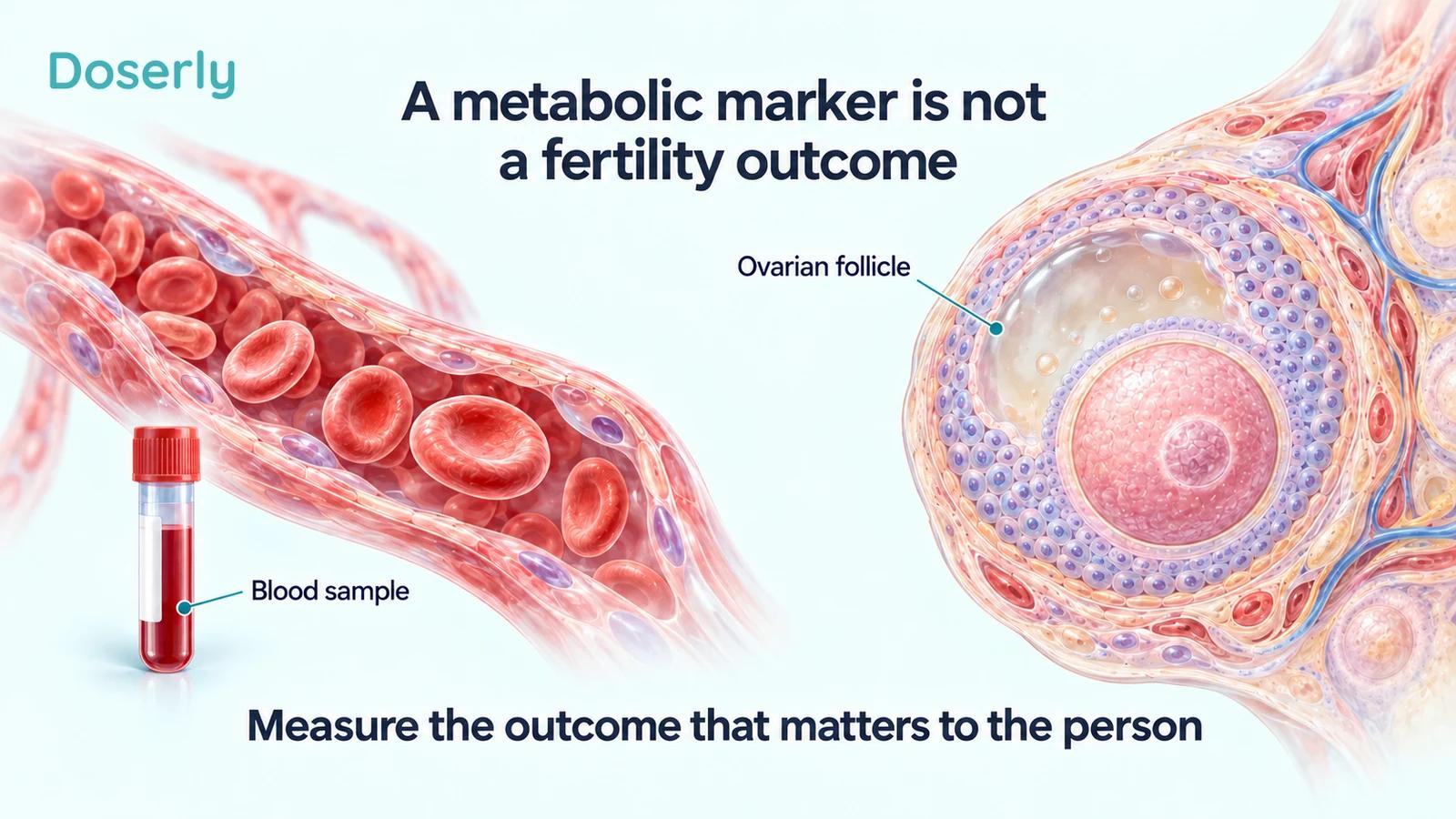
HOMA-IR is a calculated index used in research to estimate insulin resistance from fasting measurements. It is not a count of ovulations, a pregnancy test or a measure of whether a baby was born. Inositol trials often report several such metabolic and hormonal measurements alongside symptoms. A favorable result in one should not silently replace a missing result in another. The guideline evidence review.
Imagine two people reviewing the same study. One wants to understand a change in fasting insulin; the other wants to know whether treatment improves live birth. The paper may contain useful information for the first question while offering little for the second. That does not make either goal less important. It makes the outcome label essential.
A helpful clinical record separates those goals instead of merging them into “PCOS improved.” It might record cycle dates and symptoms, the clinician’s interpretation of metabolic tests, and fertility-treatment milestones where relevant. Keeping those categories distinct makes later decisions clearer, including whether a supplement is worth continuing.
Preventing pregnancy complications needs its own trials
A larger 2025 trial tested a different question: whether myo-inositol could prevent pregnancy complications in people with PCOS who were already pregnant. At 13 Dutch hospitals, 464 participants were randomized between 8 and 16 weeks of pregnancy to myo-inositol plus folic acid or a matching folic-acid-only comparator until delivery. The MYPP randomized trial.
The primary outcome combined gestational diabetes, preeclampsia or preterm birth. It occurred in 25.0% of the myo-inositol group and 26.8% of the comparator group, with no significant difference: relative risk 0.93, 95% confidence interval 0.68–1.28. The trial did not establish a preventive benefit for that combined outcome. Van der Wel and colleagues, 2025.
This was not a test of whether inositol helps someone conceive, nor was it a trial of every possible MI/DCI ratio. It directly tested a pregnancy-complication prevention claim for the studied preparation. Its negative result should not be overridden by earlier metabolic plausibility or by a fertility anecdote addressing a different stage of care.
It also means that becoming pregnant is a reason to review the whole supplement routine with the obstetric team. Continuing a product because it was started before conception assumes that the same purpose, evidence and safety considerations still apply. The trial does not justify that assumption, and a product containing folic acid or other nutrients needs to be considered alongside the prenatal regimen.
Shared decisions should be concrete
The international guideline encourages discussing inositol use with the treating professional and recognizes that supplement quality and composition can vary. Its qualified position supports an informed conversation; it does not endorse a universal ratio or a blanket promise of fertility benefit. The guideline’s inositol recommendations.
A useful conversation starts with one or two priorities. If cycle predictability is the goal, define what would count as a meaningful change and when it will be reviewed. If the priority is fertility, ask how the supplement fits into the evaluation and treatment plan without delaying care. If tolerability of metformin is the problem, discuss that problem directly rather than assuming any supplement is an equivalent replacement.
The practical record is straightforward: product name, MI and DCI amounts, other ingredients, start date, symptoms and concurrent changes in treatment. Note cost and burden as well. A powder taken daily may seem easy initially but become expensive or unpleasant over months; that matters when the expected benefit is uncertain.
No response to inositol is a verdict on the person or on how well they have managed PCOS. The research does not support that kind of judgment. It supports a more modest and useful approach: choose an outcome, examine evidence that actually measures it, account for the formulation and revisit the decision with the clinician. The ratio is one product detail within that process, not the answer to the whole condition.
Sources
- NICHD. About Polycystic Ovary Syndrome.
- Teede et al. International evidence-based PCOS guideline, 2023.
- Fitz et al. Inositol for PCOS: systematic review informing the guideline, 2024.
- Nordio et al. Comparison of seven MI/DCI ratios, 2019.
- Metformin plus inositol versus metformin alone: randomized trial, 2023.
- MI/DCI versus metformin across PCOS presentations: prospective trial, 2025.
- Van der Wel et al. Myo-inositol to prevent pregnancy complications in PCOS, JAMA, 2025.