
Peptides
October 16, 2026
IGF-binding proteins: the missing context in IGF-1 LR3 claims
On this page
IGF-1 LR3 is often described as more available because it binds weakly to IGF-binding proteins. That statement points to an important property, but the next sentence is where explanations often go wrong: weaker binding is presented as proof of a longer human half-life, better muscle growth or predictable safety.
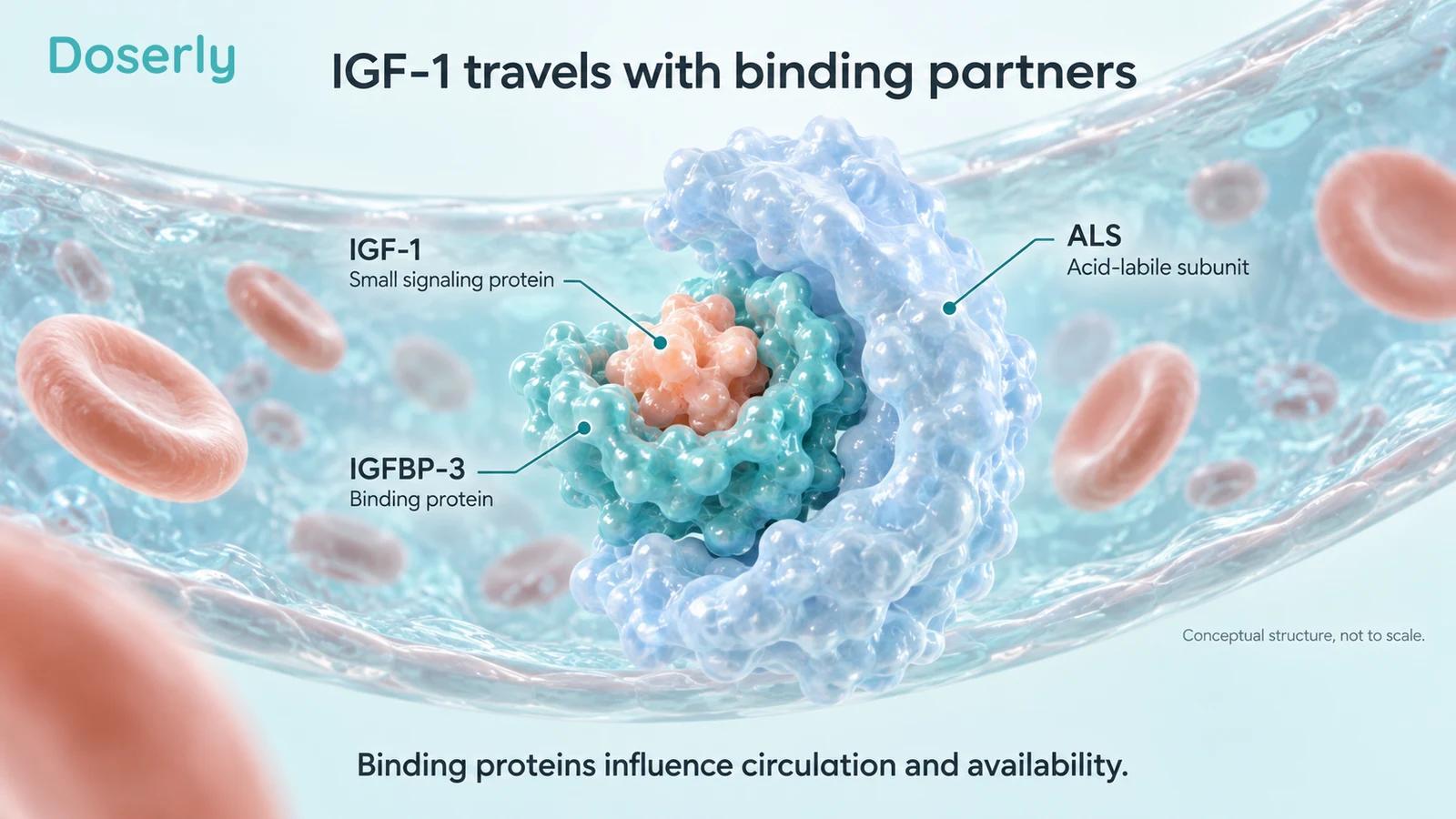
Binding proteins do more than obstruct a growth factor. They help determine how it circulates and when it is available to interact with cells. Changing those interactions can change several properties at once.
The most useful finding is also counterintuitive: a primary comparison reported that LR3 was more active in certain cell and rat growth experiments while disappearing from rat blood faster than native IGF-I. Greater activity and faster clearance occurred together. Ballard and colleagues, 1993
What an IGF-binding protein does
A binding protein is a protein that associates with another molecule. In this case, the partners are insulin-like growth factors. IGFBP-3 is a prominent example, and it can participate in a three-part complex with IGF-1 and a protein called the acid-labile subunit, or ALS.
A 2022 structural study used cryo-electron microscopy and biochemical experiments to investigate the human IGF1–IGFBP3–ALS complex. The researchers examined how the complex assembles and how changes to the binding protein influence IGF availability. Structural study
For a general reader, the important point is not the exact shape of the complex. IGF-1 does not circulate as one uniform pool of freely accessible hormone. Its interactions with other proteins are part of its biology.
That makes the phrase “binding proteins block IGF-1” too simple. A binding partner can limit immediate access to a receptor while helping retain a circulating pool. Removing or weakening that interaction changes both sides of the arrangement.
Free, bound and total are different quantities
Free IGF refers to molecules not attached to a binding protein at the moment being considered. Bound IGF is associated with a partner. Total IGF combines measured forms according to the assay's design.
These terms should not be used as interchangeable descriptions of biological activity. A total concentration is not a direct count of receptor activations in muscle, and a higher free fraction does not by itself establish a larger useful clinical effect.
Imagine two samples with the same total amount of a growth factor but different proportions bound to carrier proteins. They could have different immediate access to cells and different persistence in circulation. This is a conceptual example, not a calculation of human LR3 exposure.
It also explains why a single blood value cannot summarize the whole system. The amount measured, the forms present and the effect at a target tissue are separate questions. A claim needs to specify which one was actually investigated.
Human native-IGF experiments show why binding matters
A 1989 study followed labelled IGF-I and IGF-II after tracer injections in two healthy adults. The investigators separated circulating material into free and carrier-associated fractions. Apparent half-lives differed markedly: roughly 10–12 minutes for free tracer, 20–30 minutes in one carrier-associated fraction and 12–15 hours in a larger complex. Guler and colleagues
Those are historical tracer measurements in a very small study, not universal constants for every formulation or person. Crucially, they are not LR3 measurements.
The result demonstrates a principle: association with circulating proteins can greatly affect persistence in blood. It does not establish the duration of an analogue that was designed to interact differently with those proteins.
When a page gives a precise LR3 duration but cites this study, check the intervention. Borrowing a half-life from native IGF in a particular complex substitutes a different molecule and a different circulating form.
What LR3 changes
Long R3 IGF-I contains an extension and an arginine substitution compared with the native IGF-I sequence. Repligen describes its reduced affinity for IGF-binding proteins as a reason for its usefulness in cell culture. Manufacturer documentation
The 1993 comparison found approximately a thousand-fold difference in affinity between native IGF-I and LR3 toward several tested binding-protein preparations. That is an affinity comparison: it concerns the strength of association under the experimental conditions. It is not a thousand-fold improvement in muscle growth or a thousand-fold difference in human exposure. Binding comparison
A numerical multiplier only makes sense when its endpoint travels with it. Removing the endpoint turns a precise laboratory observation into an ambiguous potency claim.
The same caution applies to “does not bind.” Reduced affinity is not always the same as literally zero interaction under every possible condition. Concentrations, assay design and the particular binding protein matter.
Binding-protein affinity is not receptor affinity
A binding protein and a cell-surface receptor play different roles. An analogue can interact weakly with binding proteins without interacting more strongly with its signalling receptor.
In a study of dexamethasone-treated rats, LR3 had lower affinity for the type 1 IGF receptor than native IGF-I in the reported binding measurements, despite greater anabolic potency on some outcomes. The authors connected the overall activity with reduced association with binding proteins. Tomas and colleagues, 1992
This is another reason to avoid a one-dimensional ranking. Receptor affinity is one property; access to the receptor and the resulting response are others. A stronger effect in a whole experimental system need not mean tighter binding at every molecular interaction.
For a reader, a useful question is: “More potent at doing what?” If the answer switches from binding proteins to receptors to muscle growth without new evidence, the explanation has crossed several untested steps.
Why weaker binding can mean faster clearance
In the rat experiments, LR3 was removed from plasma more rapidly than native IGF-I. The researchers also examined pregnant rats, whose binding-protein environment differed; native IGF-I clearance became much closer to LR3 clearance in that setting. Ballard and colleagues
This supports the importance of the binding environment rather than a simple rule that a modified analogue must stay in blood longer.
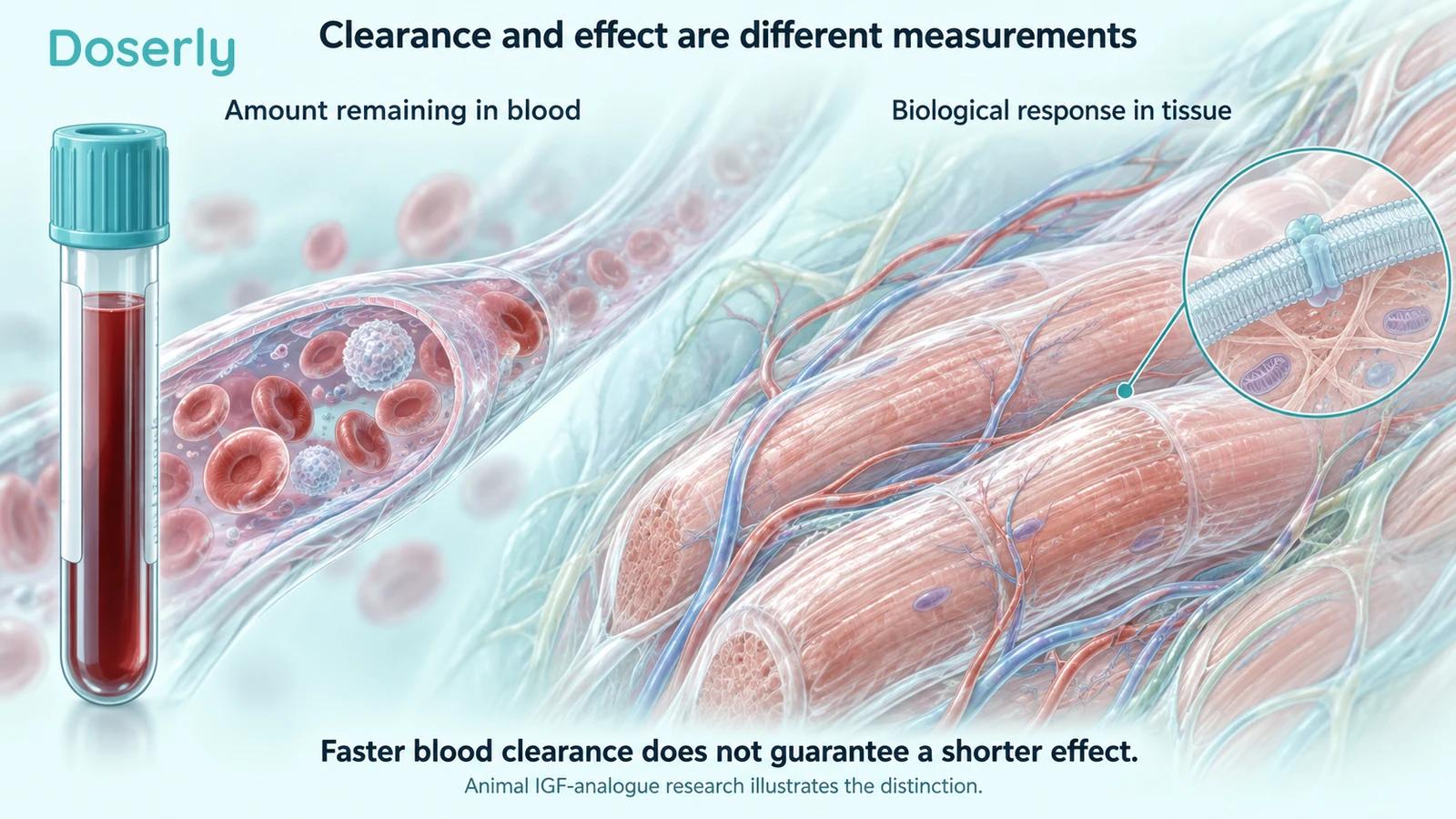
Clearance describes removal from the measured circulating compartment. It does not, by itself, tell you whether the material was degraded, distributed elsewhere or followed by a continuing downstream effect. Different experiments are needed to separate those possibilities.
That is why both “LR3 lasts longer because it binds less” and “LR3 must stop working sooner because it clears faster” are overstatements. Each treats one measurement as a complete account of what the body is doing.
Duration of a biological effect is a separate question
A 1997 study compared IGF-I variants in pigs and marmosets. LR3 was among the variants tested in pigs; the marmoset comparison involved native IGF-I and des(1-3)IGF-I. The investigators measured glucose responses after acute administration. Variants with low binding-protein affinity produced more sustained glucose lowering under the tested conditions. Tomas and colleagues
The species and analogue distinction matters. The paper's title includes marmosets, but that does not mean LR3 was tested in every arm.
For the binding-protein question, the key lesson is that a physiological response can persist even when an analogue's circulating clearance is relatively rapid. A glucose response curve and a blood concentration curve are not the same curve.
These animal findings support concern about metabolic effects. They do not define a human LR3 safe interval, a human hypoglycemia probability or an administration schedule.
The rest of the endocrine system can respond too
Adding an IGF analogue does not leave all other hormones and binding proteins fixed. In a four-day pig experiment, LR3 infusion reduced several circulating measures, including endogenous IGF-I and IGFBP-3, and affected growth hormone patterns. Food intake and daily weight gain also fell. Plasma glucose was not changed in that particular experiment. Dunaiski and colleagues, 1997
This does not predict the same outcome in a person. It demonstrates why treating the body as a container with a fixed amount of binding protein is incomplete.
It also prevents selective reading. A study in which LR3 affects an anabolic pathway is not automatically a study in which the animal grows better. Likewise, a study without a glucose change does not erase an acute experiment that found glucose lowering under different conditions.
The experimental setting is part of the explanation, not a nuisance detail to remove from it.
What “bioavailable” needs to specify
In everyday language, bioavailable often means “available to work.” In a scientific claim, that description needs a location and an endpoint.
Is the claim about the fraction reaching blood after administration? The fraction not bound to a protein? Access to a cell receptor? A measured response in a culture dish? These are related questions, but they are not interchangeable measurements.
A product page can correctly describe improved activity in cell culture while giving no basis for estimating exposure in human muscle. The cell medium and the human circulation are different environments, and the intended use of the reagent does not resolve that difference.
Repligen's FAQ states that its Long R3 IGF-I product is for cell-culture and research uses and excludes human applications. That is useful context when interpreting the manufacturer's performance descriptions. Manufacturer FAQ
What evidence would settle a human duration claim?
A credible claim would identify the actual molecule, product, route, population and analytical method. It would explain what was measured over time and whether the assay distinguished the analogue from endogenous IGF.
It would also distinguish the initial distribution phase from later elimination if the data supported more than one phase. A single quoted half-life can conceal those differences. Measurements would need enough follow-up and enough participants to describe variability rather than only a convenient average.
Finally, a duration-of-effect claim would need its own outcome measurements. A concentration remaining detectable does not automatically mean a desired benefit remains active, and a low circulating concentration does not automatically mean every effect has ended.
These requirements explain why a precise number on a marketing page can be less informative than an honest statement of uncertainty.
Using the binding-protein explanation well
The binding-protein story is valuable when it explains why LR3 behaves differently in experiments. It becomes misleading when it is used to skip the experiments needed for a human claim.
Keep four questions separate: what the molecule binds, how long it remains measurable in blood, what response occurs in tissue, and whether that response benefits a person. Evidence for one can motivate research on the others; it does not answer them automatically.
For more context, see the Doserly IGF-1 LR3 guide. The defensible conclusion is that reduced binding is an important molecular distinction with several consequences. It is not a shortcut to a proven long human half-life, selective muscle action or a safe-use protocol.
Sources
- Human IGF1–IGFBP3–ALS structural study
- Native IGF tracer half-lives in healthy adults
- IGFBP interactions, clearance and analogue activity
- IGF variants in dexamethasone-treated rats
- Acute glucose effects of IGF variants
- LR3, endogenous hormones and growth in pigs
- Repligen product documentation
- Repligen FAQ