
Peptides
October 16, 2026
IGF-1 LR3 is not mecasermin: why the distinction matters
On this page
An approved medicine contains recombinant IGF-1. IGF-1 LR3 is related to IGF-1. It is tempting to join those statements and conclude that LR3 has already passed the important human safety and effectiveness tests.
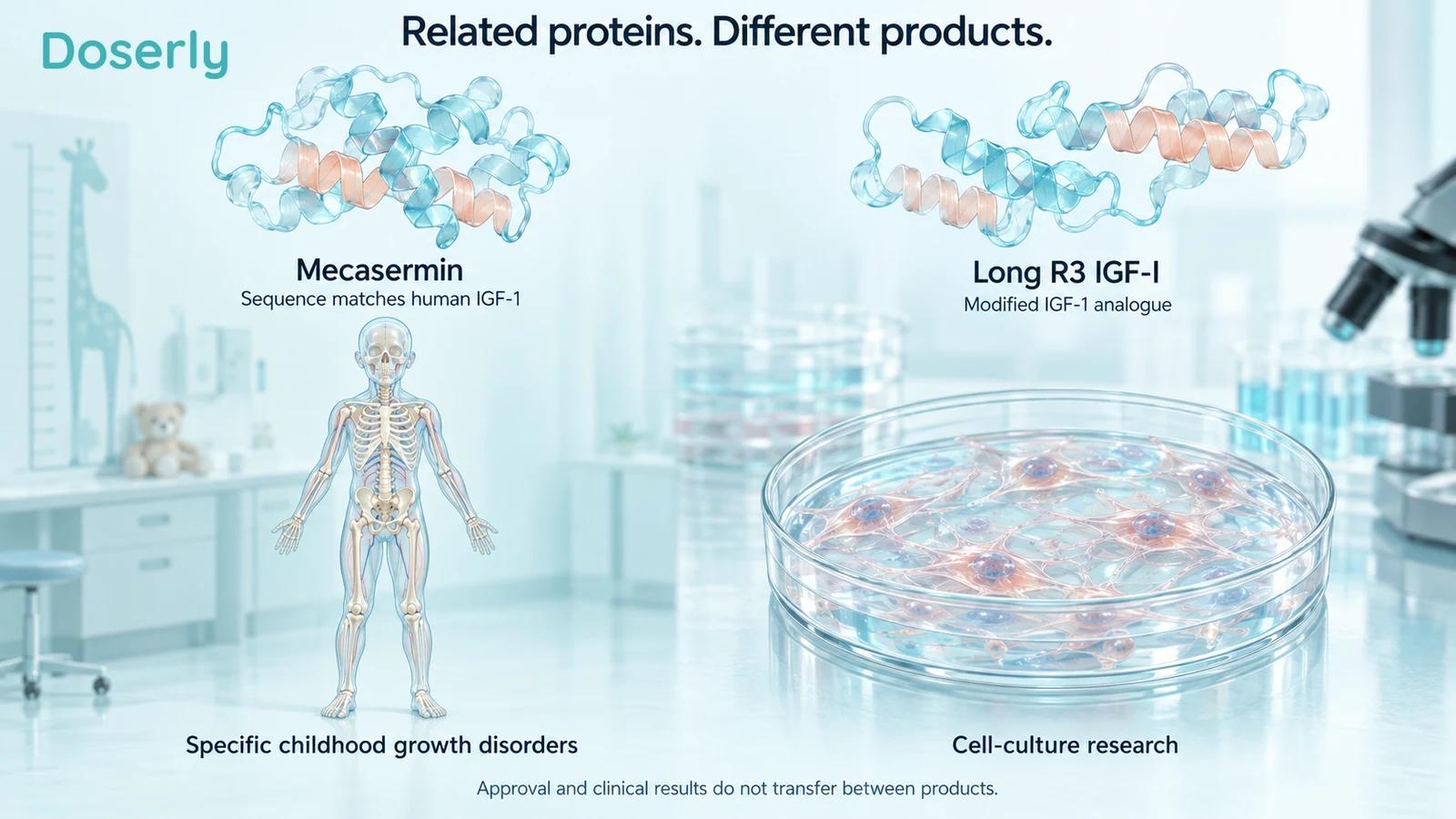
That conclusion skips the central question: which molecule was actually studied and approved? Mecasermin, the active ingredient in Increlex, has the amino-acid sequence of human IGF-1. Long R3 IGF-I is an altered analogue with different interactions with IGF-binding proteins. Their shared family name does not make them interchangeable. Increlex prescribing information, manufacturer's LR3 description
The distinction changes how to interpret childhood growth studies, hypoglycemia warnings, half-life claims, research-grade manufacturing and the absence of a validated bodybuilding protocol.
The names describe related but different proteins
IGF-1 stands for insulin-like growth factor 1. It is a signalling protein involved in growth and metabolism. “Recombinant” describes how a protein is produced using biotechnology; it does not, by itself, tell you whether the resulting sequence matches the body's protein.
Mecasermin is recombinant human IGF-1. Long R3 IGF-I adds a 13-amino-acid extension at one end and substitutes arginine at position three of the IGF-I sequence. Repligen describes those changes as reducing affinity for IGF-binding proteins and making the analogue useful in cell culture. LR3 product documentation
A reader does not need to memorize the sequence. The practical point is that a deliberate molecular change can alter what happens after the protein encounters binding partners, tissues and clearance mechanisms. Calling LR3 “IGF-1 with a longer name” hides the property that made it interesting to researchers.
The word analogue means structurally related, not clinically equivalent. Two related proteins can activate overlapping signalling systems yet differ in exposure, distribution and the evidence needed to use them responsibly.
What mecasermin is approved to treat
The US Increlex label concerns growth failure in children aged two years and older with severe primary IGF-1 deficiency, or with a growth hormone gene deletion and neutralizing antibodies to growth hormone. It is not a general approval for muscle building, recovery, anti-aging or any situation in which an adult wants a higher IGF-1 level. Current US label
That population matters. A child whose growth pathway cannot produce an appropriate IGF-1 response has a different clinical problem from an adult seeking additional muscle. The treatment goal, baseline physiology and acceptable balance of benefit and harm all differ.
An approval is attached to a defined product and use. It does not spread to all substances with similar names, all versions of a signalling protein or all desired outcomes. Likewise, a medicine's successful use for a serious deficiency does not prove that raising the same pathway beyond a person's usual state will improve health.
What the childhood studies actually measured
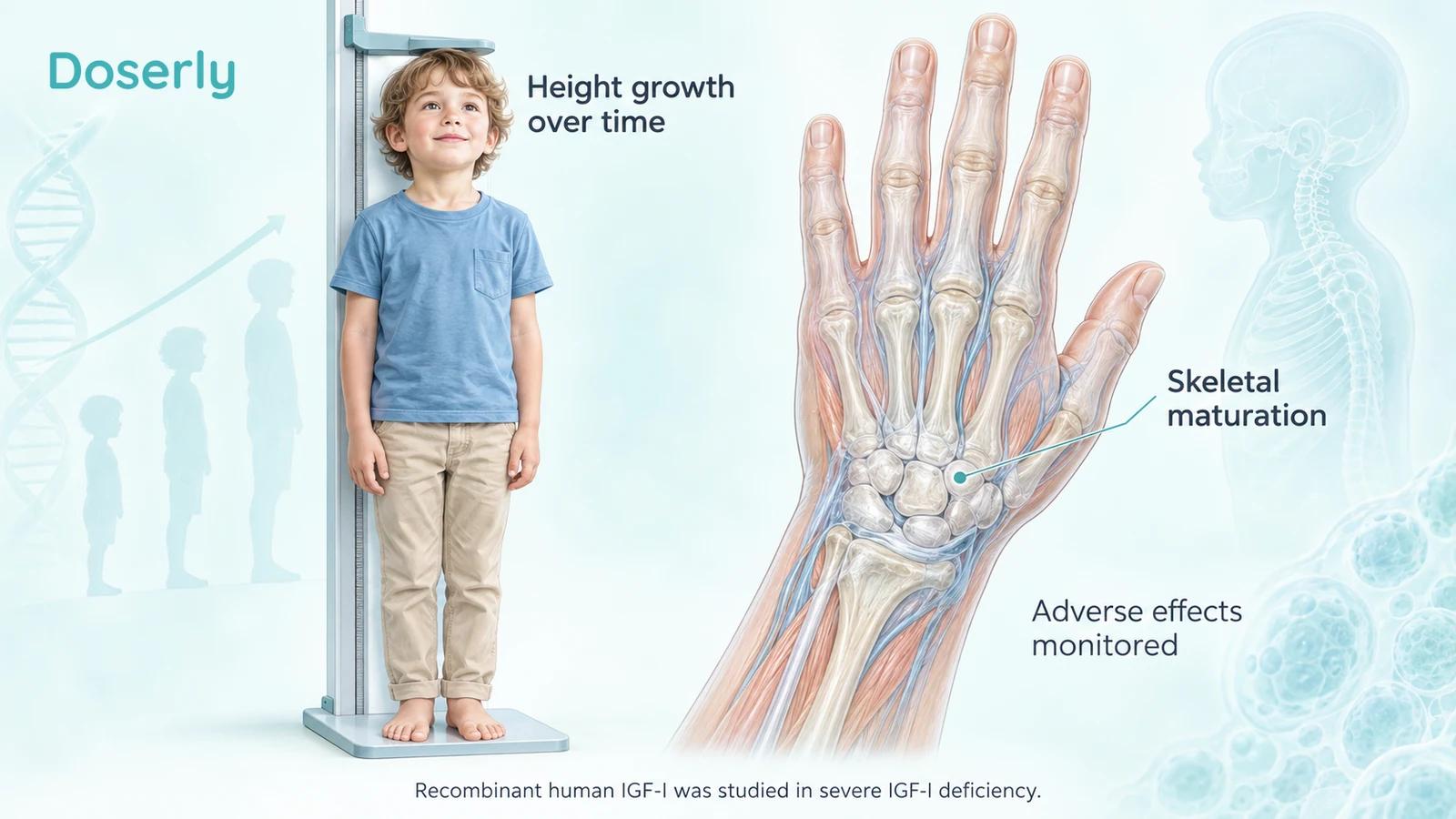
A long-term study reported on 76 children with severe IGF-I deficiency related to growth hormone insensitivity, treated with recombinant human IGF-I for up to 12 years in a predominantly open-label design. The investigators measured linear growth, skeletal maturation and adverse events. Average growth velocity rose from 2.8 centimetres per year before treatment to 8.0 during the first year; later annual growth was lower but remained above baseline for a period. Chernausek and colleagues, 2007
This is evidence of a clinically relevant outcome in an appropriate disease setting. It also has design limitations: most treatment was not blinded, follow-up varied, and the comparison was not a randomized adult muscle-building trial.
The study did not administer LR3. It did not establish an LR3 schedule, an adult performance benefit or the safety of products sold outside the approved medicine's supply chain. Those are separate questions even if a marketing page cites the study accurately.
An earlier report followed eight children with growth hormone insensitivity during two years of recombinant IGF-I treatment, with one followed for three. Height growth improved, and investigators also monitored organ growth and other effects. The small cohort and specialist follow-up are part of the result, not details to discard when translating it for a general audience. Backeljauw and Underwood, 1996
Reduced binding is not a simple human half-life upgrade
Binding proteins influence the availability and circulation of IGF molecules. Weakening those interactions can make more of an analogue available to cells under particular experimental conditions. It does not follow that the analogue remains in human blood for a specific number of hours.
In a 1993 comparison, LR3 showed much weaker binding to several IGF-binding proteins and greater activity in a muscle-cell assay. Yet in rats it cleared from blood more rapidly than native IGF-I. The same paper connected differences in circulating binding proteins with differences in IGF clearance. Ballard and colleagues
This result challenges an apparently intuitive story: “less binding” can mean less retention in blood, as well as altered access to tissue. Binding, receptor activity and clearance are different measurements.
The rat findings do not supply a reliable human LR3 half-life either. They show why a confident human duration claim requires human pharmacokinetic measurements of the actual substance. A cell-culture potency claim or an animal growth response cannot substitute for that measurement.
“More anabolic” depends on the experimental question
A frequently cited study compared IGF-I variants in rats made catabolic with dexamethasone. The researchers used sustained experimental administration and measured growth and protein metabolism. Modified forms, including LR3, were more potent than native IGF-I on some outcomes in that model. Tomas and colleagues, 1992
There is a real scientific observation here. It does not become a result in healthy adults by replacing the words “dexamethasone-treated rats” with “people trying to gain muscle.”
The illness model, food intake, treatment delivery, tissue responses and measured endpoints all matter. Even an increase in body weight would need to be separated into its components before calling it useful skeletal-muscle growth. A compound can affect more than the tissue a reader hopes to target.
This is why “stronger than IGF-1” is an incomplete statement. Stronger in which assay, at what exposure, in which species, and with which outcome? A careful answer can preserve the laboratory finding without turning it into a recommendation.
Known medicine risks inform caution, not an LR3 conversion chart
The Increlex label warns about hypoglycemia, including severe events, and contains additional monitoring and contraindication information. Those warnings make clear that activating this biology can have clinically important consequences. Prescribing information
They do not establish the frequency of each event with LR3. Nor can the medicine's administration instructions be copied to make an unapproved analogue safe. Related biology supports concern; a product-specific clinical program is needed to characterize the actual risk.
The long-term childhood study reported hypoglycemia in 49% of treated participants, with episodes occurring before treatment as well as during it. That percentage belongs to those children and that study. Presenting it as the probability of an LR3 user developing low blood sugar would misstate both exposure and population. Chernausek and colleagues
Two errors are worth avoiding together: dismissing all risk because LR3 differs from mecasermin, and treating the medicine's adverse-event percentages as exact LR3 predictions. Neither is justified.
A cell-culture product is not an injectable medicine
Repligen supplies Long R3 IGF-I for cell-culture and research applications. Its FAQ explicitly excludes human applications. That statement describes the manufacturer's product and intended use; it is not a worldwide legal analysis of every substance sold under an LR3 label. Manufacturer FAQ
Cell-culture manufacturing can require careful quality control. A reagent can be valuable for producing proteins in controlled laboratory systems without being an authorized medicine for direct administration to people.
Similarly, a purity percentage does not answer every question relevant to an injectable product. Identity, concentration, contaminants, sterility, formulation and clinical suitability are different properties. A document showing one analytical property should not be treated as proof of all the others.
The same distinction applies to labels such as “pharmaceutical grade” when they appear without a verifiable authorized product. The useful question is what has actually been assessed for the product in hand, rather than how reassuring the description sounds.
What about human studies involving an IGF conjugate?
A literature search can find human oncology research on IGF-methotrexate, or IGF-MTX. A 2019 phase I study enrolled 17 patients with advanced malignancies and investigated a conjugate of methotrexate with an IGF variant. It was a dose-finding cancer study, not a trial of unconjugated LR3 for muscle or recovery. Venepalli and colleagues
Earlier preclinical work explicitly described linking methotrexate to long-R3-IGF-1 to target tumour cells. Attaching a cytotoxic drug changes the intervention and its purpose. Conjugate development study
These papers are a reason to avoid sweeping statements that no related engineered IGF molecule has ever reached humans. They are also a reason to read beyond the search-result title. The presence of an IGF component in a clinical trial does not validate the separate research peptide as a consumer treatment.
How to check a claim without becoming a specialist
Start with the intervention named in the methods. “IGF-1,” “recombinant human IGF-I,” “mecasermin,” “Long R3 IGF-I” and “IGF-MTX” should not be silently exchanged.
Then identify the participants or model. A child with severe deficiency, a cultured cell line, a catabolic rat and an adult without a diagnosed deficiency are not interchangeable populations. Next identify the endpoint: receptor activity, cell growth, height velocity and physical strength answer different questions.
Finally, ask whether the claim being made is actually the outcome studied. A paper can be relevant background without being direct support for the advertised benefit. This approach is more reliable than judging a citation by the journal name or by how many references appear beneath it.
For a broader explanation of the analogue and its research context, see the Doserly IGF-1 LR3 guide. Keep the product distinction in view when following any discussion of IGF biology.
What this means for an individual decision
If a clinician recommends an approved medicine for a diagnosed condition, the useful discussion concerns that exact medicine, the diagnosis, expected benefit and monitoring. A product advertised online as LR3 is a different conversation and should be identified accurately.
Someone who has already used a product can help that discussion by recording the name on the label, supplier, timing, other substances and symptoms. Those details do not establish what was in the product, but they give the clinician a more useful starting point than saying only “IGF.”
The approved-drug comparison fails because it transfers evidence across both a molecular change and a clinical context change. Mecasermin's research establishes something valuable about a specific treatment for severe deficiency. LR3 needs its own evidence for the claims made about it.
Sources
- US Increlex prescribing information
- Repligen product documentation
- Repligen FAQ
- Long-term recombinant IGF-I treatment
- Earlier clinical growth study
- Binding proteins, activity and clearance
- IGF variants in dexamethasone-treated rats
- IGF-MTX phase I study
- Preclinical IGF-methotrexate conjugate study