
Peptides
October 16, 2026
IGF-1 LR3 and low blood sugar: what the evidence supports
On this page
Low blood sugar is a credible concern with IGF-1 LR3, not merely a warning copied from insulin. Direct animal experiments found glucose-lowering effects with LR3, and the approved native IGF-1 medicine mecasermin has a well-established hypoglycemia warning. Neither source tells us the exact probability, severity or duration of an episode in a person using an LR3 product. Animal comparison, Increlex label
That combination matters: there is enough evidence to take the hazard seriously, but not enough to convert it into a reliable “safe” schedule.
If someone is confused, having a seizure, unconscious or unable to swallow safely after a suspected glucose-lowering exposure, seek emergency help. Do not give food or drink to someone who cannot swallow safely. The immediate problem needs care regardless of whether the product's identity has been confirmed. NHS hypoglycemia guidance
Why a growth factor can have metabolic effects
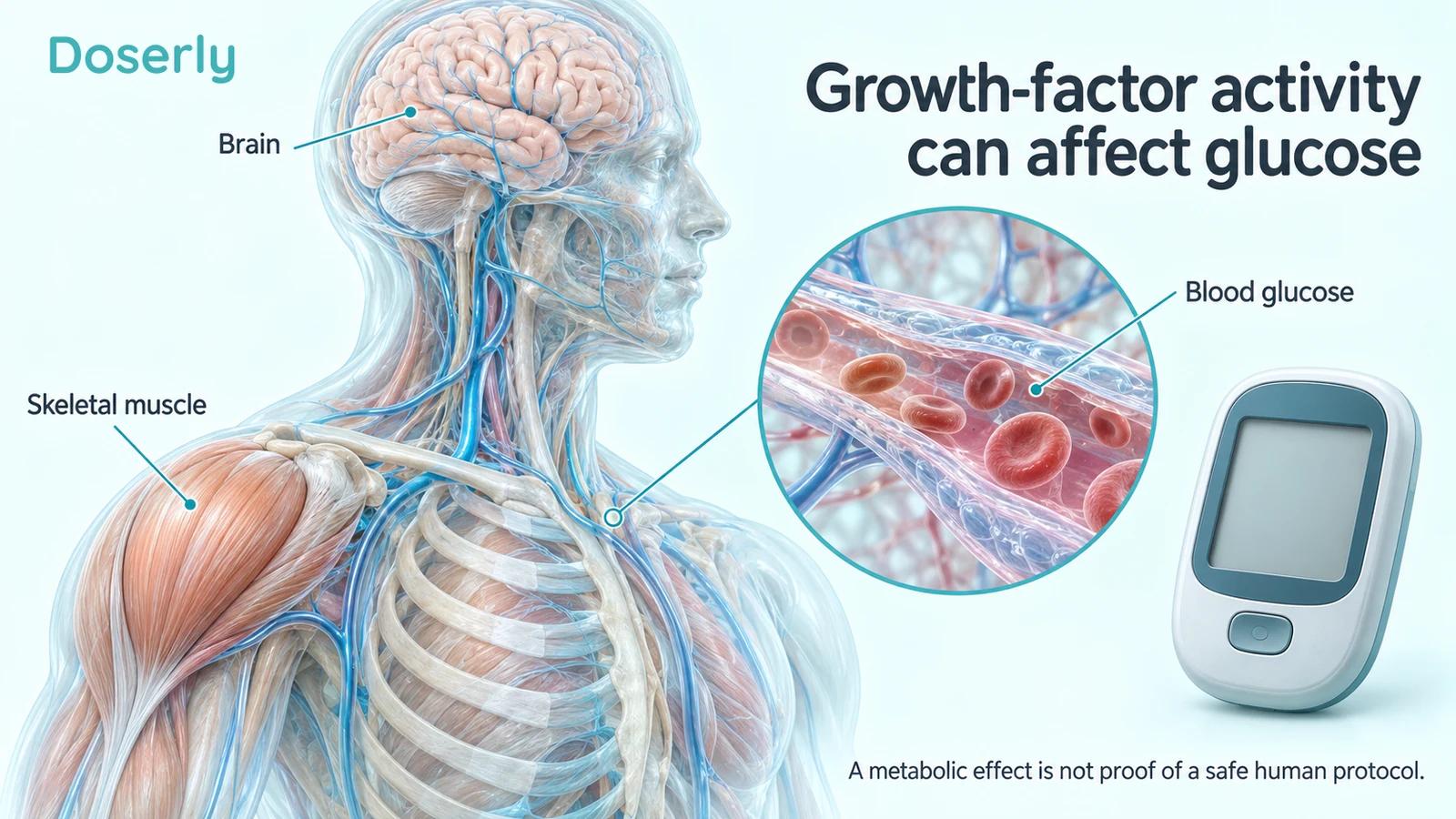
IGF stands for insulin-like growth factor. The name does not mean that IGF-1 and insulin are identical, but it signals that growth and metabolism are connected in this biology. LR3 is a modified IGF-I analogue with reduced affinity for IGF-binding proteins, developed for research applications. Manufacturer documentation
A claim about growth-related activity therefore cannot be evaluated independently of glucose handling. The same experimental intervention can change a desired tissue measure and an unwanted metabolic measure.
The exact pathway behind a glucose change can involve more than one process. An observed fall in blood glucose does not prove which receptor or tissue caused all of it. For practical risk interpretation, the observed glucose effect is important even when every mechanistic contribution has not been resolved.
That is a better basis for caution than treating a diagram of a signalling pathway as if it predicted the response of every person.
The acute pig experiment directly included LR3
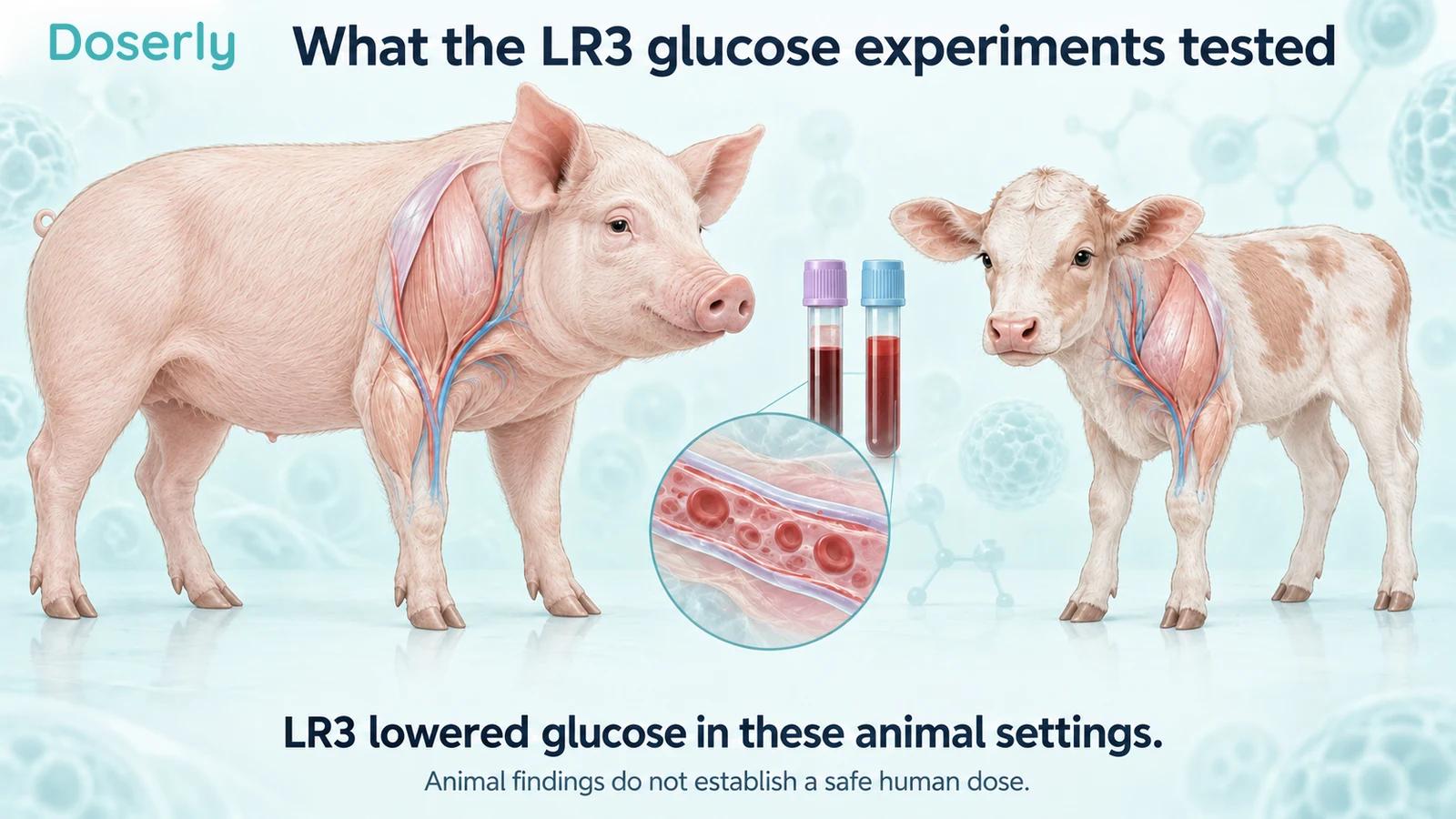
A 1997 study compared native IGF-I with several variants in pigs and marmosets. The pig experiments included LR3. Investigators collected serial blood samples before and for four hours after acute administration and compared the depth and persistence of glucose lowering. Tomas and colleagues
The variants showed more potent and prolonged glucose-lowering effects than native IGF-I under the tested conditions. The paper also distinguished the lowest glucose concentration reached from the cumulative suppression over the observation period.
Those are different ways of describing a response. Two interventions could reach similar minimum values yet keep glucose lower for different lengths of time. Looking only at the lowest point can miss that difference.
The study's title requires careful reading: the marmoset experiments compared native IGF-I with des(1-3)IGF-I, not LR3. The direct LR3 evidence in this paper comes from pigs. It would be inaccurate to claim that the study tested LR3 in both species.
A neonatal calf study reinforces the route distinction
A separate experiment in newborn calves compared oral and subcutaneous Long R3 IGF-I during the first week of life. Injected LR3 lowered circulating glucose and insulin, while orally administered LR3 did not produce the same effects in that protocol. Hammon and Blum, 1998
This is direct evidence of a glucose effect in another animal setting. It is not evidence that an oral product is effective, safe or equivalent to an injected product in humans.
The route matters because an amount administered is not the same as an amount reaching the relevant tissue. Age matters too: a neonatal calf is a particular physiological model, not a small adult human.
The useful conclusion is limited but meaningful. Glucose lowering is an observed LR3 effect under experimental conditions, and the delivery method can change what happens.
Why a pig study without glucose lowering does not cancel those findings
Another 1997 study infused LR3 over four days in finisher pigs. It found changes in endogenous hormones, binding proteins, food intake and growth, while plasma glucose was unaffected by the tested treatments. Dunaiski and colleagues
At first glance, this may seem inconsistent with the acute study. But an acute challenge and a multiday infusion are different experiments, with different exposures and observation conditions.
A result without a glucose change is useful evidence about that protocol. It does not establish that LR3 cannot lower glucose in another setting. Conversely, a glucose-lowering result does not mean every administration must produce a clinically severe episode.
This is why the most responsible explanation avoids both certainty and dismissal. The evidence supports a hazard, while its expression depends on conditions that have not been adequately characterized for consumer use.
Faster clearance does not supply a safe waiting period
Reduced binding-protein affinity is sometimes used to claim that LR3 has a particular long duration. Other explanations argue that faster clearance should make its effects short. Neither shortcut is reliable.
In a 1993 comparison, LR3 cleared from rat plasma faster than native IGF-I. The later glucose experiments nevertheless described prolonged metabolic responses with low-binding IGF variants. Clearance study, Glucose-response study
Blood concentration and biological effect are different measurements. A substance can become less measurable in blood while a downstream response continues, and circulating material can remain measurable without telling us the magnitude of every tissue effect.
These studies do not establish how many hours a person should consider themselves at risk after an uncertain LR3 exposure. A clock-based rule inferred from animal clearance is not a validated monitoring plan.
A fetal sheep study adds concern, with important limits
A study published in 2025 investigated LR3 in growth-restricted fetal sheep. The investigators reported four fetal deaths in the setting of treatment, accompanied by low glucose and low oxygen. Their discussion considered the vulnerable fetal model, variation in fetal size and exposure, and the difficulties of interpreting those outcomes. White and colleagues
This finding should not be converted into a mortality percentage for adults. Fetal growth restriction, placental insufficiency and direct fetal infusion are very different conditions.
It should not be omitted simply because the model is distant from adult use, either. It shows that a growth-related rationale did not guarantee an improved outcome and that metabolic and oxygen-related problems occurred in a vulnerable experimental setting.
The paper also illustrates why an average result among animals completing a study cannot stand in for all outcomes. Losses and exclusions need to remain visible when interpreting safety.
What mecasermin tells us, and what it cannot tell us
Mecasermin is recombinant human IGF-1, not LR3. Its US label warns of hypoglycemia, including severe episodes with seizures, and gives product-specific instructions for administration and monitoring. Increlex prescribing information
This makes the glucose concern clinically plausible across related biology. It does not establish the LR3 event rate or authorize copying mecasermin instructions.
The difference is especially important when someone proposes simply adding food around an LR3 routine. Instructions developed for an approved medicine and defined patient population do not validate a different molecule, uncertain formulation or untested exposure.
Clinical precautions are not interchangeable accessories that make any related compound safe. They are part of a specific treatment system with a known product, indication and professional follow-up.
The oncology conjugate is another distinct exposure
A phase I study of IGF-methotrexate enrolled 17 patients with advanced malignancies. The intervention linked an IGF variant to methotrexate, and grade 3 hypoglycemia was a dose-limiting toxicity. Venepalli and colleagues, 2019
That finding belongs to the conjugate and its cancer-study setting. It is not a direct estimate of risk from unconjugated LR3.
The trial is useful because it shows why closely related names require careful handling. It would be wrong to present it as a bodybuilding study, or to use its pharmacokinetic measurements as the human half-life of a separate LR3 product.
A related intervention can contribute to biological concern without answering a product-specific clinical question.
Recognizing a possible episode
Low glucose can cause shakiness, hunger, dizziness, sweating, palpitations, weakness or confusion. Severe episodes can involve seizures or loss of consciousness. Symptoms can vary, and some people do not recognize early warning signs. NIDDK guidance
Those symptoms are not specific enough to diagnose the cause on their own. Feeling shaky does not prove that a product contains LR3; feeling normal does not establish that glucose is normal.
If symptoms follow an uncertain exposure, obtain prompt medical advice and provide the product information. Do not treat the episode as evidence that the substance is “working,” and do not repeat the exposure to test the theory.
If alert and able to swallow, a person with a low glucose reading should follow their established hypoglycemia plan. NIDDK describes taking 15–20 grams of fast-acting carbohydrate and rechecking after 15 minutes for a low reading. Persistent or recurrent symptoms require medical help, especially after an uncertain product exposure. NIDDK treatment guidance
What to tell the clinician
Useful information includes the name on the product, supplier, timing, stated amount, other medicines or substances, food intake, exercise, symptoms and any measured glucose values. Keep the packaging available if possible.
A record can help reconstruct events, but it cannot establish the chemical identity or concentration of an unverified product. Describe what the label says separately from what is known about its contents.
People using prescribed glucose-lowering treatment should not independently change it to compensate for an LR3 experiment. The clinical discussion needs to consider the whole medication history, rather than assuming one new substance explains every reading.
The aim is to support assessment, not to build a self-directed protocol around an adverse response.
A monitor does not turn uncertainty into safety
A glucose reading can help identify a current problem. It cannot authenticate a product, rule out other adverse effects or prove that the next exposure will behave the same way.
Likewise, a normal reading at one moment does not document the entire period after administration. A tracking device answers a measurement question within its capabilities; it does not supply the missing clinical evidence for an intervention.
For broader context, see the Doserly IGF-1 LR3 guide. The evidence supports taking low glucose seriously, while leaving the human risk magnitude and timing unresolved. That uncertainty is a reason for clinical caution, not a reason to invent a precise safety schedule.
Sources
- Acute IGF-variant glucose effects in pigs and marmosets
- Injected and oral LR3 in neonatal calves
- Multiday LR3 infusion in pigs
- Binding and clearance experiments
- LR3 in growth-restricted fetal sheep
- Increlex US label
- IGF-MTX phase I trial
- Repligen LR3 description
- NIDDK low-glucose information
- NHS hypoglycemia guidance