
Peptides
October 16, 2026
IGF-1 LR3 and cancer concerns: what the evidence can establish
On this page
IGF-1 LR3 raises a reasonable cancer question because it interacts with a growth-factor system that is relevant to tumour biology. The available evidence supports taking that concern seriously. It does not provide a reliable percentage for the cancer risk of an adult using an LR3 product.
Two confident claims therefore go beyond the evidence: that LR3 inevitably causes cancer, and that it is safe because a definitive human cancer study has not demonstrated harm. The useful discussion lies between them, with careful attention to the substance, population and outcome actually studied.
There are several kinds of evidence to consider: experiments involving an existing animal tumour, studies of people's naturally occurring IGF-I, warnings for the prescription drug mecasermin, and research on IGF-linked chemotherapy. They are relevant for different reasons. They cannot be combined as if they were repeated trials of the same LR3 product.
Why growth-factor biology raises the question
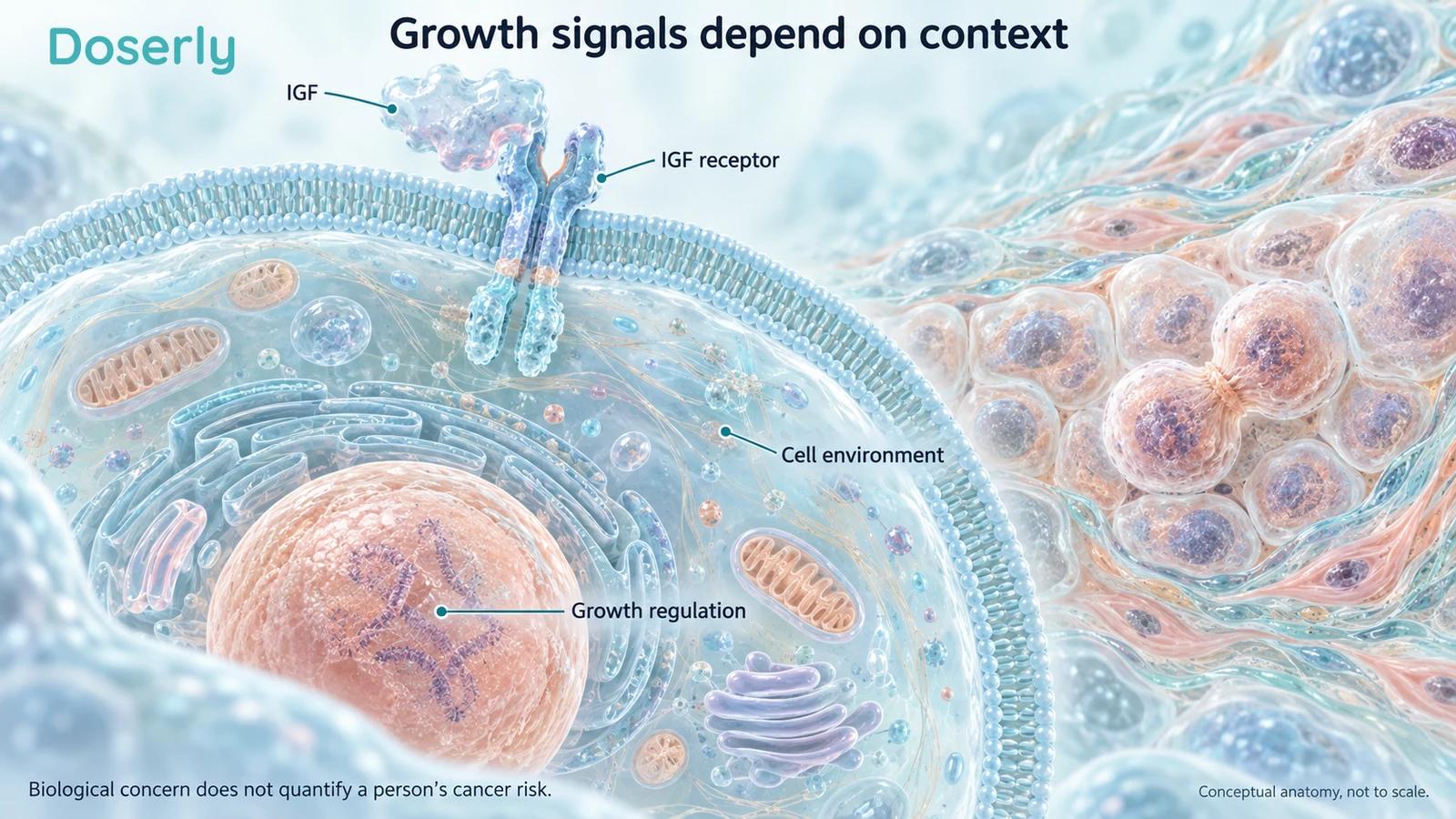
IGF-I is part of the body's growth and metabolic signalling system. LR3 is a modified analogue, with an amino-acid substitution and an extension, that has reduced binding to IGF-binding proteins. Repligen describes it as a cell-culture supplement, where its growth-promoting properties are useful for laboratory applications. Manufacturer information
That description explains why researchers might investigate it. It does not establish which tissues would respond safely in a person or whether a commercial research product has predictable exposure.
Cancer research has also examined the IGF-I receptor as a potential route for targeting tumour cells. A 2009 experiment used an IGF variant to deliver a chemotherapy drug to cells expressing this receptor. Primary conjugate study
A pathway's involvement in growth makes safety questions biologically plausible. It does not mean that every activation initiates a tumour. The important questions include the cells present, their existing abnormalities, the exposure and the surrounding biological environment.
For the reader, the distinction is practical: a plausible mechanism can justify concern without providing a personal risk estimate.
Cancer initiation and tumour growth are different outcomes
Cancer incidence counts new diagnoses in a defined population over time. A study of incidence needs a population at risk, follow-up and a way to compare outcomes.
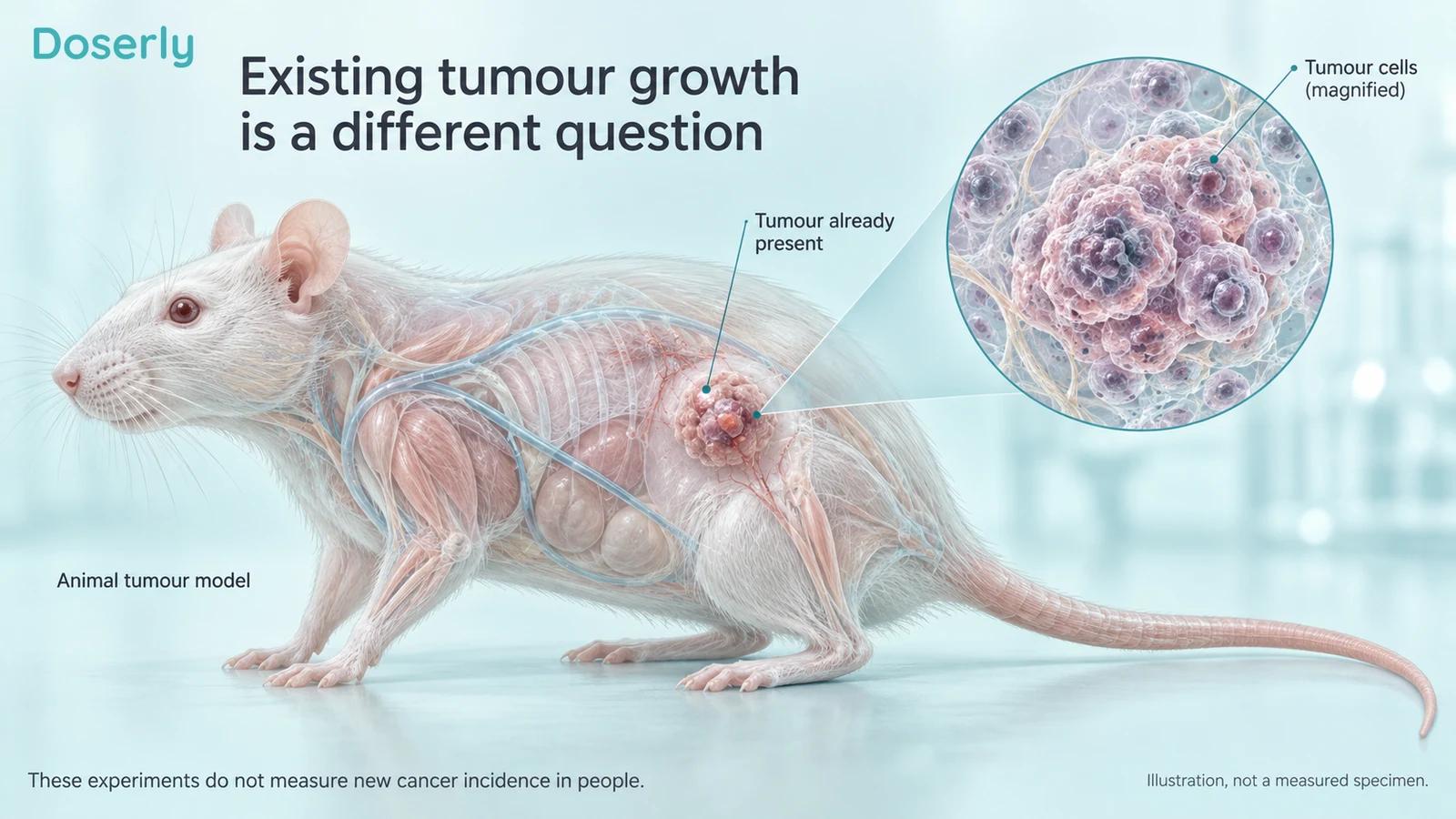
Tumour growth asks how an already established tumour behaves. Researchers can investigate that in an animal model over a much shorter period. Such an experiment may reveal a hazard, but it does not measure how often a previously cancer-free person will develop a new cancer.
These outcomes also differ from changes in cell number in a dish. Cell culture can isolate a response, while an intact animal includes metabolism, circulation, food intake and interactions between host and tumour.
Keeping these distinctions visible prevents a misleading translation: “an existing animal tumour grew more” becoming “this percentage of users will develop cancer.” It also prevents the opposite dismissal, in which an animal finding is ignored simply because it cannot supply that percentage.
What the direct LR3 rat experiment found
A 1994 study investigated IGF-I and LR3 in rats already bearing a mammary adenocarcinoma. Treatment lasted six to seven days after tumours had reached approximately 5% of body weight. This was an established tumour model, not an experiment measuring new cancer development in healthy animals. Tomas and colleagues
The investigators reported increased tumour growth with the IGFs, particularly LR3. LR3 did not produce a positive effect on carcass protein accumulation. Food intake, insulin and glucose also changed, illustrating that the intervention affected the host as well as the tumour.
One especially instructive finding was that the peptides did not promote growth of that adenocarcinoma in cell culture, despite the tumour-growth result in the animals.
That discrepancy makes a negative dish experiment a poor basis for declaring whole-body safety. It does not identify the exact human consequence, but it shows why a simplified assay may miss interactions that matter in an intact organism.
A later mouse study needs more precise wording
A 2019 study examined muscle wasting in mice bearing C26 tumours. LR3 was one of several interventions. It limited loss of some muscle mass, but did not preserve grip strength. Levolger and colleagues
The abstract describes accelerated tumour growth. The detailed results are more qualified: tumour weights were higher in the LR3 group, but the comparison with untreated tumour-bearing mice was not statistically significant, with a reported p value of 0.08.
That result should not be rewritten as a definitive increase. Equally, a comparison that did not cross the study's significance threshold does not establish that the treatments were equivalent or that LR3 was safe.
The useful reading is that this experiment raised a tumour-growth concern alongside limited muscle outcomes, with uncertainty around the size and reliability of the tumour difference. It does not establish cancer incidence in people, nor a suitable treatment for cancer-related muscle loss.
What human studies of native IGF-I contribute
Human observational research gives another perspective, but it studies a different exposure.
A UK Biobank analysis included 394,388 participants without cancer at the start and followed them for an average of 6.9 years. Higher circulating native IGF-I was associated with higher risks of colorectal, breast, prostate and thyroid cancers. Associations were not uniform: ovarian and liver cancer showed inverse associations. Knuppel and colleagues
This was not an LR3 trial. Investigators measured the body's circulating IGF-I and examined later diagnoses. The paper also acknowledged possible reverse causality, meaning disease processes could influence the measured hormone rather than the hormone alone explaining the disease.
A separate analysis pooled individual participant data from 12 prospective studies of IGFs, binding proteins and prostate cancer. It likewise concerns circulating endogenous factors and subsequent cancer risk, rather than administration of an LR3 product. Roddam and colleagues
Together, these studies make the IGF system relevant to cancer research. They do not supply a conversion from an LR3 exposure to a person's added risk.
Why a relative association cannot become an LR3 risk calculator
Imagine a claim that takes a relative association from an IGF-I cohort and applies it to a proposed LR3 regimen. Several missing steps are hidden inside that calculation.
The cohort did not establish the user's exposure to the analogue. It did not measure the contents of their product, how much reached particular tissues or how long relevant signalling lasted. It also did not randomly assign people to the proposed regimen.
Even for the original population, a relative association is not an absolute probability. A meaningful absolute estimate needs the baseline risk, outcome definition and time horizon. A percentage without those details can sound much more personal and precise than the underlying research allows.
This is not a reason to disregard observational work. It is a reason to use it for the question it addresses: whether a measured biological factor is associated with later disease in a particular population.
For LR3, the reviewed evidence does not provide a validated personal cancer-risk calculator.
The mecasermin warning is relevant, but belongs to mecasermin
Mecasermin is recombinant human IGF-I used for a defined paediatric growth indication. It is not LR3.
In January 2020, the UK Medicines and Healthcare products Regulatory Agency issued advice about benign and malignant neoplasia reported with mecasermin. Its review found that most reported cases occurred outside the authorised indication or above the maximum dose, although some occurred within the authorised indication and dosing. MHRA safety update
This matters because it shows that tumour-related concerns in the IGF field are not confined to laboratory speculation. However, it does not establish the rate, mechanism or causation of cancers after LR3 use.
The warning also defeats a simplistic argument that a related prescription medicine proves research-market LR3 is safe. Approval applies to a particular product, indication and clinical framework; it is not a general endorsement of all molecules acting through a related system.
Someone prescribed mecasermin should discuss its product-specific advice with the treating specialist. This article does not replace that care or translate paediatric prescribing rules into an adult LR3 protocol.
Why IGF-linked chemotherapy is not evidence that LR3 treats cancer
Search results can appear contradictory: one paper raises tumour-growth concerns, while another reports an IGF-related treatment inhibiting tumours.
The formulation resolves much of the apparent contradiction. The 2009 preclinical study linked methotrexate, a chemotherapy drug, to an engineered IGF variant. The resulting conjugate was intended to direct the drug toward tumour-related targets. It was a chemically linked product, not plain LR3. Conjugate experiment
A later phase I study enrolled 17 patients with advanced malignancies and tested an IGF-methotrexate conjugate containing the IGF variant 765IGF. Its purpose included finding a tolerated exposure for that investigational cancer treatment. Venepalli and colleagues
Neither study establishes that an unconjugated LR3 product prevents cancer. Neither establishes safety for otherwise healthy people pursuing muscle gain.
An ingredient or targeting component cannot inherit the complete effect of a drug conjugate. Removing the attached chemotherapy changes the intervention being discussed.
What evidence would make the human safety question clearer?
A useful human evidence base would need to identify the actual product and exposure, define the population, collect adverse outcomes systematically and follow participants long enough to address the outcome of interest.
It would also need an appropriate comparison. A collection of people who report feeling well after exposure cannot establish whether a later diagnosis occurred more or less often than expected.
Product verification matters because a label alone does not establish what was administered. Outcome verification matters because “no reported cancer” could mean several things: no diagnosis occurred, follow-up was incomplete, the observation period was short or nobody collected the information systematically.
These requirements explain why the answer remains uncertain. They do not imply that a study must prove harm before a person can reasonably decide against exposure. Decisions can account for a plausible hazard, an uncertain benefit and the absence of a dependable way to quantify the trade-off.
What a normal blood result cannot settle
A circulating IGF-I value does not, by itself, answer whether an LR3 product is authentic or establish that an individual is free of cancer risk. The observational studies above compare groups and later outcomes; they were not designed as a clearance test for analogue use.
Likewise, feeling well after an exposure does not measure a long-term outcome. Immediate tolerability and later cancer risk are separate questions.
It would be misleading to offer a particular IGF-I number, a generic scan or a home monitoring routine as a way to make LR3 use cancer-safe. The studies reviewed here do not validate such a strategy.
If someone has a cancer history, is undergoing investigation or is receiving treatment, that clinical context belongs in a discussion with the treating team. The relevant question is how an exposure could affect their actual condition and care, not whether an internet threshold appears reassuring.
A useful conversation starts with accurate information
If LR3 use or planned use is part of a medical discussion, bring the product label, available batch information, exposure dates and a list of other medicines or substances. Explain the intended benefit as well as any symptoms or concerns.
Those details help the clinician understand what is known and what remains uncertain. They should not be presented as proof that the product was pure or that the exposure was safe.
The Doserly IGF-1 LR3 guide provides broader context on the analogue and the limits of its evidence. For cancer specifically, the defensible conclusion is measured but consequential: direct animal findings and related human evidence justify concern, while the available studies do not quantify an adult LR3 user's risk.
Avoiding certainty in either direction does not mean treating the options as equally reassuring. It means acknowledging the hazard signals without inventing a prediction, and making decisions without mistaking missing evidence for demonstrated safety.
Sources
- Repligen Long R3 IGF-I molecular and product information
- IGFs in tumour-bearing rats
- LR3 in a mouse cancer-cachexia experiment
- Circulating IGF-I and 30 cancers in UK Biobank
- Individual participant analysis of IGFs and prostate cancer
- MHRA mecasermin neoplasia warning
- Preclinical IGF-methotrexate conjugate
- Phase I IGF-methotrexate study