
Peptides
October 16, 2026
Humanin and memory: what the research has actually tested
On this page
Humanin became interesting to neuroscience because it protected cells exposed to particular Alzheimer’s-related stresses. Later experiments tested modified Humanin in mice, while human studies examined naturally occurring peptide levels, genetic variation and cognitive measures. Those are meaningful lines of research. Together, they still do not establish that taking Humanin improves memory in people.
The important question is not whether a paper mentions humans or memory. It is whether researchers administered a defined molecule to people and demonstrated a worthwhile cognitive benefit against an appropriate comparison. The studies below do not supply that answer. They do explain why researchers continue to investigate the idea, and what would make the next results more useful.
Doserly’s Humanin guide introduces the peptide and its wider research context. Here, the focus is narrower: how cell survival, mouse behavior, human genetics and blood measurements contribute different pieces to the memory question.
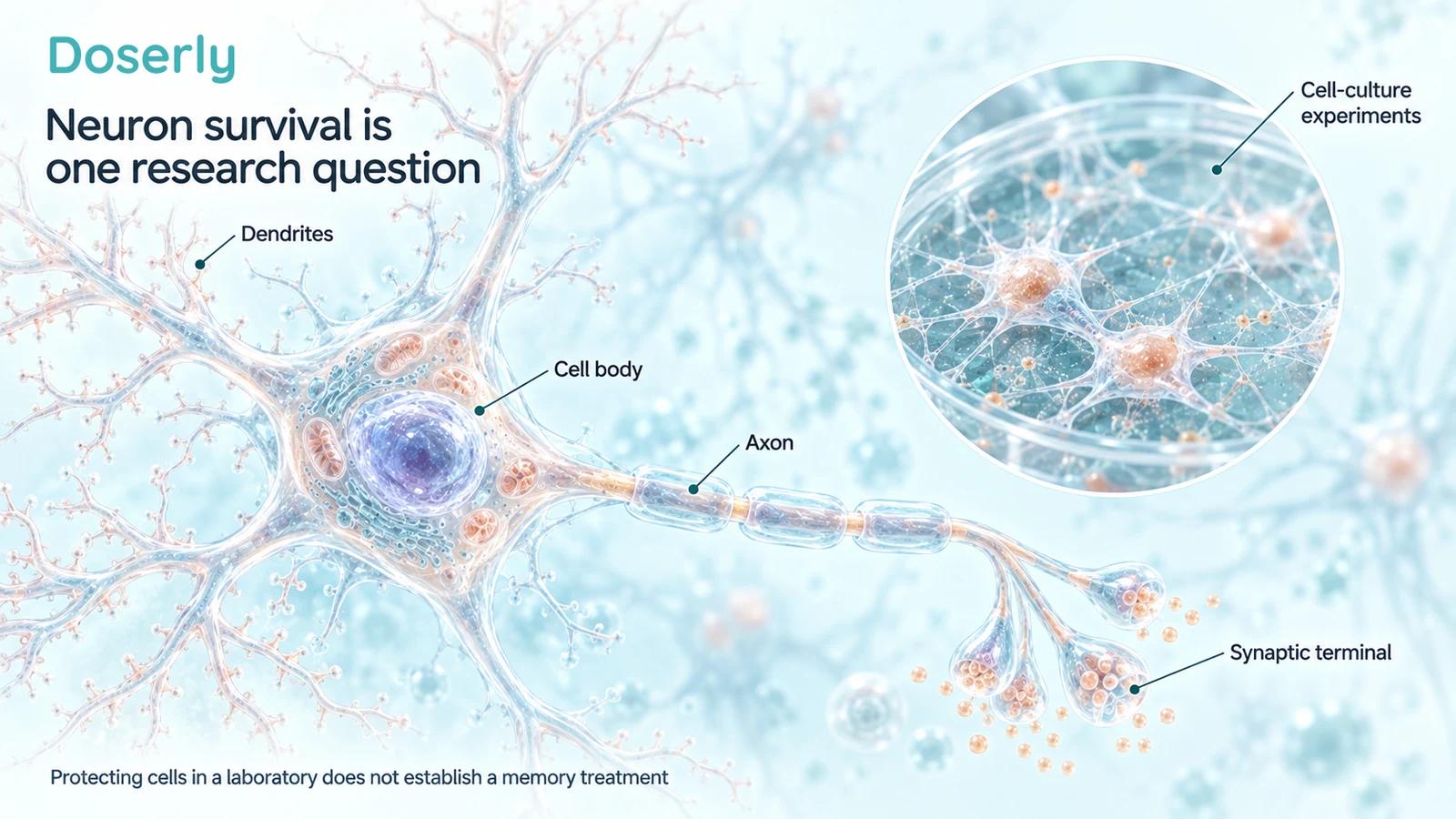
Humanin’s neuroscience story began with laboratory cell protection. This conceptual anatomy illustration does not depict a demonstrated treatment effect in a human brain.
The discovery was about surviving cells
In a 2001 PNAS paper, Hashimoto and colleagues used a functional screening approach to identify Humanin. In their experimental systems, it protected neuronal cells against several familial Alzheimer’s disease gene-related insults and amyloid beta. Protection depended on the peptide’s structure; it did not extend to every other toxic challenge they tested. That specificity was part of the result, not an inconvenient exception. Original discovery study.
A cell experiment can ask a tightly controlled question: does adding or expressing this molecule change survival after this particular insult? That is useful for identifying mechanisms and choosing candidate compounds. A memory question requires more. Cells must participate in functioning circuits, the intervention must reach its target, and any benefit must persist within the complexity of a living person.
This difference also changes what “neuroprotective” means. In a laboratory paper, it may describe fewer cells dying in a specified assay. In everyday conversation, people may hear it as preventing dementia or preserving independence. The latter claims require outcomes that the former experiment never measured. Reading the word alongside the actual experimental endpoint prevents that expansion.
Nor does selective protection make Humanin a universal shield for brain cells. A positive result under one challenge is a reason to investigate related pathways. It cannot establish activity against every cause of cognitive impairment, particularly when the original experiment itself showed limits to the protective response.
A modified peptide changed some outcomes in mice
Niikura and colleagues subsequently studied S14G-Humanin, often called HNG, in triple-transgenic Alzheimer’s-model mice. The 2011 paper used repeated intranasal administration. After several months, treated male mice performed better on selected spatial-memory measures. The female behavioral comparison was not statistically significant, and novel-object recognition did not show a significant treatment effect. Amyloid-related findings also varied by measurement and sex. Mouse study and full methods.
The restrained description matters. “Improved memory in mice” can sound as though every behavioral task and both sexes agreed. They did not. Different tests address different aspects of behavior, and the pattern of results helps define what should be replicated. The study offers a specific experimental lead, rather than a general guarantee that the peptide improves cognition.
HNG also needs its own name. A substitution at amino-acid position 14 makes it a modified molecule rather than native Humanin. A study using HNG cannot automatically establish the activity, exposure or safety of another preparation sold under the broader Humanin name. Molecular identity belongs in the conclusion as well as the methods.
The route matters for the same reason. Delivery through a mouse’s nose does not establish what an injection, oral product or differently formulated spray would do in a person. These are different exposure questions. Repeating the research dose without the research setting would not reproduce the study, and converting a mouse experiment into a personal regimen would leave the central human questions unanswered.
Human genetics adds relevance without testing treatment
A 2018 Scientific Reports paper combined experimental work with human genetic analyses. A mitochondrial variant, rs2854128, was associated with lower circulating Humanin in one cohort and with cognitive-aging measures in a separate older-adult cohort. The human analyses examined variation that people already carried. They did not assign participants to Humanin treatment. The same publication’s mouse intervention work must therefore be read separately from its human findings. Cognitive-aging and genetic study.
Genetic evidence can strengthen the case that a biological pathway deserves attention. It can also be more difficult to interpret than the phrase “Humanin gene” suggests. A variant is present throughout life, within a mitochondrial genetic background, and may relate to biology beyond a single circulating measurement. Giving a peptide later in life is a different intervention with a different duration and context.
Likewise, a calculated cognitive-age measure is an analytical outcome. It is not a measurement of years of life restored, and a between-group difference does not describe how many years an individual would gain from treatment. The appropriate next question is whether a proposed intervention can reproduce a useful part of the association safely, not whether a genetic result has already supplied the prescription.
A practical reading habit is to look for the verb attached to the human participants. Were they genotyped, sampled, followed, or treated? A paper can contain all four kinds of evidence across different experiments. Keeping those verbs attached to the correct population prevents a compelling title from doing more work than the study design supports.
The newer blood-marker research asks another question
A 2025 case-control study compared people with Alzheimer’s disease, mild cognitive impairment and subjective cognitive decline. Researchers assessed Humanin and MOTS-c transcripts and measured circulating proteins. The reported transcript differences did not translate into plasma protein concentrations distinguishing Alzheimer’s disease from mild cognitive impairment. This is a useful reminder that gene-expression measurements and peptide concentrations are different observations. Biomarker study.
The study’s diagnostic comparisons do not establish a treatment effect. They also do not mean that a single Humanin blood result can diagnose the cause of someone’s memory concern. A candidate biomarker needs to work reliably outside the sample in which it was explored, with a defined assay, a relevant comparison population and a clear role in clinical decision-making.
Consider what an individual would need from such a test. Would the result change the next investigation? Would it distinguish conditions that otherwise look similar? Would it add useful information to the assessment already available? Would the same result mean the same thing in a different laboratory? A group-level association is the beginning of those questions.
Even a genuinely useful diagnostic marker would not automatically become a replacement target. A low value could accompany illness without being the missing ingredient that caused it. Conversely, raising a measured value could leave the underlying disease unchanged. Diagnosis, mechanism and treatment are separate jobs, and a molecule can succeed in one without succeeding in the others.
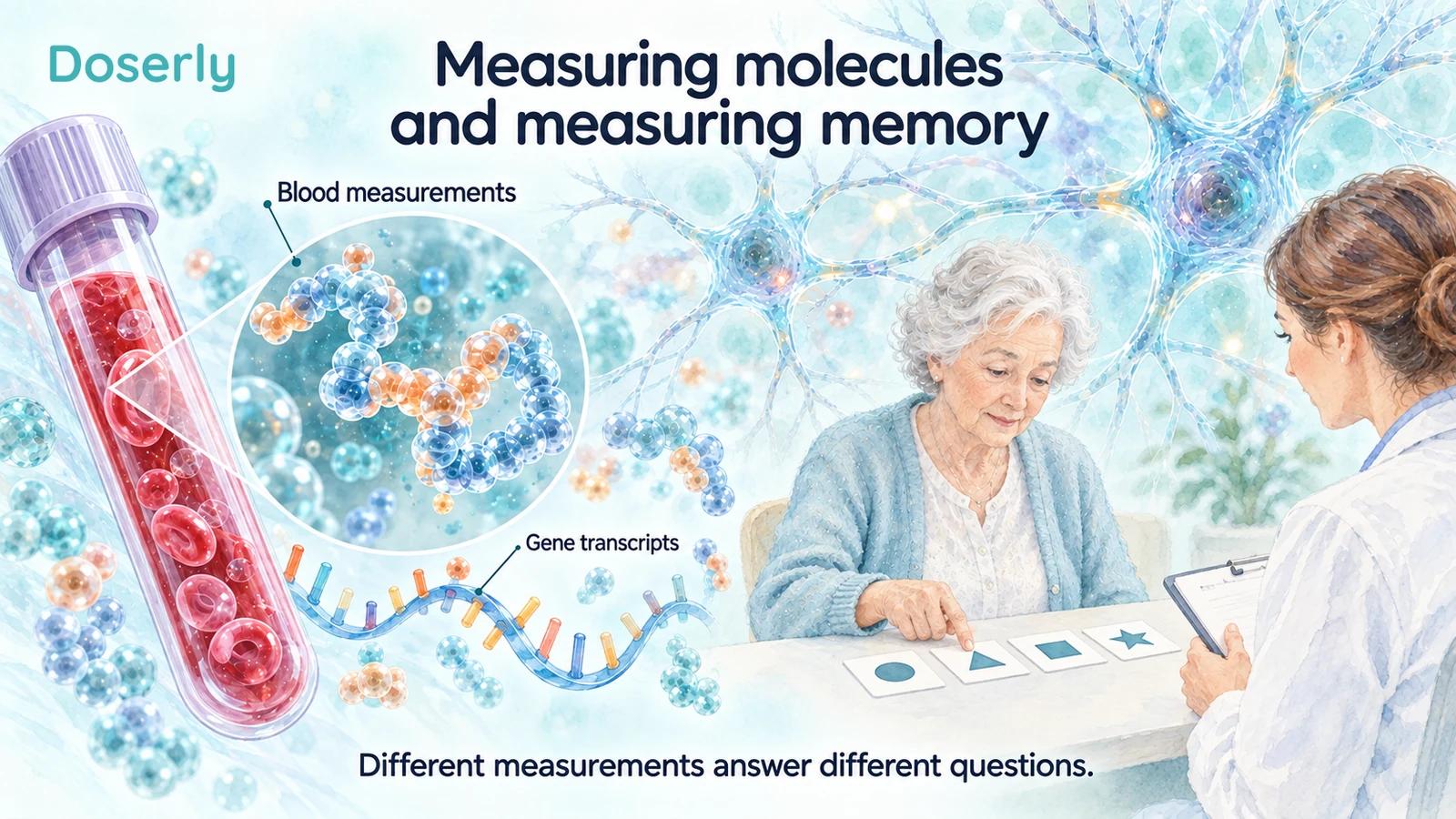
RNA, circulating peptide and cognitive performance are different measurements. Their relationships need testing; the illustration does not imply that a blood value predicts an individual’s memory.
Exposure has to be demonstrated for the actual candidate
A rodent pharmacokinetic study compared Humanin analogues and found that molecular changes and animal species altered their circulating behavior. It also examined tissue detection. Those results help explain why potency in a dish cannot substitute for knowing where a candidate travels and how long it remains available. They do not provide human brain exposure or a human dosing schedule. Humanin analogue pharmacokinetics.
For a memory treatment, “reaches the brain” would itself be incomplete. Researchers would need to identify what was detected: intact active peptide, a labeled component, or a signal from an antibody assay. They would need to connect exposure to a plausible target effect and, eventually, to an outcome that matters. A beautiful image of a peptide beside a neuron does not answer those analytical questions.
This is also why a product’s claimed purity cannot resolve the clinical uncertainty. Chemical identity and preparation quality are necessary questions, but they do not establish a beneficial exposure range, long-term safety or cognitive efficacy. Each belongs to a different part of development. Evidence about one cannot silently stand in for the others.
A registered Humanin study may be observational
ClinicalTrials.gov includes NCT03431844, a study of Humanin isoforms in cardiac muscle and plasma around cardiac surgery. The record identifies an observational cohort, with actual enrollment of 106. It concerns measurements and postoperative outcomes, not administering Humanin to improve memory. Official study record.
Its relevance here is interpretive: finding a peptide name on a trial registry is not enough to claim that the peptide has undergone therapeutic testing. The intervention field, study type, population and endpoints must match the assertion. An observational cardiac study cannot be repurposed as evidence for an Alzheimer’s intervention.
The literature and registry checks for this article did not identify a completed controlled human Humanin treatment study establishing a memory benefit. That is a dated search conclusion, not a claim that every registry and unpublished experiment worldwide has been exhausted. It is also a more accurate statement than treating any human-associated record as proof of clinical efficacy.
What a convincing memory study would need to show
A useful clinical study would start with a clearly specified candidate and population. Healthy adults concerned about ordinary forgetfulness, people with mild cognitive impairment and people with diagnosed Alzheimer’s disease are not interchangeable groups. The expected course, acceptable risks and meaningful endpoints differ.
The study would then need a comparison capable of separating treatment effects from expectation, repeated testing and ordinary fluctuation. Cognitive tests can become more familiar with practice. Participants may also change sleep, activity or other treatments during follow-up. Randomization, blinding and a prespecified analysis help address those explanations rather than assuming every improvement belongs to the experimental peptide.
The endpoint should match the proposed benefit. A short-term test score might justify further investigation; a claim about preserving independence needs evidence about everyday function and sufficient follow-up. Biomarkers could help explain an effect, but they should not be substituted for the clinical outcome after results are known.
Safety would need equal attention, including treatment discontinuations and outcomes beyond cognition. A cell-survival pathway may have effects elsewhere in the body. Establishing a worthwhile treatment means weighing the complete pattern of benefit and harm for a particular use, rather than selecting the most encouraging laboratory readout.
What to do with a real memory concern
Persistent changes in memory deserve assessment on their own terms. The National Institute on Aging advises discussing noticeable changes with a clinician and explains that medication effects, sleep problems, mood conditions and other medical issues can contribute. Trouble with familiar tasks, repeated questions or getting lost deserves attention beyond a peptide blood test. NIA guidance on memory problems.
For that conversation, concrete observations are useful: when the change began, examples of tasks affected, medication changes and what someone close to you has noticed. These details help define the problem that needs evaluation. They are more actionable than assigning a cognitive-age meaning to an experimental Humanin result.
Humanin’s memory research remains a coherent scientific idea with several kinds of supporting experiments. The open question is whether a defined intervention can safely improve cognition or daily function in people. Keeping that question open preserves the value of the research while avoiding a promise the studies have not tested.
Sources
- Hashimoto et al., 2001: original neuronal-cell discovery.
- Niikura et al., 2011: S14G-Humanin in transgenic mice.
- Yen et al., 2018: cognitive aging and mitochondrial variation.
- Rodríguez-Esparragón et al., 2025: transcript and protein biomarkers.
- Chin et al., 2013: analogue pharmacokinetics in rodents.
- ClinicalTrials.gov: NCT03431844.
- National Institute on Aging: memory problems.