
Peptides
October 16, 2026
Humanin and long-lived families: what the human comparison found
On this page
Humanin is a small peptide studied for its role in cellular stress responses. It belongs to a group known as mitochondrial-derived peptides because their genetic origins are associated with mitochondrial DNA. Researchers are interested in whether these signals help explain why some organisms—and some families—remain healthy for unusually long periods.
One frequently cited finding comes from a 2020 study comparing 18 children of centenarians with 19 age-matched controls. The offspring group had higher circulating humanin. Nobody in that comparison received humanin treatment, and researchers did not show that raising a person's level would make them live longer. Yen and colleagues
That is still a useful observation. Studying long-lived families can reveal biological features worth investigating. But the humanin story becomes more interesting, and less straightforward, when it is placed beside other human studies. Some report lower levels with age or disease; others report higher levels at older ages and in less favorable health states. The question is not simply whether humanin is “good.” It is what a measurement means in a particular person and study.
Why study the children of centenarians?
A centenarian has already reached age 100. Comparing centenarians with much younger adults creates an obvious problem: almost everything associated with age differs between the groups. Comparing people at the same age who differ in family longevity can help investigators ask a more focused question.
In the 2020 study, researchers used a cohort centered on Ashkenazi Jewish families with exceptional longevity. They examined centenarians' offspring against age-matched controls. This approach asks whether a biological feature accompanies a family background associated with unusual longevity before every participant has reached extreme old age. It doesn't require pretending that a 70-year-old and a 100-year-old have comparable bodies. Study methods and Figure 5
Age matching reduces one important difference; it does not remove every difference. Families can share inherited characteristics, environments, food habits, health behaviors and opportunities. These may influence both health and a circulating peptide. The comparison identifies a relationship within that setting, rather than isolating humanin as the reason the family lives longer.
The participants' relationship to centenarians also matters when describing the headline. This was not a trial in which centenarians took humanin, and the key comparison was not a group of 18 people who had all already reached 100. “Children of centenarians” is a specific study population, not shorthand for everyone interested in healthy aging.
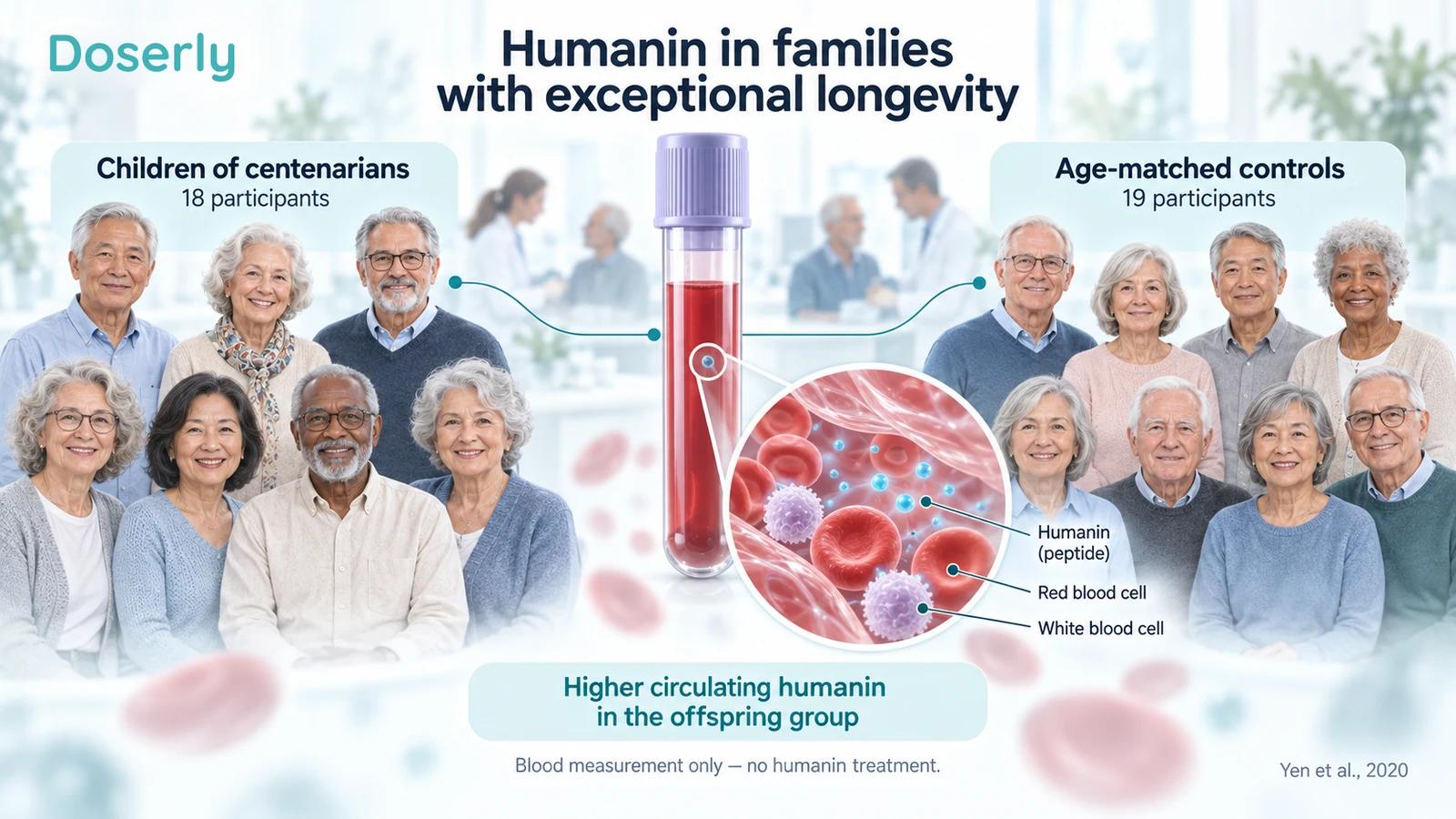
The actual comparison included 18 offspring and 19 controls. The people are symbolic illustrations, not portraits, a demographic reconstruction or a proportional participant count. Researchers measured circulating humanin; they did not administer it. Source.
What did the blood test show?
The researchers measured humanin in plasma using their laboratory's immunoassay after sample extraction. An immunoassay uses antibodies to detect a target. The result was higher humanin in the offspring group, with statistical significance reported for the comparison. Methods and results
That result doesn't supply a validated “longevity level” for an individual. A group comparison can find different averages while individuals' values overlap. A result obtained with a research assay also needs further validation before it can guide routine decisions. The paper did not establish a concentration at which treatment should begin or a target concentration that would improve survival.
There is another distinction between a snapshot and a trajectory. A higher level at one visit cannot tell us whether a person started life higher, declined more slowly, or changed because of their current health. The authors discussed such possibilities, but the comparison did not follow the offspring's humanin from birth through old age.
For someone asking whether to test their own humanin, those missing pieces are practical. A test is more useful when its result changes a decision in a way that improves health. An interesting difference between research groups is an earlier step in that process.
Did the same paper show longer life in animals?
The paper included several species and experimental approaches, which makes a single sentence about its results easy to misread. In genetically modified C. elegans worms, increased humanin expression was associated with longer lifespan. The experiment involved altering expression within the organism, not reproducing an injection schedule in people.
The mouse treatment experiment used HNG, a modified humanin analogue. Female mice began treatment at 18 months of age and were followed during a 14-month intervention. The investigators reported favorable changes in some metabolic and body-composition measures, but no significant difference in lifespan between the treatment groups. Animal results and methods
These are not contradictory sentences. Lifespan, body composition and resistance to a particular stress are different outcomes. An intervention may change one without changing another. Worm genetics, mouse analogue treatment and human blood sampling also ask different causal questions.
The distinction prevents a particularly misleading chain of reasoning: humanin was higher in long-lived families, an animal experiment changed lifespan, therefore injecting humanin has been shown to extend human life. Each step changes either the species, intervention or outcome. The original paper is valuable precisely because it contains several lines of investigation; none should silently take the place of another.
Our humanin guide explains the difference between native humanin and HNG, also called S14G-humanin. Keeping those names separate is essential when moving from blood measurements to experiments that administer a peptide.
Why another large study complicates the age story
A separate investigation measured humanin together with two other mitochondrial stress-related signals, FGF21 and GDF15, in 693 people aged 21–113. It reported higher levels in older groups, with the highest values in centenarians. The signals were also associated with less favorable health measurements and, among the oldest participants, lower survival. Conte and colleagues
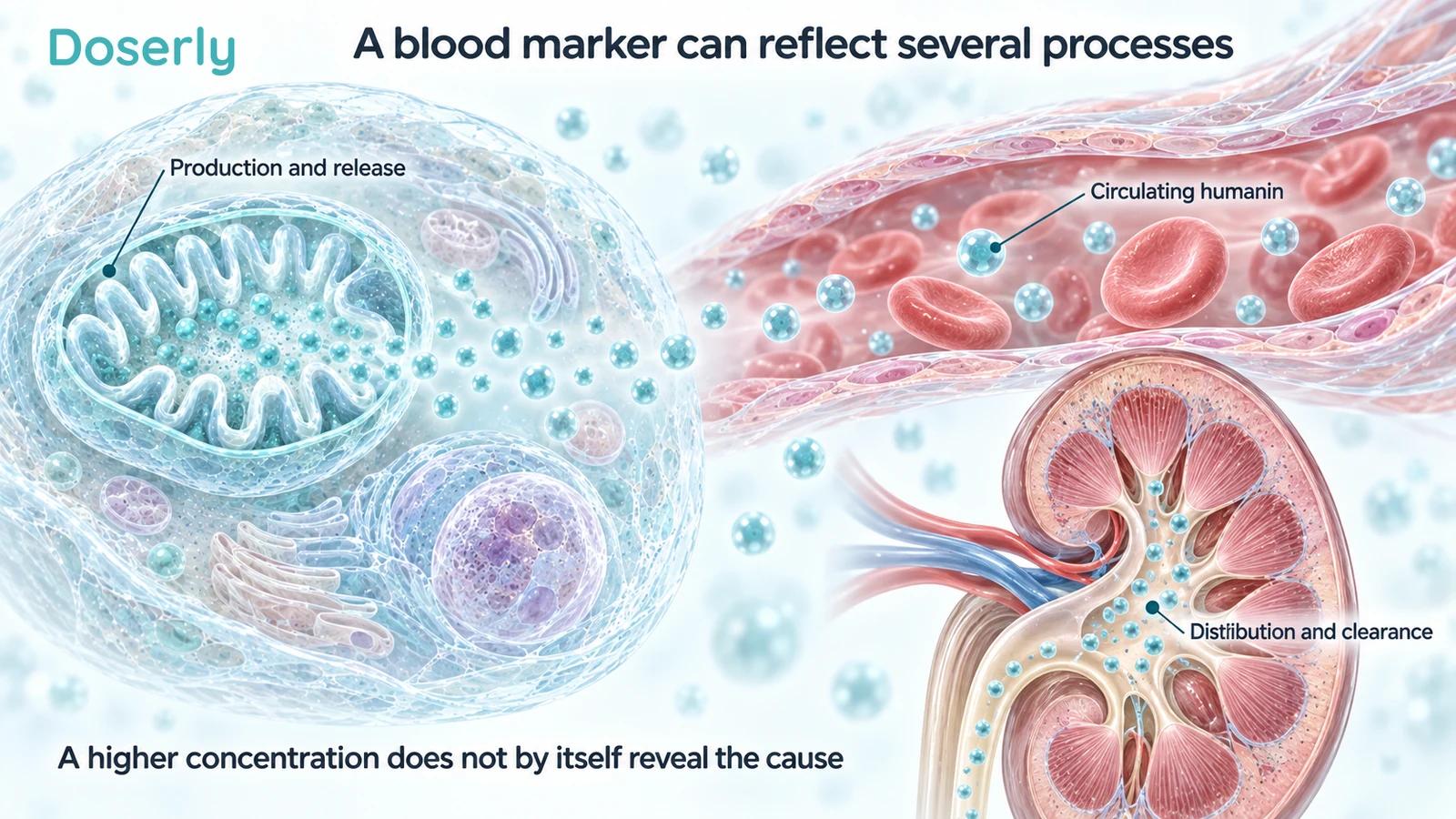
This does not prove that humanin causes poor health. A stressed body may increase a protective or compensatory signal. The higher measurement could reflect how much stress is present, how strongly the body responds, or other processes affecting concentration. Equally, an association with longevity does not establish that the signal is the cause of longevity.
It helps to distinguish two comparisons. Asking whether centenarians have higher levels than young adults is different from asking whether people of similar age with a long-lived parent have higher levels than their peers. The age ranges, selection criteria and surrounding biology differ. The 693-person study therefore should not be treated as a simple replication of the 18-versus-19 family comparison.
The authors interpreted their findings in terms of adaptation to stress, but that interpretation remains a model. It is a reason to investigate the underlying biology, not a license to call any high value protective or any low value a deficiency.
Disease can change the pattern again
A study of 569 adults aged 52–88 compared centenarians' offspring, healthy controls, people with type 2 diabetes with or without complications, and people with Alzheimer's disease. It reported disease-specific patterns rather than one uniform mitochondrial signature. Humanin was lower in the Alzheimer's group but not the diabetes groups relative to healthy controls; FGF21, a different signal, was particularly high in the offspring group. Disease-specific mitokine study
This matters because “mitokines were elevated” is not the same statement as “humanin was elevated.” Mitokine is a broad term for a mitochondrial stress-related signaling molecule. Several can be measured in the same paper, and their results need to be read separately.
Another cross-sectional study, in 225 participants, did find lower serum humanin in people with prediabetes and type 2 diabetes. Its control participants were younger, and the investigators acknowledged limitations involving body size, sampling and the inability to estimate certain fasting measures of insulin resistance. Ramanjaneya and colleagues
These studies do not establish that one is wrong simply because their findings differ. They do show why it is premature to reduce the literature to a universal rule that more humanin always means better health. Different populations and laboratory methods need to be considered before making that claim.
Hormonal context is part of the biology
Humanin also interacts with the broader hormonal environment. A 2014 study examined the growth hormone and insulin-like growth factor-I system, usually abbreviated GH/IGF-I. In a small group of children with growth hormone deficiency, circulating humanin fell after clinical growth hormone treatment. Separate mouse experiments examined related hormonal mechanisms. Lee and colleagues
The children were receiving growth hormone for a clinical reason; they were not taking humanin to test longevity. A lower humanin measurement after treatment is not, by itself, evidence that the treatment shortened their lives or harmed them. That would require outcomes the study did not measure.
This example illustrates why a blood value cannot be detached from context. The same concentration can sit within different hormonal, metabolic and disease states. Trying to maximize it without understanding that context would substitute a laboratory target for a demonstrated health benefit.
What about human genetics and cognition?
A 2018 study linked a mitochondrial genetic variant in the humanin-coding region with circulating humanin and cognitive-aging measurements. Its human component was an association analysis; a separate part treated aged mice with a humanin analogue. Yen and colleagues, cognitive-aging study
Genetic findings can add another useful line of evidence because the variant precedes the measured health outcome. They still need careful interpretation: a variant can influence more than one biological process, and an association does not establish that administering the peptide reproduces its effects. The human result was not a memory-treatment trial and did not test longevity.
For a reader interested in healthy aging, the study broadens the research question beyond a single blood draw. It encourages investigation of how inherited mitochondrial differences, peptide measurements and function fit together. It does not turn the centenarian-family comparison into a prescription.
What the family finding can usefully tell you
The 2020 comparison supports a specific statement: in a small, selected family-longevity cohort, offspring of centenarians had higher circulating humanin than age-matched controls. It is a clue about biology shared with exceptional longevity, not an estimate of how many extra years a humanin product might provide. Primary family comparison.
To turn the measurement into a useful clinical marker, researchers would need reliable methods, replication across populations and evidence that it predicts meaningful outcomes beyond information already available. To turn humanin into a treatment, they would need separate evidence about the exact administered molecule, exposure, safety and benefits. These are related development paths, but success in one would not automatically complete the other.
If a humanin result is offered as part of a longevity assessment, ask what decision it is meant to support and which study validates that decision. Ask whether the comparison comes from healthy peers, people with disease, centenarians or their offspring. A careful answer should identify the population and the assay, rather than supply a universal target.
The family study is an interesting reason to continue research. Its most useful lesson for today's reader is that humanin belongs within a complex stress-response system. Understanding that system requires the contrasting human findings as well as the appealing longevity association.
Sources
- Yen et al., lifespan and healthspan study, 2020.
- Conte et al., human aging and mitokines, 2019 issue.
- Conte et al., disease-specific mitokine patterns, 2021 issue.
- Ramanjaneya et al., diabetes biomarker comparison, 2019.
- Lee et al., GH/IGF-I and humanin, 2014.
- Yen et al., cognitive-aging genetics and separate mouse experiments, 2018.