
Peptides
October 16, 2026
Humanin, HNG and other analogues: why the exact molecule matters
On this page
Humanin research often describes protection against cellular stress. That sounds like one consistent story until you look at the substances used: native humanin, HNG, HNGF6A and colivelin can all appear in papers discussed under the general heading of humanin. They are related molecules, but they are not interchangeable names for the same treatment.
An analogue is a modified molecule. Researchers may change a peptide to investigate which parts of its structure matter or to create a candidate with different properties. In humanin research, even a single amino-acid substitution can markedly change activity in an experiment. That makes analogue studies scientifically useful, while making careless summaries misleading. Structure–function study
For a reader considering claims about memory, metabolism or muscle, the practical question is simple: which molecule produced the result? The answer determines what the study can tell you and prevents a stronger laboratory effect from becoming an unsupported claim about a different product.
What does S14G-humanin mean?
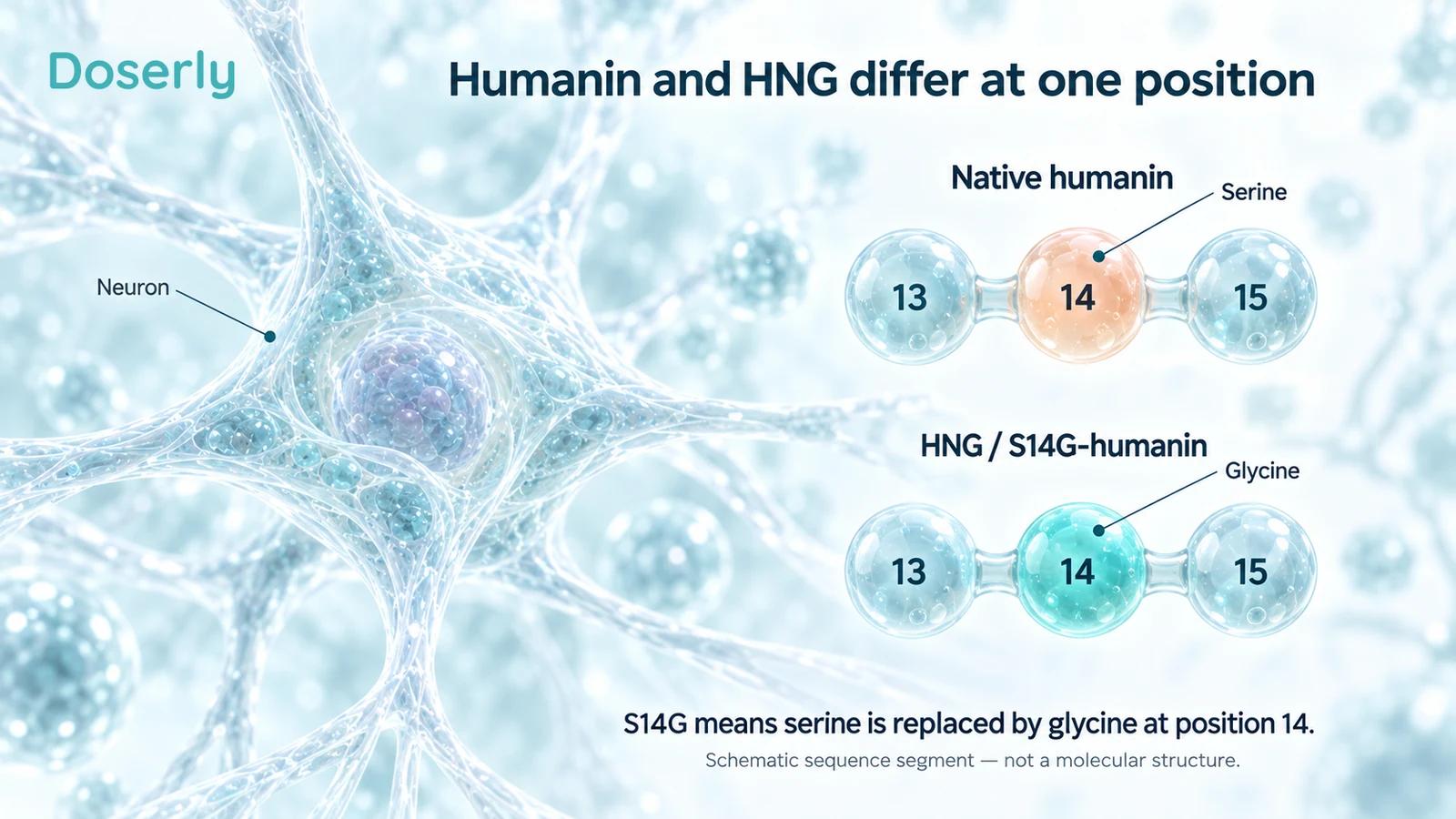
The native humanin peptide commonly studied has 24 amino acids, the small building blocks joined together to form a peptide. HNG is also called S14G-humanin. Its name describes a substitution: serine, abbreviated S, is replaced by glycine, abbreviated G, at position 14.
The change is small in sequence terms, but not necessarily small in biological effect. A peptide interacts with other molecules through its physical and chemical properties. Changing one residue can affect those interactions. The 2001 characterization study used modified sequences to examine which positions were important for protection against specific Alzheimer's-related cell insults. Hashimoto and colleagues
It is therefore inaccurate to describe HNG as merely a more concentrated bottle of humanin. Concentration describes how much of a substance is present in a volume. An analogue changes the substance itself. The distinction remains even when an article uses humanin as a broad family term in its title or introduction.
What did the stronger laboratory effects look like?
A 2004 experiment exposed rat cortical neurons to a particular toxic prion-protein fragment. Native humanin protected cells under the tested conditions. HNG showed substantially greater protective activity, reported as a 500-fold increase in that assay, while another variant, HNA, did not show protection. Sponne and colleagues
That is a comparison of activity in a specific experimental setting. It is not evidence that HNG improves human memory 500 times more, is 500 times safer, or requires a human dose exactly 500 times smaller. The cells, toxic stimulus, exposure conditions and measured outcome define what the number means.
The same report found that humanin did not protect against a different fibrillar prion fragment. This is a helpful detail: even in closely related laboratory models, activity was not universal. “Protects neurons” needs a description of the challenge and experiment to be scientifically meaningful.
Potency and effectiveness are also different ideas. Potency concerns the amount needed to produce a defined effect under specified conditions. Clinical effectiveness concerns whether a treatment provides worthwhile benefits to people. A highly potent candidate can still fail because it doesn't reach the relevant tissue, acts too briefly, causes unacceptable effects or does not influence the outcome that matters.
Why there isn't one universal potency multiplier
Laboratory comparisons may use different cells, exposure times and definitions of protection. One might count surviving cells after a toxic insult; another might measure a signaling protein or an energy-related process. A ratio from one assay should not be treated as a conversion factor for every other experiment.
The early structure–function work is useful because it deliberately tested variants against defined insults. It demonstrates that sequence matters and helps identify candidate mechanisms. It doesn't establish that every HNG effect can be predicted by multiplying a native-humanin result. Detailed characterization
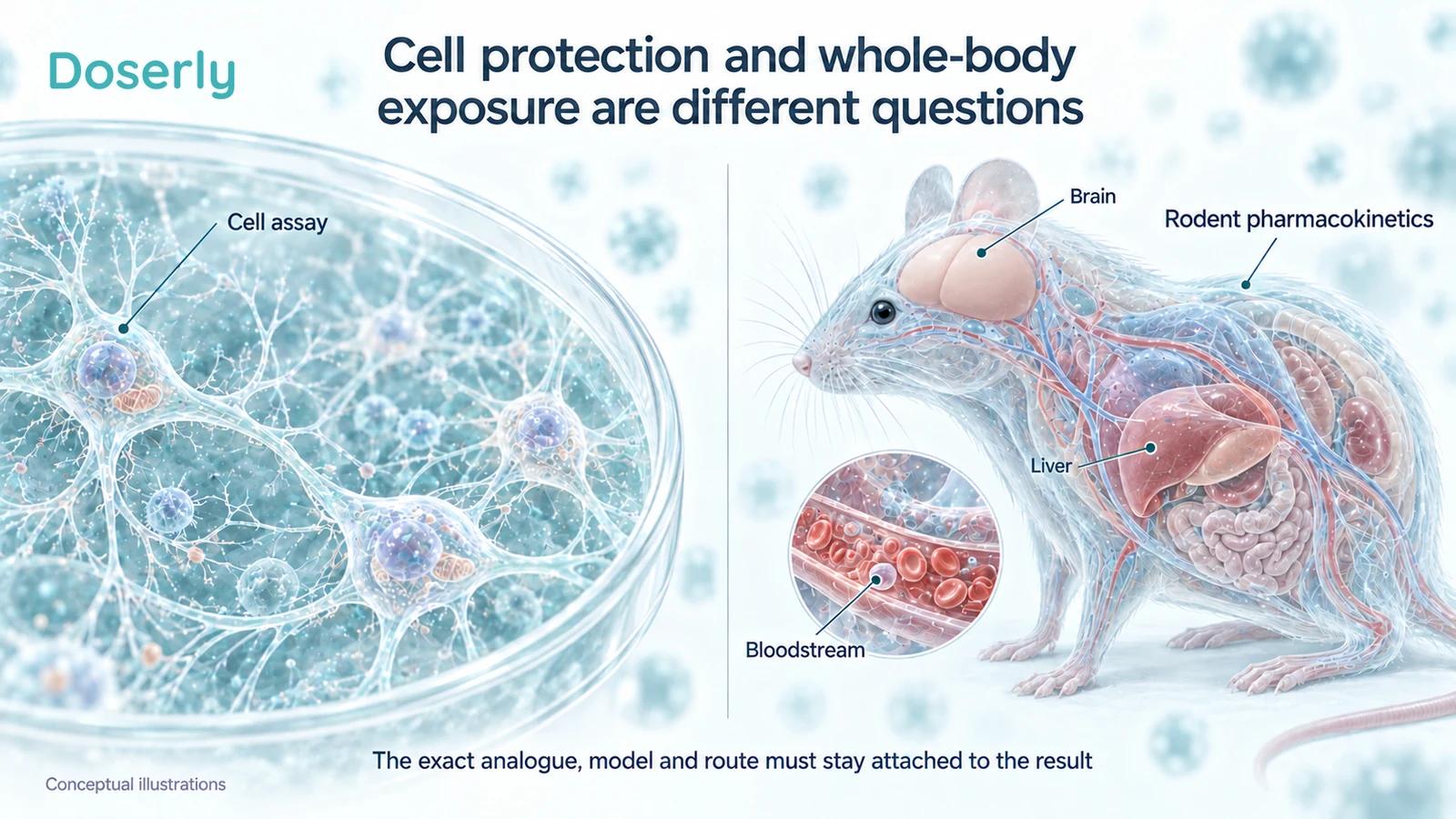
This matters when interpreting a concentration such as nanomolar or micromolar. These units describe the amount of substance relative to a volume in an experimental system. They do not specify how much a person would need to take to produce the same concentration in a particular tissue. A culture dish does not reproduce absorption, distribution and removal by a whole body.
A trustworthy summary should therefore retain the exact substance and the measured endpoint alongside any potency number. Removing that context creates an impressive statistic with little practical meaning.
HNGF6A changes another interaction
HNGF6A includes an additional substitution at position 6, replacing phenylalanine with alanine, alongside the position-14 change. It was studied in relation to IGFBP-3, a protein associated with insulin-like growth factor signaling. Unlike HNG, this analogue does not bind IGFBP-3 in the same way described in the research.
A 2013 study compared these analogues in male mice, including mice lacking IGFBP-3, and also examined HNG in male rats. Circulating persistence differed between the analogue and animal conditions. HNGF6A and HNG in IGFBP-3-deficient mice had longer measured persistence than HNG in wild-type mice. Chin and colleagues
This shows why “stronger in cells” is not the only relevant property. Binding partners can influence how a substance behaves in circulation. Altering an interaction may change exposure and other biological relationships, not just the amount needed in one assay.
The study does not establish human pharmacokinetics. In particular, a half-life measured in a mouse is not a validated schedule for subcutaneous use in a person. Even rats and mice differed in the study, which should discourage treating species as interchangeable.
A blood measurement doesn't establish brain delivery
The rodent pharmacokinetic report found HNG-related signal in plasma and liver after administration in rats, while it was undetectable in the sampled brain and heart under those assay conditions. “Undetectable” means below what that method detected at the sampled times; it is not proof that no molecule could ever reach those organs. Rodent distribution study
The finding nevertheless illustrates an important distinction. Detecting a substance in blood does not automatically establish a useful concentration in the brain. A claim about memory requires more than showing that a peptide was administered or remained in circulation.
Route matters as well. An experiment that places a substance directly into the brain's ventricular system addresses a different delivery question from one that administers it elsewhere. Behavioral improvement after direct delivery cannot establish that an unrelated formulation will cross the barriers encountered after a peripheral injection.
Colivelin is a further development, not another synonym
Colivelin is a hybrid peptide created by joining an activity-dependent neurotrophic factor component to a modified humanin derivative. Its original 2005 report described very low concentrations that protected cells in particular Alzheimer's-related assays, alongside mouse experiments involving induced memory impairment. Chiba and colleagues
The hybrid design was intended to combine activities. That is precisely why its findings should not be silently attributed to native humanin. A compound with an additional biologically active component is not merely a renamed version of the original peptide.
The title's “femtomolar-acting” description refers to experimental concentration. It does not establish a human dose, a human safety margin or a proven dementia treatment. The report's animal routes and induced disease models also need to remain attached to the result.
For readers, the useful lesson is not to memorize every derivative. It is to recognize when a summary has changed the identity of the intervention. If a paper tested colivelin, the conclusion should name colivelin, even when the finding contributes to the broader humanin research field.
Different mechanisms should not be merged into one promise
Humanin has also been studied in relation to BAX, a protein involved in apoptosis, a regulated form of cell death. A 2003 study found that humanin could interfere with BAX movement to mitochondrial membranes and with downstream events in experimental systems. Guo and colleagues
This is an intracellular mechanism, distinct from simply saying that a peptide stimulates a cell-surface receptor. It helps explain scientific interest in survival signaling, but it doesn't prove that all analogues have identical interactions or that any manipulation of cell survival is beneficial in every context.
An assay may examine one part of a pathway while a living person has many tissues and competing physiological needs. That is why a mechanistic result belongs beside, rather than in place of, exposure and safety research. It also explains why promising chemistry does not eliminate the need for clinical testing.
A recent example: “humanin” in a muscle-cell title
A 2026 paper studied mitochondrial-derived peptides in primary human myotubes, muscle cells grown in culture, exposed to dexamethasone. The title used humanin, but the methods and abstract identified the intervention as S14G-humanin/HNG. HNG and MOTS-c were tested separately, with differences in their measured effects. Elhusseiny and colleagues
A careful summary therefore says that HNG affected cultured human muscle cells under a drug-induced atrophy model. It should not say that native humanin was proven to prevent muscle loss in patients, or that a combined HNG–MOTS-c product was tested successfully.
This is a contemporary example of why reading beyond the title matters. “Human cells,” “humanin” and “clinical treatment in humans” sound similar in casual conversation but refer to different facts.
How to keep a research claim attached to the right substance
When a claim interests you, first identify the intervention in the methods or abstract. Write down the full name, including substitutions or additional components. Then note the model, route and outcome. That small amount of detail is often enough to expose an accidental substitution in a summary.
For example, “HNG protected rat neurons against one prion fragment in culture” is a narrower and more useful statement than “humanin protects the brain.” The narrower version tells you what happened and what would still need testing. It also makes comparison with another study possible without implying that both used the same molecule.
If you're discussing an actual product with a clinician, its stated identity should be clear before any research is applied to it. A dosing calculator can perform arithmetic, but it cannot establish equivalence between native humanin, HNG and another derivative. The studies reviewed here provide no validated human conversion ratio.
The humanin guide is a useful starting point for keeping these categories separate. The scientific interest in analogues comes from their differences. Preserving those differences in public explanations is how we avoid turning promising laboratory work into claims the experiment never tested.
Sources
- Hashimoto et al., structure–function characterization, 2001.
- Sponne et al., rat neuron prion-fragment experiments, 2004.
- Chin et al., analogue pharmacokinetics and distribution in rodents, 2013.
- Chiba et al., colivelin development, 2005.
- Guo et al., humanin and BAX, 2003.
- Elhusseiny et al., HNG and MOTS-c in human muscle-cell culture, 2026.