
HRT
October 16, 2026
HRT after breast cancer: why local and systemic treatment need separate discussions
On this page
Estrogen helps maintain vaginal and lower urinary tissues. When levels fall after menopause or during breast cancer treatment, dryness, burning, discomfort with sex and urinary symptoms can become persistent. These problems can affect sleep, relationships and willingness to continue cancer treatment. They deserve attention, even when treatment choices require more care.
The first distinction is between systemic hormone replacement therapy (HRT), intended to circulate through the body, and low-dose vaginal estrogen, intended mainly to treat local symptoms. Evidence about one cannot simply be transferred to the other. Nor does “local” mean that no estrogen reaches the blood. The product, dose and current cancer treatment matter. ACOG clinical consensus.
For a breast cancer survivor, the question is usually specific: what can relieve symptoms without undermining the treatment protecting against recurrence? Answering it means distinguishing the symptoms, the proposed medicine and the outcome a study actually measured.
Start with the symptoms and tissues involved
Genitourinary syndrome of menopause, often shortened to GSM, describes genital and urinary changes associated with reduced estrogen. Vaginal tissue can become less comfortable with friction, while urinary urgency or burning may occur alongside dryness. Similar symptoms can have other causes, including infection and skin conditions. An examination and appropriate testing may therefore be more useful than assuming every new symptom is hormonal. ACOG clinical consensus.
Describe the problem concretely. Is discomfort present all day, only with penetration, or mainly during urination? Has there been discharge, bleeding or a documented urinary infection? Has a particular lubricant irritated the tissue? Those details help distinguish dryness from problems needing different treatment.
Local treatment also does not answer a separate complaint such as frequent hot flashes. Someone with both vaginal symptoms and night sweats may need two discussions, with different options for each. Our vaginal estrogen guide explains the local symptom picture and the range of formulations.
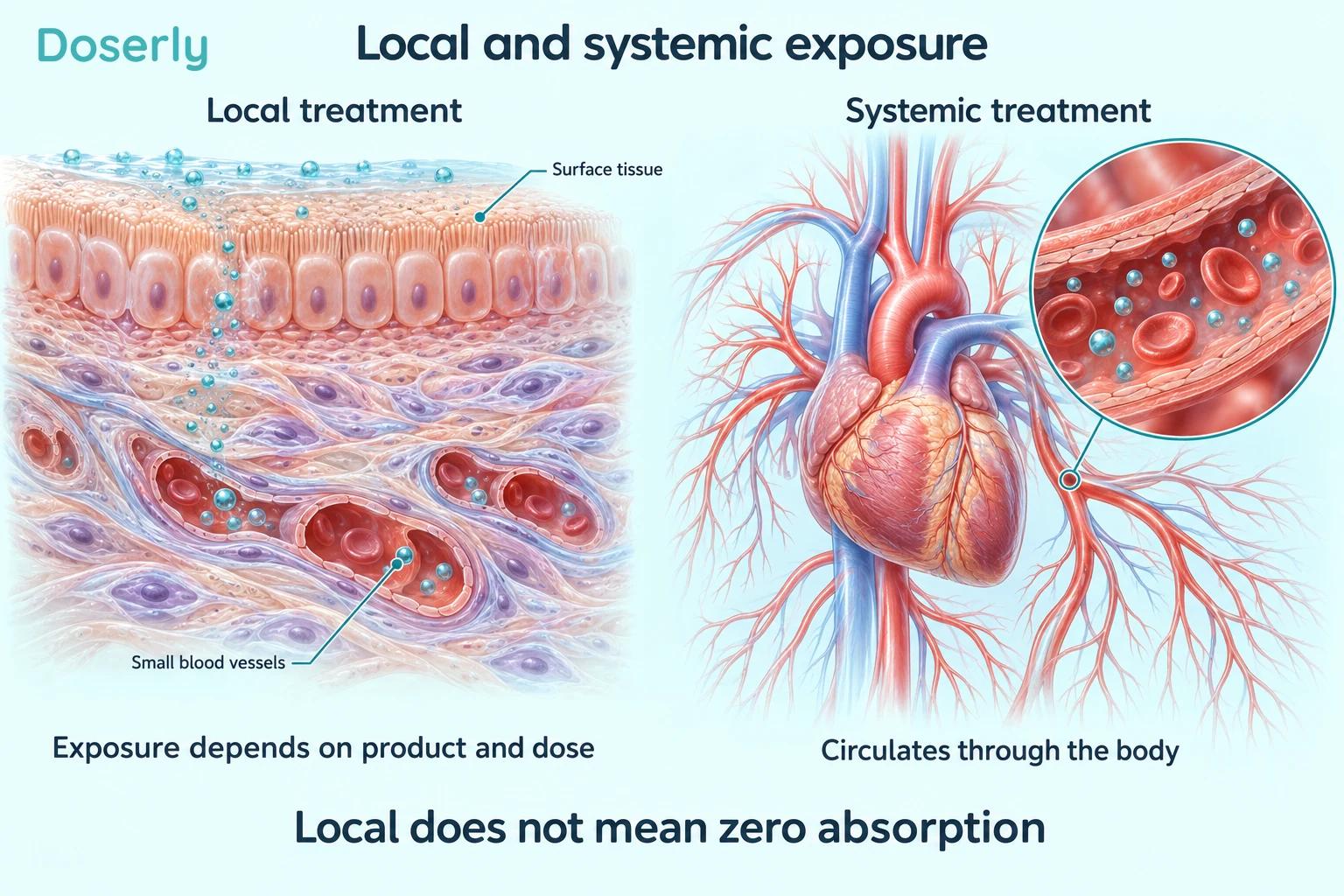
Conceptual tissue and circulation, not a measurement of absorption from any particular vaginal product. Low-dose local treatment and systemic HRT require separate safety assessments.
What systemic HRT research found after breast cancer
Concern about systemic hormones is supported by randomized evidence. In the HABITS trial, people with previously treated breast cancer were assigned to hormone therapy for menopausal symptoms or management without hormones. The trial was stopped early because of concern about new breast cancer events.
In extended follow-up, 442 of 447 randomized participants could be followed for a median of four years. A new breast cancer event occurred in 39 of 221 hormone-therapy participants and 17 of 221 controls. The hazard ratio was 2.4, with a 95% confidence interval of 1.3–4.2. A hazard ratio compares event rates over time; it is not the percentage of all patients who will have a recurrence. HABITS follow-up.
The trial did not test every current formulation, and early stopping complicates estimates. Nevertheless, it provides a strong reason not to use reassuring observational findings about vaginal therapy as permission to restart systemic HRT. NICE advises against routinely offering HRT for menopausal symptoms in people with a breast cancer history. Exceptional situations require specialist consideration of risks and symptom severity. NICE breast cancer recommendations.
“Bioidentical” does not resolve this question. A description of molecular identity says little about the safety of exposing hormone-sensitive cancer cells to a systemic treatment. The relevant evidence concerns the actual medicine, exposure and clinical context.
Why vaginal estrogen is considered separately
Low-dose vaginal products aim to improve local symptoms with much less systemic exposure than conventional systemic treatment. However, vaginal administration alone does not establish that a product is low dose or purely local. The exact formulation needs to be checked.
The clinical approach generally starts with nonhormonal measures. NICE recommends considering vaginal estrogen when genitourinary symptoms persist despite those measures, with cancer history and current therapy included in the decision. It explicitly recognizes uncertainty about recurrence risk. People taking an aromatase inhibitor should involve a breast cancer specialist in assessing options. NICE menopause recommendations.
That is a conditional treatment option, not a declaration that vaginal estrogen is harmless for every survivor. It gives room for symptom relief while acknowledging that large randomized trials capable of excluding modest recurrence risks are lacking.
A useful discussion names the intended benefit: less daily burning, more comfortable examinations or intimacy, or improvement in a clearly established urinary problem. It also names what is uncertain. That is easier to weigh than a broad debate about whether hormones are good or bad.
The Danish study: an important subgroup signal
A Danish observational study followed 8,461 postmenopausal women with early, estrogen receptor-positive breast cancer diagnosed during 1997–2004. Of these, 1,957 used vaginal estrogen after diagnosis. Median follow-up was 9.8 years for recurrence and 15.2 years for mortality.
Overall, the adjusted relative risk of recurrence with vaginal estrogen was 1.08, with a 95% confidence interval of 0.89–1.32. That did not show a statistically clear increase. Among people also receiving an aromatase inhibitor, however, the estimate was 1.39, with a confidence interval of 1.04–1.85, indicating a higher recurrence rate in that subgroup. Danish cohort.
These were prescription records and clinical outcomes, not random assignment to vaginal estrogen. Treatment selection, adherence and other patient differences could influence the result. The subgroup signal does not prove causation, but it should not disappear from an otherwise reassuring summary.
It also cannot be translated into “39 extra recurrences per 100 patients.” The 1.39 estimate is relative. An individual’s absolute risk depends on their underlying cancer risk and the follow-up period. That distinction matters when discussing a potentially frightening headline.
The large UK study asked about mortality
A separate study combined cohorts from Scotland and Wales, including 49,237 females with breast cancer, aged 40–79. It examined whether vaginal estrogen use after diagnosis was associated with breast cancer-specific mortality.
The fully adjusted pooled hazard ratio was 0.77, with a 95% confidence interval of 0.63–0.94. Investigators found no evidence of increased early breast cancer-specific mortality among vaginal estrogen users compared with people who did not use HRT. McVicker and colleagues.
This is useful reassurance about the outcome studied. It does not establish that vaginal estrogen prevents death: people offered treatment may differ from nonusers in ways that statistical adjustment cannot fully remove. Mortality is also not recurrence. A person can experience recurrence without dying during the observation period.
Consequently, this study does not cancel the Danish aromatase-inhibitor finding. Together, they support a more precise conversation: broad mortality findings are reassuring, while recurrence uncertainty remains important for particular treatment groups.
Translate population findings into a personal question
The studies above enrolled people with particular cancer histories and measured outcomes over different periods. Before applying a headline, ask whether its population resembles your own situation. A study of early estrogen receptor-positive cancer does not describe every tumor type or stage, and a result during endocrine treatment may not apply unchanged after that treatment ends.
It also helps to ask what a reassuring confidence interval still permits. The Danish overall recurrence interval included estimates below and above no association. “No statistically clear increase” therefore does not mean that every clinically relevant increase was excluded. The UK mortality result answers a different question, even though its estimate appears more favorable.
These are reasons to discuss uncertainty explicitly, rather than reasons to ignore the studies. A clinician can explain which findings are most relevant to the proposed product and current oncology plan. The decision should not depend on choosing whichever numerical result feels most reassuring.
For example, someone using an aromatase inhibitor who has persistent severe dryness despite nonhormonal treatment needs the subgroup finding and specialist discussion included. Another survivor with a different treatment history may face a different balance. Neither person's decision can be reduced to the statement that vaginal estrogen is simply “safe” or “unsafe” after all breast cancers. Danish cohort, McVicker and colleagues.
Why the current cancer medicine matters
Tamoxifen blocks estrogen’s action at receptors in breast tissue. Aromatase inhibitors reduce estrogen production. Adding estrogen while suppressing its production raises a different biological question from adding it while blocking its action at the receptor.
ACOG permits consideration of low-dose vaginal estrogen after nonhormonal treatments have failed, including for people taking tamoxifen. For aromatase-inhibitor users, it calls for shared decision-making involving the patient, gynecologist and oncologist. ACOG clinical consensus.
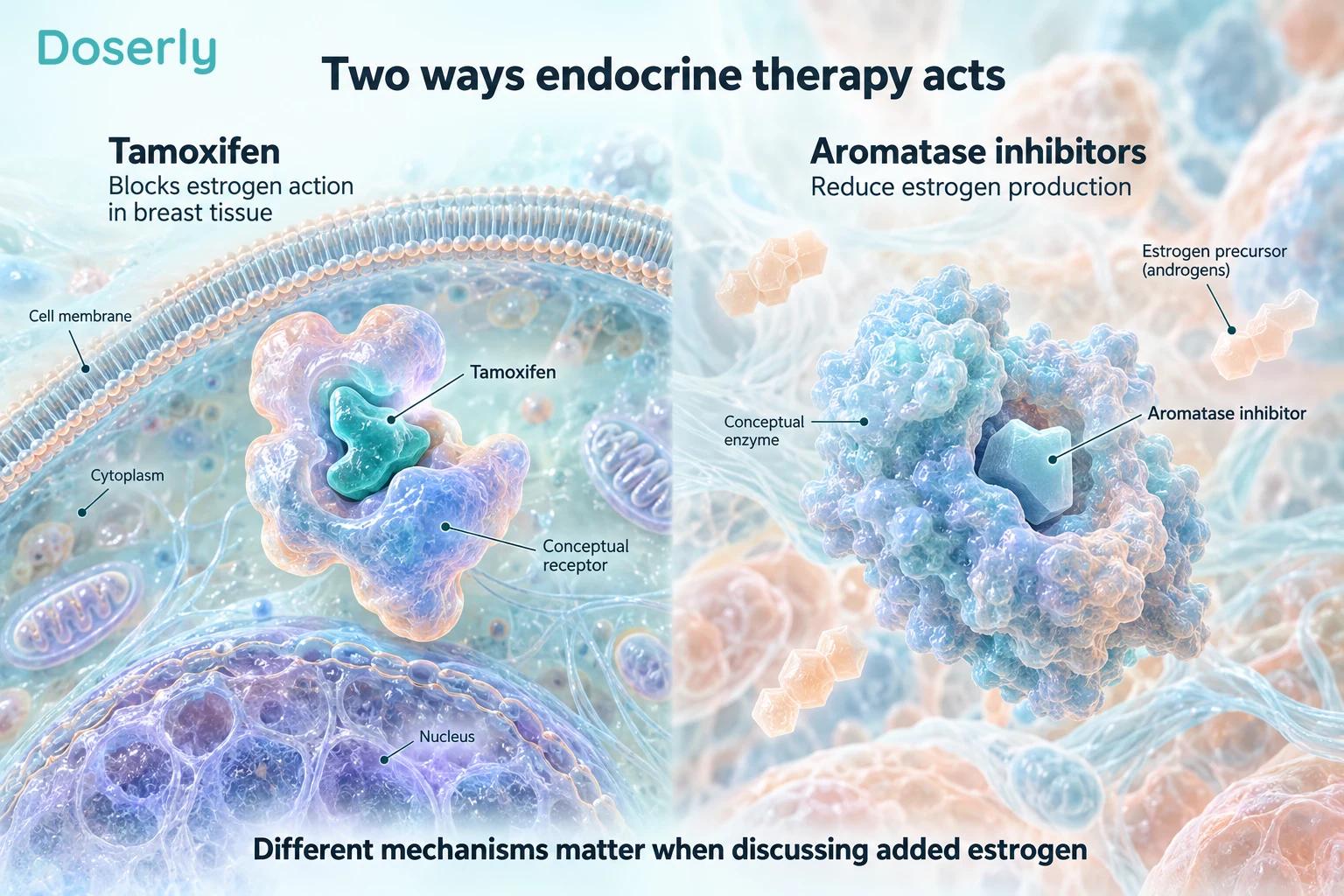
The shapes explain different drug actions; they are not literal molecular structures or evidence that adding estrogen is safe. Tamoxifen’s actions also differ between tissues.
Bring an accurate medication list, including any planned switch in endocrine treatment. “I took a breast cancer medicine several years ago” and “I currently take letrozole” describe different situations. The same applies to whether a tumor was estrogen receptor-positive, which means its cells carried receptors capable of responding to estrogen.
Do not stop or change cancer treatment yourself to make a symptom treatment seem easier to use. If symptoms are threatening adherence, tell the oncology team directly. That problem deserves an active plan rather than an unrecorded trade-off.
What nonhormonal treatment can realistically offer
Nonhormonal treatment is not one product. A moisturizer used regularly addresses ongoing dryness differently from a lubricant used to reduce friction during sexual activity. Texture, ingredients and irritation matter; an unsuccessful trial of one product does not establish that every nonhormonal approach will fail.
ACOG describes several options, including silicone-, polycarbophil- and water-based products, and notes that more than one may need to be tried. Some people also need assessment of pelvic-floor pain or other contributors to discomfort. ACOG clinical consensus.
A useful trial has a defined goal and review date. Record whether daily burning improves and whether the product itself causes stinging. If symptoms remain severe, returning with that information is more productive than being told to try a moisturizer indefinitely.
Other prescription options should be checked individually. A treatment described as non-estrogen does not automatically have established long-term safety after hormone-sensitive cancer. Ask what evidence exists in survivors taking your current endocrine medicine, rather than assuming a different label settles the concern.
Build a plan that can be reviewed
The decision should combine the original cancer characteristics, time since diagnosis, current endocrine therapy, symptom severity and response to previous treatment. It should reflect how you feel about the remaining uncertainty. Someone with mild symptoms may reasonably make a different choice from someone unable to tolerate examinations or daily activities comfortably.
Before starting treatment, establish who will review it. Is the oncology team aware of the plan? Which exact product is being prescribed? What improvement would justify continuing? What new symptoms should prompt an earlier call? These questions turn an abstract risk discussion into practical follow-up.
New bleeding, a persistent lesion, worsening pain or symptoms suggesting infection should be assessed rather than automatically attributed to GSM or the treatment. Improvement in dryness does not demonstrate anything about cancer recurrence risk; symptom review and cancer follow-up remain different parts of care.
A short dated record can help: symptom location and severity, products tried, irritation, missed cancer-treatment doses and questions for the next visit. It need not become a demanding daily scoring exercise. Its purpose is to make the conversation accurate.
You should not have to choose between silence about distressing symptoms and a falsely certain safety promise. Careful, coordinated care treats systemic HRT and low-dose vaginal therapy as different questions. Our vaginal estrogen guide provides additional background for that discussion.
Sources
- HABITS randomized trial follow-up, 2008.
- Danish observational cohort, 2022.
- McVicker and colleagues, 2024.
- ACOG clinical consensus, 2021.
- NICE NG23 menopause recommendations.
- NICE NG101 breast cancer recommendations.