
Peptides
October 16, 2026
Reading Epitalon anti-aging headlines: six findings worth checking
On this page
Epitalon research covers several genuinely interesting questions: whether a short peptide changes telomere maintenance in cells, whether it affects survival in particular animal models, and whether related pineal preparations influence human physiology. A short headline can compress those questions until they sound like one established anti-aging treatment.
The useful response is to recover the actual experiment. That does not require dismissing every positive finding or reading a paper as though you were reviewing it for a journal. It means identifying what was given, to whom or to what, and what changed.
The examples below are illustrative headline styles, not quotations attributed to a particular creator or publication. Each is paired with an actual Epitalon-related finding so you can see exactly where the interpretation changes. Our Epithalon guide provides a broader introduction to the compound.
“Human cells lived longer”
This can refer to a real laboratory result without establishing that people lived longer. The 2004 Epithalon study examined fetal lung fibroblasts grown in culture. Its abstract describes the treated cultures continuing to divide beyond the point at which control cultures lost proliferative potential. Original experiment.
The word human tells you the origin of the cells. The phrase lived longer may refer to their replicative capacity under laboratory conditions. Neither says that volunteers received a treatment or that anyone's survival was measured.
A more informative summary would be: Epithalon extended proliferative capacity in a fetal fibroblast culture experiment. That statement preserves the finding. It also gives a reader enough information to understand what remains to be tested.
The next clinical question is not how many extra human years correspond to the laboratory passages. A passage is part of maintaining a culture, not a unit of human life. Researchers would first need to establish relevant exposure and safety, then test a defined clinical outcome.
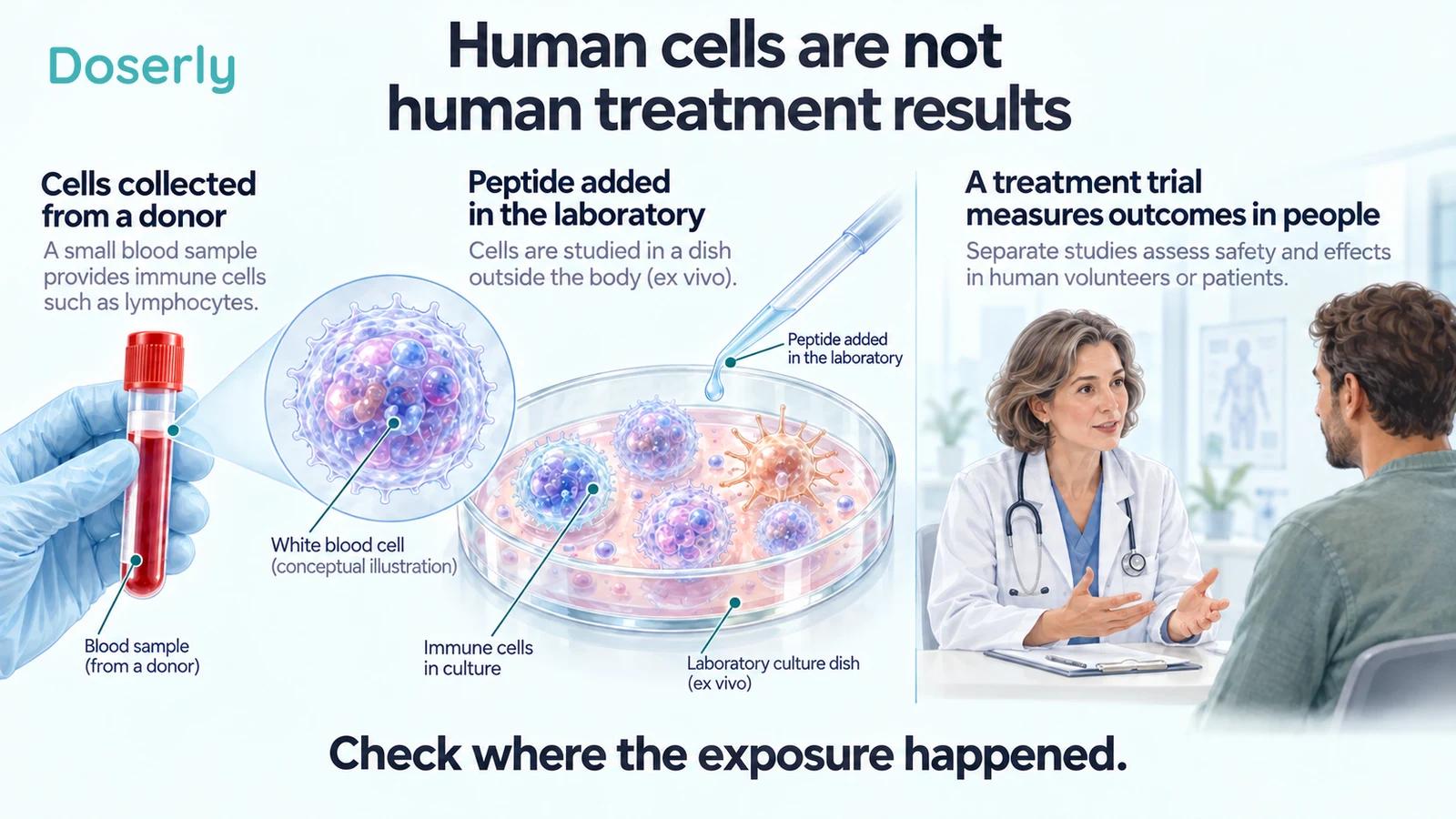
When a headline includes “human cells,” look for a sentence explaining where the treatment happened. If the peptide was added after the cells were collected, the experiment is outside the body even though the material came from a person.
“Epitalon lengthened telomeres in people”
The 2019 AEDG experiment is a useful example of how this wording can go wrong. Researchers collected lymphocytes from eleven male donors and exposed the stimulated cells to the peptide in the laboratory. The donors did not receive the experimental exposure themselves. Original study.
The results were also mixed: five donor samples showed a significant increase in telomere length, two showed a decrease, and four did not show a significant change. A headline that omits the location of exposure and the variation across samples changes two important parts of the result.
A more accurate summary is: AEDG changed telomere measurements in some donor-cell cultures, with responses in both directions. That is still a human-cell finding. It is not a treatment trial or a basis for predicting what a person's next blood test will show.
This example also shows why a large percentage from one donor should not become the headline effect for everyone. A donor-specific response in a small experiment is not the average benefit of a medication in a clinical population.
If you want to know whether a peptide improves healthy aging, the relevant evidence must eventually include outcomes in treated people. Laboratory variation may help develop that research, but it does not complete it.
“Epitalon increased lifespan”
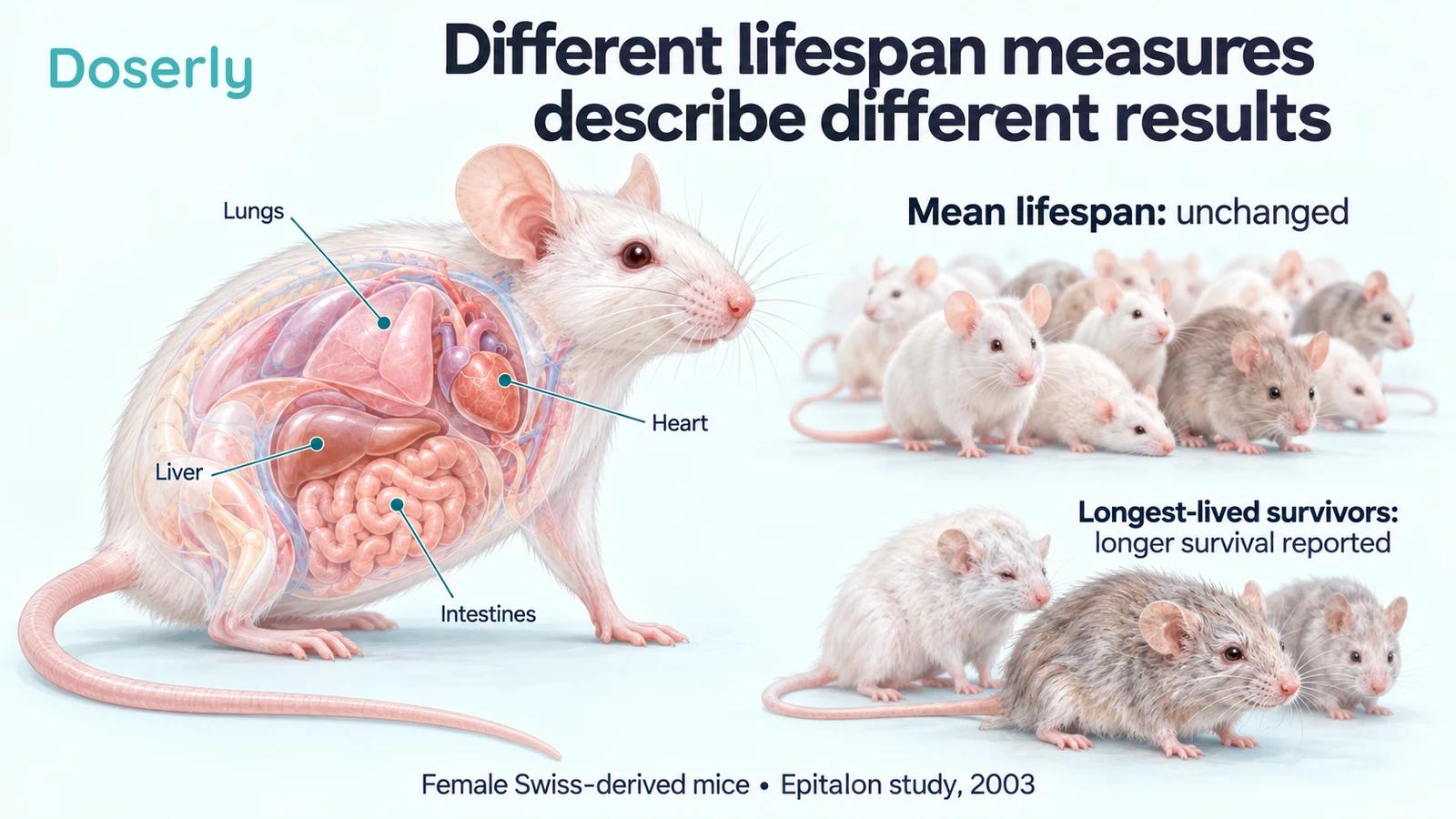
The next question is: whose lifespan, and which lifespan measure? In a 2003 experiment, female Swiss-derived SHR mice received Epitalon or saline, with 54 animals in each group. Mean lifespan was unchanged, while survival measures involving the longest-lived animals increased. Original mouse-study abstract.
The mean summarizes the group as a whole. The maximum concerns the longest observed life. A result for the final tenth of survivors describes a selected part of the survival distribution. These measures can move differently within the same experiment.
A headline that says only “lifespan increased” may leave you imagining an improvement across the whole group when the reported mean did not change. The accurate summary needs the species and endpoint: In one female-mouse model, Epitalon did not increase mean lifespan but improved measures involving the longest-lived survivors.
The mouse strain matters too. A result in a particular laboratory population is not an estimate of benefit in a healthy adult. It cannot be translated into an exact number of extra human years by multiplying a lifespan percentage.
Nor does it establish a veterinary treatment. Laboratory findings do not justify giving a research peptide to a pet. The study's value lies in the biological question it tests and the future work it can motivate.
“Older adults had lower mortality”
Unlike a cultured-cell result, mortality in a human study is a clinical outcome. But the name of the intervention remains essential. The 2003 report involving 266 older people examined thymalin, epithalamin, and combinations of those preparations. It did not test synthetic Epitalon alone. Original human report.
Epithalamin is a pineal peptide extract. Epitalon is a defined synthetic tetrapeptide. Their related history does not make their clinical effects interchangeable. FDA explicitly separates these substances in its review. FDA briefing.
A useful summary would therefore name the extract and the study population. It would also make clear whether the result came from one preparation or a combination. If two interventions were given together, the result cannot automatically be assigned to either one alone.
There is a further distinction between reporting that authors found lower mortality and treating their result as independently confirmed. The accessible abstract does not provide all the methods, event counts and participant-flow information needed to assess every comparison fully.
Older human findings can be worth investigating without supporting a modern product's sales claim. The practical check is simple: compare the substance in the methods with the substance in the claim. A real citation can still be attached to the wrong product.
“Epitalon restored the body clock”
Some human studies measured melatonin-related markers or the activity of genes involved in circadian rhythms. A 2021 report involved female night-shift workers and sublingual AEDG, with blood-cell clock-gene measurements. Related reporting examined a urinary melatonin metabolite. Original clock-gene report.
These are biological observations. They do not establish that participants fell asleep faster, woke less often or experienced a clinically meaningful improvement in insomnia. FDA's review specifically noted the absence of sleep outcomes in the study it assessed. FDA assessment.
“Restored the body clock” suggests a broader, more complete change than a blood-cell gene measurement can demonstrate. A more useful summary names both the population and measurement: A small sublingual AEDG study in night-shift workers reported circadian-related biomarker changes.
That wording also preserves the route. It does not convert a preparation used under the tongue into evidence for injections. Route, formulation and exposure are part of the intervention, not optional details that can be dropped once a mechanism sounds plausible.
If sleep is the goal, look for sleep outcomes. If the paper measures only a metabolite or gene expression, it may help explain a hypothesis, but it cannot tell you how much better someone slept.
“The new study proves it is safe—or dangerous”
The 2025 Epitalon study examined normal and breast cancer cell models. It reported telomere-maintenance changes, including different pathway patterns in different cells. The original article has a correction replacing key figures. Study, correction.
A cancer-cell result is relevant to safety questions. It is not a measurement of new cancer diagnoses in people. A normal-cell response is relevant to biological activity. It is not proof that repeated exposure is safe across a person's organs over years.
A headline can overstate the study in either direction. “Proves cancer risk” and “proves safe rejuvenation” both move beyond what a cell experiment measured. The useful interpretation is that the finding identifies mechanisms and questions for further investigation.
Corrections deserve attention because they can change the material being summarized. Reading the updated paper is more reliable than circulating an old figure. But the existence of a correction is not, by itself, proof that every result is false; its content needs to be examined.
This is one reason to prefer a description of the actual observation over an all-or-nothing verdict. “Different telomere-maintenance responses in normal and cancer cells” tells you more than a label of safe, dangerous or revolutionary.
“FDA reviewed it” is a process statement
An official review can be a valuable source, but the purpose of the document matters. The 2026 Epitalon briefing was prepared for a pharmacy compounding advisory process. It was not an approval of an Epitalon medicine for anti-aging, sleep or longevity. The document itself says the agency's final determination would follow the advisory process and completed reviews. FDA briefing.
The words “reviewed,” “nominated,” “discussed” and “approved” describe different actions. A source may accurately document one while a headline implies another.
The same distinction applies to a trial registration. A registry can show what investigators plan to test. It cannot show whether the intervention worked unless results are available, and its presence does not establish regulatory approval.
For a current decision, consult the actual dated document and its scope. A screenshot of a title or a product page's summary is less informative than the source's statement of what was evaluated and what was concluded.
Count experiments, not the number of links
Several webpages may cite the same original experiment. A review, a news article, a product page, and a correction can create four links without adding four independent tests. Following each citation back to its underlying study helps distinguish a widely repeated result from a replicated one.
For the 2025 cell study, the original article and its correction belong together. For older human reports, similar interventions and investigators warrant checking whether cohorts overlap before adding participant totals. A later publication date alone does not establish a new experiment.
This matters when a headline says that “many studies confirm” a claim. A stronger summary identifies which findings were independently repeated, in which models, and whether the claimed clinical outcome was ever tested. An extensive bibliography can provide valuable context while leaving that final treatment question unanswered.
A practical way to preserve the finding
When saving a study for a clinical conversation, write one sentence containing the intervention, experimental setting and measured result. For example: Synthetic Epitalon was added to cultured cells, and investigators measured telomere-related responses. Or: An older human report studied epithalamin extract and described mortality during follow-up.
Then write the question you still want answered. That might be whether a specific product improves fatigue, whether its route matches the study, or whether there is adequate long-term safety information for your circumstances.
This keeps interesting research connected to the decision without requiring the paper to answer more than it actually tested. It also makes disagreement easier to resolve: two people may be discussing different interventions or endpoints while using the same peptide name.
Epitalon's literature contains real experiments and real unanswered questions. An accurate headline should preserve both. The Epithalon guide is a useful companion when you want to compare the cell, animal, older human and regulatory material without merging them into a single treatment claim.
Sources
- Fibroblast proliferative-capacity experiment, 2004.
- AEDG donor-lymphocyte experiment, 2019.
- Female-mouse lifespan experiment, 2003.
- Thymalin and epithalamin human report, 2003.
- Night-shift-worker clock-gene report, 2021.
- Epitalon cell-model study, 2025 and correction.
- FDA Epitalon-related bulk substances briefing, 2026.