
Peptides
October 16, 2026
How to read an ARA-290 study without turning a promising signal into a cure
On this page
ARA-290 research spans nerve symptoms, eye measurements, blood glucose and emotional processing. That range can make the peptide sound like a treatment for many unrelated problems. The papers are more specific: each studied a particular group of people, a defined exposure and a limited set of outcomes.
The compound, also called cibinetide, is an 11-amino-acid peptide developed from part of erythropoietin. Early laboratory and animal work investigated whether it could retain tissue-protective activity without stimulating red blood cell production. Those experiments provided a rationale for human research; they did not establish a universal repair mechanism that has been clinically confirmed in every organ. Original development study
A useful way to read the evidence is to stay close to the health question you want answered. If the goal is less nerve pain, look for pain comparisons. If it is better vision, look for visual outcomes. If it is improved glucose control, examine the glucose measurements and follow-up. Below, actual ARA-290 studies show how those distinctions change the meaning of a promising headline.
Start with the substance and the clinical setting
“ARA-290,” “cibinetide” and “pHBSP” can appear in related research. A study still needs to specify what material was administered and how. The diabetes trial described a linear 11-amino-acid peptide given subcutaneously, while a healthy-volunteer emotional-processing study used a single intravenous exposure. These are not automatically equivalent treatment experiences. Diabetes study; healthy-volunteer study
Route matters because getting a peptide into circulation through an infusion, an injection under the skin or another formulation can change exposure. A paper about one route does not validate a nasal spray, tablet or topical preparation that was not studied. The treatment schedule described in a research report is a description of that experiment, not a recommendation to copy it.
Population matters just as much. Sarcoidosis-associated neuropathy, diabetic neuropathy and a traumatic nerve injury can share symptoms without being the same condition. A biological finding in one population can motivate research in another, but it cannot supply the missing comparison. Our ARA-290 guide provides background on the different research settings.
Read the main outcome before the conclusion
The 2017 phase 2b sarcoidosis study randomized 64 people with small nerve fiber loss and neuropathic pain. Its primary endpoint was the change in corneal nerve fiber area after 28 days. This is an image-derived structural measurement of small nerves in the clear front surface of the eye.
Only the 4 mg group showed a statistically significant advantage over placebo on that endpoint; the lower and higher amounts did not. Pain improved in all groups. The more favorable pain comparison in a subgroup with moderate-to-severe pain was not statistically conclusive. 2017 primary report
That is a legitimate positive finding for the main structural measure. It is not equivalent to a trial demonstrating reliable pain relief, restored normal sensation or a cure. The endpoint tells you which claim the study directly tested most prominently.
A “surrogate” endpoint is a measurement used to provide information about a disease process when the ultimate clinical outcome is harder or slower to study. It can be useful and still require validation. Corneal nerve area is attractive because researchers can visualize small fibers without repeatedly removing tissue. Its convenience does not guarantee that every treatment-induced change predicts better daily life.
Keep corneal nerves separate from retinal disease
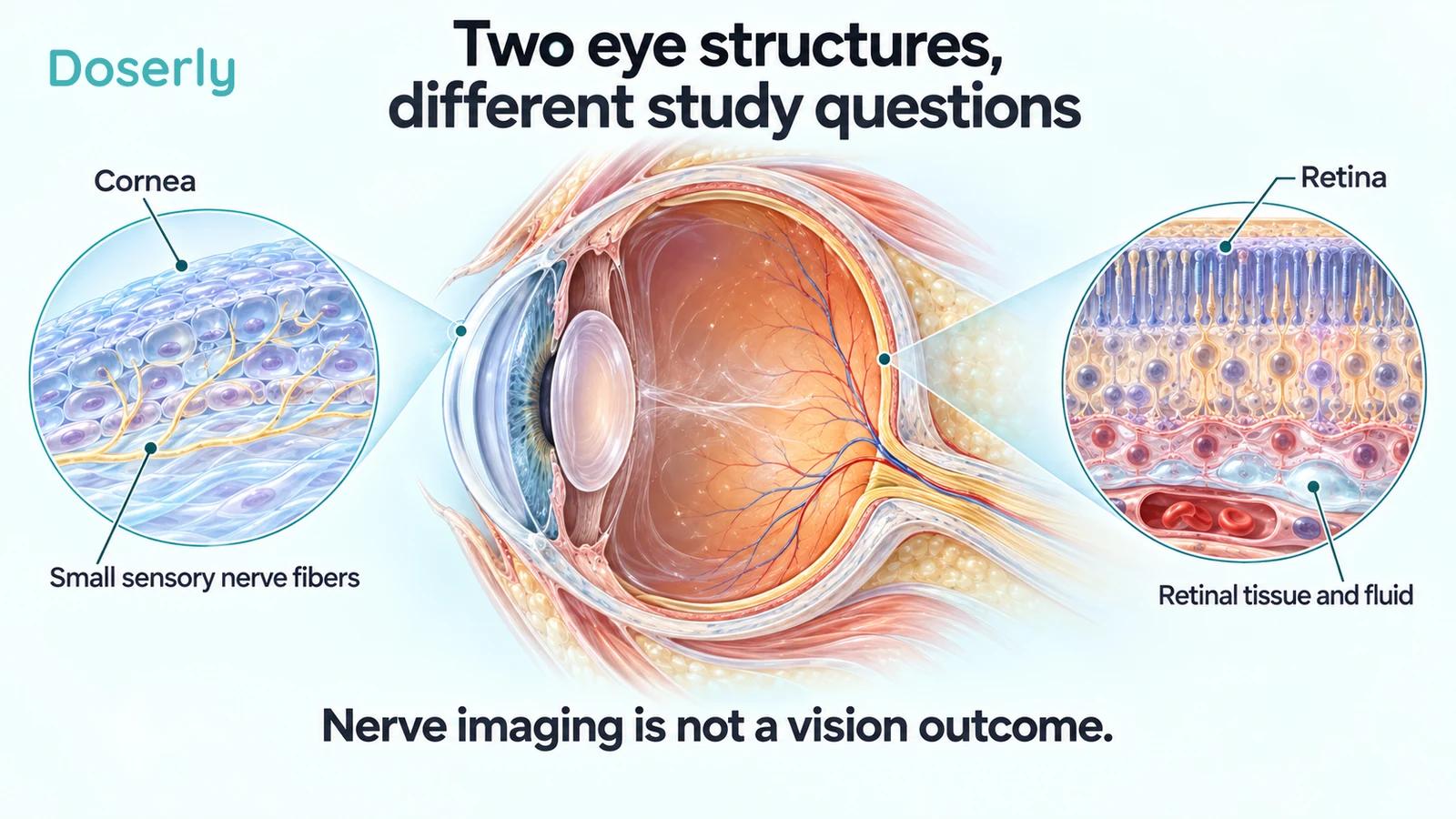
The cornea and retina are different structures. The cornea is at the front of the eye and contains small sensory nerves. The retina lines the back of the eye and detects light. A study measuring corneal nerves in systemic neuropathy is not automatically testing improved vision.
This distinction becomes particularly important when reading the diabetic macular edema study. Macular edema concerns swelling in the central retina. In the 2020 report, nine people entered a 12-week cibinetide study and eight completed it. There was no placebo group, and average visual acuity and retinal thickness did not improve. Some questionnaire and individual exploratory findings were more favorable. Eye-study primary report
Those results cannot be combined with the corneal nerve finding to claim that ARA-290 “repairs the eye.” They concern different tissues, measurements and study designs. For someone with visual symptoms, a corneal nerve-density result is not a substitute for evidence about their actual eye disease.
Compare treatment with its control, not only its starting point
In the 2013 sarcoidosis trial, pain intensity improved by about 9% in both groups. Some other measures, including a small-fiber symptom questionnaire and pain interference, favored ARA-290. 2013 randomized study
If a summary mentions only the active group's improvement, it leaves out what would have happened under the comparison conditions. The placebo group captures some effects of time, symptom fluctuation, study attention and expectations. The treatment-specific question concerns the difference between groups.
This does not mean an individual improvement is unreal. It means that observing improvement after treatment is not enough to identify how much was caused by the drug. That is why a diary, a testimonial and a randomized comparison answer different questions.
The same care applies to statistics. A significant change from baseline in one group and a nonsignificant change in another do not, by themselves, establish a significant difference between groups. The actual between-group comparison must be examined. Similarly, a numerical advantage with a wide uncertainty interval should not be rewritten as a confirmed benefit.
Do not turn every questionnaire into “pain relief”
A small-fiber symptom questionnaire can include more than pain intensity. Pain interference concerns effects on activities. A neuropathic symptom instrument may emphasize burning, tingling, electric sensations or sensitivity to touch. These are related experiences, but one number does not replace all the others.
In the diabetes trial, PainDetect improved more with ARA-290, while another pain instrument improved similarly in both groups during dosing. The overall corneal nerve-density change was not significant; a post hoc subgroup with lower starting density showed a more favorable signal. Diabetes results
This pattern suggests specific questions for replication: which patients might benefit, which symptoms change and whether the tissue findings accompany a meaningful clinical improvement. It does not justify saying that every pain outcome improved or that the subgroup result applied to everyone enrolled.
Post hoc means an analysis was developed after the original study planning. Such analyses can be valuable for discovering a promising subgroup. Their limitation is that the same data are helping generate and test the idea, increasing the need for a new study that specifies the idea in advance.
A metabolic endpoint can be planned and still preliminary
The diabetes paper explicitly listed HbA1c among its primary endpoints. It would be incorrect to dismiss it as a purely accidental secondary finding. But the HbA1c analysis involved 42 people with complete measurements, and treatment lasted only 28 days with another month of follow-up. Trial methods and metabolic results
This illustrates why “primary” and “definitive” are not synonyms. A planned outcome reduces one source of uncertainty about selective analysis; it does not remove small-sample uncertainty, missing data or limited duration. Nor does a change in HbA1c demonstrate fewer heart attacks, fewer diabetic foot problems or longer survival.
When a study measures several domains, keep the claims attached to those domains. A favorable laboratory result and a favorable symptom result do not prove that one caused the other. Mechanistic explanations may be plausible, but the trial needs appropriate measurements to test them.
A brain response is not treatment of depression
ARA-290 has also been investigated in a randomized study of 36 healthy participants examining emotional processing. Researchers assessed neural responses and cognitive tasks after a single exposure. Some task responses changed, but the study did not show improvement in mood or affective symptoms. Its authors did not find an unequivocal antidepressant-like profile. 2015 emotional-processing study
A participant's brain responding differently to a task can demonstrate biological activity. It does not show that the person feels better in daily life, and healthy volunteers are not a substitute for patients being treated for a mood disorder. The intervention, population and endpoint must all remain visible when interpreting the result.
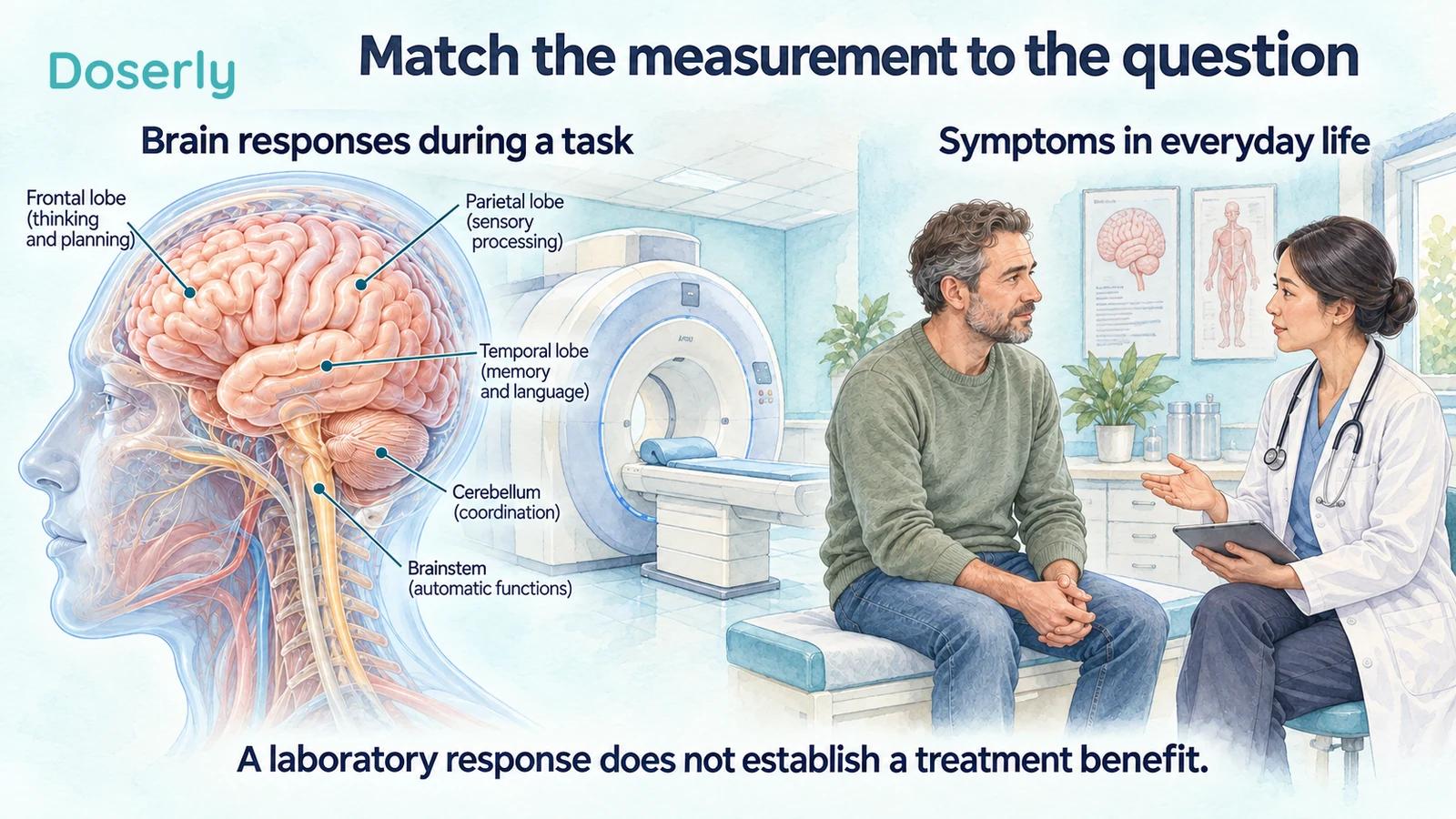
This is especially useful when a paper's title mentions a possible therapeutic role. A title often describes the question being investigated. The answer may be mixed or negative, so the title cannot be used as evidence that the proposed treatment worked.
Check how long an apparent effect lasted
An image or symptom measurement at day 28 does not establish permanence. In the 2017 trial, corneal nerve area moved back toward baseline after treatment ended. The earlier sarcoidosis report found that some symptom measures persisted longer than some functional measures. 2017 trial; 2013 follow-up
Different timelines may reflect different biology, measurement characteristics or other influences. They should not be compressed into “the effect lasts for months” unless the particular effect and follow-up actually support that description.
A repeated-course recommendation requires its own evidence. One short course followed by observation does not establish an ideal break, a maintenance amount or the benefit-risk balance of repeated use. A schedule can sound precise while resting on no direct comparison of schedules.
Read safety details alongside the benefit
The 2017 report recorded serious adverse events, including suicidal ideation judged possibly related to treatment in one participant. The diabetes report described a kidney-related withdrawal and additional serious events with varying causality assessments. These details qualify broad reassuring descriptions of tolerability. 2017 trial; diabetes safety results
An adverse event during a study does not automatically mean the drug caused it. Equally, uncertainty about causation is not a reason to omit it. A useful treatment decision considers the size and reliability of the expected benefit alongside known events, exposure duration and unresolved risks.
Small studies are especially limited for uncommon harms. A few weeks without a particular event cannot establish safety for years, for a different patient population or for a product made under different conditions. Our ARA-290 risk section expands on those distinctions.
Use registrations to understand plans and dates
The macular edema study has a ClinicalTrials.gov record first posted in 2024, although the trial ended in 2017 and its results were published in 2020. The record states that the study stopped because the drug expired and no replacement was available. A recent registry posting therefore does not necessarily describe new treatment research or a new successful result. NCT06626971
Registries are useful for checking planned outcomes, enrollment and study status. They should be compared with the publication rather than treated as another independent trial. The same participants appearing in a paper, registry and follow-up report should not be counted three times when describing the size of the evidence base.
Likewise, “terminated” is not a self-explanatory efficacy verdict. The stated reason matters. Stopping for drug supply does not prove a lack of benefit, but it can leave the clinical question unanswered because the intended study was not completed.
A practical way to summarize a paper
Try writing one plain sentence containing the population, intervention, comparison, duration and actual outcome. For the larger sarcoidosis study, that sentence would describe a short randomized trial with a positive corneal-area result at one tested amount and inconclusive pain findings. It would not say that the study proved a cure for neuropathy.
Then add what changes the interpretation: a subgroup analysis, missing participants, short follow-up, inconsistent symptom instruments, adverse events or sponsor involvement. Those details are part of the finding, not obstacles to appreciating it.
ARA-290 has enough human research to ask concrete questions about possible benefits. The most useful discussion keeps those questions specific. Before making a treatment decision, bring the actual paper and your clinical goal to a qualified clinician; the ARA-290 evidence guide can help you prepare.
Explore the research
- 2008 peptide-development study: laboratory and animal rationale.
- 2013 sarcoidosis trial: multiple symptom and functional outcomes.
- Diabetes trial: planned metabolic outcomes and exploratory subgroup findings.
- 2017 sarcoidosis trial: corneal-area primary endpoint and pain comparisons.
- Healthy-volunteer emotional-processing study: task effects without mood improvement.
- 2020 diabetic macular edema report: uncontrolled retinal and vision study.
- Macular edema registry: dates and reason for early termination.