
Peptides
October 16, 2026
How growth-hormone feedback changes the response to sermorelin
On this page
Sermorelin asks the pituitary gland to release growth hormone. It doesn't supply growth hormone directly, and it doesn't act on an otherwise empty system. The gland is already receiving signals from the brain and responding to the body's metabolic state.
That helps explain why two people can have different hormone responses, or why the same person's response can change over time. The amount administered is only one part of the result. Pituitary capacity, inhibitory signals, downstream feedback and the circumstances of measurement also matter.
If you've seen claims that sermorelin will reliably restore a “youthful” hormone pattern, or that a weaker response proves the body needs a larger exposure, it is worth looking at the human experiments. They show real biological activity, but they also show why the pathway cannot be reduced to a predictable input and output.
Start with the receptor
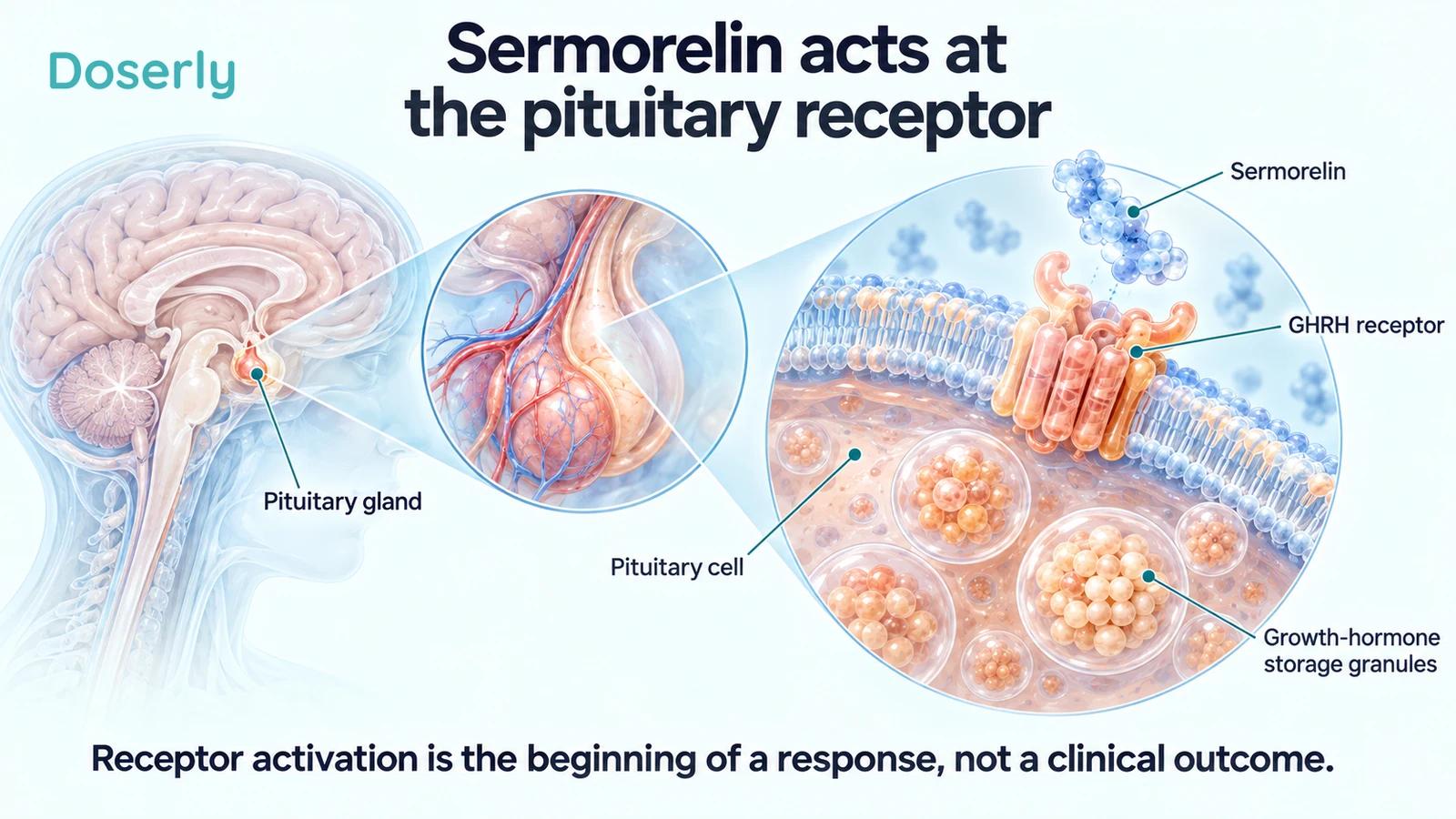
A receptor is a protein that detects a signal and changes what a cell does. In this case, the relevant receptor recognizes growth-hormone-releasing hormone, abbreviated GHRH, on pituitary cells that produce growth hormone.
A 1993 molecular study cloned a human GHRH receptor from pituitary tissue and tested its activity in cultured cells. The expressed receptor bound GHRH and generated a cellular signaling response. This helped establish how the signal could be recognized. It was a receptor experiment, not a trial showing improved health after sermorelin treatment. Gaylinn and colleagues.
Sermorelin corresponds to the first 29 amino acids of natural GHRH. That structural relationship explains why it can stimulate the pathway. The archived Geref diagnostic information describes its use to examine the functional response of the anterior pituitary. Historical product information.
A receptor response is the beginning of the chain. It doesn't tell us how much growth hormone ultimately reaches tissues, how downstream measurements change or whether a person's original symptom improves.
What does feedback add?
The hypothalamus provides signals that stimulate and restrain growth-hormone release. Somatostatin is one of the inhibitory signals. Growth hormone also promotes production of insulin-like growth factor 1, or IGF-1, and downstream signals participate in feedback regulation.
This is not a sequence in which every step always increases by the same percentage. An external stimulus encounters a gland whose activity varies with time and physiological circumstances. A stronger inhibitory influence or a different baseline state may change the response to the same stimulus.
The historical Geref test information makes this clinically concrete. It notes that thyroid disease, high somatostatin levels, obesity, hyperglycemia and elevated free fatty acids can affect responsiveness. These are reasons the test required interpretation under specialist supervision, not reasons to self-adjust treatment to overcome a laboratory result. Geref diagnostic precautions.
Understanding feedback is therefore useful for explaining variability. It becomes misleading when it is used to promise the same response in everyone or to dismiss the need to measure what actually happened.
What do acute studies establish?
An early experiment gave GHRH(1-29)NH2 and a modified D-Ala2 analogue intravenously to five healthy men, with vehicle control testing. Growth-hormone responses peaked at 15 or 30 minutes. The modified analogue was more potent, and transient flushing occurred at the highest tested exposure. Other measured hormones and glucose did not change in that short experiment. Barron and colleagues, 1985.
This supports acute hormone-releasing activity. It does not establish what happens after months of repeated administration, whether a particular subcutaneous preparation behaves the same way or whether patients become stronger or sleep better.
The analogue comparison also matters. A chemical modification can change activity. Similar names or shared receptors do not make two peptides interchangeable. A study of a modified GHRH molecule should remain identified as such when its findings are discussed.
Can a short study restore hormone levels without proving rejuvenation?
Yes. In a 1992 study, 10 older men received two GHRH(1-29) treatment exposures in random order, each lasting 14 days, separated by a nontreatment interval. Nine younger men provided baseline comparison measurements. At the higher exposure, several growth-hormone measures and IGF-1 increased relative to the older men's baseline values. Corpas and colleagues.
That is a meaningful physiological observation. It shows that the older participants' hormone system could respond. It does not show that matching selected measurements in younger men reverses aging, improves long-term health or gives older tissue the same response to every signal.
The comparison also illustrates a statistical point. Finding no significant difference between two groups after treatment is not proof that they have become biologically identical. A small study may have limited ability to detect differences, and the measured hormone variables cover only a small part of health.
For a reader considering treatment, the next question is what changed in daily life. A biochemical response creates a reason to investigate clinical outcomes; it does not supply those outcomes automatically.
Why can growth hormone and IGF-1 move differently?
Growth hormone and IGF-1 are related measurements, but they are not the same substance. A pattern of pituitary secretion and a circulating downstream growth-factor measurement describe different parts of the system.
In the six-week study of 11 men aged 64–76, nightly GHRH(1-29) increased overnight growth-hormone secretion without a significant IGF-1 change. Body-composition measurements also did not change significantly. Vittone and colleagues.
That result prevents a simplistic assumption that more measured growth hormone must produce a proportional IGF-1 increase and then a proportional body-composition benefit. It does not identify one universal reason for the lack of downstream change. The schedule, participants and short duration were features of that study.
Clinically, a discordant result should prompt interpretation rather than an automatic conclusion that the treatment is too weak. The goal is to understand the overall response in context, including whether the desired benefit appeared and whether unwanted effects developed.
Does a smaller response over time prove tolerance?
Not by itself. Tolerance usually refers to a diminished response after repeated exposure, but identifying its mechanism requires more than noticing that one later measurement is lower.
In a year-long study enrolling 18 children with idiopathic short stature, growth velocity increased during GHRH(1-29)NH2 treatment while overnight growth-hormone levels and responses to stimulation testing declined. IGF-1, fasting glucose and insulin increased. Kirk and colleagues.
The finding shows that acute responsiveness and ongoing biological effects can diverge. It does not isolate receptor desensitization as the cause, and it does not establish an adult cycling schedule. The participants were children with a specific growth question, not adults following a wellness regimen.
A proposed treatment break might be based on a hypothesis about responsiveness. To establish that it improves outcomes, researchers would need to compare schedules and measure both benefit and harm. The presence of a feedback system is not evidence that a particular on-and-off calendar has been tested.
Why timing matters when blood is collected
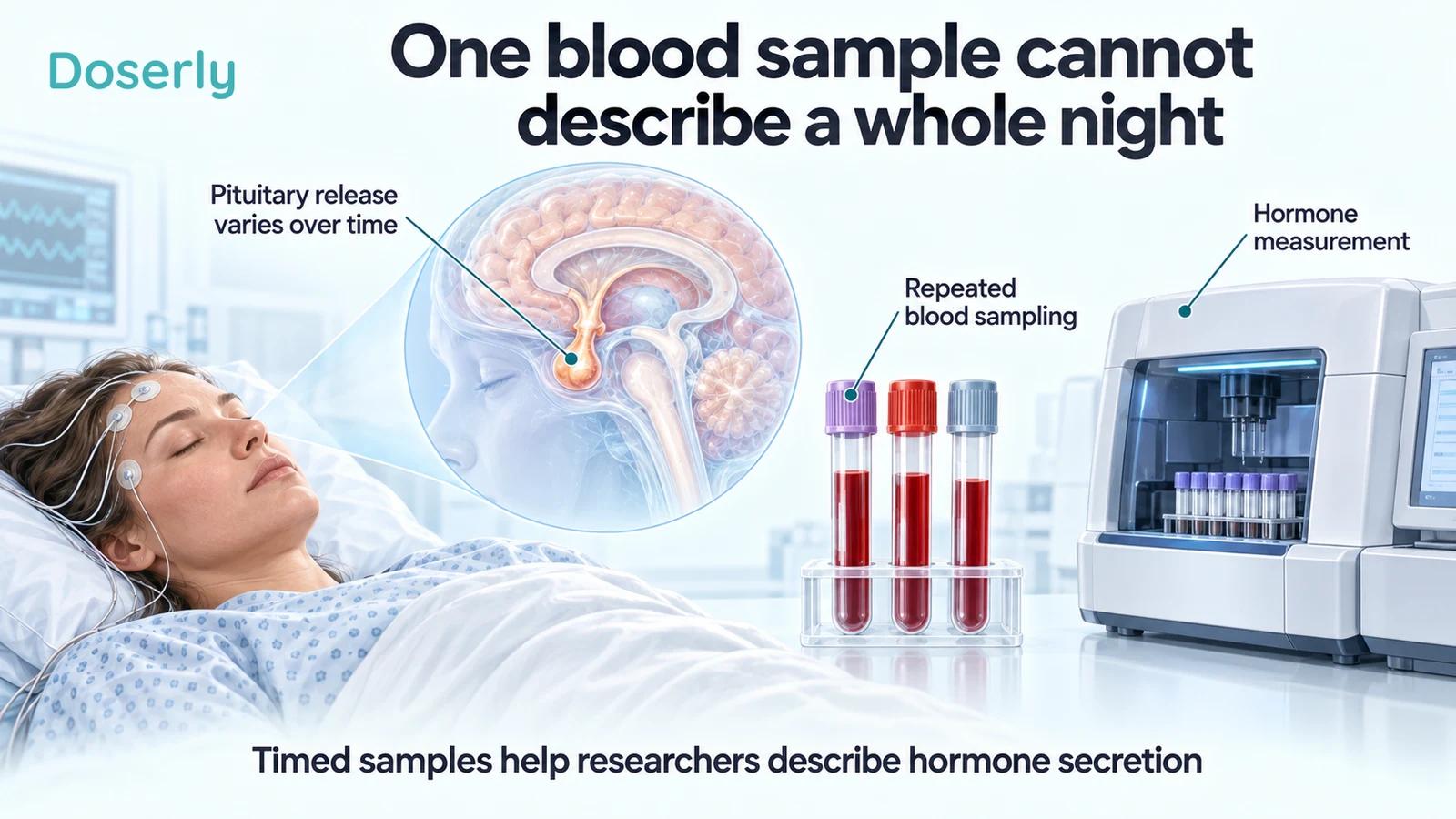
Growth-hormone secretion varies over time. A sample taken near a pulse can look very different from one taken between pulses. Research studies describe secretion patterns by collecting repeated samples rather than treating one draw as an entire day's output.
The studies above used serial sampling to characterize hormone release. A routine appointment blood draw does not reproduce that research protocol. A single number therefore cannot show whether a complete overnight pattern is “normal,” whether pulse frequency changed or how much hormone was secreted overall.
IGF-1 can provide another view of the system, but it also needs clinical interpretation. The Endocrine Society emphasizes appropriate testing when adult growth-hormone deficiency is suspected, usually including stimulation testing. The diagnosis is not established by a nonspecific symptom and an isolated hormone result. Adult deficiency guideline.
How other medicines complicate interpretation
A medication list can matter even when the main question concerns one peptide. The archived Geref information lists drugs and hormonal influences capable of altering pituitary testing. It is a diagnostic document, so its precautions should not be transformed into a modern combination-treatment protocol.
For example, if a hormone measurement changes after several medicines change, the result cannot automatically be assigned to sermorelin. The timing of blood collection, other hormone treatment and changes in underlying illness may also be relevant. A clinician needs the complete sequence to interpret the finding.
This doesn't mean every fluctuation is a dangerous interaction. It means that the same laboratory change can have more than one explanation. A dated record of the actual products, changes and laboratory visits is more useful than assuming one pathway explains everything.
What should a useful follow-up conversation include?
Bring the original treatment goal back into view. Was the concern a diagnosed pituitary disorder, reduced function or an unexplained symptom? Ask which test is being used to assess hormone activity and which measure will show whether the goal is being met.
If results differ from expectations, ask what plausible explanations should be considered before changing the plan. Differences in measurement conditions, product details and other treatments deserve attention alongside feedback biology. A higher result is not automatically better, and a lower result is not automatically evidence that more treatment is needed.
It is also reasonable to ask what is known about the proposed duration. Acute experiments, two-week physiology studies and a year-long pediatric study do not answer the same question. The evidence should match the exposure and clinical problem being discussed as closely as possible.
Sermorelin's feedback-dependent response is a reason to assess people individually. The biology explains why responses can vary, while clinical measurements tell us whether a particular intervention helps. For a broader comparison of the human studies and their limitations, see the sermorelin evidence guide.
Sources
- Gaylinn et al., 1993: human GHRH receptor cloning and expression.
- Archived Geref 50 diagnostic product information.
- Barron et al., 1985: GHRH(1-29) and D-Ala2 analogue responses.
- Corpas et al., 1992: repeated GHRH(1-29) in older men.
- Vittone et al., 1997: nightly GHRH(1-29) in older men.
- Kirk et al., 1994: repeated treatment in children.
- Endocrine Society: adult growth-hormone deficiency.