
Supplements
October 16, 2026
Green tea extract: why a capsule is not simply a cup of tea
On this page
Green tea and green tea extract share a plant, but they do not necessarily produce the same exposure. A beverage is an infusion of leaves in water. A concentrated capsule can deliver a substantial amount of selected compounds in one sitting, sometimes without food. That difference matters when the reason for taking the product is weight control or a general promise of antioxidant protection.
The compound most often emphasized is epigallocatechin gallate, usually shortened to EGCG. It belongs to a family of plant compounds called catechins. The European Food Safety Authority’s assessment distinguished traditional tea infusions from concentrated supplements because composition, concentration and consumption pattern can change the safety question. It did not treat the two as interchangeable. EFSA scientific opinion, 2018.
A useful review therefore begins with the product and the goal: how much EGCG it supplies, whether it contains caffeine or other ingredients, and what outcome the human research actually measured. The Doserly green tea extract guide provides additional ingredient background. This article focuses on why concentrating tea changes the decision, especially when modest or uncertain benefits are weighed against a real liver-safety signal.
Extract weight, catechins and EGCG are different numbers
“Green tea extract” on the front of a bottle is not a complete description. The total extract weight includes more than EGCG. Total catechins and EGCG are also not synonymous: EGCG is one catechin within the mixture. A label that reports only milligrams of extract cannot be compared directly with a trial reporting milligrams of EGCG. This distinction is central to the exposure assessment in EFSA’s review.
Suppose an illustrative label describes 500 mg of extract standardized to 50% EGCG. That would imply 250 mg of EGCG per listed serving, provided the percentage applies to that extract and the label is accurate. Two servings would double the amount. This is arithmetic for interpreting a label, not an endorsement of either amount.
The other ingredients still need attention. A product marketed for weight management may combine green tea with caffeine or additional botanicals. “Decaffeinated” answers a caffeine question; it does not say that EGCG has been removed or that liver injury is impossible. The well-studied Minnesota trial used a decaffeinated preparation and still observed a liver-enzyme signal. Dostal and colleagues, 2015.
The most useful information to bring to a medication review is the complete label, serving size and actual daily use. A product name alone may not identify the exposure, especially if its formulation has changed or another supplement supplies the same ingredient.
Fasting can increase exposure rather than improve the result
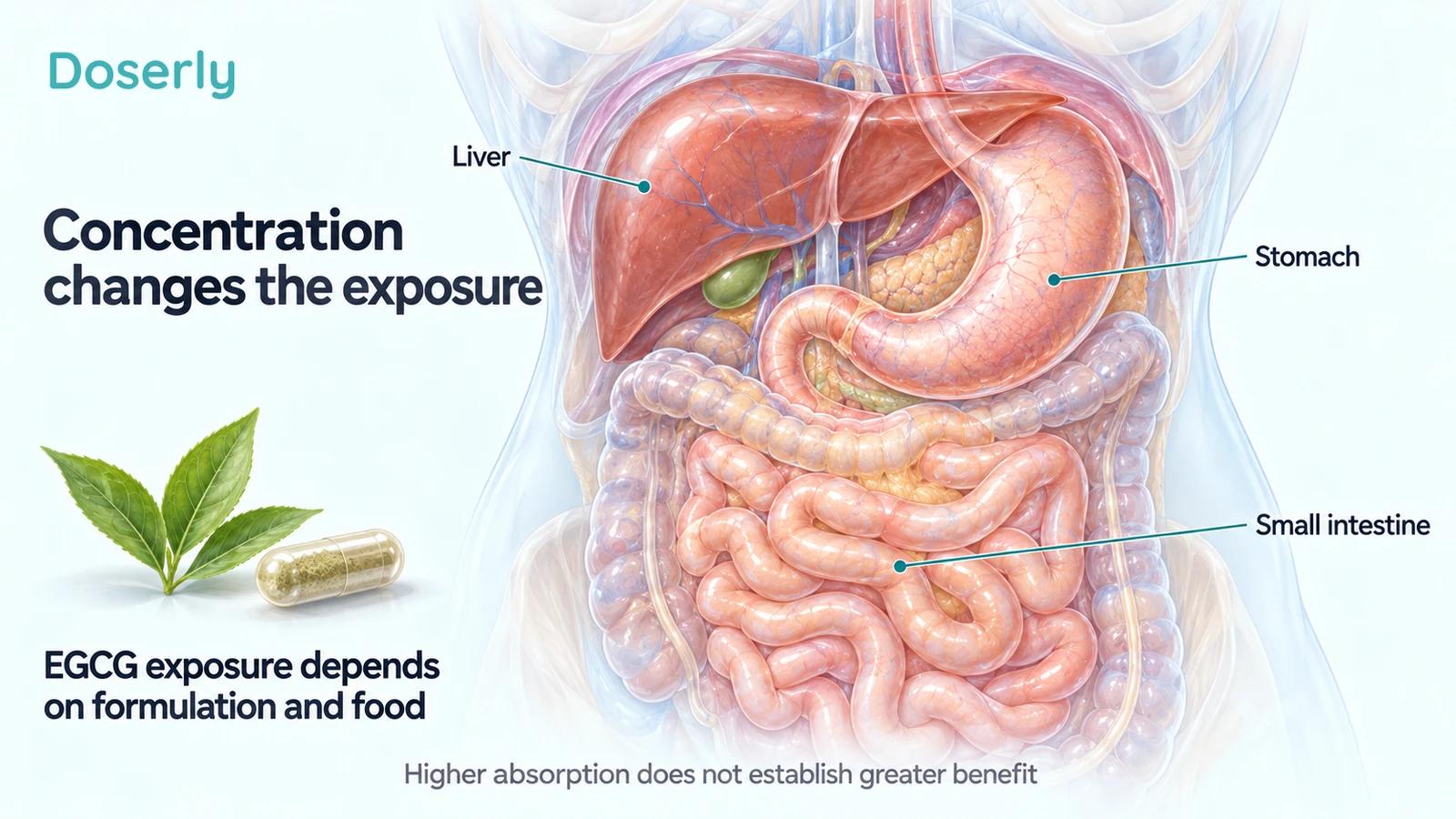
In a human pharmacokinetic study, 30 healthy volunteers received a defined green tea catechin preparation under fasting and fed conditions. Participants crossed over to the other condition after a washout. The doses were expressed as 400, 800 or 1,200 mg of EGCG. The average maximum blood concentration of free EGCG was more than 3.5 times higher when the preparation was taken fasting than with food. Nausea was most common at the highest dose and in the fasting condition. Chow and colleagues, 2005.
That study measured how much of the compound appeared in blood after a dose. It did not establish better weight loss, cancer prevention, or long-term safety. Its finding is sometimes presented as an instruction to maximize absorption. For a compound with a liver-injury concern, the same finding also raises a safety question: greater exposure is not automatically desirable.
This is a good place to separate two meanings of “effective.” A formulation may effectively deliver a chemical into the bloodstream without effectively treating a health problem. The first requires pharmacokinetic measurements; the second requires an appropriate clinical trial. Substituting the first result for the second leaves out both benefit and harm.
A large monitored trial found more ALT elevations
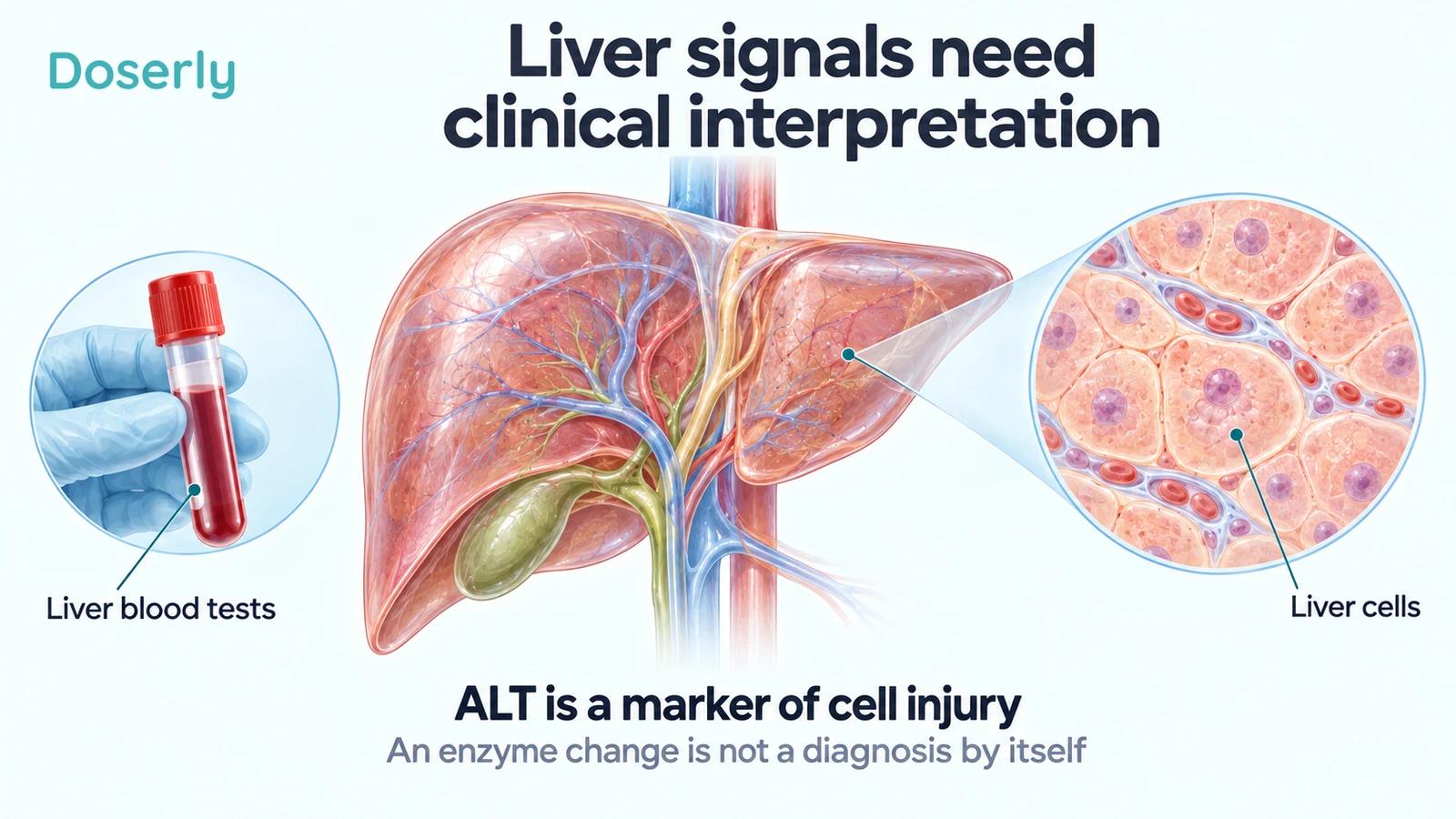
The Minnesota Green Tea Trial randomized 1,075 postmenopausal women to green tea extract supplying 843 mg of EGCG daily or placebo for one year. It was designed around breast-cancer-related biomarkers, and its safety report recorded adverse events prospectively. Overall adverse-event rates were not significantly different between groups, but alanine aminotransferase, or ALT, elevations were more frequent with extract: 36 women, or 6.7%, versus four women, or 0.7%, with placebo. The 2015 safety report.
ALT is an enzyme used as a marker of liver-cell injury. An elevation requires interpretation alongside other tests, symptoms, medication exposures and possible causes. It is not automatically liver failure. Equally, the absence of a significant difference in a broad “any adverse event” category does not make the specific ALT difference disappear. EFSA’s assessment considered this type of trial evidence in its liver-safety evaluation.
The trial’s dose and population define what it can tell us. Its percentages should not be presented as the chance of injury from every retail green tea capsule. They show that a concentrated preparation can produce a detectable safety signal even in a monitored research setting. That is a different evidential situation from an isolated anecdote about someone feeling unwell.
Monitoring also changes the setting. A research participant can have an abnormal result identified and the intervention reviewed through a study protocol. A buyer using several products may have no comparable system. “Used in a trial” therefore does not mean “suitable to copy at home,” particularly when safety monitoring is part of how the researchers managed the intervention.
Severe cases add information that trials cannot provide alone
A US Drug-Induced Liver Injury Network analysis attributed 40 episodes of liver injury to green tea among cases undergoing formal causality assessment. These were selected patients with suspected liver injury, not a representative sample of supplement users. Most implicated products contained multiple ingredients. Three cases required liver transplantation. Hoofnagle and colleagues, 2021.
The study also found a strong association with the immune-related genetic variant HLA-B*35:01. The pattern supports an idiosyncratic susceptibility: some people may react differently to an exposure that many others tolerate. It does not mean that every carrier develops injury or that a person without the variant has a guarantee of safety. The primary DILIN analysis describes the case selection and genetic comparison.
The denominator is essential. Three transplants among these selected liver-injury cases is not a transplant risk of three in forty for ordinary supplement users. The study helps characterize the kind and possible severity of injury, while leaving the population incidence unanswered. It is possible to take that evidence seriously without turning it into a frightening but incorrect probability.
Nor is trying the product again a sensible way to test whether it caused a previous problem. The report documented recurrent injury after re-exposure in some cases. A suspected supplement-related liver problem belongs in clinical care, with the product label and timing available for review, rather than in a home challenge experiment.
There is no universal safe threshold hidden in the literature
A 2018 systematic review examined adverse-event information from 159 human intervention studies alongside toxicology evidence. It found that some concentrated, catechin-rich preparations were associated with liver-related adverse events, particularly under large bolus-dose conditions. The review proposed numerical intake levels for particular preparations, but those estimates should not be treated as a personal safety guarantee. Hu and colleagues, 2018.
EFSA’s separate assessment found evidence of increased liver enzymes at supplemental EGCG intakes of 800 mg per day or more, while concluding that the available evidence did not allow identification of a safe supplemental dose. That number describes where a signal was established in the reviewed trials; it is not a boundary below which injury becomes impossible. EFSA’s explanation of its findings.
This distinction prevents two common errors. One is to interpret a concern at high exposure as evidence that any cup of tea is dangerous. The other is to treat a capsule just below a quoted threshold as clinically cleared. Neither conclusion follows from the evidence. Product form, exposure pattern and individual susceptibility remain relevant.
Weight-loss findings do not justify maximizing the dose
A 12-month body-composition substudy of the Minnesota trial included 121 women with overweight or obesity. The decaffeinated extract did not produce an overall advantage in BMI, total fat mass, percentage body fat or bone mineral density compared with placebo. Some exploratory interactions were reported, but the overall adiposity results were negative. Dostal and colleagues, 2016.
A different 12-week randomized trial in women with central obesity reported weight reduction with a high-dose extract supplying 856.8 mg of EGCG daily. The abstract describes the active group’s weight changing from 76.8 to 75.7 kg. That within-group change should not be relabeled as a 1.1 kg advantage over placebo: the number is a before-and-after comparison within the extract group. Chen and colleagues, 2016.
The two reports do not establish a dependable high-dose weight-loss strategy. They differ in population and duration, and the smaller trial’s report of good tolerability cannot rule out uncommon harm. The longer study also reminds us that a short-term or subgroup signal may not translate into an overall body-composition benefit.
For someone considering extract primarily to lose weight, the relevant balance is not “some biological activity versus no activity.” It is the size, durability and certainty of benefit against the exposure and safety burden. An antioxidant mechanism does not supply the missing long-term clinical result. Neither does a higher EGCG percentage on the label.
What a practical safety review looks like
NCCIH identifies uncommon liver injury, mainly with extracts in tablets or capsules, and also describes interactions with medicines including nadolol, atorvastatin and raloxifene. That is a reason to review the actual product with a pharmacist or clinician before adding it to an existing medication routine. A capsule’s botanical origin does not keep it outside a medication review. NCCIH green tea guidance.
If symptoms suggesting liver trouble develop, such as yellowing of the skin or eyes, dark urine or abdominal pain, stop the suspected extract and seek medical advice promptly. NCCIH specifically advises discontinuing concentrated extracts and consulting a clinician when liver symptoms occur. Taking the capsule with food is not a remedy for symptoms and does not establish that continuing it is safe. NCCIH safety guidance.
Record the start date, amount, other products and any change in symptoms. Include products marketed for energy or weight control even if green tea is not prominent in their name. Such a record is useful for reconstructing exposure; it does not prove causality by itself. If abnormal tests have already prompted medical advice, follow that advice rather than changing several supplements and trying to infer the cause from how you feel.
For an ordinary tea drinker, this article is not an instruction to replace a familiar beverage with a supplement or to fear every cup. It is a reason to evaluate an extract as its own preparation. The clinically useful questions are the exact exposure, the intended benefit, the evidence for that benefit and the person’s safety context. Convenience and concentration do not answer them.
Sources
- EFSA. Scientific opinion on the safety of green tea catechins, 2018.
- EFSA. Explanation of the catechin safety assessment, 2018.
- Chow et al. Food and fasting effects on green tea catechin bioavailability, 2005.
- Dostal et al. Minnesota Green Tea Trial safety report, 2015.
- Hoofnagle et al. HLA-B*35:01 and green tea-induced liver injury, 2021; full primary report.
- Hu et al. Systematic review of green tea and extract safety, 2018.
- Dostal et al. Long-term extract supplementation and body composition, 2016.
- Chen et al. High-dose extract and weight reduction, 2016.
- NCCIH. Green Tea.
- NCCIH. High Cholesterol and Natural Products: safety guidance.